
Toonflow – Open-Source All-in-One AI Short-Drama Creation Tool
Executive Summary:
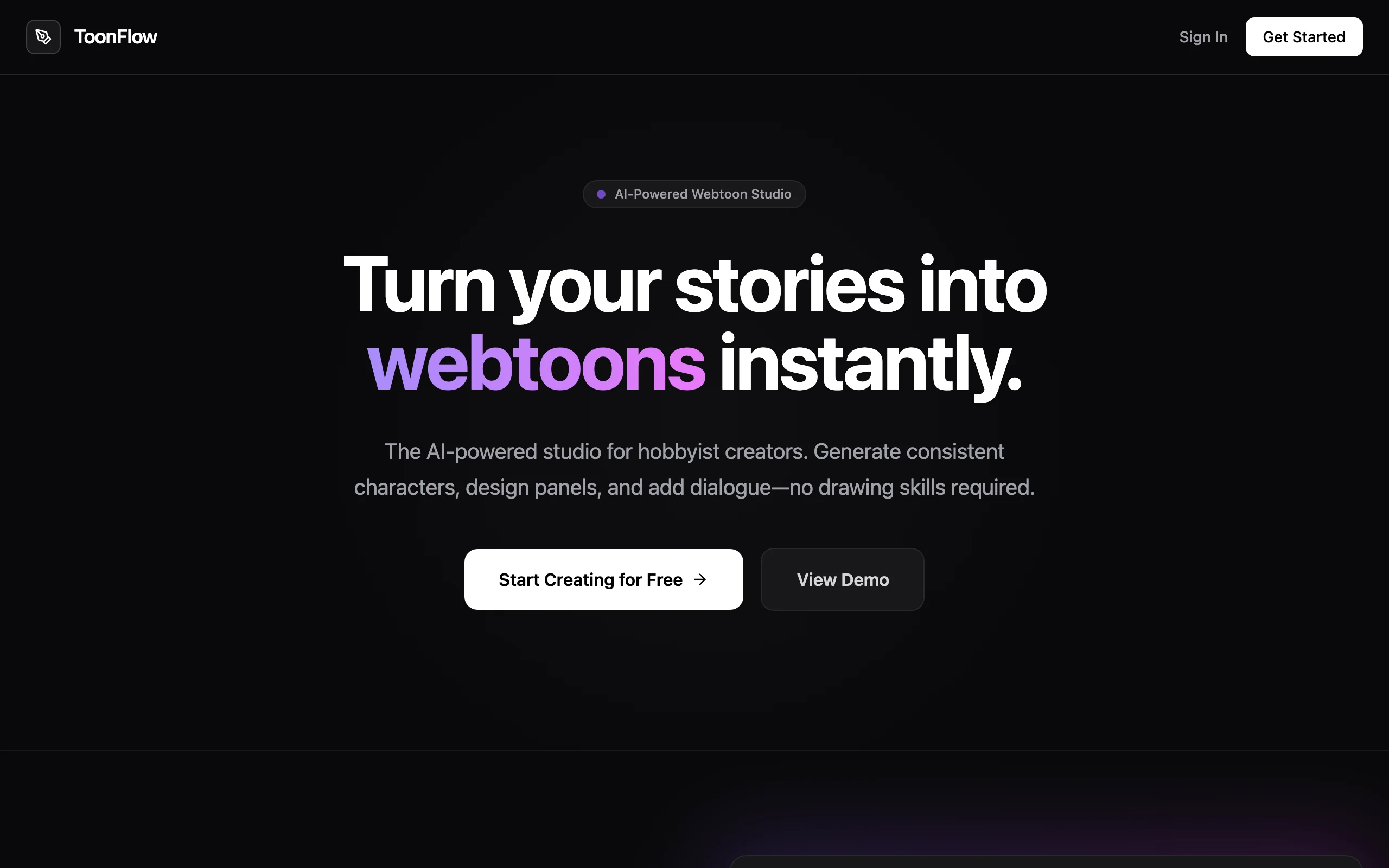
Toonflow is an open-source, multi-agent platform that turns novels or creative text into structured scripts, storyboards, character visuals, and animated video—full pipeline from words to finished sho...
1. What Is Toonflow
Toonflow is an open-source, multi-agent platform that turns novels or creative text into structured scripts, storyboards, character visuals, and animated video—full pipeline from words to finished short drama. A three-tier agent stack (decision, execution, supervision) runs parallel collaboration via Vercel AI SDK and Socket.IO, with ONNX vector retrieval for persistent memory so characters stay consistent across scenes and chapters. Cross-platform desktop builds on Windows, macOS, and Linux keep data local—low-cost, high-fidelity industrial short-drama production.
Image source: Official article
Technical positioning and domain: NLP × computer vision for short-form drama automation—parse, script, board, character art, assembly. It abstracts writer, storyboard, character design, VO, and edit into programmable agents, using event graphs to adapt long novels without losing plot fidelity.
Development background: Community-driven OSS (no single corporate owner stated). Motivation: most AI video tools weak on narrative structure and character consistency. Multi-agent division plus memory targets “face drift” and incoherent plots.
Core value: Fixes three pains: character consistency via anchor DB; long-text adaptation via chapter event graphs instead of one-shot full-book prompts; tool sprawl by unifying script, boards, images, VO, and edit in one flow—10×+ efficiency claims for batch creators.
Technical characteristics: Model-agnostic—Kling, Jimeng, Nano Banana, local models. Infinite-canvas node workspace for parallel production; programmable TypeScript provider hooks in settings without rebuilds.
2. Key Features
Multi-agent scriptwriting: Director, writer, storyboard, consistency, QA, dubbing agents in parallel—director sets pace; writer splits scenes/dialogue/rhythm to standard script format with iterative refinement.
Smart storyboards: Shot size, composition, lighting, camera motion in board scripts—replacing manual previz labor.
Character consistency: Anchor system + local ONNX vector DB recalls look, wardrobe, props across shots—anti “face swap” drift.
Batch image gen: Nano Banana, GPT Image 2, Kling, Jimeng, Hailuo, etc.—character sheets and environment concepts with swappable providers.
Video assembly: Multi-role TTS, subtitles, edit; 9:16 and 16:9 export ready for Douyin, Kuaishou, Bilibili.
Infinite canvas: Nonlinear node graph for script, character, board, asset, and video stages with parallel lanes.
Chapter event graph adaptation: Structured per-chapter events for context pulls—token-efficient fidelity vs dumping entire novels.
Programmable providers: Write TypeScript provider logic in settings—hot reload, no fork/restart.
3. How to Use
Install: GitHub Releases for your OS; Node.js 18+ recommended. GPU with ≥8 GB VRAM (e.g., RTX 3060+) speeds inference; CPU works slower.
Configure providers: API keys for text/image/video models—GPT-4 class text, Kling/Jimeng/Nano Banana images, Runway Gen-3/Pika video; multi-provider routing supported.
Create project: Default login
admin/admin123; import TXT/Markdown/PDF; pre-split chapters when possible.Extract events: Run event extraction to build the chapter graph (entrances, conflicts, turns).
Script with ScriptAgent: Generate skeleton, adaptation plan, structured script; iterate scenes; run QA agent for plot/character holes.
Production canvas: ProductionAgent boards; batch character/environment stills; anchor IDs for consistency.
Export video: Tune nodes, generate clips, auto dub/subtitle/edit; export 9:16 or 16:9.
Tips: Try sample project first; seed character appearance text for anchors; watch API quotas; prefer GPU for video steps.
4. Pros and Cons
| Pros |
|---|
| Full pipeline: Text-to-final in one app—10×+ speed for MCN batch drama. |
| Agent team quality: Beats single LLM dump via role split like a real crew. |
| Character anchors: Local ONNX recall solves core short-drama pain. |
| Provider freedom: No vendor lock; local models OK. |
| Apache-2.0 OSS: Free for commercial/academic use. |
5. Comparison with Similar Tools
| Dimension | Toonflow | Descript | RunwayML |
|---|---|---|---|
| Architecture | Multi-agent + event graph + ONNX memory | Text-driven A/V editor | Diffusion video stack |
| AI writing | ✅ Multi-agent script + graph adaptation | ❌ No native scripting | ❌ Prompt-to-video only |
| Character consistency | ✅ Anchor DB cross-scene | ❌ None | ❌ Manual seeds at best |
| Storyboards | ✅ Pro boards (shots, light, motion) | ❌ Basic layout | ❌ None |
| Video gen | ✅ Via Kling/Seedance/Nano Banana etc. | ⚠️ Light AI backgrounds | ✅ Native T2V/I2V |
| Audio AI | ⚠️ Dubbing agent + multi-role TTS | ✅ Studio Sound, Overdub, transcript | ❌ Basic music |
| Editing paradigm | Node canvas + structured script | Text-like A/V edit | Timeline + prompts |
| License | Apache-2.0 OSS | ❌ Commercial closed | ❌ Closed |
| Deploy | Desktop + Docker self-host | Cloud SaaS | Cloud + API |
| Audience | Short drama, MCN, novel adaptation | Podcast/YouTube/marketing | Ads/artists |
Selection guidance: Novel/script → coherent short drama with boards and anchors → Toonflow (especially MCN/novel IP teams wanting OSS customization). Pro A/V polish without AI writing → Descript. Raw clip beauty → Runway/Pika, often chained after Toonflow boards.
6. Editor's Take
Toonflow’s bet is production discipline, not single-frame wow—agent crew + event graph + anchors address fidelity and consistency rare in OSS video stacks. QA agent shows quality-aware design.
Strong for web-novel pilots and MCN batch output; anchors tackle “face changing” commercial tools still fumble. Model-agnostic providers avoid lock-in.
Audience: Short-drama creators, MCN, adaptation teams—some API/TS comfort helps; basics usable for non-devs.
Future: Could become the “OS” for AI short drama if docs and Chinese defaults improve.
— Big innovation and utility; − for GPU, learning curve, Chinese polish.
7. Use Cases
Short-video platforms: Douyin/Kuaishou/Bilibili/YouTube batch shorts from text.
Novel adaptation pilots: Event-graph fidelity before full production spend.
Author self-service: Writers without video skills ship sample episodes.
Pre-production prototyping: Parallel script/board variants for pitch reviews.
Asset factory: Character sheets, environments, clips for games or concept art.
8. FAQ
Q: GPU required?
A: CPU works for script/events; GPU strongly recommended for boards/video (RTX 3060 8 GB+).
Q: Consistent characters?
A: Define 3–5 anchor traits per character at creation; ONNX DB recalls embeddings each gen pass.
Q: Chinese script/VO?
A: Chinese input OK—use Qwen/GLM-class text models; TTS may need Azure/Volcano etc. for natural Mandarin.
Q: Commercial use?
A: Apache-2.0 allows it; check each external model’s terms separately.
Q: Add new image model?
A: Programmable provider TypeScript in settings—REST/SDK templates, no rebuild.
Q: Pro cinema quality?
A: Depends on hooked models (~720p–1080p typical); best for short/light drama prototypes—polish externally for film grade.
Q: Data privacy?
A: Local storage for scripts/anchors/media; external API calls hit vendor servers—prefer local models when sensitive.
9. Project Links
- GitHub: https://github.com/Toonflow/Toonflow (verify live repo)
- Website: https://toonflow.ai (verify)
- Hugging Face: https://huggingface.co/Toonflow (verify)
Related AI Model Articles
OpenMuse – CopilotKit Open-Source Personal AI Assistant
OpenMuse is an open-source personal AI assistant project developed by the CopilotKit team. Its core design philosophy is "giving an Agent a computer" — by combining a persistent browser, optional Linu...
In-Depth Review of Longcat-2.5-preview: Meituan's Next-Generation Multimodal Long-Range Agent Model
LongCat-2.5-preview is Meituan's latest next-generation large model. Building upon the 1.6T total parameters, approximately 48B active parameters, and native 1M token context of LongCat-2.0, it marks ...
Review of DeepSeek Harness Desktop: How the Official GUI Client Lowers the Bar for Agent Usage
DeepSeek Harness Desktop is the official graphical client launched by DeepSeek, designed to provide a visual interface for the originally command-line-based DeepSeek Harness framework. After users log...
Step Code – In-Depth Review of StepFun's Open-Source Terminal Programming Agent
Step Code is an open-source terminal programming agent launched by StepFun, licensed under the MIT License, which allows developers to complete the full workflow of code writing, debugging, execution,...
© All Rights Reserved. Some content on this site is partially generated by AI with human review.