
turbovec – Google's Open Vector Index Library
Executive Summary:
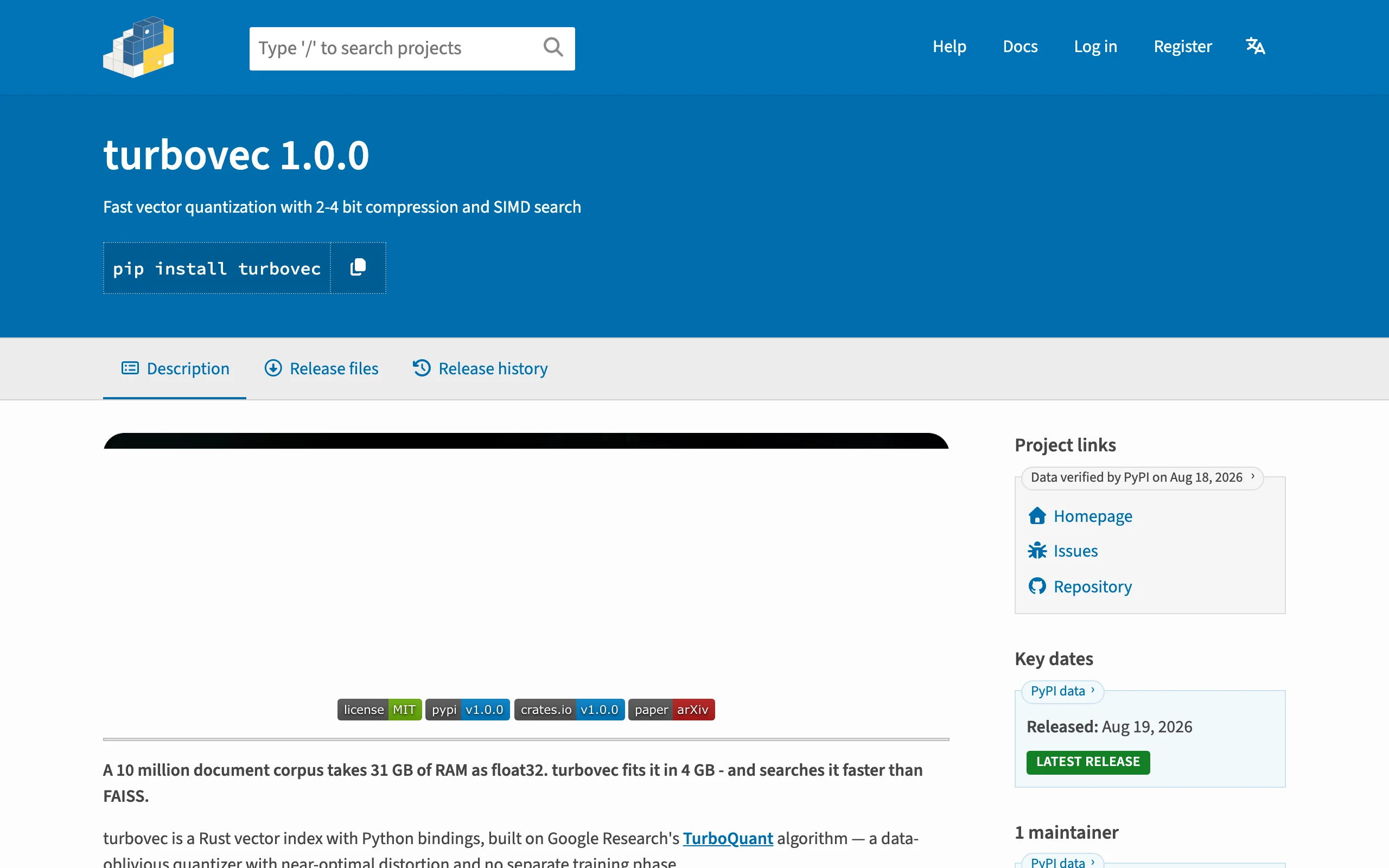
turbovec is a high-performance vector index library open-sourced by Google Research, implementing the TurboQuant algorithm. Written in Rust with Python bindings, it targets RAG workloads. Data-agnostic quantization needs no training—compress ~10M float32 vectors from ~31GB to ~4GB—and hand-tuned SIMD kernels on ARM and x86 beat FAISS on search speed. Supports search-time filtering, index persistence, and drop-in replacement in major frameworks—efficient for memory-sensitive, low-latency retrieval.
1. What Is turbovec
turbovec is a high-performance vector index library open-sourced by Google Research, implementing the TurboQuant algorithm. Written in Rust with Python bindings, it targets RAG workloads. Data-agnostic quantization needs no training—compress ~10M float32 vectors from ~31GB to ~4GB—and hand-tuned SIMD kernels on ARM and x86 beat FAISS on search speed. Supports search-time filtering, index persistence, and drop-in replacement in major frameworks—efficient for memory-sensitive, low-latency retrieval.
Image source: Official article
Technical positioning and domain: Vector indexing and approximate nearest neighbor search (ANNS) for RAG—high performance, low memory. Data-agnostic quantization without training codebooks distinguishes it from classic trained-quantization indexes.
Research background: Google Research open-sourced TurboQuant to cut training overhead and improve compression vs speed tradeoffs in large-scale indexes. Strong quantization theory and SIMD optimization heritage.
Core value: Fixes FAISS-style k-means training cost, high memory, and inefficient filtered search. Online ingestion: add vectors and search immediately—no rebuild tuning. ~16× compression fits ten-million-scale indexes on modest servers; fully local for privacy.
Technical characteristics: Random orthogonal rotation, TQ+ adaptive calibration, Lloyd-Max scalar quantization, bit-packing—no training, high compression, low distortion. Handwritten NEON and AVX-512BW kernels: ARM 10–19% faster than FAISS IndexPQFastScan; x86 wins at 4-bit. Filter logic short-circuits inside SIMD—no over-fetch, zero recall loss from filtering.
2. Key Features
Online ingestion index: Vectors searchable immediately after add—no pre-training, tuning, or rebuild on corpus growth—ideal for dynamic datasets.
Fast SIMD search: Handwritten NEON (ARM) and AVX-512BW (x86)—ARM 10–19% faster than FAISS IndexPQFastScan; x86 4-bit leads. Bit-packing and precomputed buckets minimize latency.
Search-time filtering: ID allowlists or slot bitmasks filtered inside SIMD kernels—no retrieve-then-filter over-fetch; critical for ACL and hybrid retrieval.
Stable external IDs and deletion:
IdMapIndexsupports custom uint64 external IDs and O(1) deletion—stable document IDs for updates.Index persistence:
write/loadto disk without re-encoding—compact format, fast cold start and disaster recovery.Framework plug-and-play: Official LangChain, LlamaIndex, Haystack, Agno integrations—swap imports in a few lines.
Fully local: No hosted service—data stays on machine or VPC for offline RAG stacks.
3. How to Use
Requirements: ARM (NEON) or x86 (AVX-512BW); Linux or macOS recommended; Python 3.8+; updated pip.
Install:
pip install turbovec—prebuilt Rust wheels, no manual C++ build.Create index:
TurboQuantIndex(dim=1536, bit_width=4)—2-bit or 4-bit; 4-bit balances compression and accuracy for most cases.Add vectors:
index.add(vectors)—auto normalize, rotate, TQ+calibration, Lloyd-Max quantize.Search:
index.search(query, k=10)—top-K scores and IDs by inner product; single or batch queries.Persist:
index.write("my_index.tv")andTurboQuantIndex.load("my_index.tv").External IDs: Use
IdMapIndexforadd_with_idsand O(1) delete on stable doc IDs.Hybrid retrieval: SQL/BM25/ACL narrows candidates → pass
allowlistfor dense rerank.
4. Pros and Cons
| Pros |
|---|
| No training, online ingest: Data-agnostic quant—add and search immediately for dynamic corpora. |
| High compression, low RAM: 16× (2-bit)—10M vectors ~31GB → ~4GB. |
| SIMD-accelerated search: ARM 10–19% faster than FAISS; 4-bit x86 wins. |
| Zero-overhead filtered search: SIMD short-circuit—no recall penalty from filter-after-search. |
| Local privacy: No cloud required—data never leaves your infra. |
5. Comparison with Similar Tools
| Dimension | turbovec | FAISS (IndexPQFastScan) | HNSWlib |
|---|---|---|---|
| Core architecture | Data-agnostic quant (rotation + scalar) | k-means product quantization | HNSW graph |
| Training | None, online | k-means codebooks | Graph build time |
| Compression | 16× (2-bit) / 8× (4-bit) | Similar, training-dependent | None (raw storage) |
| ARM search speed | 10–19% faster than FAISS FastScan | Baseline | No ARM tuning |
| x86 search speed | 4-bit wins; 2-bit near | Baseline; 2-bit VBMI strong | Slower graph traverse |
| Search-time filter | In-kernel short-circuit | Post-filter over-fetch | Post-process only |
| Deployment | Embedded local library | Embedded local | Embedded local |
| Framework integration | Official 4 frameworks | Broad community | Community |
| Recall | High after TQ+calibration | High after training | Very high (graph) |
For memory-tight dynamic RAG—especially ARM edge—turbovec’s online ingest and compression stand out. Max recall on modest data: HNSWlib but heavy RAM and weak native filtering. Max trained precision: ScaNN/FAISS PQ with training cost. turbovec wins on no-training, low latency, and filter-in-kernel for modern RAG pipelines.
6. Editor's Take
turbovec brings Google Research TurboQuant to production: data-agnostic quantization vs FAISS k-means—no training, online ingest, no tuning pain. ARM SIMD gains (10–19% over FAISS) enable edge/mobile RAG. 16× compression puts 10M vectors on ordinary servers; in-kernel filtering boosts hybrid search; local-only satisfies compliance.
Audience: small teams, RAG builders, privacy-sensitive sectors, edge developers. As community and integrations grow, turbovec could become a default RAG index.
Rating: ★★★★☆ (4.5/5) −0.5 for sparse docs, 2-bit x86 competitiveness, smaller community vs FAISS.
7. Use Cases
Memory-constrained RAG: Index tens of millions of docs on limited RAM—~4GB for 10M vectors with online updates.
Low-latency online services: Production RAG/recommend/search needing minimal p99—SIMD wins on ARM and x86 4-bit.
Privacy-first architecture: Government/finance—fully offline RAG, no third-party vector SaaS.
Edge and mobile: Rust core + ARM optimization on phones, IoT, embedded retrieval.
Hybrid retrieval: BM25/SQL/ACL prefilter →
allowlistdense rerank without over-fetch.
8. FAQ
Q: Training required?
A: No. Quantization is data-agnostic: after add, vectors are searchable with no k-means step and no corpus rebuild. That matters for RAG corpora that grow every day, where FAISS PQ would otherwise need a training pass.
Q: Supported hardware?
A: ARM NEON and x86 AVX-512BW. ARM 10–19% faster than FAISS FastScan; 4-bit x86 leads; 2-bit x86 closer to parity.
Q: LangChain integration?
A: Replace imports with from turbovec.langchain import TurboQuantVectorStore and pass your index instance.
Q: Compression ratio?
A: About 16× at 2-bit (1536-d float32: 6144 B → 384 B) and 8× at 4-bit. Prefer 4-bit for recall/speed; use 2-bit only when RAM is tight and you are on ARM. On x86, 2-bit is closer to FAISS FastScan than the ARM gap suggests.
Q: Delete vectors?
A: Yes. IdMapIndex maps your uint64 document IDs and deletes in O(1)—useful for expiry and ACL revocation. You do not rebuild the whole index; write/load keeps the file searchable after deletes.
Q: vs FAISS advantages?
A: No training, online ingest, faster ARM search, in-kernel filtering, local-only, official framework hooks. FAISS still stronger ecosystem and some low-D recall cases.
9. Project Links
Related AI Model Articles
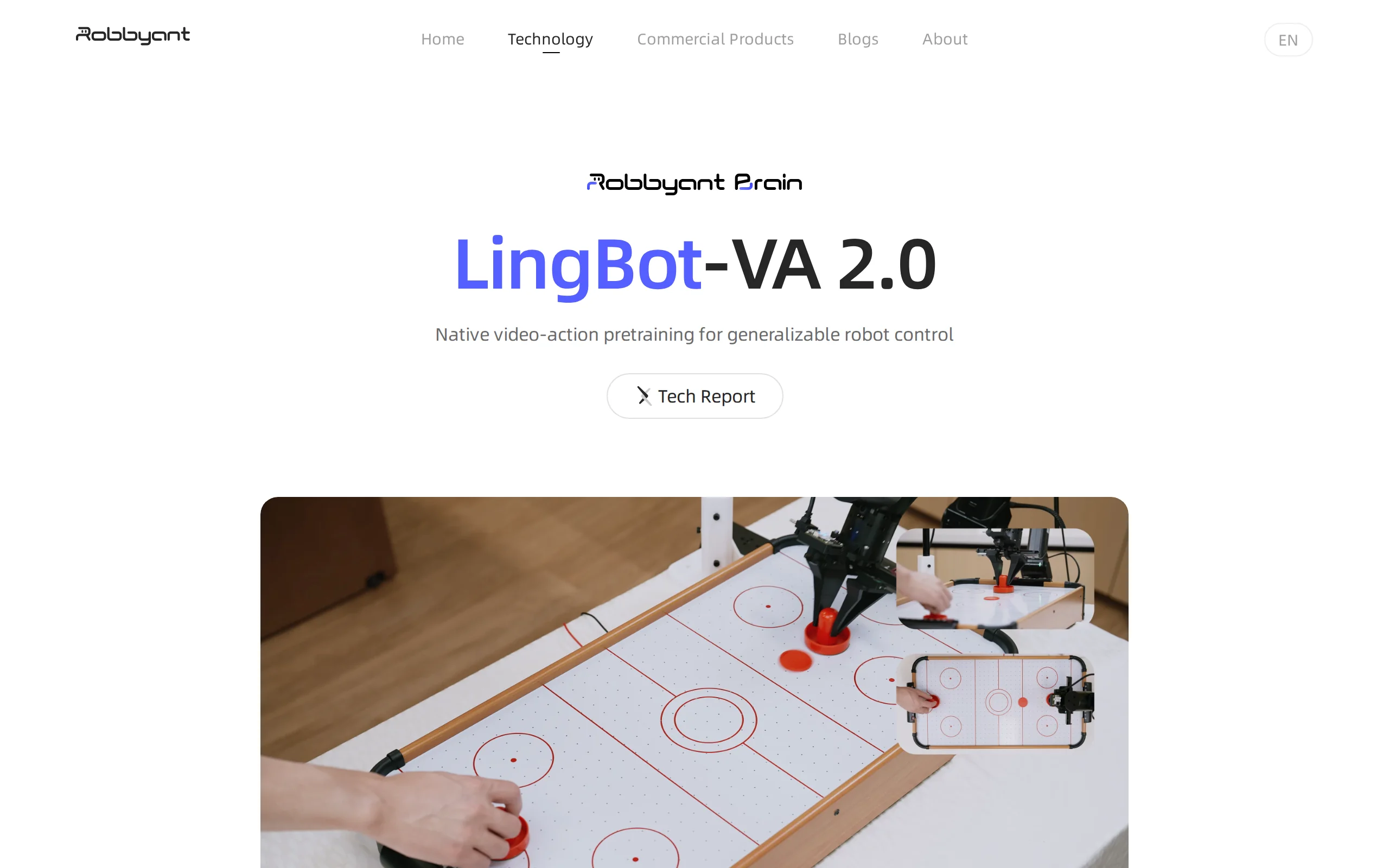
LingBot-VA 2.0 – AntWorld's Native World Action Model for Embodied Intelligence
LingBot-VA 2.0 is AntWorld's industry-first native world action model for embodied intelligence, pre-trained from scratch based on an autoregressive architecture, enabling robots to possess general-pu...
KAT-Coder-Pro V2.5 – Kwai's Agentic Coding Model
KAT-Coder-Pro V2.5 is the flagship Agentic Coding model introduced by KwaiKAT, focusing on long-range engineering capabilities and general Agentic abilities. By leveraging its self-developed AutoBuild...
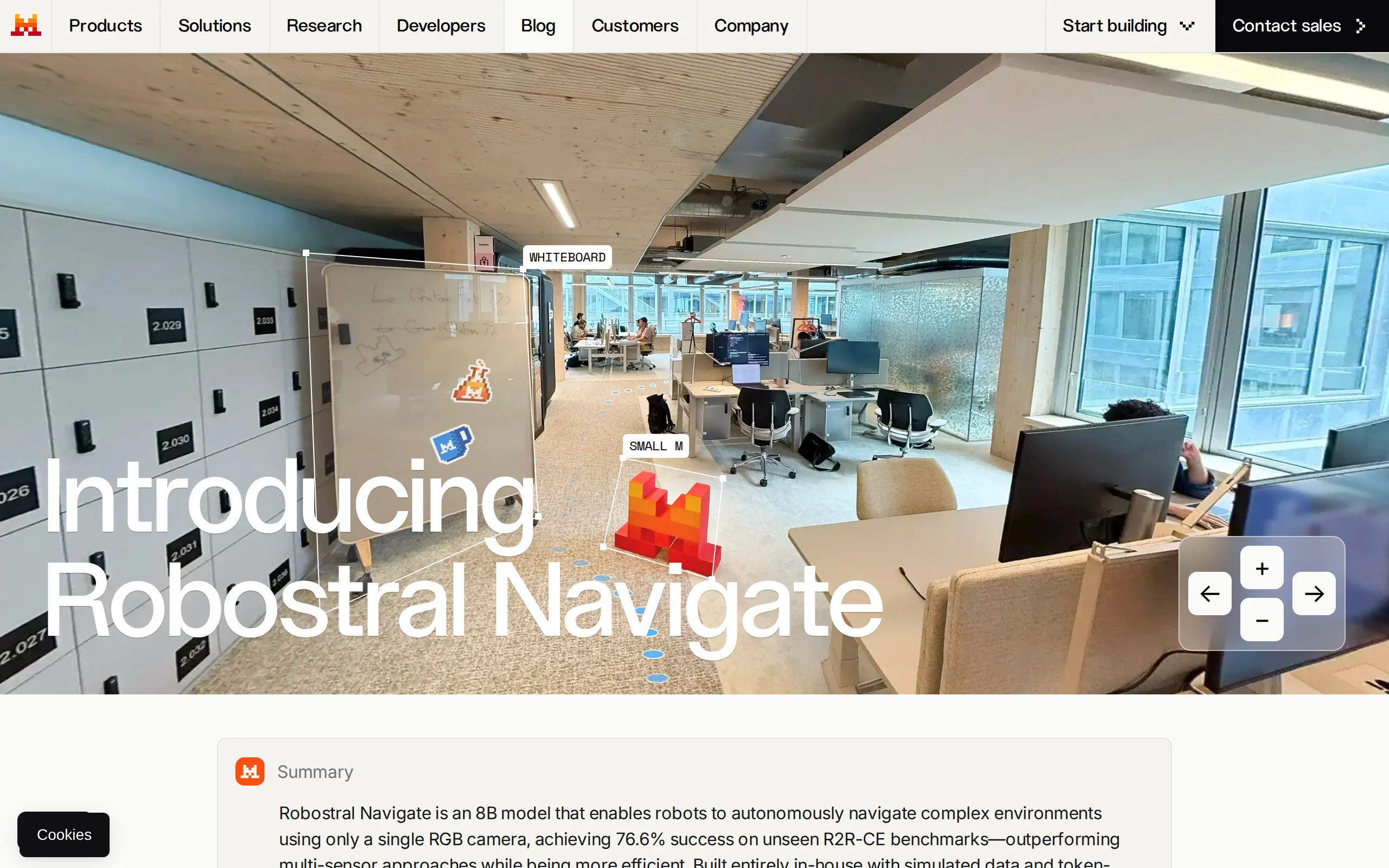
Robostral Navigate – Mistral AI's Embodied Intelligence Navigation Model
Robostral Navigate is Mistral AI's first embodied intelligence navigation model. Its core innovation lies in enabling robots to achieve autonomous navigation in complex environments using only a stand...

Seedream 5.0 Pro – A Multimodal Image Creation Model Launched by ByteDance
Seedream 5.0 Pro is a multimodal image creation model introduced by ByteDance's Seed team, specifically designed for complex professional scenarios. This model has achieved a comprehensive upgrade in ...
© All Rights Reserved. Some content on this site is partially generated by AI with human review.