
SwarmFlow – openJiuwen’s Open Multi-Agent Workflow Orchestration Framework
Executive Summary:
SwarmFlow is openJiuwen’s open-source framework for controllable multi-agent workflow orchestration. Its core idea separates orchestration from reasoning: collaboration flows run as predefined scripts...
1. What Is SwarmFlow
SwarmFlow is openJiuwen’s open-source framework for controllable multi-agent workflow orchestration. Its core idea separates orchestration from reasoning: collaboration flows run as predefined scripts while agents handle judgment calls. workflow.py operatorizes team pipelines with parallel, pipeline, phased, and other patterns, built into JiuwenSwarm’s SwarmSkill Creator—one natural-language sentence can yield an executable team skill pack. It targets Leader Agent overload when one model both orchestrates and reasons—unstable context, inconsistent paths—and offers deterministic, production-grade orchestration for complex business flows.
Image source: Official article
Technical positioning and domain: Multi-agent systems × workflow engineering for repeatable processes. Unlike AutoGen or CrewAI where agents dynamically coordinate, SwarmFlow says “system orchestrates, agents infer”—fixed flows as reusable operator scripts for finance quant, paper batch jobs, document automation, etc.
Development background: openJiuwen’s JiuwenSwarm stack already ships runtime, skill market, and visual terminal. SwarmFlow emerged from Leaders drowning in flow control plus reasoning—context overflow and divergent runs. Orchestration moved to system scripts; agents focus on subtask inference.
Core value: Deterministic-first collaboration—same task, same path every run. Decoupling cuts Leader cognitive load. SwarmSkill Creator one-shot team skills lowers the bar for multi-agent adoption.
Technical characteristics: Atomic operators (agent, parallel, pipeline, phase, workflow, human, budget) compose like blocks; dual mode adapts open Swarm Skills vs scripted workflow.py; TUI /swarmflows tree monitoring, checkpoint resume, and budget caps for production.
2. Key Features
Operatorized workflows: Declarative
agent,parallel,pipeline,phase,workflow,agent_session,human,budgetblocks—parallel fan-out, batch pipelines, observable phases.Dual Swarm Skill forms: Same team skill as open coordination (no script) or executable orchestration (
workflow.py); auto-picks dynamic vs fixed flows.SwarmSkill Creator generation: One NL prompt (“five-dimensional stock analysis workflow”) → roles, operators, constraints, reusable skill pack.
Team mode auto-routing: NL task description routes to SwarmFlow (deterministic), open Swarm Skill (dynamic), or single agent (simple)—users stay at business level.
TUI visualization:
/swarmflowslive tree with stage progress, agent state, drill-down prompts/outputs for prod observability.Human-in-the-loop nodes: Native
humanoperator for approval or input at any step—no extra wiring.Resource budgets:
budgetcaps tokens/calls for whole flows or sub-phases—cost control for quant and API-heavy jobs.
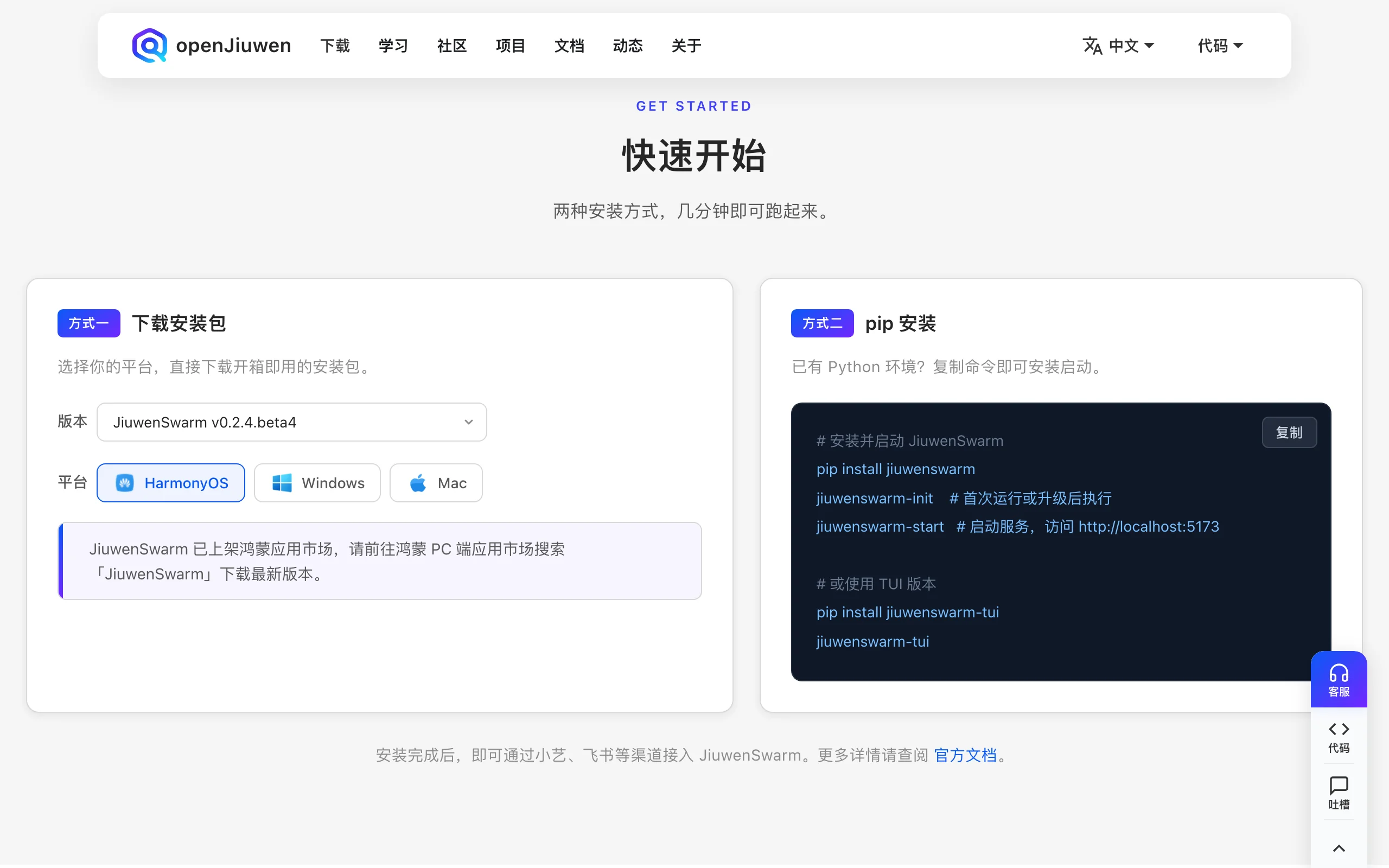
3. How to Use
Environment: Python 3.9+ on Linux/macOS/Windows.
pip install jiuwenswarm; optionalpip install jiuwenswarm-tui. Use a venv and fresh pip.Init and start:
jiuwenswarm-initthenjiuwenswarm-start(default port 8080, configurable). Check logs for clean startup.TUI:
jiuwenswarm-tui;/helpfor commands—primary entry for skills.Generate skill: Describe goal in Creator, e.g., “Stock five-factor analysis with parallel finance, market, capital, sentiment, industry agents.” Inspect output under
skills/.Edit workflow.py: For executable form, review
scripts/workflow.py; tweak parallelism,human,budgetas needed.Run: In Team mode, e.g., “Analyze this company with swarmflow”—auto-routes and executes with live TUI progress.
Monitor/debug:
/swarmflowstree; fix script or prompts; checkpoint resume from failure.
4. Pros and Cons
| Pros |
|---|
| Deterministic runs: Scripted flows repeat identically—ideal for finance/compliance. |
| Orchestration vs intelligence split: Leaders avoid context flood; stable complex jobs. |
| Low-friction generation: One sentence → full team skill for non-engineers. |
| Dual-mode flexibility: Open swarm for dynamic work; scripts for fixed pipelines. |
| Production observability: Live tree, resume, budgets for audit and cost control. |
5. Comparison with Similar Tools
| Dimension | SwarmFlow (openJiuwen) | CrewAI | AutoGen (Microsoft) |
|---|---|---|---|
| Orchestration philosophy | System runs flow; agents infer | Crew process drives agent actions | Conversation-driven coordination |
| Core abstractions | Operator scripts | Crew, Agent, Task, Process | AssistantAgent, UserProxyAgent |
| Code barrier | NL SwarmSkill Creator | Hand-written Python crews | Hand-written dialog loops |
| Dynamic collaboration | Dual form: open vs scripted | Sequential/hierarchical presets | Highly dynamic, hard to debug |
| Visualization | TUI /swarmflows tree |
Logs/third-party | Callbacks/Chainlit |
| Human-in-the-loop | Native human operator |
Custom tools/callbacks | UserProxyAgent patterns |
| Resource control | Native budget |
DIY at agent/task layer | Manual token tracking |
| Best fit | Deterministic batch flows (quant, papers, PPT, office automation) | Standard business automation | Exploratory multi-agent chat/code |
Selection guidance: Need repeatability and budgets → SwarmFlow. Medium business flows with mature community → CrewAI. Open-ended debate/code exploration → AutoGen. Custom state machines → LangGraph.
6. Editor's Take
SwarmFlow productizes “separate orchestration from intelligence” with operator scripts and dual-mode adaptation—not novel in theory, strong in execution. Its obsession with determinism fits finance and compliance where CrewAI/AutoGen paths wander.
TUI monitoring, resume, and budgets directly address prod pain: debug hell and runaway tokens. Ecosystem is early; full JiuwenSwarm install feels heavy for orchestration-only teams.
Audience: Devs building deterministic multi-agent pipelines—quant, research, office automation. Pair with AutoGen/LangGraph for exploratory work.
Future: Richer docs, Web UI, preset skills, maybe a lightweight standalone package.
— Innovation and utility 4.5; ease 4 (platform weight); ecosystem 3.5.
7. Use Cases
Quant analysis: Five parallel factor agents, cross-validation,
budget-guarded daily batches.Paper/office automation: Parse → analyze → doc → email pipelines with
humanconfirm before send.Large doc generation: 200-page deck—parallel chapter agents, phased merge/style pass.
Tech research: Search, summarize, trend mailouts;
agent_sessionmemory and forked what-if branches.Expert roundtables: Open Swarm Skill for fixed phases, dynamic discussion flow.
8. FAQ
Q: SwarmFlow vs CrewAI?
A: SwarmFlow scripts flows for determinism; CrewAI lets agents drive order dynamically. Fixed pipelines → SwarmFlow; moderate dynamic tasks → CrewAI.
Q: Must I code?
A: Usually no—Creator handles NL. Custom tools or operator tuning needs workflow.py Python edits.
Q: Which LLMs?
A: SwarmFlow is model-agnostic via JiuwenSwarm—OpenAI, Anthropic, local vLLM endpoints in config.
Q: Debug failures?
A: /swarmflows → failed node logs; fix and checkpoint-resume.
Q: Set budgets?
A: e.g., budget(token_limit=100000, cost_limit=5.0) on workflow or phase scope.
Q: Multi-user?
A: Single-machine/server today—share skills/logs manually; team features may come later.
Q: License?
A: Apache 2.0—commercial use OK with attribution; see repo LICENSE.
9. Project Links
- JiuwenSwarm quick start (SwarmFlow): https://openjiuwen.com/jiuwenswarm#quick-start
- GitHub (openJiuwen/SwarmFlow): https://github.com/openjiuwen/SwarmFlow (verify official URL)
- Docs: https://docs.openjiuwen.com/jiuwenswarm
Related AI Model Articles
OpenMuse – CopilotKit Open-Source Personal AI Assistant
OpenMuse is an open-source personal AI assistant project developed by the CopilotKit team. Its core design philosophy is "giving an Agent a computer" — by combining a persistent browser, optional Linu...
In-Depth Review of Longcat-2.5-preview: Meituan's Next-Generation Multimodal Long-Range Agent Model
LongCat-2.5-preview is Meituan's latest next-generation large model. Building upon the 1.6T total parameters, approximately 48B active parameters, and native 1M token context of LongCat-2.0, it marks ...
Review of DeepSeek Harness Desktop: How the Official GUI Client Lowers the Bar for Agent Usage
DeepSeek Harness Desktop is the official graphical client launched by DeepSeek, designed to provide a visual interface for the originally command-line-based DeepSeek Harness framework. After users log...
Step Code – In-Depth Review of StepFun's Open-Source Terminal Programming Agent
Step Code is an open-source terminal programming agent launched by StepFun, licensed under the MIT License, which allows developers to complete the full workflow of code writing, debugging, execution,...
© All Rights Reserved. Some content on this site is partially generated by AI with human review.