
OpenMuse – CopilotKit Open-Source Personal AI Assistant
Executive Summary:
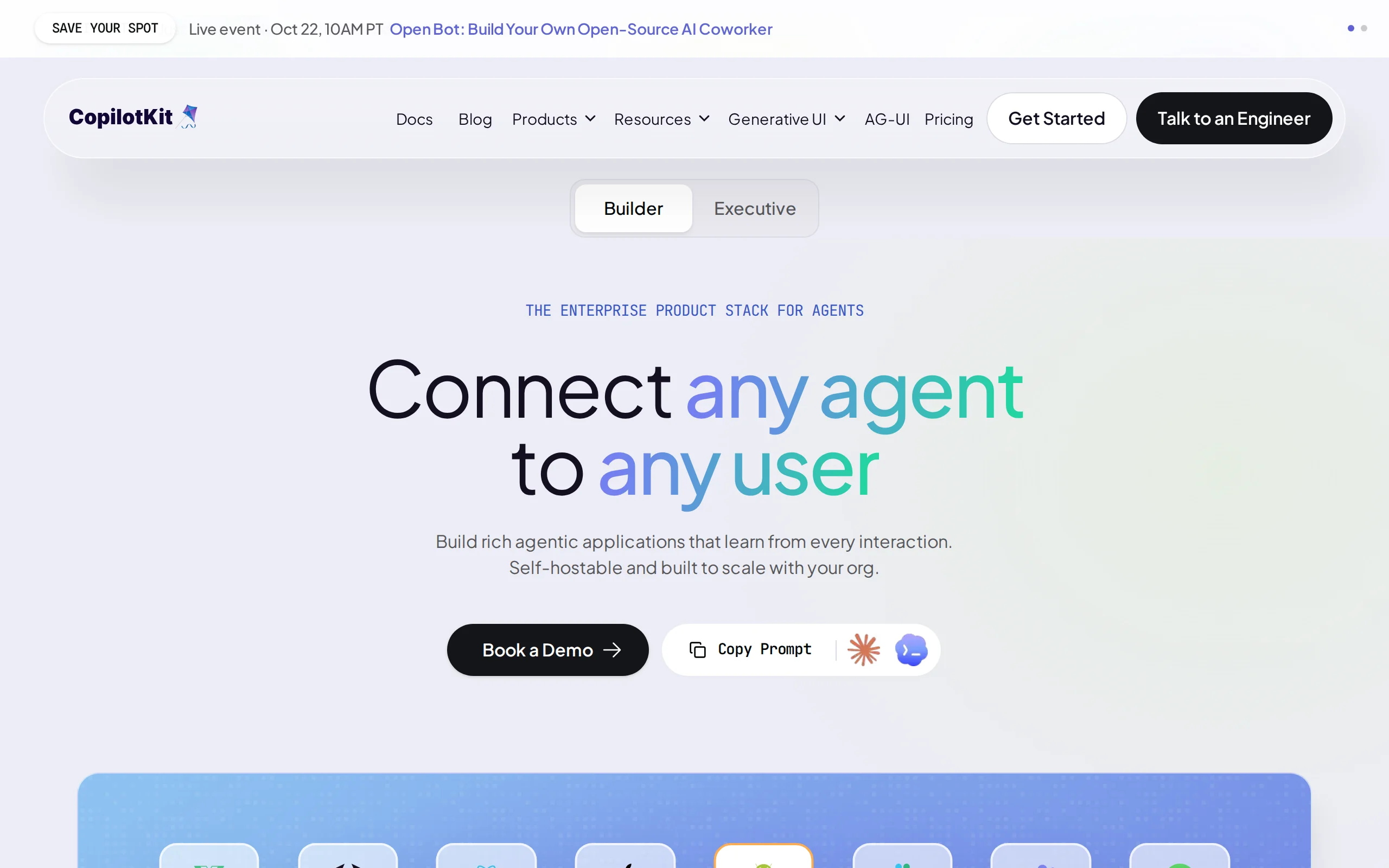
OpenMuse is an open-source personal AI assistant project developed by the CopilotKit team. Its core design philosophy is "giving an Agent a computer" — by combining a persistent browser, optional Linu...
1. What is OpenMuse
OpenMuse is an open-source personal AI assistant project developed by the CopilotKit team. Its core design philosophy is "giving an Agent a computer" — by combining a persistent browser, optional Linux Docker containers, and a file system, it enables AI agents to run complex tasks continuously in the background, while allowing users to pause, take over, or resume operations at any time. The project supports iOS, Android, and Web platforms, and includes high-frequency personal assistant scenarios such as Gmail and calendar integration, PDF form filling, web monitoring, and expense analysis. It also provides personal memory and goal tracking capabilities. OpenMuse is positioned as a developer-friendly framework for secondary development, requiring users to configure their own model API keys and cloud service credentials.
Image source: Official article
Image source: official article
Technical positioning and domain: OpenMuse belongs to the intersection of AI Agent application frameworks and personal productivity tools. Its technical stack is centered around CopilotKit, connecting the front-end and back-end via the AG-UI protocol, and it follows a typical "front-end interaction layer + back-end execution engine" decoupled architecture. In the AI Agent space, OpenMuse's differentiated positioning lies in its "visual workspace" — every step of the Agent's operation (browsing web pages, executing commands, processing files) is presented in an observable manner, rather than as a black-box task dispatch.
Development background: OpenMuse was developed and open-sourced by the CopilotKit team. CopilotKit itself is a mature AI application development framework, having accumulated a wealth of Agent interaction components within the React/Vue ecosystem. OpenMuse can be seen as a benchmark case of the CopilotKit team productizing their own framework capabilities. Its development motivation was to address the common pain points in current AI Agent applications: "tasks are invisible, processes are uncontrollable, and interruptions lead to loss," while also validating the engineering feasibility of CopilotKit in complex, multi-step task scenarios.
Core value: OpenMuse solves three practical issues: first, AI Agent task execution lacks transparency, making it difficult for users to determine what the agent is doing or at which step it is; second, long-running tasks (such as web research or batch file processing) are interrupted when the front-end is closed, and cannot continue running in the background; third, the agent's write operations (such as sending emails or modifying calendars) lack a safety confirmation mechanism, which can easily lead to irreversible consequences. Through a persistent browser, a server-side task engine, and a manual confirmation mechanism, OpenMuse brings these three issues under control.
2. Key Features
Agent Desktop (Persistent Workspace): Built-in persistent Chromium browser and optional Linux Docker container, allowing the Agent to genuinely browse the web, execute Shell commands, and process files and PDFs. Browser sessions and file systems remain continuous across tasks, enabling the Agent to return to previous operational contexts at any time. This feature is the core capability that distinguishes OpenMuse from purely conversational Agents.
Manual Takeover (Take Control): Users can open the browser or terminal at any time to view the Agent's real-time operations and take over the same session directly via the "Take Control" button. This "human-machine collaboration" mode retains the Agent's automation efficiency while granting users full control at critical points, especially suitable for scenarios in web operations that require human judgment.
Task Management Engine: Each task includes planning, progress, and approval stages, supporting pause, resume, cancel, and retry operations. Task status is persistently stored on the server, allowing tasks to continue running even after the frontend is closed. At the底层 level, task lifecycle is managed through SQL lease mechanisms, enabling resumption from the point of interruption and avoiding redundant work.
Gmail and Calendar Integration: Access via the Google OAuth protocol, supporting full email thread viewing, draft editing, and creation/modification/deletion of calendar events. Every write operation (sending an email, modifying a calendar event) requires manual user confirmation to prevent irreversible effects from Agent misoperations. This feature upgrades email handling from "passive review" to "proactive task management."
Smart PDF Form Filling: Reads PDF forms from email attachments, automatically identifies fields requiring input, prompts the user for missing information, generates a filled version for review, and prepares a draft for response. This feature compresses the complete process of "download → read → fill → reply" into just "confirm → send," significantly improving document processing efficiency.
Goal Tracking and Web Monitoring: Goals can be broken down into milestones, and the Agent regularly checks for content changes on public web pages, product restocking status, and price thresholds. When alerts are triggered, the Agent automatically de-duplicates them to avoid repeated notifications. This feature is ideal for scenarios such as flash sales, price comparisons, and competitor monitoring that require continuous attention to external information, transforming passive waiting into active sensing.
Expense Analysis: Imports bank transaction CSV files, automatically generates categorized expense summaries and savings goal recommendations, and creates an interactive accounting dashboard. This feature transforms scattered spending records into structured financial insights, helping users quickly understand their cash flow.
Personal Memory: Supports editable settings for name, tone, avatar, and memory preferences, which are persistently retained across tasks. The Agent maintains consistent style and context during interactions with the user, avoiding the need to start each conversation from scratch.
3. How to Use
Environment Requirements: Requires a Node.js environment (recommended version 18+) and the pnpm package manager. The backend API service runs by default on localhost:8787, and the Web frontend runs on localhost:8081. To enable the Linux workspace, install Docker and build the container image; to run the mobile version, also install Xcode (iOS) or the Android toolchain.
Clone and Install: In the terminal, execute
git clone https://github.com/CopilotKit/OpenMuse.git openmuseto clone the project, then runcd openmuseto enter the directory. Executepnpm install --frozen-lockfileto install all dependencies according to the lockfile. It is recommended to use the lockfile for installation to ensure consistency in dependency versions.Configure Environment Variables: Execute
cp .env.example .envto copy the example configuration. Then runnpx copilotkit@latest loginto complete the login, followed bynpx copilotkit@latest project selectto select or create an Intelligence project. Enter the generatedCPK_INTELLIGENCE_API_KEYinto the.envfile; this key is required for the conversation persistence feature.Start the Service: Execute
pnpm devto start the API service and check the health status via localhost:8787/api/health. Open a new terminal and runpnpm dev:webto start the Web frontend. Access the application interface in the browser by visiting localhost:8081. If you need the browser workspace thread, first runpnpm --dir apps/worker exec playwright install chromiumto install the browser, then executepnpm dev:browser.Configure Real Models and External Services: In the
.envfile, setAGENT_BACKEND=model,MODEL=provider/model-id, and enter the API keys for OpenAI, Anthropic, or Google. To integrate with Gmail and Calendar, create an OAuth client on the Google Cloud Platform and enable the Gmail and Calendar APIs. Enter the Client ID and Secret into the.envfile, and then complete account authorization on the Apps page of the application.Enable Linux Workspace (Optional): Execute
docker build -t openmuse-computer:local apps/computerto build the container image, then runCOMPUTER_ENABLED=true pnpm devto start the API and activate the workspace. When running the mobile version, for iOS devices, executepnpm --dir apps/mobile ios, and for Android devices, executepnpm --dir apps/mobile android.
4. Pros and Cons Analysis
| Pros |
|---|
| True Agent Workspace: Built-in persistent Chromium browser and optional Linux container, allowing the Agent to genuinely browse web pages, execute commands, and handle files, rather than being limited to text-based conversations. This significantly enhances the Agent's task execution capabilities. |
| Fully Visible and Controllable: Users can open the browser or terminal at any time to view the Agent's real-time operations and take control of the session instantly via the "Take control" feature. This transparent design gives users full control over the Agent's behavior, reducing trust barriers. |
| Task Execution Continues in the Background: Task planning, progress, and execution records are persistently saved. Closing the frontend does not interrupt the backend execution, and tasks can resume from the breakpoint after interruption. The SQL lease mechanism ensures the reliability of task scheduling. |
| Clear Security Boundaries: All write operations such as sending emails and modifying calendars require manual confirmation. Credentials are encrypted and stored, with no hidden retries. The container runs as non-root, with network isolation and command timeouts, indicating a relatively rigorous security design. |
5. Comparative Analysis with Similar Tools
| Dimension | OpenMuse | OpenClaw | AutoGPT |
|---|---|---|---|
| Core Positioning | Personal assistant application with a "visual workspace," emphasizing process transparency and manual takeover | Unified AI execution engine with a gateway style, focusing on multi-channel message connectivity and autonomous operation | General-purpose autonomous Agent framework, emphasizing task decomposition and tool calling |
| Interaction Interface | Native iOS/Android/Web application, Rich Threads with rich conversations, inline cards to display results | No native main interface, driven by chat channels, companion app optional | Web interface + command line, moderate task visualization |
| Agent Workspace | Persistent Chromium browser + optional Linux container + file/PDF, fully visualized throughout | Shell commands, file operations, browser control (Puppeteer/Playwright) | File system + code execution + web browsing, no persistent browser |
| Manual Takeover Mechanism | Supports real-time takeover of the browser/terminal session with "Take control" | No equivalent mechanism, more focused on "assign tasks and wait for results" | Supports task pause and manual intervention, but takeover granularity is coarse |
| Security Model | Manual confirmation required for each write operation, non-root containers, network isolation, and command timeouts | Two modes: sandbox and full access, requiring self-configuration | Configurable tool calling permissions, but default policies are relatively lenient |
| Task Continuity | Server-side task engine + SQL lease, continues running even after frontend is closed | 7×24 autonomous operation, supports scheduled triggers (Cron) | Depends on host process, task stops when closed |
| Model Integration | OpenAI/Anthropic/Google (via CopilotKit) | Very broad: Claude, GPT, Gemini, DeepSeek, Kimi, local models, etc. | Supports OpenAI, Anthropic, and local models, etc. |
| Open Source License | MIT | MIT | MIT |
| Ecosystem Expansion | Built-in scenarios for Gmail, calendar, PDF, monitoring, finance, etc. | ClawHub skill marketplace with over 5,000 community skills | Plugin ecosystem is relatively rich, with an active community |
Selection Recommendations: If your primary requirement is an Agent experience that is "visible and controllable," involving personal assistant scenarios such as email, PDFs, and web monitoring, and you want one set of code to cover three platforms, OpenMuse is a more suitable choice. Its visual workspace and "Take control" mechanism provide clear advantages in scenarios requiring human judgment for web operations. If you prioritize multi-channel message integration (e.g., WhatsApp, Telegram, Discord) and 7×24 autonomous operation capabilities, and need to integrate with more model providers such as local models or DeepSeek, OpenClaw's gateway-style architecture and ClawHub skill ecosystem are more appealing. For developers requiring deep customization of Agent behavior, AutoGPT offers better framework flexibility, though you must handle task persistence and frontend display yourself. If your team prefers an out-of-the-box product experience and is not concerned about closed-source nature, Manus's cloud-hosted model can eliminate deployment and maintenance burdens.
6. Editor's Summary
OpenMuse has made valuable engineering explorations in the application layer of AI Agents. Its most notable innovation lies in turning the concept of "process transparency" into a concrete mechanism—persistent browsers make every operation of the Agent visible, Take control enables smooth handover between human and machine collaboration, and SQL leases ensure task resumption from a breakpoint. The combination of these three capabilities directly addresses the most criticized issue in current AI Agent implementations: the "black box execution" problem. In terms of practical value, the scenarios covered by OpenMuse, such as email handling, PDF form processing, web page monitoring, and expense analysis, all originate from real personal assistant needs rather than conceptual demonstrations, with each scenario having a fully implemented end-to-end workflow. Its security design (write confirmation required, non-root containers, network isolation) also reflects a pragmatic consideration of the risks associated with Agent loss of control.
OpenMuse's target audience is clearly defined: individual developers with a certain level of technical expertise, teams needing to quickly prototype Agent applications, and engineering teams looking to integrate Agent workspace capabilities into their own products. For non-technical users, the prerequisite steps such as configuring model keys, Google OAuth, and Docker present a high usage barrier. In terms of growth potential, the CopilotKit framework that OpenMuse relies on is still rapidly evolving, and the decoupled architecture of the AG-UI protocol leaves room for future integration with more Agent harnesses. If the community can build an ecosystem around scenario-specific skills similar to ClawHub, OpenMuse's competitiveness in the personal assistant space will further increase. At this current stage, it is more suitable as a reference implementation for technical teams researching Agent workspace design and task orchestration, rather than as a mature product for the general public.
7. Application Scenarios
Email Task Processing: The assistant automatically searches through emails, opens relevant ones, reads PDF attachments, and prompts you for any missing information. It fills out form copies and drafts responses, waiting for a one-click confirmation to send. This is ideal for scenarios such as leave applications, registration forms, and contract signing that require frequent handling of form attachments, reducing each processing time from several minutes to just tens of seconds.
Web Research and Information Gathering: When browsing Hacker News or researching a specific topic, browser operations and summary results are directly inlined within the chat window. Users can随时 take control and intervene to correct the direction. This is suitable for tasks such as competitive analysis, technical evaluation research, and news tracking that require multi-page browsing and information integration. The Agent can open multiple pages in parallel and summarize key points.
Price and Inventory Monitoring: After setting a target, the system regularly checks product pages and automatically alerts when restocking occurs or when the price drops below a threshold. Alerts are automatically deduplicated to avoid repeated notifications. This is applicable for scenarios such as purchasing limited-edition items, cross-border price comparisons, and tracking price fluctuations of commonly used consumables, eliminating the need for users to manually refresh pages repeatedly.
Schedule and Event Management: By integrating with Gmail/Calendar via OAuth, the assistant can review event information from emails, create or modify calendar events, and require user confirmation for each change. This is ideal for scenarios such as meeting coordination, itinerary planning, and event registration that involve cross-application operations between emails and calendars, reducing the cost of manually switching between apps.
Personal Financial Management: Import bank transaction CSV files to automatically generate categorized expense summaries and savings goal recommendations, forming an interactive accounting dashboard. This is suitable for scenarios such as monthly budget management, consumption structure analysis, and savings plan formulation, helping users quickly identify unnecessary expenses and optimize their financial allocation.
8. FAQ
Q: What distinguishes OpenMuse from regular chatbots like ChatGPT?
A: The core difference of OpenMuse lies in its "action capability" and "process transparency." Regular chatbots generate text responses based solely on conversation, while OpenMuse provides persistent browsers, Linux containers, and file systems for Agents, enabling them to perform real web browsing, command execution, and file processing tasks. Additionally, all operation processes are visualized, allowing users to take over at any time, rather than just waiting for the final result.
Q: What are the prerequisites for deploying OpenMuse?
A: You need Node.js 18+ and pnpm. If you enable the Linux workspace, Docker must be installed; for mobile deployment, you need Xcode (iOS) or the Android toolchain. Additionally, you must prepare a model API key (OpenAI/Anthropic/Google), create a Google OAuth client to access Gmail/calendar, and obtain a CopilotKit Intelligence project key for conversation persistence.
Q: Will running tasks be interrupted if the browser or frontend page is closed?
A: No. OpenMuse's task engine runs on the server side, and task status is persistently saved using SQL leases. Closing the frontend will not interrupt the task, and you can view the progress, resume, or cancel the task after reopening the application. However, note that the API service process itself must remain running.
Q: How can we ensure that the Agent does not accidentally send emails or modify calendar events?
A: OpenMuse provides dual safeguards in its security design: all write operations (such as sending emails or modifying calendar events) require manual user confirmation, and Agents cannot execute them automatically. Additionally, credentials are encrypted and stored, containers run as non-root users, networks are isolated, and command execution is time-limited, reducing the risk of accidental operations and privilege escalation from a systemic perspective.
Q: Does OpenMuse support integration with models other than OpenAI, Anthropic, and Google?
A: Officially supported model providers are OpenAI, Anthropic, and Google, integrated via the CopilotKit framework. Due to the architecture's use of the AG-UI protocol for decoupling, the Agent backend could theoretically be replaced with any compatible harness, but a custom adapter layer would need to be developed. Currently, direct configuration of DeepSeek, Kimi, or local models is not supported.
9. Project Links
- CopilotKit Official Website: https://www.copilotkit.ai (Official website of the CopilotKit framework, with OpenMuse as its open-source project; related documentation and announcements are published here)
- GitHub Repository: https://github.com/CopilotKit/OpenMuse (Official code repository, containing full source code and deployment documentation)
Related AI Model Articles
In-Depth Review of Longcat-2.5-preview: Meituan's Next-Generation Multimodal Long-Range Agent Model
LongCat-2.5-preview is Meituan's latest next-generation large model. Building upon the 1.6T total parameters, approximately 48B active parameters, and native 1M token context of LongCat-2.0, it marks ...
Review of DeepSeek Harness Desktop: How the Official GUI Client Lowers the Bar for Agent Usage
DeepSeek Harness Desktop is the official graphical client launched by DeepSeek, designed to provide a visual interface for the originally command-line-based DeepSeek Harness framework. After users log...
Step Code – In-Depth Review of StepFun's Open-Source Terminal Programming Agent
Step Code is an open-source terminal programming agent launched by StepFun, licensed under the MIT License, which allows developers to complete the full workflow of code writing, debugging, execution,...
In-Depth Review of Claude Opus 5.5: A Revolution in Programming Efficiency and Safety for Anthropic's Flagship Model
Claude Opus 5.5 is the first flagship model in Anthropic's Claude 5.5 series, launched in June 2026. It is positioned as a high-end AI model designed for enterprise-level agent programming, complex kn...
© All Rights Reserved. Some content on this site is partially generated by AI with human review.