
In-Depth Review of Longcat-2.5-preview: Meituan's Next-Generation Multimodal Long-Range Agent Model
Executive Summary:
LongCat-2.5-preview is Meituan's latest next-generation large model. Building upon the 1.6T total parameters, approximately 48B active parameters, and native 1M token context of LongCat-2.0, it marks ...
1. What is LongCat-2.5-preview
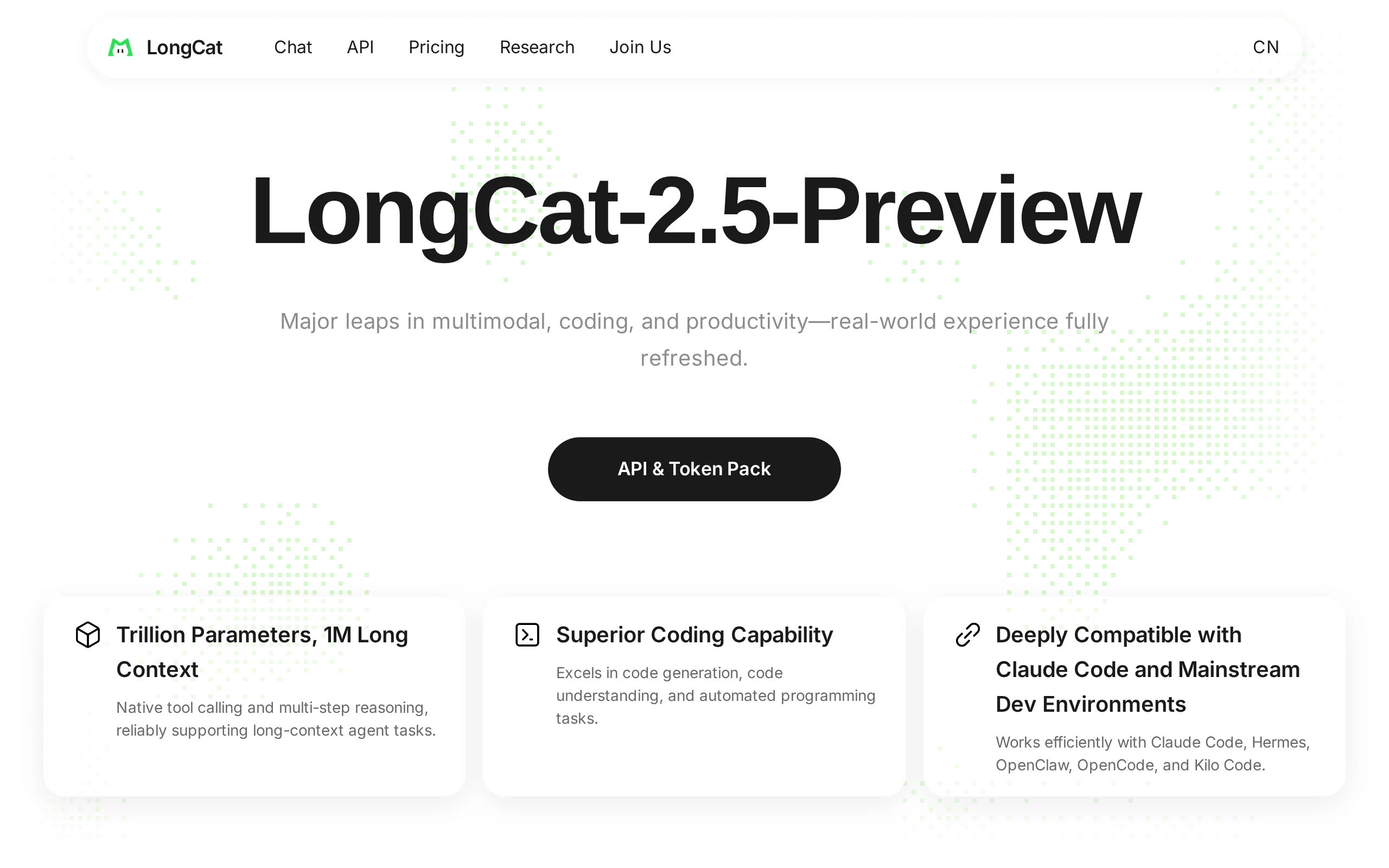
LongCat-2.5-preview is Meituan's latest next-generation large model. Building upon the 1.6T total parameters, approximately 48B active parameters, and native 1M token context of LongCat-2.0, it marks the first time that multimodal capabilities have been directly integrated into the base model. Designed to perform long-flow Agent tasks across terminal, browser, and desktop software scenarios, this model has been officially integrated with the API and is compatible with both OpenAI and Anthropic interface protocols. It supports output of up to 128K tokens and can be directly called by mainstream Agent tools such as Codex and OpenClaw, representing a key upgrade from a pure text encoder model to a multimodal long-range intelligent agent.
Image source: Official article
Image source: official article
Technical positioning and domain: Belongs to the field of large-scale sparse-activation language models, combining MoE architecture with multimodal joint modeling. It is positioned as a base model for Agent systems capable of executing long-range real-world software operations, covering scenarios such as programming, office automation, and GUI interaction.
Development background: Developed by Meituan's LongCat team, it continues the MoE route with 1.6T total parameters from LongCat-2.0, and builds upon the DiNA (Discrete Native Autoregressive) paradigm validated in LongCat-Next, integrating image understanding directly into the base model rather than maintaining a separate visual repository.
Core value: Solves the system engineering challenges of multimodal joint modeling under million-level context conditions, while leveraging dual-interface compatibility to allow existing OpenAI/Anthropic ecosystem Agent tools to be nearly zero-migration integrated, significantly lowering the threshold for implementing long-range tasks.
Technical features: Combines MoE sparse activation (1.6T total parameters / 48B active parameters) with native 1M token context, unifies multimodal tokens and text through discrete modeling, and supports dlp speculative decoding for accelerated inference.
2. Key Features
Native Multimodal Base Modeling: Unlike the 2.0 era, which split images and videos into separate open-source repositories, 2.5 integrates visual encoding directly into the base model. Images and text are jointly modeled within the same model, supporting cross-modal Q&A, content summarization, and complex visual reasoning, resulting in a more unified interactive experience.
Long-Range GUI Agent Tasks: Executes long-flow autonomous operations on real software interfaces such as terminals, browsers, GUIs, spreadsheets, and design tools. It can complete multi-step unattended tasks like "scraping web data → cleaning → populating Excel → generating reports."
Agentic Coding Capabilities: Continues the positioning of LongCat-2.0 in code generation, code understanding, and automated programming tasks. It supports cross-file refactoring, defect localization, and large PR generation, directly driven by tools such as Claude Code and OpenCode.
Dual-Protocol API Interface: Compatible with both OpenAI and Anthropic API formats, with a maximum output of 128K tokens. Existing Agent tools can be integrated by simply modifying the base_url and model name, without changing the application logic.
Deep Development Environment Adaptation: Efficiently collaborates with mainstream Agent tools such as Claude Code, Hermes, OpenClaw, OpenCode, and Kilo Code. The official provides integration tutorials, covering major coding and automation scenarios.
Million-Level Context Memory: Native 1M token window can accommodate ultra-long documents, entire codebases, system logs, and multi-round complex tasks in a single session, providing a complete memory foundation for long-range Agent multi-step execution.
3. How to Use
Register for an Open Platform Account: Open the LongCat Open Platform (https://longcat.ai/platform/), register and log in to your Meituan LongCat account, and access the console.
Create an API Key: In the console navigation, locate the API Key management page and create a new API Key. Keep this key secure, as it will be required for all subsequent calls.
Configure SDK and base_url: Use existing official SDKs from OpenAI or Anthropic, without needing to install any new client. Modify the
base_urlto(link to be updated after official release)(OpenAI format) or(link to be updated after official release)(Anthropic format), and input the newly created key.Specify the Model and Initiate a Request: Enter the model ID as
LongCat-2.5-Preview, and send requests in the OpenAI chat.completions or Anthropic messages standard format. The model supports image input and long-text generation.Integrate with Agent Tools (e.g., Claude Code): Set the environment variables
ANTHROPIC_BASE_URL=(link to be updated after official release)andANTHROPIC_AUTH_TOKEN=your key, and setANTHROPIC_MODELtoLongCat-2.5-Preview. Once configured, you can start Claude Code and directly call the model. Similar steps apply for tools like OpenClaw, OpenCode, and Codex.Direct Web Experience: Visit the LongCat official website (https://longcat.ai/), log in, and select the
LongCat-2.5-Previewmodel. You can then experience conversations, image uploads, and simple Agent tasks directly on the web interface, without writing any code.
4. Pros and Cons Analysis
| Pros |
|---|
| Ultra-large sparse model with low-cost inference: With a total of 1.6T parameters, only about 48B are activated at a time. The MoE dynamic routing effectively controls the computational cost per inference while maintaining model capacity, balancing performance potential with cost considerations. |
| Million-level native context: A 1M token window can accommodate an entire codebase or complete logs in one go, combined with a maximum output of 128K tokens, providing significant advantages in analyzing long documents and maintaining long process memory. |
| Native multimodal integration into the base model: It continues to use the DiNA discrete native autoregressive paradigm, unifying vision and text into discrete tokens for joint modeling, avoiding the interaction fragmentation issues caused by the separation of multimodal repositories in the 2.0 era. |
| Dual protocol zero-migration integration: It is compatible with both OpenAI and Anthropic interfaces. Existing Agent tools can be switched to LongCat simply by changing the base_url, significantly reducing the migration cost for developers and minimizing friction when switching ecosystems. |
5. Comparative Analysis with Similar Tools
| Comparison Dimension | LongCat-2.5-Preview | Claude Opus 5.5 |
|---|---|---|
| Core Architecture | MoE sparse activation, 1.6T total parameters / 48B activated, multi-modal integrated into the base model | Dense Transformer architecture, native multi-modal (mature for images/documents) |
| Context Window | Native 1M tokens | 1M tokens |
| Maximum Output | 128K tokens | 128K tokens |
| Interface Protocol | Compatible with both OpenAI and Anthropic protocols | Only Anthropic protocol |
| GUI Agent Capabilities | In early stages, covers browser/desktop/table operations, no public benchmark | Claude Computer Use has been commercially iterated multiple times, with extensive real-world data |
| API Pricing | Token-based package billing, includes 5 million free tokens, clear cost-performance positioning | $4 / $20 per million tokens (approx. ¥29 / ¥143), premium pricing tier |
| Ecosystem Tool Integration | Official tutorials cover Codex / OpenClaw / Claude Code / OpenCode, etc. | Claude Code, Cowork, etc., official toolchain deeply integrated |
| Data Transparency | No official benchmarks, third-party evaluations are lacking | Public benchmarks such as SWE-bench available, rich third-party ecosystem |
Selection Recommendations: For application teams that have already developed extensively using the OpenAI or Anthropic protocols, LongCat-2.5-Preview's dual-protocol compatibility and the inclusion of free tokens significantly reduce migration barriers. It is particularly suitable for small and medium-sized teams that need to handle large codebases and hundreds of thousands of documents, offering flagship-level context capabilities while keeping costs under control.
For enterprise users relying on mature GUI automation capabilities and a rich third-party ecosystem, Claude Opus 5.5's Computer Use solution has undergone multiple rounds of iteration and validation. It demonstrates superior stability and handling of edge cases in browser operations and desktop software interactions, making it ideal for sectors with strict requirements for task reliability, such as finance and government services.
6. Editor's Summary
LongCat-2.5-Preview has made clear differentiated technical choices: it integrates a 1.6T parameter MoE architecture with native multimodality at the base level, while retaining a million-level context of 1M tokens. This combination is relatively rare in the current large model market. From a technical perspective, the continuation of the DiNA discrete native autoregressive paradigm enables visual information and text to be modeled within the same semantic space, avoiding the common modality alignment bias issues seen in late-fusion approaches. Meanwhile, the design that activates only 48B parameters out of a total of 1.6T achieves a good balance between model capacity and inference cost.
The model's most prominent practical value lies in its dual-protocol API compatibility strategy, which allows it to be integrated into existing OpenAI or Anthropic development toolchains with minimal migration cost. For developers relying on tools such as Claude Code or OpenClaw, switching the underlying model simply requires modifying environment variables. This "plug-and-play" integration method effectively reduces the replacement cost for Agent applications. Additionally, the native multimodal integration into the base model provides a natural synergy advantage in scenarios that combine long document analysis with image understanding.
However, the model still lacks publicly verified data on its GUI Agent capabilities, and the official has not released standard evaluation results such as those from SWE-bench, which to some extent affects its reference value during technical selection. When deploying in actual production environments, the stability metrics of the API service and long-term rate-limiting strategies also require further observation. Overall, LongCat-2.5-Preview is suitable for development teams with clear requirements for handling ultra-long contexts, cost control, and joint multimodal modeling, especially showing strong engineering adaptation potential under domestic computing power ecosystems. As future versions iterate and benchmark data is supplemented, its market potential in the long-range Agent domain is worth continued attention.
7. Application Scenarios
Full-codebase-level programming assistant: Load the entire repository source code in one go with 1M context, enabling cross-file refactoring, defect localization, and large-scale PR generation. Developers can configure LongCat-2.5-Preview as the underlying model via Claude Code or OpenCode, achieving intelligent code completion and automated modifications within the IDE based on full-repository context.
Cross-software long-process office automation: The model can operate browsers, spreadsheets, and desktop software, executing multi-step unattended tasks such as "scraping web data → cleaning → populating Excel → generating reports." Enterprises can delegate repetitive data processing workflows to the Agent, freeing up human resources to focus on higher-value tasks.
Enterprise-level log and document analysis: Feed system logs, contract archives, or academic papers with millions of tokens into the model for in-depth, one-time question-answering, summarization, and anomaly detection. This avoids context fragmentation caused by RAG slicing and is suitable for scenarios such as operations troubleshooting, legal document review, and academic literature research, enhancing analytical depth and efficiency.
GUI interface testing and operations: Automatically operate terminals and desktop software to perform bulk configuration, interface regression testing, and automated data entry for legacy systems—tasks that are traditionally labor-intensive. By visually understanding interface elements and combining them with natural language instructions, the model can effectively automate control of non-standardized GUIs.
Multimodal content production assistance: With the newly added image understanding capability, the model can convert screenshots into code, reconstruct design drafts (integrating with design tools), and structure and rework图文混合 (text-image mixed) materials. This introduces stronger multimodal cognition into the content production workflow.
8. FAQ
Q: What is the core difference between LongCat-2.5-Preview and LongCat-2.0?
A: The core difference lies in the positioning of multimodal capabilities. In 2.0, image and video capabilities are split into separate open-source repositories, requiring separate deployment and invocation; in 2.5, multimodal capabilities are directly integrated into the base model, enabling joint modeling of visual and textual information within the same model. Through the DiNA paradigm, images are discretized into tokens for unified processing, allowing users to obtain cross-modal understanding capabilities without needing to load additional visual modules.
Q: How can I adapt my existing OpenAI SDK to use LongCat-2.5-Preview?
A: No need to replace the SDK or modify your business code. Simply change the base_url parameter to (链接待官方发布后更新), replace the API Key with the one created on the LongCat open platform, and specify the model ID as LongCat-2.5-Preview. All request formats remain consistent with the OpenAI chat.completions standard, and support for extended fields such as image input is retained.
Q: What should be noted when integrating Agent tools that follow the Anthropic protocol (e.g., Claude Code)?
A: You need to set three environment variables: ANTHROPIC_BASE_URL pointing to (链接待官方发布后更新), ANTHROPIC_AUTH_TOKEN filled with your API Key, and ANTHROPIC_MODEL set to LongCat-2.5-Preview. Note that some tools may have hard-coded Anthropic-specific parameters internally. It is recommended to first verify compatibility on small-scale tasks before scaling up to production environments.
Q: What types of image inputs does the model support? Are there any size or format restrictions?
A: The model currently supports common static image formats (e.g., JPEG, PNG, WebP). Specific size limits and resolution requirements can be found in the official documentation. It is recommended to upload images no larger than several MBs to ensure response speed. The model performs well in parsing complex charts, screenshots, and design drafts, but video input is not yet explicitly supported through official channels.
Q: What hardware resource requirements are there for processing 1M token context?
A: Due to the model's MoE architecture, which activates only approximately 48B parameters, the memory required for a single inference is significantly less than the 1.6T needed for full parameter loading. However, when processing long prompts at the 1M token level, the memory overhead of the KV Cache will increase substantially. Actual deployment requires ample high-bandwidth GPU memory and system memory resources. For specific hardware configuration recommendations, please refer to the official deployment documentation. Cloud API calls do not require local hardware support.
Q: How can I obtain free API quotas and pricing details?
A: The official platform provides 5 million free tokens for new users to test, which is sufficient for small to medium-scale verification needs. Any usage beyond this will be billed based on token packages, with specific pricing details displayed in the console of the open platform. It is recommended to thoroughly evaluate the actual token consumption of long-context tasks before deploying in a production environment to plan your budget accordingly.
9. Project Links
- Product Official Website: https://longcat.ai/
- Official Open Platform (API Console and Key Management): https://longcat.ai/platform/
Related AI Model Articles
OpenMuse – CopilotKit Open-Source Personal AI Assistant
OpenMuse is an open-source personal AI assistant project developed by the CopilotKit team. Its core design philosophy is "giving an Agent a computer" — by combining a persistent browser, optional Linu...
Review of DeepSeek Harness Desktop: How the Official GUI Client Lowers the Bar for Agent Usage
DeepSeek Harness Desktop is the official graphical client launched by DeepSeek, designed to provide a visual interface for the originally command-line-based DeepSeek Harness framework. After users log...
Step Code – In-Depth Review of StepFun's Open-Source Terminal Programming Agent
Step Code is an open-source terminal programming agent launched by StepFun, licensed under the MIT License, which allows developers to complete the full workflow of code writing, debugging, execution,...
In-Depth Review of Claude Opus 5.5: A Revolution in Programming Efficiency and Safety for Anthropic's Flagship Model
Claude Opus 5.5 is the first flagship model in Anthropic's Claude 5.5 series, launched in June 2026. It is positioned as a high-end AI model designed for enterprise-level agent programming, complex kn...
© All Rights Reserved. Some content on this site is partially generated by AI with human review.