
Qwen3.7-Plus – Alibaba Tongyi's Agentic Multimodal Large Model
Executive Summary:
Qwen3.7-Plus is Alibaba Cloud Tongyi Qwen team's next-generation multimodal large model positioned as an "agent foundation," integrating visual perception, language understanding, code generation, and...
1. What Is Qwen3.7-Plus
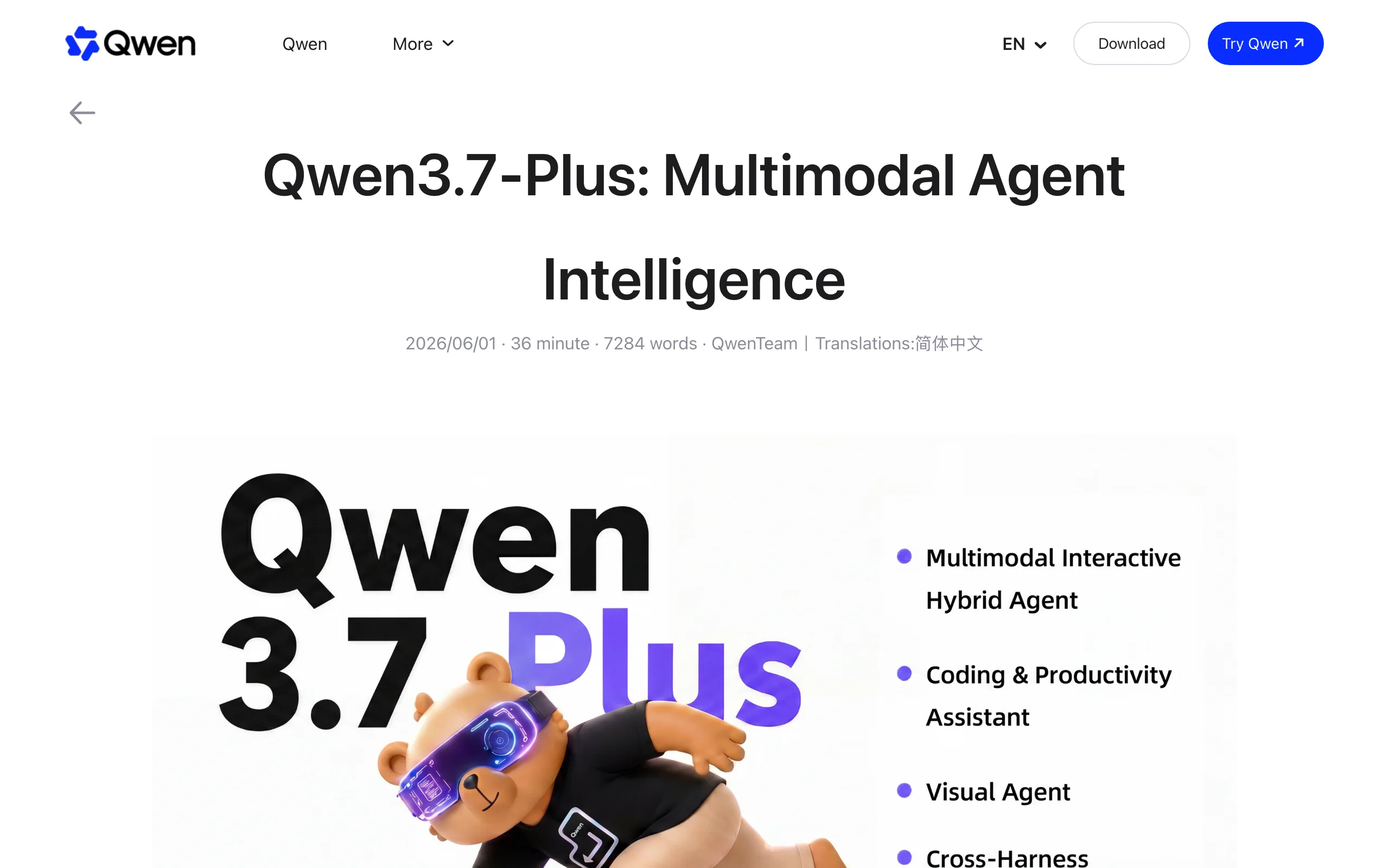
Qwen3.7-Plus is Alibaba Cloud Tongyi Qwen team's next-generation multimodal large model positioned as an "agent foundation," integrating visual perception, language understanding, code generation, and GUI control into one workflow loop. It understands real-world scenes in real time, reads screen content, executes multi-step actions, and generates executable code from visual references—seamlessly blending CLI and GUI interaction in a single agent loop. As an all-in-one coding agent and productivity assistant, it covers frontend prototyping through complex software engineering automation and multi-step workflow orchestration with cross-framework generalization stable across Claude Code, OpenClaw, Qwen Code, and other deployments.
Image source: Official article
Technical positioning and domain: Multimodal LLM × agent tech—"multimodal interactive hybrid agent foundation" vs. pure text or vision models. Single-loop perceive-think-write-act-verify for visual programming, GUI automation, multimodal QA, and real-world perception.
Research background: Built on Qwen LLM and multimodal lineage. Motivation: models could see interfaces or generate code but couldn't chain vision, execution, tools, and verification—Qwen3.7-Plus closes end-to-end autonomy from requirements to delivery.
Core value: Fixes "understands but can't act"—unifies vision, code, GUI ops, search augmentation, and autonomous execution. Innovations: visual programming near GPT-5.4 (QwenVision2Code 1772.0); GUI ops first tier (ScreenSpot Pro 79.0, AndroidWorld 81.0); ultra-long autonomous runs (11+ hours, 10,000+ lines of code, 1,000+ invocations).
Technical characteristics: Unified vision-language encoding; code interpreter for computable visual problem solving; GUI automation with element localization, planning, multi-step interaction; search augmentation combining vision with external retrieval; cross-framework deployment consistency.
2. Key Features
Multimodal interactive hybrid agent: Images, video, screenshots, web pages, text in one loop—GUI ops, CLI commands, tool calls. Visual goals like "replicate this app's login screen" trigger autonomous planning, code interpreter, testing, iteration.
Visual agent: Vision + code interpreter + search for puzzles (spot-the-difference, Klotski), real-world QA, complex reasoning—spatial modeling, path search, state rollout, self-verification code, structured answers.
Visual programming: Images/video → SVG, web, interactive frontend code. QwenVision2Code 1772.0 near GPT-5.4 1884.0, ahead of Claude-Opus-4.6 1518.0 and Gemini-3.1 Pro 1632.0.
GUI agent: Mobile and desktop UI understanding, element localization, planning, multi-step ops—ScreenSpot Pro 79.0, AndroidWorld 81.0 for see-operate-build chain.
Real-world perception and reasoning: Real scenes, document charts, OCR, video events, driving scenes—RealWorldQA 86.9, VideoMMMU 88.0 with visual evidence + external knowledge.
Long autonomous runs and cross-framework generalization: 11+ hour runs, 10,000+ lines, 1,000+ calls; stable across Claude Code, OpenClaw, Qwen Code without framework-specific tuning.
Search-augmented multimodal QA: Extract entities/scenes/text from images, search external knowledge, combine for answers—MMSearchPlus 41.4 vs. GPT-5.4 19.7.
3. How to Use
Environment: Cloud API via Alibaba Cloud Bailian or Qwen Studio—no local GPU required; stable network recommended. Local deploy: A100-class GPU, Linux/Windows, Python 3.10+, PyTorch 2.0+.
Access platform: Register at Bailian (https://bailian.console.aliyun.com) or Qwen Studio (https://qwen.studio), search "Qwen3.7-Plus."
Configure parameters: Max tokens 4096+ recommended; temperature 0.2 for coding, 0.7 for creative; enable code interpreter and search as needed; upload screenshots/URLs for GUI tasks.
Multimodal input: Upload images, video, screenshots, links with text instructions—e.g., UI design + "generate HTML+CSS." Pick agent modes (Visual, GUI, Visual Coding) for closed-loop execution.
Review and iterate: Human review or self-verification; code runs return results; GUI ops can screenshot feedback; natural language for adjustments.
Best practices: Stage very long tasks (full app builds) to avoid context overflow; vision input ≥512×512 for element accuracy; stable network for search; consistent model version across frameworks.
4. Pros and Cons
| Pros |
|---|
| Multimodal agent closed loop: Vision, code, GUI, tools in one workflow—end-to-end automation from understanding to delivery. |
| Leading visual programming: QwenVision2Code 1772.0 near GPT-5.4—design to executable code lowers dev cost. |
| First-tier GUI ops: ScreenSpot Pro 79.0, AndroidWorld 81.0 for mobile/desktop automation. |
| Search-augmented QA: MMSearchPlus 41.4 far above GPT-5.4 19.7 for real-time visual questions. |
5. Comparison with Similar Tools
| Dimension | Qwen3.7-Plus | GPT-5.4 | Claude-Opus-4.6 |
|---|---|---|---|
| Architecture | Multimodal interactive hybrid agent foundation | General multimodal LLM | Multimodal, safety/long context |
| Visual programming | QwenVision2Code 1772.0 | 1884.0 | 1518.0 |
| GUI ops | ScreenSpot Pro 79.0, AndroidWorld 81.0 | 67.4, not tested | Not published |
| Visual reasoning | BabyVision 70.4/64.7 | 53.1 | Not published |
| Search-augmented QA | MMSearchPlus 41.4 | 19.7 | Not published |
| Terminal coding | Terminal Bench 2.0 70.3 | Not tested | Not published |
| Cross-framework | Claude Code, OpenClaw, Qwen Code, etc. | OpenAI API only | Anthropic API only |
| Long autonomous run | 11+ hours, 10k+ lines | Not published | Not published |
| Open source | Partial (weights not fully open) | Closed | Closed |
Selection advice:
- End-to-end GUI automation and software engineering automation, cross-framework teams: Qwen3.7-Plus for GUI and long-run advantages.
- Pure visual programming with highest accuracy: GPT-5.4 slightly ahead on QwenVision2Code but small gap.
- Safety and long context: Claude-Opus-4.6—GUI/visual programming benchmarks not public.
- Balanced tool use and multimodal fusion: Gemini-3.1 Pro weaker on visual programming and GUI vs. top two.
6. Editor's Review
Qwen3.7-Plus marks multimodal evolution from "understanding" to "acting." Unified vision, code, GUI, and tools in one loop—not text-only output. Benchmarks: visual programming near GPT-5.4, GUI ops far ahead, search QA nearly double GPT-5.4—first-tier agent capabilities.
Direct beneficiaries: developers, test engineers, PMs—design to frontend code, GUI test generation/execution, requirements to full apps. 11+ hour runs suit overnight builds and CI. Researchers benefit from cross-framework deployment flexibility.
Audience: pro developers prototyping from visuals; automation testers; AI app builders for multimodal agents; PMs validating concepts. Chinese UI/QA may need extra tuning vs. dedicated Chinese models.
Future: more open weights and Chinese optimization could make it a multimodal agent benchmark; "agent foundation" hints at more tools and sensors (camera streams, robotics) toward embodied AI. Long-context stability and cloud latency need ongoing work.
— Top innovation and GUI/visual programming; limited openness and Chinese optimization deduct; expect improvements in later versions.
7. Use Cases
Full-stack software automation: Requirements (text/design) → code framework, logic, tests, GUI automation, iterative optimization—CI/CD acceleration.
Desktop app replication and migration: UI screenshots/recordings → high-fidelity source with real APIs—legacy desktop to web or competitor feature replication.
Visual content generation and design delivery: Figma prototypes or sketches → SVG, HTML/CSS, React components.
Multimodal knowledge QA: Historical building photos → style identification + background search; product images → brand, price, reviews.
Autonomous driving and embodied AI research: Driving scene understanding for perception pretraining/simulation; robot "brain" planning from camera input.
Education: Handwritten physics/math photos → recognized problems, step-by-step solutions and grading assistance.
8. FAQ
Q: Local GPU required?
A: No for cloud API via Bailian or Qwen Studio. Local partial deploy (e.g., vLLM) needs A100-class GPU; weights not fully open—may need permission.
Q: Chinese input/output?
A: Chinese text supported; Chinese GUI element recognition may trail English. Chinese instructions work for QA and code; English comments/output often preferred. Pure Chinese tasks: consider Qwen-Plus Chinese models.
Q: Dynamic pages (scroll, popups)?
A: Multi-step interaction handles scrollbars, modals, dropdowns. Complex real-time charts need sufficient frame rate (1+ fps recommended).
Q: Generated code quality?
A: QwenVision2Code 1772.0—SVG/HTML/CSS often usable directly; complex state/API logic needs human review. Iterative natural-language refinement supported.
Q: Context forgetting in long runs?
A: 11+ hour stability demonstrated but theoretical overflow possible—stage tasks, save intermediates, external memory for key facts.
Q: Updates and community?
A: Follow qwen.ai/blog and github.com/QwenLM; Alibaba developer forum or HuggingFace model pages; official Discord limited—Alibaba tickets for support.
9. Project Links
- Blog: https://qwen.ai/blog?id=qwen3.7-plus
- Alibaba Bailian: https://bailian.console.aliyun.com
- GitHub: https://github.com/QwenLM
Related AI Model Articles
OpenMuse – CopilotKit Open-Source Personal AI Assistant
OpenMuse is an open-source personal AI assistant project developed by the CopilotKit team. Its core design philosophy is "giving an Agent a computer" — by combining a persistent browser, optional Linu...
In-Depth Review of Longcat-2.5-preview: Meituan's Next-Generation Multimodal Long-Range Agent Model
LongCat-2.5-preview is Meituan's latest next-generation large model. Building upon the 1.6T total parameters, approximately 48B active parameters, and native 1M token context of LongCat-2.0, it marks ...
Review of DeepSeek Harness Desktop: How the Official GUI Client Lowers the Bar for Agent Usage
DeepSeek Harness Desktop is the official graphical client launched by DeepSeek, designed to provide a visual interface for the originally command-line-based DeepSeek Harness framework. After users log...
Step Code – In-Depth Review of StepFun's Open-Source Terminal Programming Agent
Step Code is an open-source terminal programming agent launched by StepFun, licensed under the MIT License, which allows developers to complete the full workflow of code writing, debugging, execution,...
© All Rights Reserved. Some content on this site is partially generated by AI with human review.