
Qwen-VLA – Alibaba Tongyi's General Vision-Language-Action Model
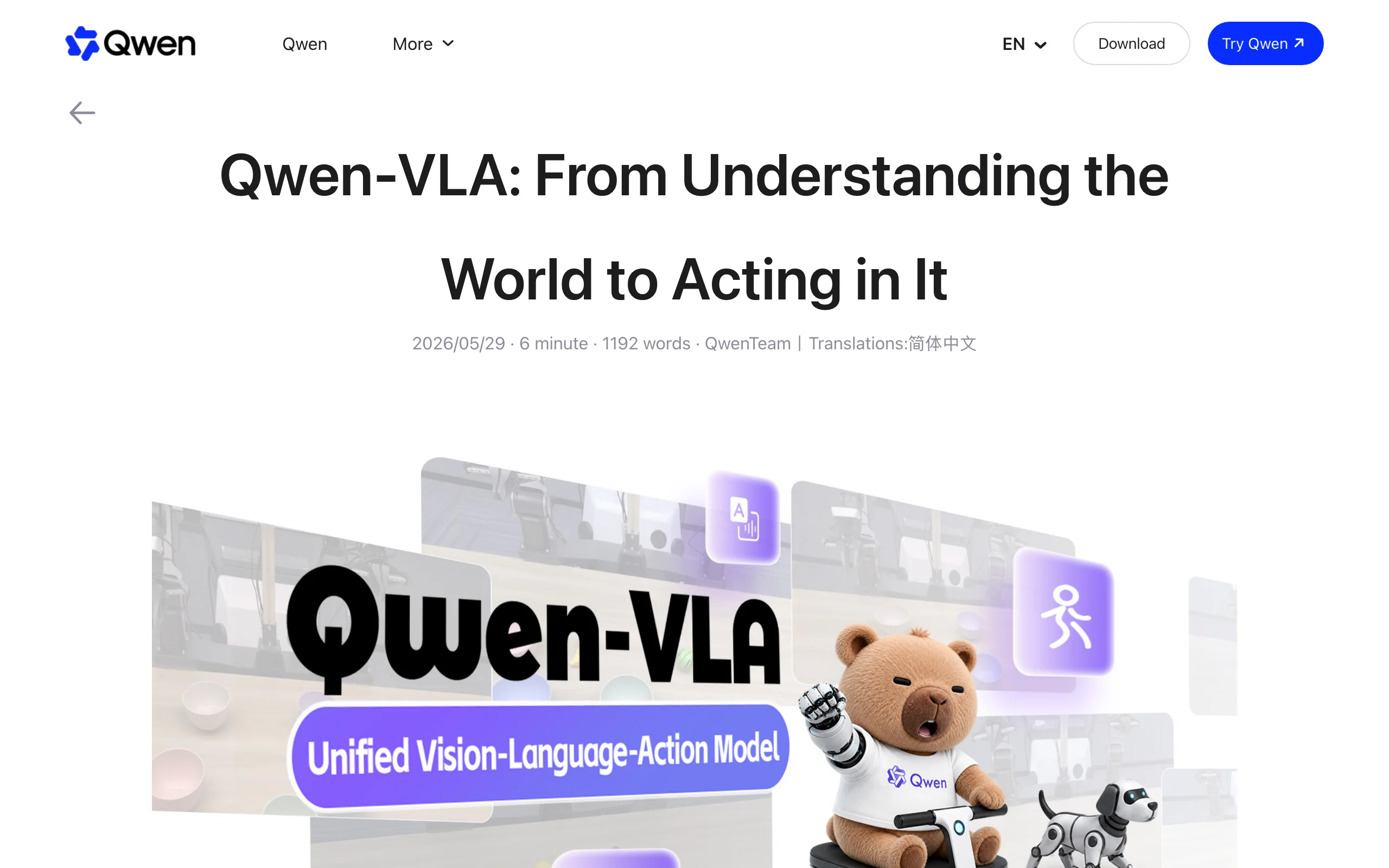
Executive Summary:
Qwen-VLA is Tongyi Lab's general vision-language-action model: Qwen3.5-4B VLM backbone plus 1.15B DiT action decoder. A unified action trajectory prediction framework merges manipulation, navigation, ...
1. What Is Qwen-VLA
Qwen-VLA is Tongyi Lab's general vision-language-action model: Qwen3.5-4B VLM backbone plus 1.15B DiT action decoder. A unified action trajectory prediction framework merges manipulation, navigation, and trajectory prediction; embodiment-aware prompt conditioning adapts 11 robot platforms by editing text alone. It beats specialized models on multiple benchmarks with 26.6% zero-shot dynamic manipulation success—pushing embodied AI from skill specialists toward general actors.
Image source: Official article
Technical positioning and domain: Embodied AI VLA for robot manipulation, navigation, and trajectory prediction. Unifies three traditionally separate tasks under one architecture with shared VLM and action decoder for cross-task transfer—breaking "one task, one model" fragmentation.
Development background: Alibaba Tongyi Lab, building on Qwen multimodal models. Motivation: poor generalization and high cross-embodiment cost of specialized models. Qwen3.5-4B visual-language strength plus DiT sequence generation yields the first true general VLA baseline.
Core value: (1) Task fragmentation—operation, navigation, prediction once required separate training/deployment without shared visual representations; (2) hardware adaptation cost—each platform needed fine-tuning or custom heads. Unified framework + text conditioning: one model, many tasks and embodiments, lower deployment and R&D cost.
Technical characteristics: Decoupled VLM + DiT; Text-to-Action (T2A) pretraining trains DiT without vision at ~1/10 multimodal cost; embodiment prompts encode hardware differences as structured text for plug-and-play cross-platform use.
2. Key Features
Cross-task unified control: One model for manipulation, navigation, trajectory prediction. Beats best specialists on 3/5 sim benchmarks (CALVIN, RLBench, MetaWorld)—shared observe-understand → predict action sequence paradigm.
Cross-embodiment plug-and-play: WidowX, Franka Panda, Mobile ALOHA, Galaxea R1, 11 platforms—single/dual arm, mobile base. Edit hardware fields in text prompts (model, DOF, control frequency)—no retrain or structural change.
Zero-shot open-world generalization: Strong OOD on unseen color, instance, position, background, instruction. Real-world average OOD success 76.9% vs. π₀.₅ 41.5% and no-pretrain 36.2%—reliable in novel environments without new data collection.
Dynamic object manipulation: Zero-shot on moving objects without dynamic training data. DOMINO 26.6% vs. PUMA 17.2%—VLM scene understanding + DiT continuous trajectories for logistics and industrial lines.
Long-horizon navigation: Task-adaptive token allocation preserves rich episode history for long instructions. VLN-CE R2R 57.5%, RxR 59.6%—beats navigation specialists.
Efficient T2A pretraining: Freeze VLM; train DiT without images for action distribution, text-action alignment, embodiment conditioning at ~1/10 multimodal cost. Best mix 20% synthetic + 80% real (71.1% success); no-image T2A beats with-image in ablations.
3. How to Use
Environment: Clone https://github.com/QwenLM/Qwen-VLA; Python 3.10+, PyTorch 2.0+, Transformers. A100 or ≥24GB GPU; ~4.5GB weights.
pip install -r requirements.txt.Embodiment prompts: Structured text e.g.
"robot_type: WidowX, arm_count: 1, joint_config: [0.0, ...], control_freq: 10Hz"—model, arms, joints, frequency.Inference: Load weights; input image(s), instruction, embodiment prompt; output action sequence (EE pose or joint angles) via robot API. Loop observe → infer → act. Example:
python run_inference.py --image_path scene.jpg --instruction "pick up the red cube" --robot_prompt "robot_type: Franka Panda".Training (advanced): T2A → CPT → SFT → RL. T2A: DiT only; CPT: multimodal; SFT: task data; RL: closed-loop optimization. Official scripts and logging tools per stage.
Platform switch: Change hardware fields in prompt only. New embodiment: 100–500 demos for light SFT. Data conversion for Robosuite, MuJoCo.
4. Pros and Cons
| Pros |
|---|
| Generality beats specialists: 3/5 sim benchmarks; unified architecture lowers multi-task deployment cost. |
| Light cross-embodiment adapt: Text prompt switch across 11 platforms; near-zero adaptation cost. |
| Efficient T2A: ~1/10 multimodal pretrain cost; no-image T2A ablation wins. |
| Strong OOD: Real-world 76.9% vs. π₀.₅ 41.5%. |
5. Comparison with Similar Tools
| Dimension | Qwen-VLA | π₀.₅ (Physical Intelligence) | RT-2 (Google DeepMind) |
|---|---|---|---|
| Architecture | Qwen3.5-4B VLM + 1.15B DiT | Flow-matching VLA; pretrained vision + Transformer | PaLM-E/PaLI-X → action tokens |
| Task unity | Manipulation + navigation + trajectory | Manipulation focus | Mostly manipulation; limited nav |
| Cross-embodiment | Text prompts; no architecture change | Per-embodiment fine-tune/heads | Per-embodiment data fine-tune |
| Platforms | 11 (WidowX, ALOHA, Franka, etc.) | Few mainstream (ALOHA, Franka) | Limited sim/real |
| Pretraining | T2A no-vision (~1/10 cost) | End-to-end multimodal | End-to-end multimodal |
| Dynamic manipulation | Zero-shot 26.6% (DOMINO) | Zero-shot 7.5% | Not public |
| OOD | Real 76.9% | 41.5% | ~50% (sim) |
| Navigation | VLN-CE R2R 57.5% | Not supported | Not supported |
| Open source | Paper + code + weights | Partial (weights closed) | Closed |
Selection advice: For operation + navigation + trajectory in one open stack with low cross-embodiment cost, Qwen-VLA is the best comprehensive choice. Fine manipulation only: π₀.₅ may edge specific benchmarks but is partially closed. Research flexibility: Octo lacks nav/dynamic ops. RT-2 strong but closed. Qwen-VLA leads on generality, openness, and cross-platform adaptation.
6. Editor's Review
Qwen-VLA is a paradigm shift in embodied AI. Unified trajectory framework proves computational isomorphism across tasks. Embodiment prompts elegantly abstract hardware without per-robot heads. T2A solves VLM-pretrained vs. DiT-from-scratch asymmetry at 1/10 cost; counterintuitively, no-image T2A wins—worth deeper study.
Deployment barrier drops: weeks/months per platform/task → edit text prompts. 76.9% OOD reduces field debugging. Audience: robotics labs, industrial integrators, university labs, embodied AI startups.
—innovation and open practicality; hardware and training complexity deduct 0.25 each. Among the most important open general VLA models today.
7. Use Cases
Multi-task industrial robots: Grasp, transport, navigate between stations under one model and switching instructions.
Service robots across scenes: Kitchen manipulation, living-room navigation, hallway trajectory planning—mode switch by scene and command.
Research/education platforms: Many robots in one lab—change prompt fields, not retrain per platform.
Dynamic environments: Conveyor package picking without dynamic-specific training data.
Long complex instructions: Museum guide multi-step tours with adaptive history tokens.
8. FAQ
Q: Hardware for inference?
A: A100 40/80GB or ≥24GB (RTX 4090). ~4.5GB weights; ~20GB peak FP16. Lower resolution or INT8 (DIY) on consumer GPUs. CPU inference impractical for DiT.
Q: Deploy on new robot?
A: Write structured embodiment prompt; test zero-shot; if needed 100–500 demos for SFT. Conversion scripts for Robosuite/MuJoCo.
Q: Chinese instructions?
A: Qwen3.5-4B supports Chinese; model can understand Chinese commands but English-heavy eval—validate on small Chinese test sets; train with Chinese instruction-action pairs to avoid language drift.
Q: Why no-image T2A works better?
A: With images in T2A, DiT may overfit vision and underlearn text-action/embodiment; no-image forces robust action priors before multimodal CPT/SFT.
Q: Training data scale?
A: T2A ~2M synthetic + 800K real trajectories; CPT/SFT ~5M multimodal demos. Scripts and public links provided; custom HDF5/JSON with image, joints, actions, instruction.
Q: Real-time control? latency?
A: A100 ~50–80 ms/frame → 10–20 Hz. Higher rates need smaller VLM or DiT distillation. ROS integration examples available.
9. Project Links
- Official blog: https://qwen.ai/blog?id=qwenvla
- GitHub: https://github.com/QwenLM/Qwen-VLA
- arXiv: https://arxiv.org/pdf/2605.30280
- Hugging Face: https://huggingface.co/Qwen/Qwen-VLA (confirm official release)
Related AI Model Articles
In-Depth Review of Longcat-2.5-preview: Meituan's Next-Generation Multimodal Long-Range Agent Model
LongCat-2.5-preview is Meituan's latest next-generation large model. Building upon the 1.6T total parameters, approximately 48B active parameters, and native 1M token context of LongCat-2.0, it marks ...
Xiaomi MiMo-V2.6 – Xiaomi's Open-Source Multimodal Model Series
Xiaomi MiMo-V2.6 is a series of fully multimodal models released and open-sourced by Xiaomi, comprising two native full-modal models: Pro and Flash. It is centered on large-scale Agentic reinforcement...
In-Depth Review of Step 5 Preview: A 600B Sparse MoE Flagship with 1M Token Context and 1/8 Cost Advantage
Step 5 Preview is a new-generation flagship foundation model launched by StepFun, designed for real-world Agentic tasks. Based on a sparse MoE architecture, the model has a total of 600B parameters bu...
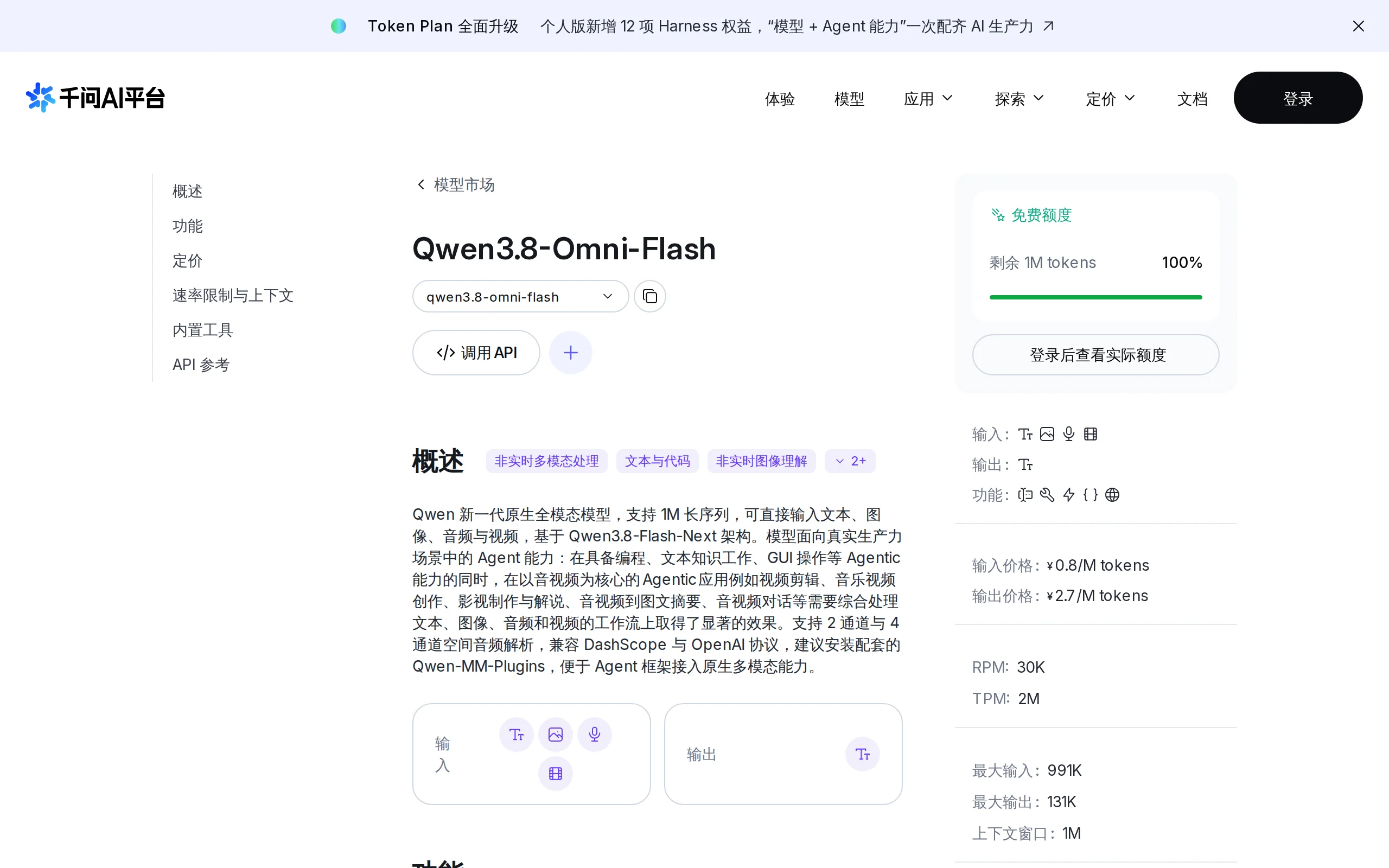
Qwen3.8-Omni-Flash – A Native Multimodal Model Launched by Alibaba Qwen
Qwen3.8-Omni-Flash is a native multimodal model launched by Alibaba Qwen. It jointly models four modalities—text, image, audio, and video—within a single architecture, supporting a context length of u...
© All Rights Reserved. Some content on this site is partially generated by AI with human review.