
In-Depth Review of Step 5 Preview: A 600B Sparse MoE Flagship with 1M Token Context and 1/8 Cost Advantage
Executive Summary:
Step 5 Preview is a new-generation flagship foundation model launched by StepFun, designed for real-world Agentic tasks. Based on a sparse MoE architecture, the model has a total of 600B parameters bu...
1. What is Step 5 Preview
Step 5 Preview is a new-generation flagship foundation model launched by StepFun, designed for real-world Agentic tasks. Based on a sparse MoE architecture, the model has a total of 600B parameters but only activates 27B parameters during each inference. It supports a super-long context window of 1 million Tokens and achieves native multimodal integration of text and vision. In the globally authoritative Artificial Analysis Intelligence Index evaluation, Step 5 Preview scored 44 points, ranking among the top three open-source models, with performance second only to GPT-6 Astra and Claude Opus 5. Its single-task cost is just 1/8 of those two models. On October 15, 2026, the full weights will be released, making it one of the few foundation models in the open-source community that combines flagship-level performance with high inference efficiency.
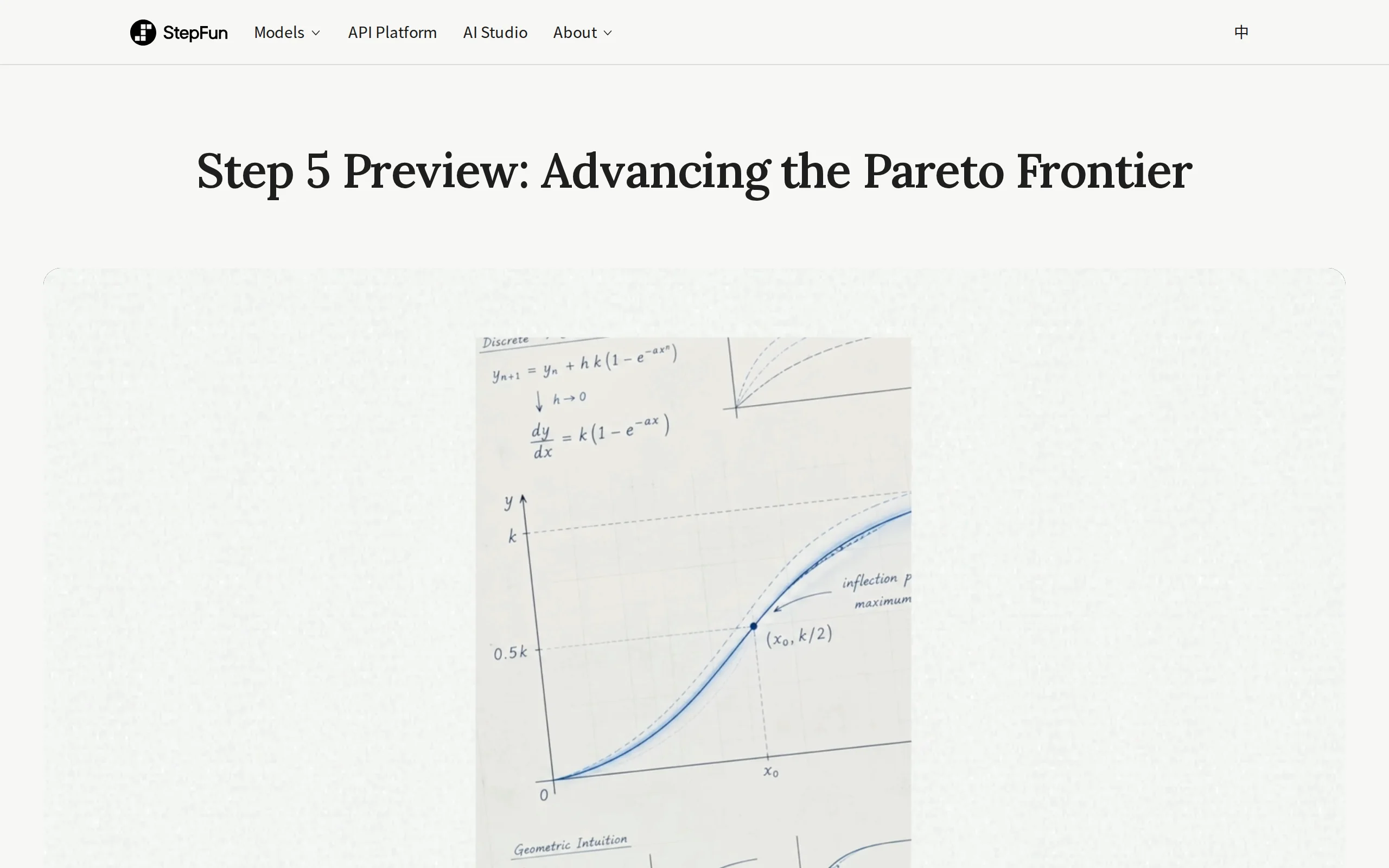
Image source: Official article
Image source: official article
Technical positioning and domain: Belongs to the field of natural language processing and multimodal AI, positioned as a general-purpose Agentic task execution engine, covering complex cross-industry scenarios such as AI programming, financial analysis, scientific research, and front-end development. Its balanced performance in the "capability–cost–efficiency" triangle is a core distinguishing feature from similar open-source flagship models.
Development background: Developed by the StepFun team, it continues the technical approach of Step 3.5 Flash. The core focus is on how to more efficiently convert computation into model capabilities, continuously pushing the Pareto frontier of capability and cost outward through architectural design.
Core value: Addresses the dual pain points of open-source models in long-term autonomous tasks: "insufficient capability" and "high cost." The model can continuously perform complex tasks within 24 hours, such as GPU kernel optimization and automated post-training data processing, while achieving a single-task cost that is only 1/8 of the closed-source flagship model Claude Opus 5. This provides enterprises and researchers with a high-performance, cost-effective Agent infrastructure.
2. Key Features
AI Programming and Software Engineering: Covers real-world development tasks such as bug fixing, feature development, and refactoring across 553 code repositories and 33 programming languages. It can also interact with real hardware devices for continuous debugging lasting over three hours, demonstrating near-professional developer task completion capabilities on benchmarks like SWE-bench.
Long-duration Autonomous Task Execution: Can continuously execute complex tasks for up to 24 hours without interruption, such as optimizing a GPU kernel from scratch up to 508 TFLOPS (surpassing Claude Opus 5's 493 TFLOPS) and automating subsequent training data workflows. This is made possible by the 1 million Token context window, which fully retains historical execution records, tool return results, and debugging feedback.
Front-end and Creative Development: Can invoke Blender to generate 3D assets and integrate them with Three.js interactive applications, enabling efficient conversion from natural language descriptions to visual interactive prototypes, significantly shortening the development cycle for designers and creative professionals.
Financial Analysis and Investment Research: Possesses three core capabilities: information retrieval and verification, enterprise valuation modeling, and the production of in-depth research reports, validated through external FrontierFinance evaluations. It can provide professional services such as financial data verification, valuation model construction, and research report generation for investment analysts.
Ultra-long Context Understanding and Tracking: Supports a 1 million Token context window, allowing continuous context tracking in long task chains and multiple tool calls to complete deliveries, effectively addressing information loss and task drift issues that traditional models face in long conversation scenarios.
Native Multimodal Fusion Processing: Processes text and visual inputs natively within the same base model. The model can understand visual information such as documents and screenshots, as well as generate and iterate visual content, providing a unified foundation for cross-modal reasoning and multimodal Agent tasks.
Hardware Device Operation and Debugging: Capable of autonomously reading device documentation and operating serial ports and cameras. It can continuously modify code based on error messages returned by real hardware until the task is completed, making it suitable for embedded development board debugging and IoT device validation scenarios.
3. How to Use
Online Experience: Access the Studio platform (Link to be updated after official release) to try out the 5 Preview version, ideal for quickly verifying model capabilities and scenario compatibility.
Domestic API Integration: Go to the Jieyu Xingchen Open Platform (Link to be updated after official release) to obtain your API Key and call the Step 5 Preview according to the official API documentation. Suitable for enterprise developers who need to integrate the model into their own business systems.
International API Integration: Overseas users can access the international version of the open platform (Link to be updated after official release) to obtain an API Key and integrate it into their applications or Agent workflows. Note that the account systems of the domestic and international platforms are not interoperable; separate registrations are required.
Configure Agent Task Parameters: When calling the API, explicitly set long context parameters (such as max_tokens and context window size) and tool calling-related configurations (tool_use parameter) to activate the model's Agentic execution mode, thereby supporting complex multi-turn tasks such as programming and financial research.
Environmental Compatibility Verification: API integration does not require local hardware, but be mindful of network latency and rate-limiting policies; if planning for local private deployment, wait until the weights are released on October 15, 2026, and then assess the multi-GPU inference cluster configuration based on the official documentation (specific hardware list to be announced by the official).
Best Practice Recommendations: For long-term tasks, break them down into phased sub-goals and use them in conjunction with the feedback loop from tool calling; in Agent scenarios, it is recommended to enable streaming output to observe the model's decision-making process in real time; in production environments, configure error retry mechanisms and task timeout interruption protection.
4. Pros and Cons Analysis
| Pros |
|---|
| Optimal Performance and Cost Balance: The Artificial Analysis Intelligence Index reaches 44 points, ranking among the top three open-source models, with a single-task cost only 1/8 that of Claude Opus 5, significantly advancing the Pareto frontier of intelligent efficiency. It is an ideal choice for agent scenarios sensitive to cost. |
| Ultra-long Context Window: Supports a context window of up to 1 million Tokens, maintaining complete historical records and continuously understanding context across multi-hour long task chains, making it suitable for complex multi-round tool calling and long document analysis scenarios. |
| Agentic Tool Calling Loop: Capable of autonomous "plan—execute—observe—correct" cycles, it can access external tools such as serial ports, cameras, and APIs, and continuously modify code until the task is completed based on the status and errors returned from the real environment. |
| Native Multimodal Fusion: Text and visual inputs are natively processed on the same base model, supporting the understanding of visual information such as documents and screenshots, as well as iterative generation of visual content, providing a unified base for cross-modal agent tasks. |
| Ability to Handle Long-term Tasks: Can continuously execute complex autonomous tasks within 24 hours, such as GPU kernel optimization (508 TFLOPS surpassing Claude Opus 5) and automated data pipelines, demonstrating persistent planning and self-correction capabilities. |
5. Comparative Analysis with Similar Tools
| Comparison Dimension | Step 5 Preview | Claude Opus 5 | GPT-6 Astra |
|---|---|---|---|
| Developer | StepFun (Step 5) | Anthropic | OpenAI |
| Model Architecture | Sparse MoE (Total 600B / Activated 27B) | Not disclosed | Not disclosed |
| Intelligence Index | 44 points (Top 3 globally in open source) | Slightly higher than Step 5 Preview | Leading |
| Single Task Cost | Baseline cost (lowest) | Approximately 8 times that of Step 5 Preview | Approximately 8 times that of Step 5 Preview |
| Context Window | 1 million Tokens | 200K Tokens | 400K Tokens (estimated) |
| Input Modalities | Native text + visual | Text + visual | Text + visual + audio |
| Long-term Agent Tasks | Supports continuous execution for 24 hours | Supports but with short duration | Not disclosed |
| Open Source Status | Full weights released on October 15, 2026 | Closed source, only API | Closed source, only API |
Selection Recommendations: For enterprise-level Agent applications that prioritize extreme inference cost efficiency and require support for ultra-long context windows, Step 5 Preview is currently the most competitive option within the open-source ecosystem, especially in fields such as financial analysis, scientific research, and hardware debugging that require long-term autonomous iteration. Its single-task cost advantage of 1/8 makes large-scale parallel Agent scheduling feasible.
For institutions with extremely high data security requirements that must deploy models in a fully private environment, DeepSeek-V3 (Apache 2.0 license) remains the optimal open-source alternative for immediate deployment during the period before the full weights of Step 5 Preview are released. If the team has sufficient budget and prioritizes the strongest global performance regardless of cost, they may consider evaluating the closed-source GPT-6 Astra and Claude Opus 5, but must accept a unit task cost difference of more than 10 times.
6. Editor's Summary
The release of Step 5 Preview marks a significant advancement in the "intelligent efficiency" dimension for open-source base models. Its core innovation lies in combining a sparse MoE architecture with a large-scale context window, integrating flagship model capabilities with ultra-low inference costs into a practical product form. With a total of 600B parameters and only 27B activated parameters, the model compresses the cost per task to one-eighth of that of closed-source competitors while maintaining high performance—this gap translates into orders of magnitude differences in overall costs when deploying at scale, offering real economic value in production environments.
From a technical evolution perspective, Step 5 Preview continues the "efficiency Scaling" approach established during the Step 3.5 Flash phase, shifting the optimization goal from purely enhancing capabilities to a multi-objective Pareto advancement of "capability—cost—efficiency." This strategy aligns with the broader industry trend of transitioning from a "parameter race" to an "efficiency race." The model's real-world performance on hard-core tasks such as GPU kernel optimization (508 TFLOPS) and post-training on AIME24 (60%, with less token consumption) also validates the feasibility of this technical path.
It's important to note rationally that the model weights are not yet open-sourced, and the ecosystem toolchain is still in its early stages. Currently, users can only experience its capabilities through the API. For development teams seeking rapid commercial integration and aiming to obtain long-context Agent capabilities at a low cost, Step 5 Preview is undoubtedly worth incorporating into their technical evaluation process as soon as possible. However, for users with a strict requirement for local deployment, further validation of deployment feasibility will need to wait until the model weights are released on October 15, 2026.
Overall, Step 5 Preview demonstrates strong practical value and a differentiated market positioning. Its future open-source ecosystem development is definitely worth keeping an eye on.
7. Application Scenarios
AI Programming and Software Development: Daily tasks such as code writing, bug detection and fixing, feature development, refactoring, and environment configuration are supported, with compatibility for 33 programming languages and real-world development needs across 553 code repositories. It can serve as the primary coding assistant model for developers. Its long context capability enables understanding and modification of multi-file codebases.
Long-term Research and Engineering Tasks: Suitable for research tasks requiring extended continuous operation and autonomous iteration, such as GPU kernel optimization, automated post-training data pipelines, and model compression. Step 5 Preview can execute tasks continuously for 24 hours and adaptively adjust strategies based on intermediate results, freeing researchers from repetitive parameter tuning work.
Hardware Development and Embedded Debugging: In IoT projects such as ESP32 development board modifications, the model can autonomously read device documentation, operate serial ports and cameras, and continuously correct code based on actual hardware error reports, significantly reducing the debugging burden for embedded developers. This capability is also applicable for rapid validation of smart hardware product prototypes.
Financial Analysis and Investment Research: Provides three types of support capabilities for investment researchers: financial information retrieval and verification, enterprise valuation modeling, and in-depth research report writing. Its usability in real financial tasks has been validated through external FrontierFinance evaluations, making it suitable for the intelligent upgrading of securities firms, funds, and corporate strategy departments.
Front-end and Creative Content Development: From web interface design and data visualization development to Blender 3D asset generation and Three.js interactive application setup, design and creative professionals can drive Step 5 Preview through natural language descriptions to complete multi-step development tasks, achieving efficient realization from inspiration to interactive prototypes.
8. FAQ
Q: What is the difference between Step 5 Preview and the previous Step 3.5 Flash?
A: Step 5 Preview is the next-generation flagship base model, with the total parameter count adjusted from the previous generation's 1T level to 600B sparse MoE (activated 27B). It expands the context window to 1 million Tokens and introduces more robust agentic tool calling capabilities. On the Intelligence Index, Step 5 Preview (44 points) is significantly higher than Step 3.5 Flash, while maintaining a low single-task cost.
Q: Does the model experience performance degradation when using the 1 million Token context window in practice?
A: According to officially published information, Step 5 Preview has been specifically optimized for ultra-long contexts at the design level, enabling it to fully retain historical execution records and maintain continuous contextual understanding in long task chains. However, specific long-context decay curves have not yet been released with independent evaluation data. It is recommended to assess performance through stress testing in real business scenarios.
Q: Does the 600B total parameter count require extremely high hardware configurations for inference?
A: Under the sparse MoE architecture, only 27B parameters are activated during each inference, so the actual memory and computational power consumption is much lower than that of a 600B dense model. However, during the current phase where weights are not yet open, inference is provided via the Jieyue Cloud platform, and users do not need to prepare their own hardware. Once the weights are released on October 15, 2026, specific hardware requirements for local deployment should be referenced from the official deployment documentation.
Q: Is Step 5 Preview suitable for enterprise private deployment?
A: Not currently. Weights are not yet available, and the model can only be accessed via API, with related data processed through the Jieyue Cloud platform. For enterprises with strict data security requirements, it is recommended to monitor the deployment feasibility assessment after the weights are open-sourced on October 15, 2026, or consider open-source alternatives such as DeepSeek-V3 that have already released their weights.
Q: Has the model's financial analysis capability been professionally certified?
A: The financial analysis capability of Step 5 Preview covers three categories: information retrieval and verification, enterprise valuation modeling, and the production of in-depth research reports. It has been validated by external evaluation agency FrontierFinance. However, this validation is conducted by a third-party evaluation institution and does not constitute official certification by financial regulatory authorities. In practical applications, final review by professional personnel is still required.
9. Project Links
- Product Official Website: https://www.stepfun.com/step-5-preview
- Studio Experience Platform: https://studio.stepfun.com/
- Domestic API Open Platform: https://platform.stepfun.com/
- Overseas API Open Platform: https://platform.stepfun.ai/
Related AI Model Articles
Review of DeepSeek Harness Desktop: How the Official GUI Client Lowers the Bar for Agent Usage
DeepSeek Harness Desktop is the official graphical client launched by DeepSeek, designed to provide a visual interface for the originally command-line-based DeepSeek Harness framework. After users log...
Step Code – In-Depth Review of StepFun's Open-Source Terminal Programming Agent
Step Code is an open-source terminal programming agent launched by StepFun, licensed under the MIT License, which allows developers to complete the full workflow of code writing, debugging, execution,...
In-Depth Review of Claude Opus 5.5: A Revolution in Programming Efficiency and Safety for Anthropic's Flagship Model
Claude Opus 5.5 is the first flagship model in Anthropic's Claude 5.5 series, launched in June 2026. It is positioned as a high-end AI model designed for enterprise-level agent programming, complex kn...
In-Depth Review of GPT-6 Sol: A Cost-Effective Revolution in OpenAI's Mid-to-High-End Large Model
GPT-6 Sol is a mid-to-high-end large model introduced by OpenAI, derived from the GPT-6 Astra base model. It brings Astra's reasoning, programming, factual accuracy, and Agent capabilities down to a m...
© All Rights Reserved. Some content on this site is partially generated by AI with human review.