
MaineCoon – Real-Time Audio-Visual World Model Built for Social Interaction
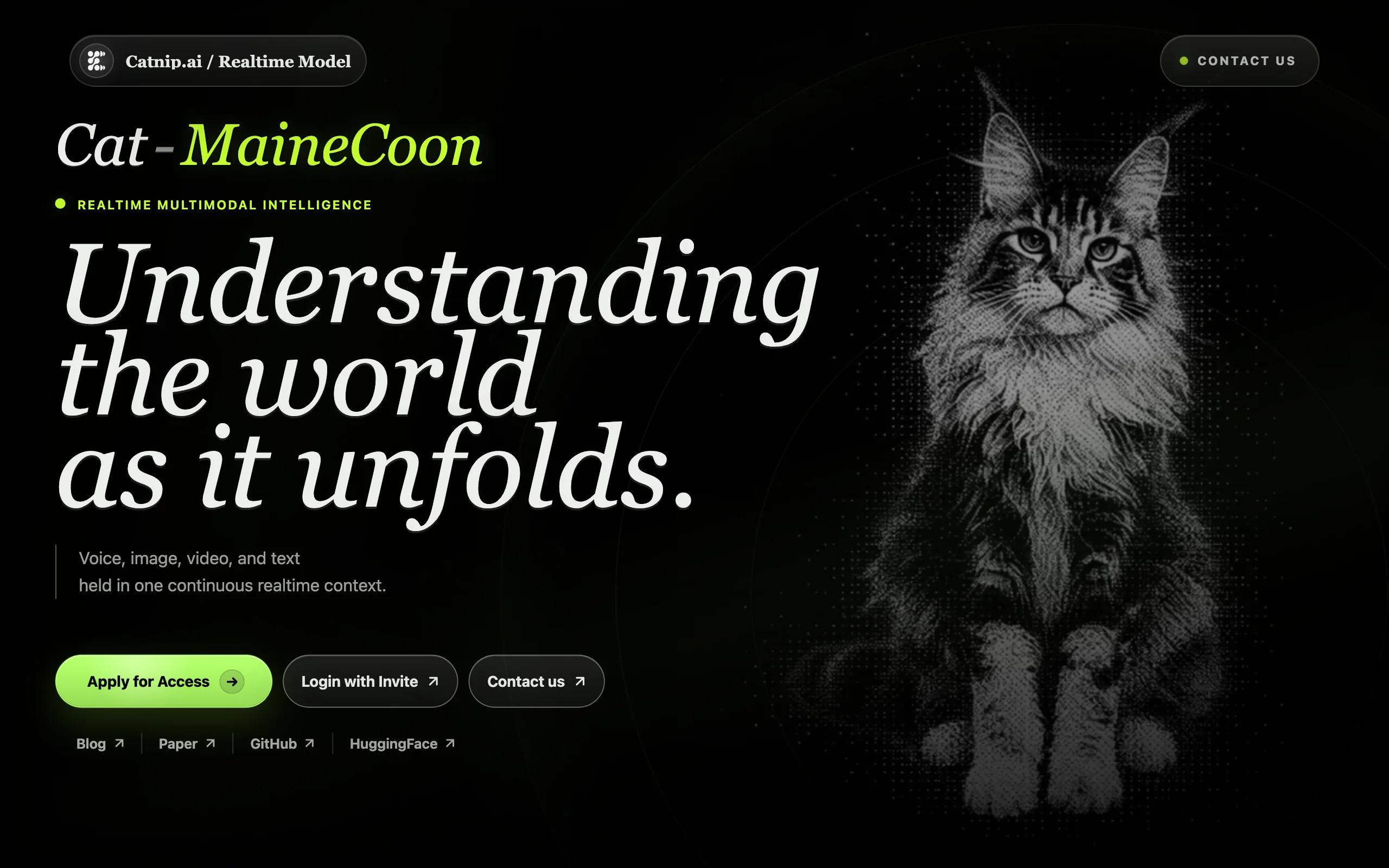
Executive Summary:
MaineCoon is the world’s first real-time audio-visual autoregressive world model optimized for social interaction scenarios. With 22 billion parameters, it delivers 47.5 FPS streaming generation on a ...
1. What Is MaineCoon
MaineCoon is the world’s first real-time audio-visual autoregressive world model optimized for social interaction scenarios. With 22 billion parameters, it delivers 47.5 FPS streaming generation on a single GPU, supporting sub-second interactive response and continuous audio-visual output lasting thousands of seconds. Unlike traditional world models focused on physical environment simulation or game exploration, MaineCoon is the first to orient the world-model paradigm toward human-centered social dynamics. Through innovations such as self-resampling, cross-modal representation alignment, and domain-aware preference optimization, it lays a critical foundation for the next generation of AI-native social platforms.
Image source: Official article
Technical positioning and domain: MaineCoon belongs to the multimodal autoregressive world model category, with core applications in real-time audio-visual social interaction. While models like Genie and VideoWorld emphasize physical environment simulation or game exploration, MaineCoon targets the largely unaddressed domain of human-to-human social interaction. It achieves breakthrough fidelity in facial expressions, tone, and conversational logic, filling a major gap in world-model applications for social scenarios.
Research background: MaineCoon was developed by the Catnip AI Tech team, which has long focused on multimodal interaction and real-time generation. The motivation came from a clear gap in existing AI social platforms: they lack underlying models with real-time perception and generation capabilities. Traditional approaches rely on pre-rendered animation or text-driven pipelines and cannot deliver truly dynamic audio-visual interaction. Through an autoregressive architecture and streaming inference framework, MaineCoon introduces real-time world-model generation into social settings for the first time, providing a technical foundation for digital humans, virtual companions, and related applications.
Core value: MaineCoon addresses three critical challenges: real-time audio-visual generation in social contexts (sub-second latency), semantic and visual consistency over long interactions (thousands of seconds without drift), and synchronized multimodal joint modeling (cross-modal representation alignment). Its value lies in upgrading the world model from an “environment simulator” to a “social interaction engine,” enabling AI to perceive, generate, and respond to social signals in real time much like humans do, and dramatically lowering the technical barrier to building AI-native social platforms.
Technical characteristics: MaineCoon’s core advantages include 47.5 FPS real-time streaming generation on a single GPU, making deployment feasible on consumer hardware; cross-modal representation alignment for precise audio-visual synchronization; a Self-Resampling mechanism that reduces reliance on labeled data and improves training efficiency; and Domain-Aware Preference Optimization for social-scene preference alignment, enhancing the realism of human interaction. Together, these capabilities give MaineCoon a clear edge in real-time performance, consistency, and scenario fit over comparable models.
2. Key Features
Real-time audio-visual streaming generation: Delivers 47.5 FPS high-frame-rate output on a single GPU, supporting low-latency continuous real-time audio-visual content generation. This provides a smooth visual and auditory experience for social interaction, allowing dialogue, facial expression changes, and action feedback between users and AI characters to flow seamlessly with sub-second latency.
Cross-modal audio-visual joint modeling: Cross-modal representation alignment connects audio and visual modalities to simulate social scenes with synchronized sound and picture. The model processes speech tone, facial expressions, body movement, and other dimensions simultaneously, ensuring lip sync with speech and emotional consistency with tone during generation, significantly improving interaction realism.
Ultra-long temporal consistency generation: Supports continuous audio-visual generation beyond thousands of seconds, effectively mitigating visual drift and semantic breaks in long videos. Using ROPD (Reinforcement Online Policy Distillation) and an agentic streaming inference framework, the model maintains character identity, scene background, and conversational logic over extended interactions, avoiding common long-sequence degradation.
Agentic caching and prompt planning: Built-in Agentic Streaming Inference Framework manages historical interaction context through agentic caching and combines prompt planning to optimize stability and coherence in long-form generation. This allows the model to reference prior information during ongoing dialogue, delivering human-like memory and context awareness.
Social-scene specialized optimization: Domain-Aware Preference Optimization aligns preferences for social interaction, improving realism in facial expressions, tone, and conversational logic. Training incorporates large-scale social dialogue data with reinforcement on politeness, emotional expression, and social etiquette, making AI characters feel more natural.
Sub-second interactive response: Designed for real-time social scenarios, user input receives model feedback within sub-second latency, meeting instant interaction needs. This is enabled by streaming inference optimization in the autoregressive architecture and efficient single-GPU deployment, making turn-taking in virtual social settings feel nearly delay-free.
Efficient training mechanisms: Self-Resampling and ROPD (Reinforcement Online Policy Distillation) significantly improve training efficiency and accelerate convergence. Self-resampling dynamically adjusts training data distribution to reduce dependence on manually labeled data, while ROPD efficiently transfers reinforcement learning signals to the generative model, substantially shortening training cycles.
3. How to Use
Apply for closed beta on the official site: Visit the MaineCoon website at https://mainecoon.tech/ to apply for closed beta access. The site provides the latest paper, demo videos, and technical documentation—the primary entry point for understanding capabilities and obtaining access. Beta applications typically require a use-case description; once approved, you receive an API key or local inference package.
Read the arXiv paper for technical details: Review the paper MaineCoon: Real-Time Audio-Visual Social World Model (link to be updated upon official release) to understand Self-Resampling, ROPD, cross-modal representation alignment, Domain-Aware Preference Optimization, and related principles—the foundation for developer and researcher secondary development.
Follow the GitHub repository for open-source progress: Visit https://github.com/catnip-ai-tech/MaineCoon to track plans for open-sourcing code and model weights. The project is currently at the paper-release stage; full inference code and weights are not yet open, but the repository is established and expected to release incrementally. Star the repo and enable notifications for updates.
Prepare hardware environment: According to the paper, real-time inference runs on a single GPU. We recommend an NVIDIA RTX 4090 or equivalent with at least 24GB VRAM. Despite 22B parameters, quantization and streaming inference optimization allow consumer GPUs to reach 47.5 FPS. Use Linux (Ubuntu 22.04 or later) with CUDA 12.0+ drivers.
Wait for official inference interface release: The project is currently at the paper-release stage; full inference code and weights are not yet open. Monitor GitHub and the official site for announcements. Once released, you can typically install dependencies via pip and launch services via CLI or Python API.
Join community discussion and feedback: Use GitHub Issues or channels on the project homepage to discuss use cases and optimization suggestions with the team and community. Community participation helps you pick up tips, resolve deployment issues, and stay current—useful for fast onboarding after open release.
4. Pros and Cons
| Pros |
|---|
| First-of-its-kind social focus: The world’s first world model centered on human-to-human social interaction, filling a gap left by Genie, VideoWorld, and similar models, and providing a dedicated foundation for AI-native social platforms. |
| Extreme real-time performance: 47.5 FPS plus sub-second latency on a single GPU lowers deployment cost and compute requirements compared with TPU-dependent Genie 3. |
| Long-form generation without drift: ROPD and the agentic streaming inference framework enable thousands of seconds of continuous generation without obvious visual or semantic drift, addressing a common long-sequence failure mode in video generation. |
| Improved training efficiency: Self-Resampling significantly reduces dependence on massive labeled datasets and accelerates convergence, making 22B-parameter training feasible under limited compute. |
| Strong cross-modal alignment: Cross-modal representation alignment achieves precise audio-visual synchronization, with better sound-picture consistency than many single-modality or weakly aligned models. |
5. Comparison with Similar Tools
| Dimension | MaineCoon | Google DeepMind Genie 3 | VideoWorld |
|---|---|---|---|
| Positioning | Real-time audio-visual social world model | General real-time interactive world model | Pure visual world model |
| Real-time interaction | ✅ 47.5 FPS, sub-second latency | ✅ 24 FPS, real-time navigation | ❌ Non-real-time, offline inference |
| Modality support | Joint audio + video generation | Primarily 3D visual environments | Pure vision (video frame prediction) |
| Scenario focus | Social interaction, human dialogue | Physical environments, game exploration, robot training | General visual environment understanding |
| Generation duration | Thousands of seconds continuous | Minutes of consistency | Minute-level video prediction |
| Resolution | Not specified in paper | 720p | Not specified in paper |
| Open-source status | GitHub repo established, code pending | Research preview, limited access | Paper published, partial code open |
| Compute requirements | Single-GPU real-time inference (RTX 4090) | TPU network, high compute | Medium GPU cluster |
| Core advantage | Social-scene optimization, audio-visual sync | Physical consistency, promptable world events | Pure visual understanding, environment dynamics |
Selection guidance: If you are building AI-native social platforms, virtual companions, or real-time interactive live streaming centered on people, MaineCoon is currently the only model optimized for this use case with real-time audio-visual generation—47.5 FPS and sub-second latency are unmatched for real-time performance. Note it remains at the paper stage with uncertain open-source timing, best suited for technical pre-research or closed beta.
For physical environment simulation, game exploration, or robot training, Google DeepMind Genie 3 remains the more mature choice with physical consistency, promptable world events, and 720p resolution, though compute demands are higher (TPU-dependent). VideoWorld suits general visual understanding without audio but lacks real-time interaction. DIAMOND fits the RL research community with full open source and tight RL integration, but generation quality and duration are limited.
6. Editor's Take
MaineCoon stands out for technical innovation. It is the first to shift world models from physical environments to social interaction—a directional breakthrough with milestone significance. Self-Resampling reduces training data dependence; ROPD addresses long-form drift; cross-modal alignment achieves precise audio-visual sync—these are original designs for social scenarios, not mere hyperparameter tuning. Running 22B parameters at 47.5 FPS on one GPU also reflects serious engineering optimization.
In practical terms, MaineCoon directly serves the fast-growing AI-native social platform market. Virtual companions, digital-human live streaming, and AI social apps struggle with real-time performance and realism—MaineCoon’s sub-second response, thousand-second consistency, and audio-visual sync hit those pain points. Once open-sourced, it could become foundational infrastructure for next-generation social apps. Today, with only the paper released and no full inference code or weights, practical value is mainly for validation and research.
The audience is clear: AI social product developers, digital-human researchers, and multimodal generation academic teams benefit most. Casual users and light developers cannot use it yet—worth watching until open release.
Long-term potential is strong. As social metaverse, virtual humans, and real-time interactive AI heat up, the “social world model” track MaineCoon opens may become the next hot area. If the team open-sources soon, builds community, and improves resolution and diversity, it could become a benchmark in the space.
Basis: full marks for innovation (5/5), minus one for limited practical value before open source (closed beta only), minus one for immature ecosystem (community and toolchain). Strong long-term potential—worth following closely.
7. Use Cases
AI-native social platforms: Build virtual social spaces with real-time interaction where users have natural audio-visual dialogue with AI characters. 47.5 FPS streaming and sub-second response let AI read expressions and tone and respond appropriately for immersive social experiences. Platforms can generate multi-character dialogue scenes and support custom AI partner appearance and personality.
Virtual companions and digital humans: Create virtual partners or customer-service avatars with realistic emotional feedback, tone variation, and expression-driven behavior. Cross-modal alignment keeps lip sync and facial expression aligned with speech; domain-aware preference optimization improves natural emotional expression—for mental health companionship, elder social support, brand virtual spokespeople, and more.
Real-time interactive live streaming: Streamers drive virtual avatars with real-time audio-visual interaction, lowering production cost. MaineCoon generates voice, expression, and motion in real time from text or simple commands for 24/7 streams—e-commerce, entertainment, education, and similar scenarios.
Social skills training simulation: Provide safe AI-simulated dialogue for people with social anxiety or sales training. MaineCoon generates varied social scenarios (job interviews, negotiations, casual chat) with different AI personalities. Users practice repeatedly without pressure; preference optimization adjusts difficulty and feedback.
Remote collaboration and virtual meetings: Generate immersive virtual meeting rooms where participants interact via AI-enhanced avatars in real-time audio-visual communication. Personalized digital twins with voice-driven expression and motion improve presence and efficiency—cross-border teams, online seminars, and more.
Education and language learning: Create real-time interactive virtual language partners simulating authentic dialogue and pronunciation correction. MaineCoon can play native speakers in multiple languages, adjusting speed, vocabulary, and topics to learner level, with synchronized audio-visual feedback on pronunciation, intonation, and expression.
8. FAQ
Q: Does MaineCoon require an internet connection?
A: During closed beta, use is via API key from the official site and requires connectivity. After open release, weights can be deployed locally on a single GPU for offline use. Local deployment needs suitable hardware (NVIDIA RTX 4090 or better, 24GB VRAM).
Q: Can MaineCoon generate Chinese social dialogue?
A: The paper does not clearly describe training language distribution. Architecturally, autoregressive models support multilingual generation, but social preference optimization may rely mainly on English data. Chinese realism may lag English until Chinese fine-tuning or domain adaptation. Test Chinese during beta.
Q: How does MaineCoon differ from Sora, Runway, and similar video models?
A: Sora and Runway are text-to-video models focused on creative production, not real-time interaction, and typically offline generation. MaineCoon is a real-time world model for interactive scenarios with instant audio-visual feedback and cross-modal joint modeling. Different positioning entirely.
Q: What is MaineCoon’s output resolution?
A: The paper does not specify resolution—a current information gap. Given single-GPU 47.5 FPS real-time inference, resolution is likely low to medium (e.g., 512×512 or 720p). Await official release or further paper details.
Q: How do I get MaineCoon closed-beta access?
A: Visit https://mainecoon.tech/ and submit the beta application. You typically provide org/personal background, use case, and intended purpose. Review often takes one to two weeks; approval sends API key and documentation by email.
Q: Does MaineCoon support custom character appearance?
A: The architecture uses prompts to control generation; in theory, character description, reference images, or voice samples can customize roles. Specific APIs need closed-beta or open-source validation—the paper does not detail API design yet.
9. Project Links
- Official site: https://mainecoon.tech/
- GitHub: https://github.com/catnip-ai-tech/MaineCoon
- arXiv paper: https://arxiv.org/pdf/2606.17800
Related AI Model Articles
In-Depth Review of Longcat-2.5-preview: Meituan's Next-Generation Multimodal Long-Range Agent Model
LongCat-2.5-preview is Meituan's latest next-generation large model. Building upon the 1.6T total parameters, approximately 48B active parameters, and native 1M token context of LongCat-2.0, it marks ...
Xiaomi MiMo-V2.6 – Xiaomi's Open-Source Multimodal Model Series
Xiaomi MiMo-V2.6 is a series of fully multimodal models released and open-sourced by Xiaomi, comprising two native full-modal models: Pro and Flash. It is centered on large-scale Agentic reinforcement...
In-Depth Review of Step 5 Preview: A 600B Sparse MoE Flagship with 1M Token Context and 1/8 Cost Advantage
Step 5 Preview is a new-generation flagship foundation model launched by StepFun, designed for real-world Agentic tasks. Based on a sparse MoE architecture, the model has a total of 600B parameters bu...
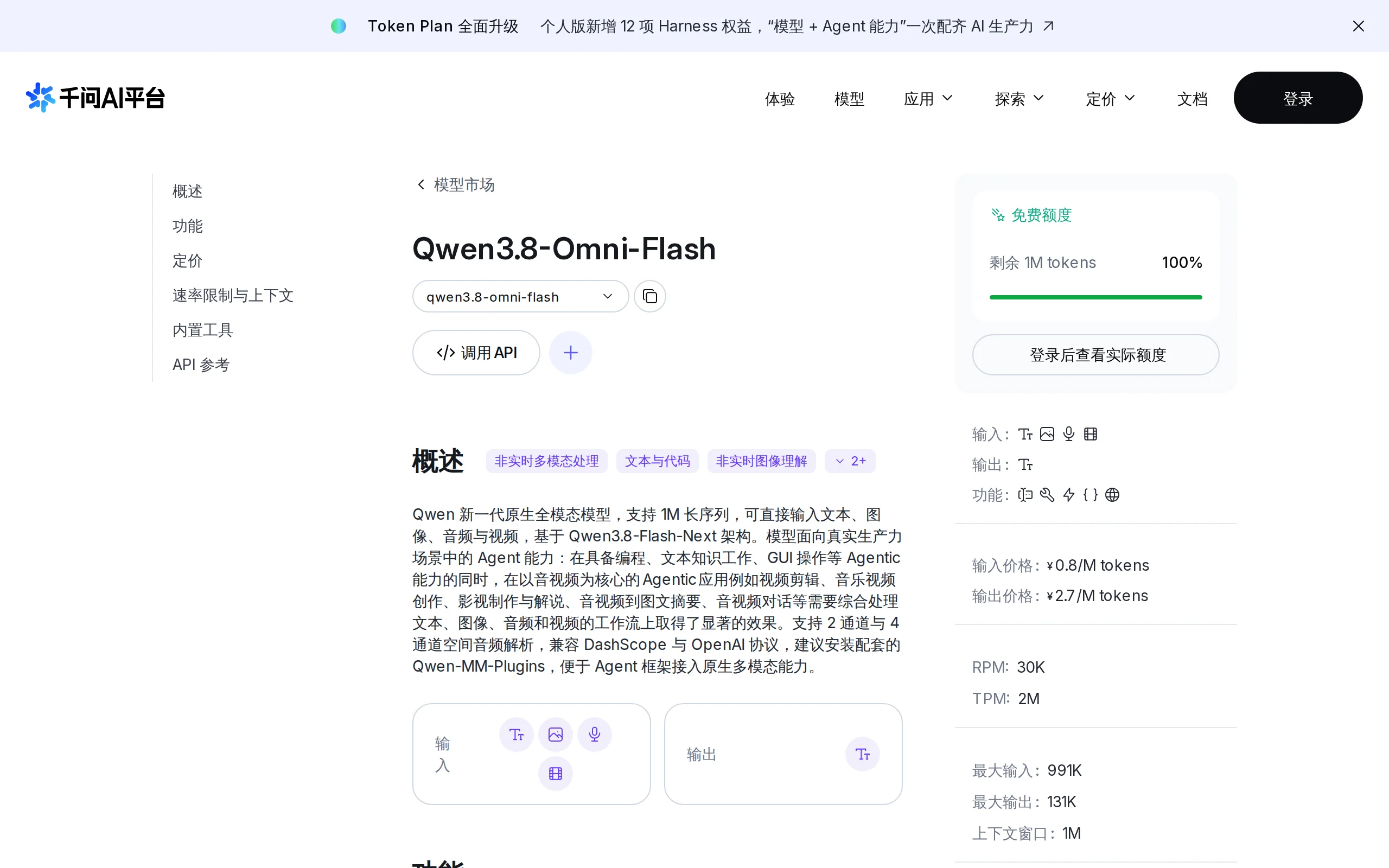
Qwen3.8-Omni-Flash – A Native Multimodal Model Launched by Alibaba Qwen
Qwen3.8-Omni-Flash is a native multimodal model launched by Alibaba Qwen. It jointly models four modalities—text, image, audio, and video—within a single architecture, supporting a context length of u...
© All Rights Reserved. Some content on this site is partially generated by AI with human review.