
MAI-Voice-2 – Microsoft's Next-Generation Text-to-Speech Model
Executive Summary:
MAI-Voice-2 is Microsoft's next-generation text-to-speech (TTS) model launched in June 2026, built on a proprietary speech foundation architecture. It delivers a generational leap in fidelity, languag...
1. What Is MAI-Voice-2
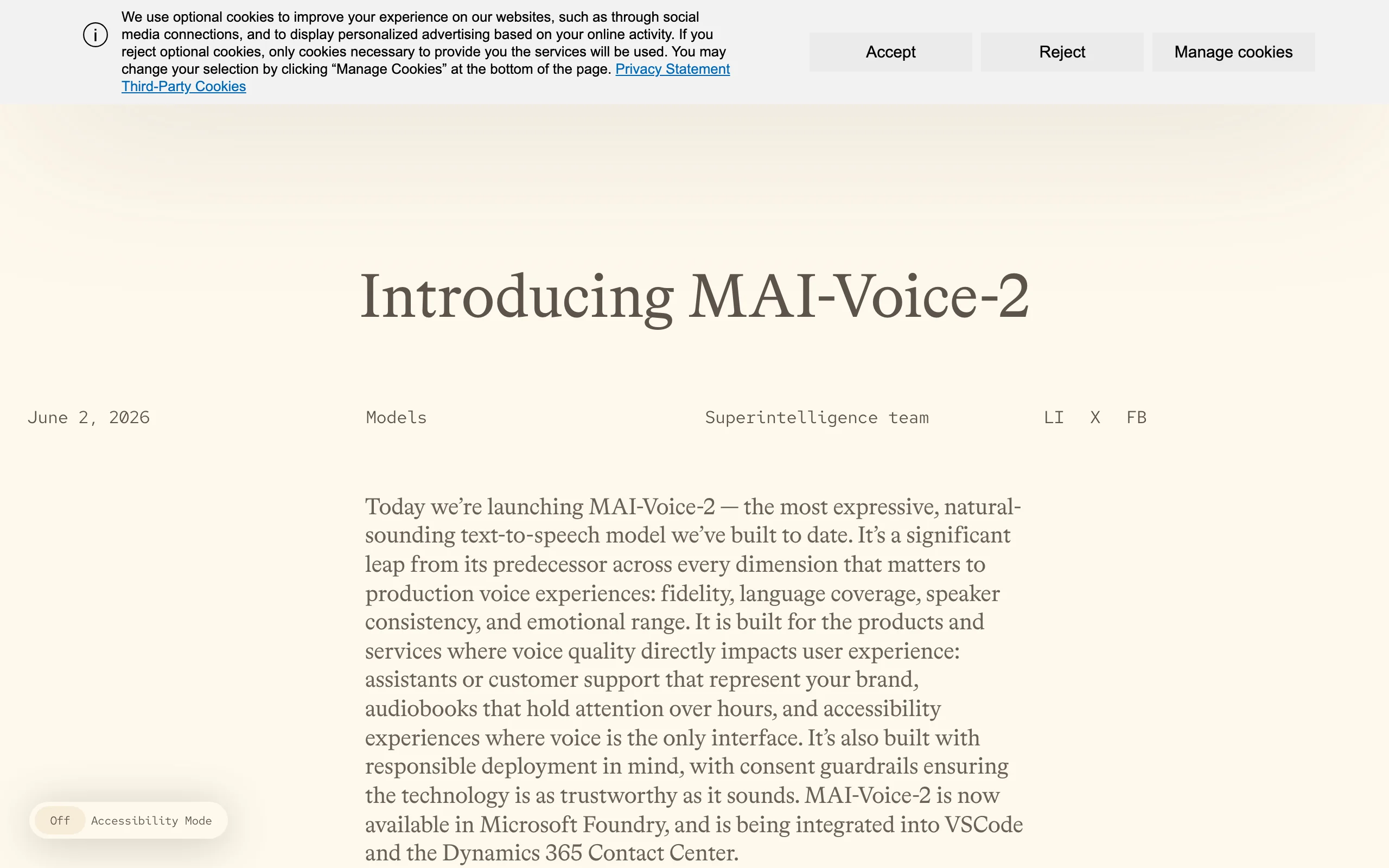
MAI-Voice-2 is Microsoft's next-generation text-to-speech (TTS) model launched in June 2026, built on a proprietary speech foundation architecture. It delivers a generational leap in fidelity, language coverage, speaker consistency, and emotional expressiveness. Supporting 15+ languages with fine-grained emotion control, zero-shot voice cloning, and natural code-switching, 72% of listeners in blind tests preferred its audio quality over the previous generation, with synthetic speech reaching near-indistinguishable similarity to human recordings. As a core component of Microsoft's AI speech stack, MAI-Voice-2 targets enterprise applications and content creation with highly natural, controllable, and secure speech synthesis.
Image source: Official article
Technical positioning and domain: MAI-Voice-2 belongs to neural text-to-speech within natural language processing, positioned as a multilingual, high-expressiveness end-to-end TTS model. Unlike concatenative or parametric synthesis, it uses a proprietary foundation architecture to extract semantic, emotional, and prosodic features from text and generate highly human-like speech.
Research background: Microsoft Research and Azure AI have deep speech expertise; Azure Neural HD voices are widely used commercially. MAI-Voice-2 is a major upgrade addressing prior limitations in language coverage, emotional control granularity, long-text stability, and market demand for zero-shot cloning and code-switching.
Core value: The model solves inconsistent naturalness across languages in multilingual TTS through unified modeling so 15+ languages reach English-level quality. Zero-shot voice cloning lowers custom voice cost (only 5–60 seconds of audio required), while system-level mandatory consent mechanisms reduce voice misuse risk, balancing innovation and compliance.
Technical characteristics: End-to-end architecture adapts tone and emotion without manual tuning; unified multilingual modeling optimized for different phonological systems; zero-shot cloning via Voice Prompting preserving timbre and prosody; fine-grained SSML emotion tags supporting sadness, whisper, excitement, and more.
2. Key Features
Multilingual natural synthesis: Expanded from English-only to 15+ languages including tonal (Chinese), pitch-accent (Japanese), stress-timed (English), and syllable-timed (Spanish) languages. Deep phonological optimization ensures comparable naturalness and expressiveness across languages without switching models.
Fine-grained emotion control: SSML tags support precise control of sadness, whisper, excitement, confusion, anger, and more. Developers embed emotion tags in text; the model adjusts pitch, speed, and timbre for smooth transitions from calm narration to emotional delivery—ideal for audiobooks and film dubbing.
Zero-shot voice cloning (Voice Prompting): Extract speaker identity from only 5–60 seconds of reference audio and transfer to any target language. Reference encoder extracts speaker embedding to preserve timbre, tone, and prosody without per-speaker fine-tuning or retraining—greatly lowering brand voice customization barrier.
Speaker identity stability: Maintains consistent speaker characteristics over hours of long content (audiobooks, podcasts, lectures) without timbre drift or sudden tone shifts—enabled by internal attention and long-context modeling for coherent narration.
Natural code-switching: Supports in-sentence mixing such as Hindi-English and Spanish-English without losing prosody or identity consistency. The model recognizes language boundaries and adjusts pronunciation for bilingual-native fluency—valuable for multilingual market localization.
Character style performance: Supports preset roles such as motivational coach, sports commentator, and news anchor. Developers use role prompts or custom parameters to match scene tone, pacing, and emotion without extensive manual tuning.
3. How to Use
Environment requirements: Access MAI-Voice-2 through Microsoft Azure Foundry; no local deployment hardware required. Azure subscription and MAI-Voice-2 API service required. Python 3.8+ with REST API or Azure SDK recommended. Voice cloning requires additional authorization; production allows only permitted voices.
Core workflow: Create MAI-Voice-2 resource in Azure Foundry and obtain API key and endpoint. Send synthesis requests via HTTP POST with text, voice ID (preset or custom), language code, and optional emotion tags. Example:
import requests
headers = {"Ocp-Apim-Subscription-Key": "YOUR_KEY"}
body = {
    "text": "The weather is beautiful today. Let's go for a walk.",
    "voice": "zh-CN-XiaoxiaoNeural",
    "style": "cheerful"
}
response = requests.post("https://your-endpoint.cognitiveservices.azure.com/...", headers=headers, json=body)
Key configuration: Emotion control uses SSML such as
<mstts:express-as style="sad">. For cloning, upload 5–60 seconds of reference audio (16 kHz mono WAV or MP3); the system generates a voice model ID for later synthesis. Code-switching works by mixing languages in text; optional<lang xml:lang="en">tags improve results.Notes and best practices: Voice cloning requires authorization; unauthorized voices cannot be used in production—apply early. Split long text into segments (≤10 minutes each) to avoid API timeout. Match emotion tags to content. Free tier available for testing; standard tier recommended for production concurrency and stability.
4. Pros and Cons
| Pros |
|---|
| Leading audio quality: 72% blind-test preference over prior generation; synthetic speech nearly indistinguishable from human recordings at top industry naturalness. |
| Convenient zero-shot cloning: Only 5–60 seconds of audio needed without fine-tuning, greatly lowering brand voice customization cost. |
| Excellent long-text stability: Consistent speaker and quality over hours of audiobooks/podcasts without timbre drift. |
| Strong security compliance: System-level mandatory consent; unauthorized voices blocked in production, meeting enterprise compliance needs. |
5. Comparison with Similar Tools
| Dimension | MAI-Voice-2 (Microsoft) | Google Gemini 3.1 Flash TTS | ElevenLabs TTS |
|---|---|---|---|
| Core architecture | Proprietary end-to-end speech foundation; unified multilingual modeling | Gemini multimodal speech module | Proprietary deep learning; cloning + emotion |
| Language support | 15+ with code-switching (Hindi-English, Spanish-English) | 70+ broadest coverage | 29 languages; multilingual cloning |
| Emotion control | Fine-grained SSML (sad, whisper, excited, etc.) | 200+ inline audio tags ([sigh], [laughing]); NL prompts | Emotion slider 0–100; preset styles |
| Voice cloning | ✅ 5–60 sec zero-shot; all languages; authorization required | ❌ Not supported | ✅ High quality; paid Professional+ |
| Multi-speaker | ❌ No native multi-person dialogue | ✅ Native 2-speaker in one API call | ✅ Manual stitch / project features |
| Long-text stability | Optimized for audiobooks/podcasts; hours stable | May drift after minutes; chunking recommended | Good but drift reports exist |
| Security/compliance | Mandatory consent; unauthorized voices blocked | SynthID watermark; terms-based | Voice verification; no hard block |
| Deployment | Azure Foundry cloud API | Google Cloud API | Cloud API + partial local SDK |
| Pricing | Per-character; free tier | Per-character; free tier | Per-character; no free tier |
Selection advice: Choose Google Gemini Flash TTS for broad language coverage (especially low-resource) without cloning. Choose MAI-Voice-2 for high-quality cloning and long-text stability if you accept fewer languages and authorization workflow. ElevenLabs excels at clone quality and emotion but costs more with limited free tier. OpenAI TTS suits simple high-naturalness tasks without emotion control or cloning.
6. Editor's Review
MAI-Voice-2 represents Microsoft's latest speech synthesis achievement. Innovation spans three layers: holistic end-to-end text-to-speech understanding without manual prosody tuning; unified multilingual modeling giving 15+ languages English-level naturalness; and zero-shot cloning paired with mandatory consent—a reusable commercial pattern balancing access and safety.
Practical value is strong in audiobooks, podcasts, contact centers, and game dubbing—especially long-text stability and emotion control boosting content production efficiency. Cloning lets smaller teams build brand voices without professional studios.
Best for enterprise dev teams, content creators, game developers, and accessibility tool builders. Authorization workflow and cloud dependency may block some users.
Future potential includes expansion toward 40+ languages, native multi-speaker dialogue, and possible offline options; security mechanisms may influence industry standards.
7. Use Cases
Smart assistants and contact centers: Brand-exclusive voices for Copilot, virtual agents, and devices via cloning and emotion control for empathetic responses—calm professional tone for banking, energetic tone for entertainment assistants.
Audiobooks and podcasts: Convert text to high-quality long-form audio without studios; long-text stability supports hours of consistent narration; emotion tags control story pacing.
Game and AR/VR dubbing: Multilingual multi-style voices for NPCs and narration via role performance—fast character voice generation at lower cost.
Accessibility: High-naturalness reading for visually impaired users; cloning lets speech-impaired users communicate with authorized personal voices.
Online education: Course and simulation voices with code-switching for bilingual teaching and engaging emotional delivery.
8. FAQ
Q: Which languages does MAI-Voice-2 support?
A: 15+ including English, Mandarin Chinese, Japanese, Korean, Spanish, French, German, Italian, Portuguese, Russian, Arabic, Hindi, and more. Microsoft plans further expansion especially for low-resource languages.
Q: How much reference audio is needed for cloning? Quality requirements?
A: 5–60 seconds, preferably 16 kHz mono WAV or MP3, clear without background noise. Longer references improve stability; 60 seconds already yields excellent results. Phone recording is acceptable.
Q: How is voice cloning authorized?
A: Submit authorization in Azure Foundry; after approval you receive a voice model ID. Production allows only licensed voices; unauthorized voices cannot be used commercially. Limited trial quota in test phase.
Q: Can MAI-Voice-2 run locally?
A: Currently Azure Foundry cloud API only. Microsoft provides encryption and compliance certifications but not full offline use.
Q: How does code-switching work (e.g., Chinese-English mix)?
A: Mix languages directly in text; the model detects boundaries and switches pronunciation. Use <lang xml:lang="en"> tags for best results.
Q: Long-text character limits?
A: Single request recommended ≤10 minutes audio (~5000 characters). For full audiobooks, synthesize in segments; speaker consistency holds within and across stitched segments.
Q: Which emotion tags are available?
A: Sad, whisper, excited, confused, angry, calm, serious, humorous, and more. Use SSML <mstts:express-as style="sad"> or API style parameter. Match emotion to content for natural results.
9. Project Links
- Official announcement: https://microsoft.ai/news/mai-voice-2expressive-speech-in-10-languages/
- Azure Foundry documentation: https://learn.microsoft.com/en-us/azure/ai-services/speech-service/ (search "MAI-Voice-2")
Related AI Model Articles
Review of DeepSeek Harness Desktop: How the Official GUI Client Lowers the Bar for Agent Usage
DeepSeek Harness Desktop is the official graphical client launched by DeepSeek, designed to provide a visual interface for the originally command-line-based DeepSeek Harness framework. After users log...
In-Depth Review of Spark-ASR-2.0: A New Paradigm in Speech Recognition with Non-Autoregressive Architecture
Spark-ASR-2.0 is the latest generation speech recognition large model launched by iFLYTEK based on its proprietary Spark-Audio speech foundation model. This model continues the non-autoregressive para...
Qwen-Audio-3.1: A Full-Stack Evaluation of the Qwen Audio Large Model Series
Qwen-Audio-3.1 is a series of large audio models launched by Alibaba's Qwen. It consists of five models: ASR speech recognition, ASR-Next audio understanding, TTS speech synthesis, TTS-Next audio crea...
Qwen3.8-LiveTranslate – A Real-Time Simultaneous Interpretation Model Launched by Alibaba Tongyi
Qwen3.8-LiveTranslate is a real-time simultaneous interpretation large model launched by the Tongyi Qianwen team at Alibaba. Based on the Interleave single-stream architecture, it processes audio and ...
© All Rights Reserved. Some content on this site is partially generated by AI with human review.