
MAI-Thinking-1 – Microsoft's First In-House Advanced Reasoning Model
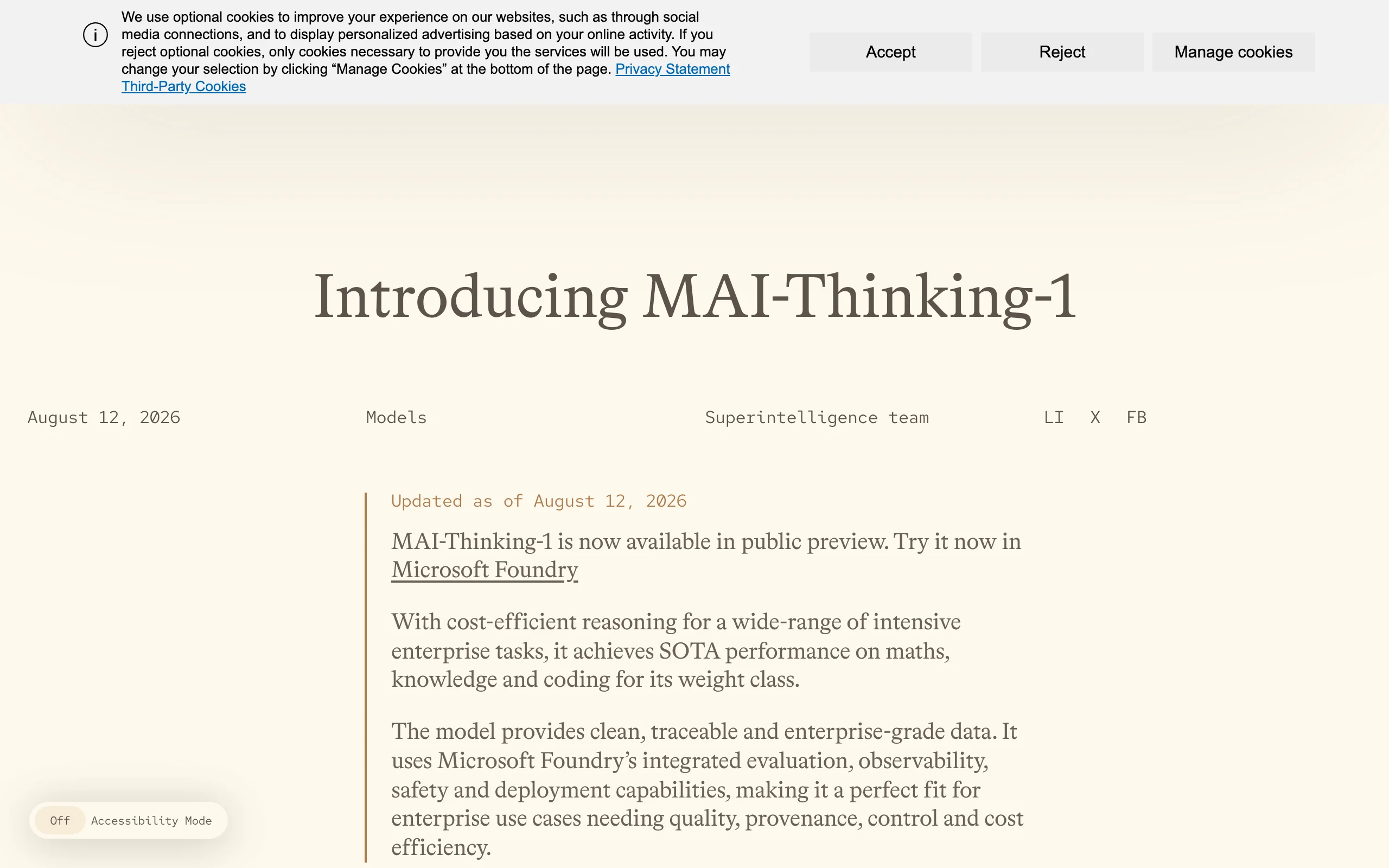
Executive Summary:
MAI-Thinking-1 is Microsoft's first in-house advanced reasoning model—a strategic shift from follower to leader in foundation models. It uses a sparse MoE with 35B active / ~1T total parameters, train...
1. What Is MAI-Thinking-1
MAI-Thinking-1 is Microsoft's first in-house advanced reasoning model—a strategic shift from follower to leader in foundation models. It uses a sparse MoE with 35B active / ~1T total parameters, trained from scratch on clean, commercially licensed data with no third-party distillation. It matches Claude Opus 4.6 on SWE-Bench Pro, AIME 2025/2026, and beats Sonnet 4.6 in blind tests. Built on Microsoft-owned accelerators, training frameworks, and RL environments end-to-end, it anchors a fully controllable AI stack.
Image source: Official article
Technical positioning and domain: Advanced math, science reasoning, and intelligent software engineering—not general chit-chat. Extends Microsoft AI from applications to foundation layer.
Development background: Microsoft Research + Azure AI, leveraging distributed training, hardware acceleration, and RL. Motivation: demand for explainable, controllable, traceable models and reduced third-party dependency.
Core value: Mitigates "black box" reasoning models—no AI-generated training text, commercial data only, behavior explainable and improvable. 35B active rivals much larger models at lower inference cost. "Hill-climbing machine" design enables ongoing capability growth vs. one-shot training.
Technical characteristics: 78-layer decoder-only Transformer with alternating sparse MoE (8/512 experts) and dense FFN, 5:1 local/global attention. Custom RL learns reasoning chains without prior CoT distillation; thousands of steps of log-linear gains across STEM, agentic coding, and helpfulness/safety.
2. Key Features
Advanced math and science: 97.0% AIME 2025, 94.5% AIME 2026—IMO-level problems for research, competition coaching, and heavy STEM workloads.
Intelligent software engineering: 52.8% SWE-Bench Pro, 87.7% LiveCodeBench v6—multi-step read/edit/test/recover for review, bugfix, features, and tests.
Ultra-long context: Up to 256K tokens for contracts, papers, and whole codebases—global refactor and analysis.
Tool use and agents: Plan workflows, call APIs, databases, shell—core engine for automation, analytics, and ops.
Safety/helpfulness balance: RL reward models reduce harmful output for enterprise deployment.
RL hill-climbing: Learns reasoning chains from scratch without CoT distillation; absorbs better data, rewards, and compute over time.
3. How to Use
Access channels may still be rolling out; guidance follows Microsoft AI service patterns:
Environment: ~35GB+ VRAM (A100/H100), 256GB RAM, fast SSD, Linux, CUDA 12+, PyTorch 2.0+. MoE needs bandwidth and compute.
Access: Expected via Azure AI Studio or GitHub Model Catalog—register, request access, authenticate with Azure CLI or Python SDK (REST/gRPC).
Deploy: Local weights ~70GB; set
max_tokensto 256K,temperature0.1–0.3 for reasoning, enabletool_usefor agents; Docker images may ship from Microsoft.Inference: Stream responses;
reasoning_steps=Truefor chain visibility; CoT prompts for math; full context + tests for code; chunk very long docs.Notes: Preview may rate-limit; benchmark Chinese before production; English-centric—Chinese may need prompt engineering.
4. Pros and Cons
| Pros |
|---|
| Fully in-house, no distillation: No third-party bias; behavior driven by owned data—easier to steer and customize. |
| Top performance at moderate scale: 35B active vs. Opus-class models; 97.0% AIME 2025 beats DeepSeek-R1 ~79.8%. |
| Clean traceable data: No AI-generated training text; commercial licenses—enterprise-friendly. |
| Full-stack control: Microsoft hardware → framework → RL—end-to-end optimization, lower supply-chain risk. |
| Continuous evolution: Hill-climbing supports online RL improvement—not frozen after one train. |
5. Comparison with Similar Tools
| Dimension | MAI-Thinking-1 | Claude Opus 4.6 |
|---|---|---|
| Architecture | 35B active / 1T MoE, 78-layer decoder, 8/512 experts | Undisclosed large dense |
| Training | From scratch, 30T clean commercial tokens, no distill | Undisclosed mixed data |
| SWE-Bench Pro | 52.8% | ~52.8% (tie) |
| AIME 2025 | 97.0% | Not stated |
| Context | 256K | 200K |
| Data strategy | Clean commercial, no AI text, decontaminated benchmarks | Undisclosed |
| Full-stack owned | Yes (Microsoft HW to framework) | No |
| Agent tools | Multi-step tool use | Tool use, more limits |
| Open license | TBD; likely API/partial open | Closed |
Selection advice: Enterprise STEM/reasoning with data provenance—MAI-Thinking-1 leads AIME and matches Opus on SWE. Flexible deploy/community—DeepSeek-R1 MIT. Mature closed ecosystem—Opus still strong but less stack control.
6. Editor's Take
MAI-Thinking-1 is among 2026's most strategic AI releases. Sparse MoE at 35B active near 1T-class performance challenges "scale is all you need." Hill-climbing RL without CoT distillation is methodologically fresh.
97.0% AIME and 52.8% SWE-Bench Pro are directly usable in research, education, and engineering automation. Audience: enterprise builders, labs, finance/health needing precision—individuals may wait for broader access/open components.
Microsoft's full-stack path enables chip-to-model co-design Anthropic and DeepSeek cannot fully replicate; clean data helps under tightening AI regulation.
— Top innovation, performance, and strategy; ecosystem/access caveats do not outweigh long-term value for autonomous, controllable enterprise AI.
7. Use Cases
Enterprise software development: Repo-wide review, bugfix, features, auto tests—30%+ efficiency gains claimed in workflow design.
Scientific computing: Multi-step math/physics/chemistry derivation and experiment design.
Long document intelligence: 256K analysis of contracts, manuals, papers—risk and summary extraction.
Agent automation: Office, analytics, ops with API/DB/shell orchestration.
Finance: Risk models and quantitative analysis over long historical context.
Competition training: AIME-level tutoring with detailed reasoning traces.
8. FAQ
Q: Open source?
A: Plan not final—likely Azure API plus possible partial open components; watch microsoft GitHub and blog.
Q: Hardware to run locally?
A: ~35GB+ VRAM minimum; A100 80GB/H100 recommended; 4090 may need FP8/INT4 quantization.
Q: vs. GPT-4o?
A: MAI-Thinking-1 wins depth on math/science/code; GPT-4o stronger on general chat, creativity, multimodal maturity.
Q: Chinese support?
A: English-primary training; Chinese benchmarks not public—expect gap vs. Qwen-class; prompt/fine-tune may help.
Q: Data safety?
A: Commercial licensed data, no AI-generated training set, benchmark decontamination; Azure compliance layers for enterprise.
Q: What is "hill-climbing machine"?
A: RL-from-scratch reasoning chains without CoT distill; continuous log-linear gains from better data, rewards, and compute.
Q: Commercial products?
A: Trained on commercial data—likely allowed; confirm Microsoft AI terms before shipping.
9. Project Links
- Announcement: https://microsoft.ai/news/introducing-mai-thinking-1/
- Technical paper: https://microsoft.ai/wp-content/uploads/2026/06/main_20260602_2.pdf
- GitHub: Not yet—watch https://github.com/microsoft
- Hugging Face: Not yet—likely https://huggingface.co/microsoft later
Related AI Model Articles
In-Depth Review of Gemini 3.8 Live – Google's Native Real-Time Speech Dialogue Model
Gemini 3.8 Live is a series of native real-time speech dialogue models launched by Google, which includes two variants: Gemini 3.8 Live and Gemini 3.8 Live Extended Thinking. This series employs an en...
Xiaomi-CocktailASR-1: In-Depth Evaluation of a Target Speaker ASR Model Based on an End-to-End LLM Architecture
Xiaomi-CocktailASR-1 is Xiaomi's open-source Target Speaker ASR (TS-ASR) large model, designed using an end-to-end LLM architecture. It uses a reference speech as a speaker embedding prompt to accurat...
Mureka V9.5 – A New Generation AI Music Generation Model from Kunlunwanwei
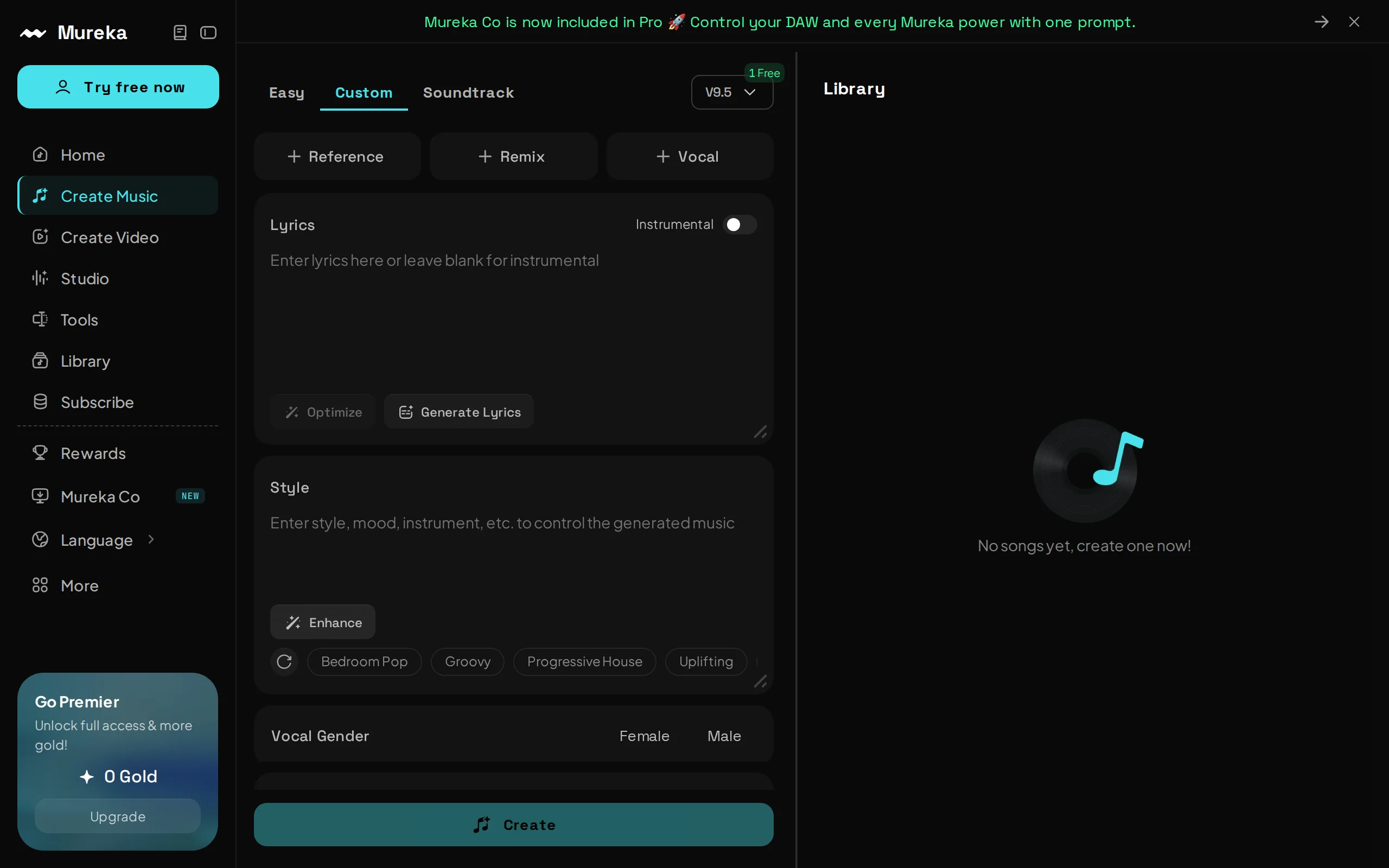
Mureka V9.5 is a new generation AI music generation model launched by Kunlunwanwei, built upon its self-developed MusiCoT music reasoning framework. It first constructs a global musical structure befo...
VibeThinker-3B – Weibo's Open-Source 3-Billion-Parameter Dense Reasoning Model
VibeThinker-3B is a 3-billion-parameter dense reasoning model open-sourced by the AI team at Weibo. Built upon the Qwen2.5-Coder-3B base model, it undergoes an enhanced Spectrum-to-Signal post-trainin...
© All Rights Reserved. Some content on this site is partially generated by AI with human review.