
In-Depth Review of Spark-ASR-2.0: A New Paradigm in Speech Recognition with Non-Autoregressive Architecture
Executive Summary:
Spark-ASR-2.0 is the latest generation speech recognition large model launched by iFLYTEK based on its proprietary Spark-Audio speech foundation model. This model continues the non-autoregressive para...
1. What is Spark-ASR-2.0
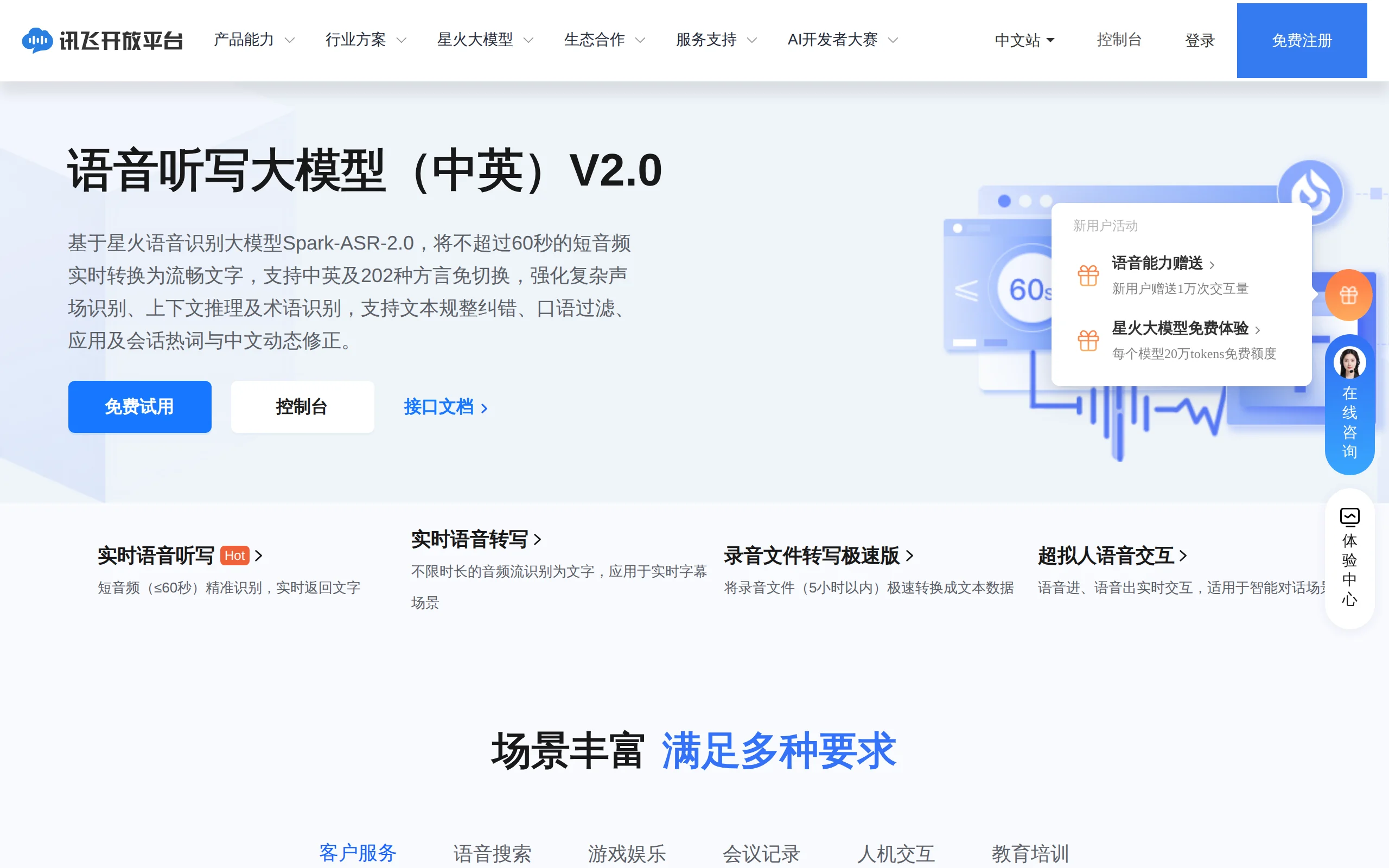
Spark-ASR-2.0 is the latest generation speech recognition large model launched by iFLYTEK based on its proprietary Spark-Audio speech foundation model. This model continues the non-autoregressive parallel decoding paradigm introduced in Spark-ASR-1.0 and innovatively incorporates an LLM-enhanced autoregressive recognition mechanism. Through a collaborative architecture combining "non-autoregressive + LLM-enhanced autoregressive," it achieves significant improvements in recognition performance across complex scenarios such as mixed Chinese-English speech, dialects, technical terminology, and high-noise, low-volume environments. Meanwhile, the inference cost has increased by only 10% compared to the previous generation. The model has been deployed first in iFLYTEK Input Method and simultaneously offers an API interface for developers to call. Future plans include deployment on intelligent terminal devices such as AI glasses and office tablets.
Image source: Official article
Image source: official article
Technical Positioning and Domain: Spark-ASR-2.0 is a specialized large model in the field of speech recognition (Automatic Speech Recognition, ASR), positioned as a foundational capability for general speech recognition in complex scenarios. Unlike general-purpose large models, this model focuses on efficiently and accurately converting speech signals into standardized text. Its "non-autoregressive + LLM-enhanced autoregressive" hybrid architecture offers a differentiated technical feature in the industry.
Development Background: This model was developed by the iFLYTEK Research Institute based on its self-developed Spark-Audio-1.0-Preview speech foundation model. With over two decades of technical accumulation in the field of speech technology, iFLYTEK's motivation for development was to address the accuracy bottlenecks of traditional speech recognition models when handling real-world complex scenarios such as mixed Chinese-English speech, dialect switching, technical terminology, and noisy environments, while also maintaining inference efficiency and cost control.
Core Value: This model addresses core pain points of traditional speech recognition systems, such as insufficient accuracy in complex acoustic scenarios, the need to switch models for multiple dialects, and low recognition rates for technical terminology. Its innovative value is reflected in three aspects: first, it achieves a balance between accuracy and inference efficiency through the collaborative architecture of non-autoregressive and autoregressive mechanisms; second, it enables personalized recognition optimization through a dynamic context injection mechanism; third, it directly generates standardized text with "smooth composition" output capabilities, reducing downstream text processing costs.
Technical Features: The model uses non-autoregressive parallel decoding to ensure inference efficiency, while incorporating LLM-enhanced autoregressive recognition to improve language understanding capabilities. Joint enhancement technology for mixed Chinese-English text and acoustics models text and acoustic layers separately and then jointly optimizes them. Dynamic context injection fuses the user's historical recognition content, modification records, and personalized keywords in real time. Overall, it is built upon the Spark-Audio-1.0-Preview speech foundation model, inheriting its recognition advantages in complex acoustic environments.
2. Key Features
Chinese-English Mixed Recognition: Achieves precise recognition in complex code-switching scenarios, allowing users to naturally mix Chinese and English without switching language modes. This feature is realized through joint enhancement technology for Chinese-English mixed text and acoustics, modeling both the textual and acoustic layers separately and then jointly optimizing them, effectively addressing recognition challenges in code-switching contexts.
Dialect Recognition Without Switching: Supports dialect recognition for 202 cities across the country, eliminating the need for users to manually switch recognition modes when speaking in dialects. This capability covers major Chinese dialect regions, including Wu, Cantonese, Minnan, and Sichuan dialects, maintaining high recognition accuracy even in mixed scenarios involving dialects and Mandarin.
Specialized Terminology Recognition: Specifically optimized for difficult-to-recognize terminology in fields such as medicine, chemistry, and technology, significantly improving recognition performance compared to previous-generation models. This feature leverages an LLM-enhanced autoregressive recognition mechanism, using the semantic understanding capabilities of large language models to perform contextual reasoning on specialized terms, reducing recognition errors caused by obscure terminology.
Recognition in Complex Acoustic Scenarios: Demonstrates outstanding performance in challenging acoustic environments such as high noise, low volume, fast speech, and children's voices, with recognition results surpassing the current state-of-the-art in the industry. This capability is inherited from the Spark-Audio-1.0-Preview speech foundation model, trained on large-scale multi-scenario acoustic data to provide enhanced noise robustness and adaptability to non-standard pronunciations.
Contextual Recognition and Dynamic Disambiguation: Integrates recognition history, modification records, and personalized hotwords to inject dynamic context in real-time during recognition, effectively resolving homonyms and semantic ambiguities. For example, after frequent use of the term "myocardial infarction" in a medical context, the model will be more inclined to output this term rather than ambiguous homophones in subsequent recognitions.
Textual Fluency and Normalization: Automatically simplifies redundant expressions, removes filler words (such as "um," "ah," "you know"), completes punctuation marks, and standardizes numerical units, directly outputting polished and coherent formal text. This feature enables the model to produce well-structured text "off the cuff," saving users the time and effort of manual editing and organization, making it especially suitable for high-quality text scenarios such as meeting transcripts and content creation.
3. How to Use
Spark-ASR-2.0 offers multiple usage methods, covering general users, developers, and enterprise-level application scenarios.
Online Experience: Visit the iFLYTEK Research Experience Page (https://iflytekresearch.iflytek.com/experience/spark-asr), and speak directly into the page or upload an audio file to view real-time recognition results. This method is suitable for quickly evaluating the model's performance without any development setup.
Using with iFLYTEK Input Method: Download and install the latest version of the iFLYTEK Input Method from the app store. In the input interface, click the microphone icon and hold it to speak, using Spark-ASR-2.0 for voice input. This method is aimed at general users, supporting mixed Chinese and English speech and free use of dialects. The recognition results are automatically normalized and can be sent directly.
API Integration (for Developers): Log in to the iFLYTEK Open Platform (https://www.xfyun.cn/services/spark_asr_zh_en_v2.0), register an application, and obtain authentication information such as AppID and APIKey. By following the API documentation and inputting the audio stream, developers can integrate recognition capabilities into their own applications. The API supports both real-time streaming recognition and audio file transcription modes, allowing developers to flexibly choose based on their business scenarios.
Integration with Terminal Devices: Hardware terminals such as iFLYTEK AI glasses, office tablets, and translation devices will gradually incorporate Spark-ASR-2.0 capabilities. Developers can integrate the model using the device-side SDK provided by the iFLYTEK Open Platform, enabling offline or online speech recognition functions. When integrating with terminal devices, attention should be paid to model compression and quantization strategies to adapt to the computational constraints of different hardware.
Notes: When calling the API, be mindful of concurrency quotas and billing policies. For high-frequency calling scenarios, it is recommended to communicate with iFLYTEK's business team in advance. Additionally, when handling sensitive audio data, relevant data security regulations must be followed. The iFLYTEK Open Platform offers data encryption transmission and private deployment options for enterprises to choose from.
4. Pros and Cons Analysis
| Pros |
|---|
| Superior performance in complex scenarios: The recognition accuracy in scenarios such as mixed Chinese-English speech, dialects, high noise, and low volume is better than the current industry-leading standards. The WER (Word Error Rate) has significantly decreased, especially with a notable advantage in the breadth of dialect coverage. |
| Efficient non-autoregressive architecture: Outputs the entire text sequence in parallel, maintaining low inference latency while ensuring high accuracy, making it suitable for real-time speech interaction scenarios and balancing recognition quality with response speed. |
| Smooth and coherent text generation: Automatically removes filler words, adds punctuation, and standardizes numerical symbols and units, directly outputting neat and coherent formal text, significantly reducing downstream text processing costs, and offering substantial value in scenarios such as meeting transcription and content creation. |
| Complete product ecosystem across the chain: Already launched in the iFlytek Input Method and opened the API, with future plans to deploy on terminal devices such as AI glasses and office tablets, forming a full-chain product matrix from model to application, allowing developers to quickly integrate. |
5. Comparative Analysis with Similar Tools
| Comparison Dimension | iFLYTEK Spark-ASR-2.0 | SenseTime AudioClaw | Whisper (OpenAI) |
|---|---|---|---|
| Product Positioning | Specialized speech recognition large model (ASR foundation capability) | AI-native intelligent input method / speech intelligent agent application | General-purpose speech recognition open-source model |
| Large Model Foundation | iFLYTEK Spark-Audio-1.0-Preview speech foundation model | SenseTime's "RiRiXin" multimodal large model + OpenClaw ecosystem | Encoder-decoder architecture derived from GPT series |
| Technical Architecture | Non-autoregressive + LLM-enhanced autoregressive collaborative architecture | Self-developed ASR + semantic optimization with multimodal large models | Encoder-decoder Transformer with autoregressive decoding |
| Dialect Support | Dialect recognition for 202 cities nationwide without switching | Supports partial dialects and multilingual translation | Supports 99 languages, but has limited dialect recognition capabilities for Chinese |
| Contextual Capabilities | Dynamic context injection, integrating historical data, modification records, and hotword disambiguation | Automatically builds a dedicated knowledge base, enabling cross-meeting question retrieval | No built-in context mechanism, requires external prompt concatenation |
| Special Features | "Smooth Composition": removes filler words, adds punctuation, standardizes numerical symbols and units | Oral purification, umpteenth speech recognition, meeting summarization, voice command rewriting and translation | Multilingual translation, timestamp alignment, long audio segmentation processing |
| Recognition Performance | Superior performance in dialects, high noise, and low volume scenarios compared to industry benchmarks, with only a 10% increase in inference cost | Millisecond-level response, accurate recognition in noisy environments and specialized terminology scenarios | High accuracy in general scenarios, but slower inference speed and higher resource consumption |
| Deployment Method | Cloud API + on-device SDK, closed-source commercial use | Client-side install-and-use, seamless integration with applications like WeChat | Open-source with local deployment support, API calling available |
| Open Source License | Closed-source commercial | Closed-source commercial | MIT open source license |
| Community Ecosystem | iFLYTEK Open Platform with enterprise-level support and comprehensive documentation | SenseTime ecosystem, targeting end-user consumers | Large global developer community, mature ecosystem |
Selection Recommendations: For enterprise users requiring nationwide dialect coverage, prioritizing recognition performance in complex scenarios, and quick integration into business systems, Spark-ASR-2.0 is currently a well-balanced choice, offering broad dialect support and the "Smooth Composition" feature. It demonstrates strong competitiveness in Chinese scenarios, particularly in terms of recognition accuracy. However, its closed-source commercial model may impose limitations on cost and customization flexibility.
For technical teams prioritizing data privacy, requiring local deployment, or seeking deep model customization, open-source solutions like Whisper or FunASR are more appealing. Whisper's multilingual capabilities make it suitable for international products, although its inference speed is relatively slow. FunASR is well-optimized for Chinese scenarios, supports streaming recognition and hotword customization, and offers high deployment flexibility. SenseTime AudioClaw is more suitable for direct use as a consumer-facing input method product, rather than as an ASR foundation capability for secondary development.
6. Editor's Summary
Spark-ASR-2.0 demonstrates iFLYTEK's deep technical accumulation in the field of speech recognition with its architecture. The collaborative architecture combining "non-autoregressive + LLM-enhanced autoregressive" represents an innovative direction worth noting — the non-autoregressive decoding ensures inference efficiency, while the LLM-enhanced autoregressive recognition compensates for the shortcomings of pure non-autoregressive models in terms of language understanding. This hybrid architecture design effectively balances recognition accuracy and inference cost, with data showing that inference cost increases by only 10%, indicating a high level of engineering efficiency in its implementation.
In terms of practical value, Spark-ASR-2.0's "smooth composition" capability provides a differentiated competitive advantage in speech recognition products. Traditional ASR systems output raw transcribed text with filler words and without punctuation, which still requires manual editing by users; in contrast, Spark-ASR-2.0 directly outputs standardized formal text, significantly reducing the conversion cost from speech to usable text. The optimizations for scenarios such as mixed Chinese-English input, dialect recognition without switching, and identification of professional terminology also directly address actual market pain points in China.
This model is suitable for the following users: enterprise developers requiring high-accuracy speech transcription capabilities (via API integration), frequent users of voice input (via iFLYTEK input method), and smart hardware manufacturers such as AI glasses and office tablets (via device-side SDK). For teams seeking open-source controllability, the limitations imposed by the closed-source commercial model must be carefully considered.
In terms of future potential, the subsequent development of Spark-ASR-2.0 will focus on two directions: one is to further expand the coverage of dialects and enhance the recognition capabilities of minority languages, and the other is to reduce the deployment threshold on device-side through model compression techniques. As terminal devices such as AI glasses and smart office tablets become more widespread, the value of voice interaction as an entry point will continue to rise. As the core foundation of iFLYTEK's speech ecosystem, the pace of technical iteration and the speed of practical implementation of Spark-ASR-2.0 are worth continuous attention.
7. Application Scenarios
Mobile Input and Social Communication: In the iFLYTEK Input Method, users can input text via voice without switching between Chinese-English modes or dialect modes. Simply speaking naturally completes the input. The recognition results automatically remove filler words and complete punctuation, generating neat text that can be directly sent to social apps like WeChat and SMS, significantly improving text input efficiency in mobile scenarios.
Meeting Transcription and Interview Recording: In products such as iFLYTEK Meeting Notes and iFLYTEK Hearing, the model transcribes meeting content in real time, maintaining high accuracy even in noisy conference room environments. The model automatically standardizes the transcription, producing formal text with punctuation, reducing the need for manual post-meeting organization. In interview scenarios, the model effectively distinguishes and accurately transcribes the different speech characteristics of the interviewer and interviewee.
Professional Domain Knowledge Recording: In academic lectures, seminars, and clinical records within fields such as medicine, chemistry, and technology, there are often numerous complex and obscure professional terms. Spark-ASR-2.0 leverages its LLM-enhanced language understanding capabilities to accurately recognize professional terminology within contextual settings, providing high-accuracy speech recording tools for professionals such as doctors and researchers.
Smart Hardware Voice Interaction: In voice command recognition and conversational interaction scenarios within iFLYTEK AI glasses, translation devices, and other terminal equipment, the model performs stably even in low-volume environments (e.g., noisy outdoor streets, inside vehicles). Its low inference cost makes it suitable for deployment on resource-constrained edge devices, offering foundational technical support for voice interaction experiences in smart hardware.
Enterprise-Level Voice Service Integration: Enterprise applications such as call transcription in customer service centers, automatic generation of video subtitles, and voice input systems can integrate with Spark-ASR-2.0 via the open platform API, gaining high-accuracy, low-cost speech recognition capabilities. Developers can choose between real-time streaming recognition or audio file transcription modes based on business needs, and combine with hotword functionality to optimize recognition for specific business-related vocabulary.
8. FAQ
Q: What is the core difference between Spark-ASR-2.0 and Spark-ASR-1.0?
A: Spark-ASR-2.0 builds upon the non-autoregressive parallel decoding architecture of version 1.0 by introducing an LLM-enhanced autoregressive recognition mechanism. These two mechanisms work together to improve overall accuracy and language understanding capabilities. Additionally, it features new technologies for joint enhancement of mixed Chinese-English text and acoustics, and strengthens dynamic context injection capabilities, significantly improving recognition performance for dialects, technical terms, and complex acoustic scenarios, with inference costs increasing by only 10% relatively.
Q: Which dialects does Spark-ASR-2.0 support? Is it necessary to switch dialect modes?
A: The model supports dialect recognition for 202 cities nationwide, covering major dialect regions such as Wu, Cantonese, Minnan, and Sichuan. Users do not need to manually switch dialect modes; the model automatically recognizes and transcribes dialect content, maintaining high recognition accuracy even in mixed scenarios involving dialects and Mandarin.
Q: How can developers integrate Spark-ASR-2.0 into their own applications?
A: Developers can register their application on the iFLYTEK Open Platform (https://www.xfyun.cn/services/spark_asr_zh_en_v2.0) to obtain AppID, APIKey, and other authentication information, and then call the API service according to the interface documentation. The API supports two modes: real-time streaming recognition and audio file transcription, which can be selected based on the business scenario. Enterprise users can also consult iFLYTEK's business team for private deployment solutions.
Q: How does Spark-ASR-2.0 perform in noisy environments?
A: The model outperforms the current state-of-the-art in complex acoustic scenarios such as high noise, low volume, fast speech, and children's voices. This capability is inherited from the Spark-Audio-1.0-Preview base model for speech, which was trained on large-scale multi-scenario acoustic data, giving it strong noise-robustness. However, recognition performance in extreme noise environments (e.g., construction sites) still requires evaluation through actual testing.
Q: Does Spark-ASR-2.0 support offline recognition?
A: Currently, Spark-ASR-2.0 mainly provides services through cloud-based APIs, supporting real-time streaming recognition. Future integration of the device-side SDK on terminal devices such as iFLYTEK AI glasses and office notebooks will enable a certain level of offline recognition capability. For specific offline recognition capabilities and device compatibility, please refer to the official announcements on the iFLYTEK Open Platform.
9. Project Links
- Xunfei Open Platform Product Page: https://www.xfyun.cn/services/spark_asr_zh_en_v2.0
- Xunfei Open Platform Official Website: https://www.xfyun.cn
- Xunfei Research Institute Homepage: https://iflytekresearch.iflytek.com
- Online Experience Entry: https://iflytekresearch.iflytek.com/experience/spark-asr
- Xunfei Input Method Download: https://srf.xunfei.cn (Official Xunfei Input Method Download Page)
Related AI Model Articles
Review of DeepSeek Harness Desktop: How the Official GUI Client Lowers the Bar for Agent Usage
DeepSeek Harness Desktop is the official graphical client launched by DeepSeek, designed to provide a visual interface for the originally command-line-based DeepSeek Harness framework. After users log...
Qwen-Audio-3.1: A Full-Stack Evaluation of the Qwen Audio Large Model Series
Qwen-Audio-3.1 is a series of large audio models launched by Alibaba's Qwen. It consists of five models: ASR speech recognition, ASR-Next audio understanding, TTS speech synthesis, TTS-Next audio crea...
Qwen3.8-LiveTranslate – A Real-Time Simultaneous Interpretation Model Launched by Alibaba Tongyi
Qwen3.8-LiveTranslate is a real-time simultaneous interpretation large model launched by the Tongyi Qianwen team at Alibaba. Based on the Interleave single-stream architecture, it processes audio and ...
Qwen3.8-Omni-Flash – A Native Multimodal Model Launched by Alibaba Qwen
Qwen3.8-Omni-Flash is a native multimodal model launched by Alibaba Qwen. It jointly models four modalities—text, image, audio, and video—within a single architecture, supporting a context length of u...
© All Rights Reserved. Some content on this site is partially generated by AI with human review.