
Mega-ASR – NTU, NUS & Shanghai AI Lab Open-Source Speech Recognition Model
Executive Summary:
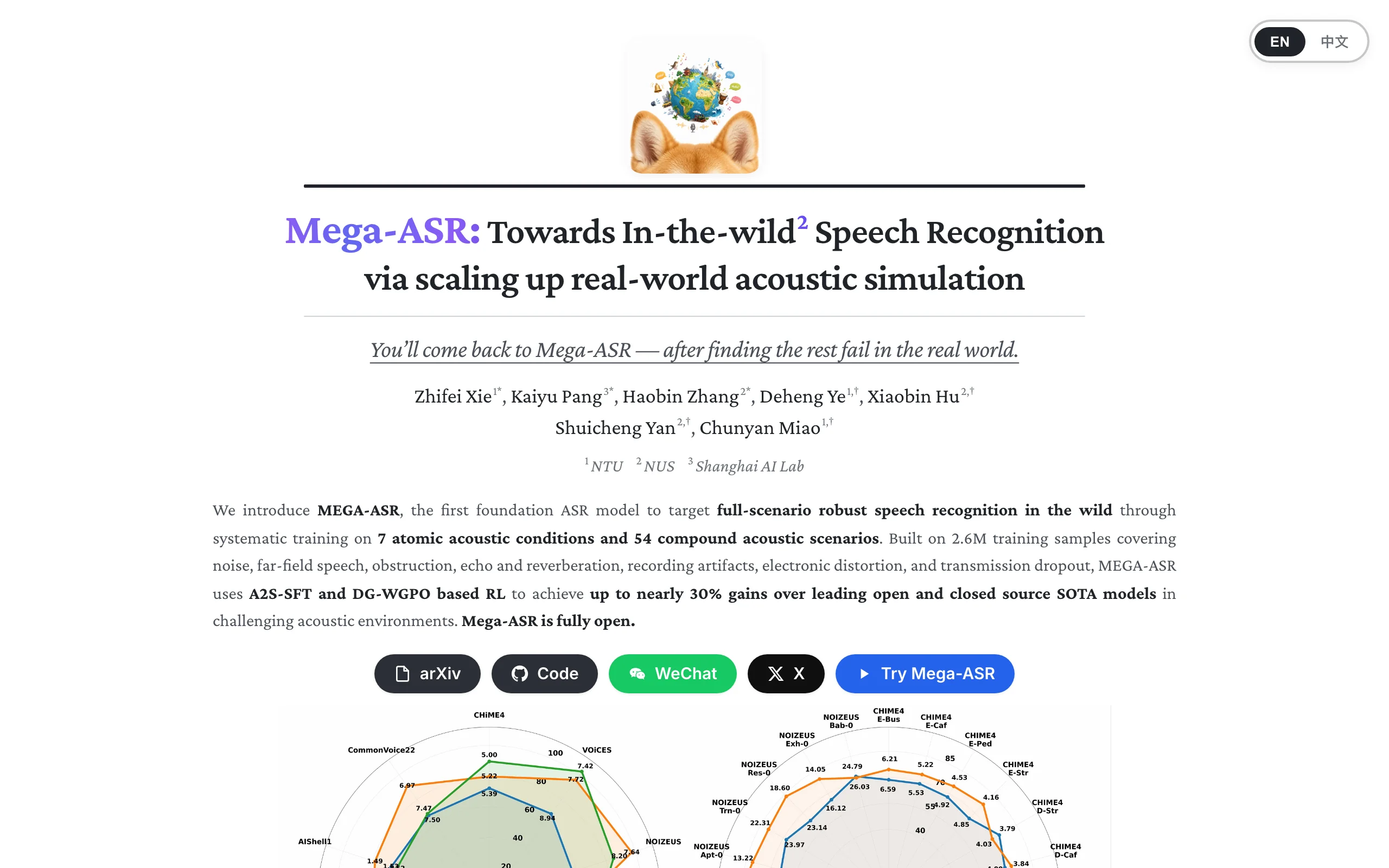
Mega-ASR is an open all-scenario robust ASR foundation from Nanyang Technological University (NTU), National University of Singapore (NUS), and Shanghai AI Lab. Built on Qwen3-ASR 1.7B, it uses compos...
1. What Is Mega-ASR
Mega-ASR is an open all-scenario robust ASR foundation from Nanyang Technological University (NTU), National University of Singapore (NUS), and Shanghai AI Lab. Built on Qwen3-ASR 1.7B, it uses composite data construction and progressive acoustic-to-semantic optimization to handle real-world acoustic degradation—noise, far-field, echo, occlusion, packet loss, and 54 physically plausible compound scenes from 7 atomic effects.
Image source: Official article
Technical positioning and domain: Robust ASR—a single base model for clean lab speech through extreme degradation, not single-noise specialists.
Development background: Joint academic effort leveraging NTU/NUS speech signal processing and Shanghai AI Lab large-model training. Mainstream ASR (Whisper, Qwen-ASR) WER can spike from single digits to 80%+ under compound conditions (far-field + echo + noise).
Core value: Unlocks coupled "acoustic perception" and "semantic reconstruction" bottlenecks—hallucination or blank output under extreme loss. Three-stage A2S-SFT plus DG-WGPO cuts WER vs. Whisper-Large-v3 by 65.8% on compound scenes; 0% WER recovery at far-field peak −5.2 dB in cited cases.
Technical characteristics: Environment-aware plug-and-play routing—a lightweight classifier (>99.5% accuracy) splits clean vs. degraded audio with zero intrusion to clean-domain performance. Fully open with Voices-in-the-Wild-2M (2.4M synthetic + 5K eval, 1.5K real).
2. Key Features
All-scenario robust ASR: Covers seven atomic acoustic effects (noise, far-field, occlusion, echo/reverb, recording coloration, electronic distortion, packet loss) and 54 physically plausible composite scenarios. A single model handles conditions from lab-clean speech to extreme degradation without scene switching or model reload.
Progressive A2S-SFT: Three-stage curriculum—first train encoder and aligner on moderate degradation (WER tiers 30%→50%→70%); second activate the LLM's semantic recovery; third end-to-end joint fine-tuning. This resolves coupling between acoustic perception and semantic reconstruction and prevents collapse on extreme samples.
DG-WGPO dual-granularity rewards: When WER exceeds 30%, errors shift from word-level confusion to sentence-level hallucination or dropped sentences. Token-level refinement rewards distinguish soft vs. hard substitution errors; sentence-level reconstruction uses longest common subsequence with length penalty. WER gate τ=0.3 blends local refinement at low WER with global semantic preservation at high WER.
Environment-aware routing: Lightweight single-layer Transformer (hidden dim 128) on 80-dim log-Mel features achieves >99.5% clean/degraded classification. Clean speech uses the Qwen3-ASR backbone; degraded speech routes to Mega-ASR robust LoRA—LibriSpeech WER improves from 1.78/3.57 to 1.63/3.37 without clean-domain regression.
Voices-in-the-Wild-2M dataset: 2.4M synthetic plus 5,000 evaluation audios (1,500 real). Spectrum-level simulation of atomic effects, agent-validated physical composites (e.g., church = far-field + reverb), unified severity k∈[0,1], and filtering of WER>70% unstable samples.
Training stability: Curriculum difficulty expansion plus filtered unlearnable samples ensure reproducible convergence and avoid training collapse under extreme acoustic degradation.
3. How to Use
Environment: Python 3.8+, PyTorch 2.0+, transformers, torchaudio; NVIDIA GPU (A100 preferred, RTX 3090 OK slower).
Load dual weights: Qwen3-ASR 1.7B backbone + Mega-ASR robust LoRA + routing model:
from transformers import AutoModelForSpeechSeq2Seq, AutoProcessor
model = AutoModelForSpeechSeq2Seq.from_pretrained("zhifeixie/Mega-ASR")
processor = AutoProcessor.from_pretrained("zhifeixie/Mega-ASR")
Preprocess and route: 80-d log-Mel → routing classifier → clean or degraded branch automatically.
Inference: Clean path preserves benchmark performance; degraded path activates robust LoRA—no manual switch.
Output: Text transcript; evaluate with jiwer. Strong completeness under NOIZEUS 0 dB and far-field −5.2 dB cases cited in paper.
4. Pros and Cons
| Pros |
|---|
| Compound-scene leadership: 2.73/4.57 WER on Voices-in-the-Wild-Bench; −65.8% vs. Whisper-Large-v3. |
| Semantic recovery: 0% WER vs. blank/hallucinated rivals at extreme far-field example. |
| Clean domain preserved: Routing improves LibriSpeech vs. base Qwen3-ASR. |
| Fully open Apache 2.0: Weights, code, dataset recipe, benchmarks. |
| Stable training: Filtered data + curriculum avoids extreme-collapse. |
5. Comparison with Similar Tools
| Dimension | Mega-ASR | Whisper Large-v3 | Qwen3-ASR 1.7B |
|---|---|---|---|
| Open | Yes Apache 2.0 | Yes MIT | Yes Apache 2.0 |
| Architecture | Qwen3-ASR + LoRA | Encoder-decoder | Qwen3-ASR 1.7B |
| Compound scenes | 7 atomic + 54 compound | Mostly single noise | Mostly single noise |
| NOIZEUS 0 dB WER | 19.80 | ~55.78 | 23.97 |
| VOiCES R4-B-F WER | 45.69% | ~60%+ | 54.01% |
| LibriSpeech | 1.63/3.37 | 1.78/3.53 | 1.78/3.57 |
| Semantic recovery | Strong (0% in cited extreme case) | Weak hallucination/drop | Medium |
| Plug-in routing | Yes | No | No |
| Training data | 2.4M synth + 5K eval | 680K hours multilingual | Undisclosed |
Selection advice: Real messy acoustics ( automotive, outdoor, far-field meetings)—Mega-ASR best open choice with clean-path safety net. Clean/single-noise only—Whisper or Qwen3 may be lighter. Ultra-low latency controlled environment—optimized Whisper pipelines. Multilingual API convenience—Gemini, weaker on compound degradation.
6. Editor's Take
Mega-ASR's A2S-SFT and DG-WGPO systematically decouple perception and semantics under compound loss—65.8% WER reduction and 0% recovery cases are compelling.
Environment-aware routing is the engineering highlight: drop-in replacement without hurting LibriSpeech. Targets automotive, meeting capture, outdoor media, smart home, VoIP QA teams; academics get reproducible robust ASR benchmarks.
Scale-up, multilingual, and latency optimization are natural next steps; routing may generalize beyond ASR.
— Innovation 5/5, utility 4.5/5, open 5/5, performance 4.5/5, deploy 3.5/5.
7. Use Cases
In-car voice: Engine, wind, tire, HVAC, multi-talker compound noise.
Far-field meetings/classrooms: Reverb, distance, overlap, device coloration—minutes-long stable transcripts.
Outdoor interview/live captions: NOIZEUS-class noise with fewer dropped sentences.
Smart home: Distant wake words and commands through appliance noise—plug-in routing on existing stacks.
Call center/VoIP QA: Packet loss, codec artifacts, echo on unstable networks.
8. FAQ
Q: Chinese ASR?
A: Trained/evaluated primarily in English on ViT-W-2M; Qwen3 base is multilingual but Mega-ASR robust branch not verified for Chinese—await updates or fine-tune.
Q: Hardware?
A: A100 recommended; RTX 3090 24GB works offline/batch, not real-time.
Q: Clean speech regression?
A: No—routing keeps clean on backbone; LibriSpeech improves vs. Qwen3-ASR base.
Q: Fine-tune on custom data?
A: Open training code—format like ViT-W-2M, run three A2S-SFT stages per GitHub scripts.
Q: Real-time latency?
A: ~200–500 ms on A100 per utterance—OK for meeting/QA, not ultra-low-latency wake word.
Q: Multi-speaker overlap?
A: Single-speaker focus; combine with diarization or wait for future multi-speaker support.
9. Project Links
- Project page: https://xzf-thu.github.io/Mega-ASR/
- GitHub: https://github.com/xzf-thu/Mega-ASR
- Hugging Face: https://huggingface.co/zhifeixie/Mega-ASR
- arXiv: https://arxiv.org/pdf/2605.19833
Related AI Model Articles
Review of DeepSeek Harness Desktop: How the Official GUI Client Lowers the Bar for Agent Usage
DeepSeek Harness Desktop is the official graphical client launched by DeepSeek, designed to provide a visual interface for the originally command-line-based DeepSeek Harness framework. After users log...
In-Depth Review of Spark-ASR-2.0: A New Paradigm in Speech Recognition with Non-Autoregressive Architecture
Spark-ASR-2.0 is the latest generation speech recognition large model launched by iFLYTEK based on its proprietary Spark-Audio speech foundation model. This model continues the non-autoregressive para...

Qwen-Audio-3.1: A Full-Stack Evaluation of the Qwen Audio Large Model Series
Qwen-Audio-3.1 is a series of large audio models launched by Alibaba's Qwen. It consists of five models: ASR speech recognition, ASR-Next audio understanding, TTS speech synthesis, TTS-Next audio crea...

Qwen3.8-LiveTranslate – A Real-Time Simultaneous Interpretation Model Launched by Alibaba Tongyi
Qwen3.8-LiveTranslate is a real-time simultaneous interpretation large model launched by the Tongyi Qianwen team at Alibaba. Based on the Interleave single-stream architecture, it processes audio and ...
© All Rights Reserved. Some content on this site is partially generated by AI with human review.