
GitNexus – Open-Source Code Knowledge Graph Engine for Full Dependency Maps
Executive Summary:
GitNexus is an open-source code knowledge graph engine that uses Tree-sitter parsing to turn repositories into complete dependency graphs and exposes structured context to AI coding tools (Cursor, Cla...
1. What Is GitNexus
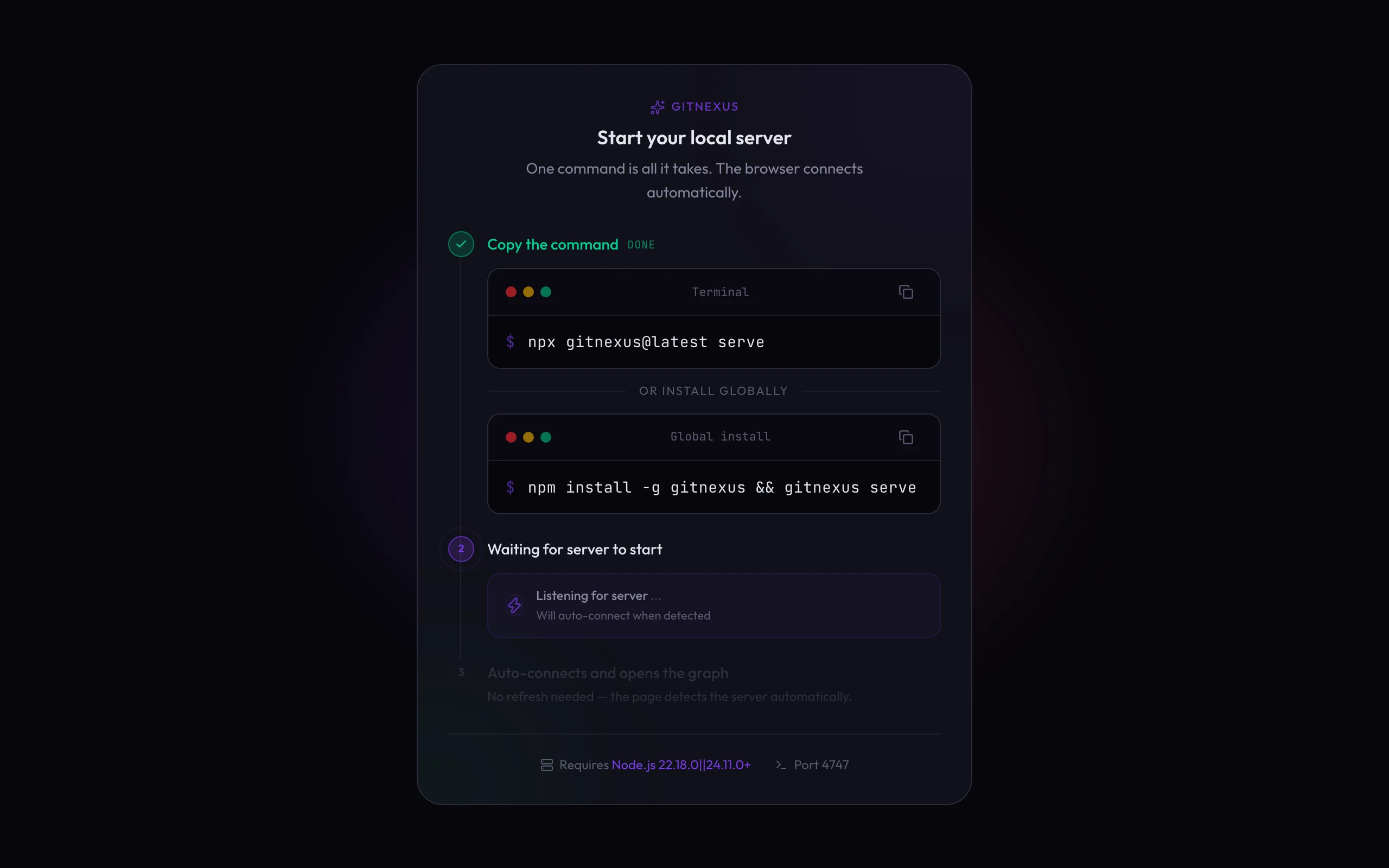
GitNexus is an open-source code knowledge graph engine that uses Tree-sitter parsing to turn repositories into complete dependency graphs and exposes structured context to AI coding tools (Cursor, Claude Code, Codex, etc.) via MCP. Unlike Graph RAG that relies on LLMs to explore raw graph edges at query time, GitNexus precomputes call chains, community clustering, and risk scoring at index time—so AI gets a global code view in one tool call. It supports 14 languages with CLI, Web UI, and Docker, runs fully locally, and never uploads your code.
Image source: Official article
Technical positioning and domain: Code analysis knowledge graphs for AI-assisted development, large refactors, and review. Precomputed relational intelligence plus deep MCP integration reduces model reasoning demands—small models can match large ones on architecture clarity.
Development background: Created by Abhigyan Patwari from frustration with slow context handoff between analyzers and AI editors. Sourcegraph/OpenGrok offer search/jump; Graph RAG needs multi-turn LLM exploration. GitNexus front-loads graph building so MCP returns high-value structure immediately.
Core value: Fixes AI "context blindness" on big repos—editing one function without seeing dependents causes cascading breaks. Impact analysis, 360° symbol context, and change detection tell AI blast radius and risk before edits.
Technical characteristics: Six-stage multithreaded pipeline—Tree-sitter AST, Leiden communities, hybrid BM25 + semantic + RRF search; LadybugDB local persistence; Cypher queries; Claude Code hooks for stale-index detection after commits.
2. Key Features
Knowledge graph construction: Nodes (functions, classes, methods, interfaces) and edges (calls, inheritance, imports, implements) for 14 languages. Infers constructors and self/this receiver types for accurate cross-file calls—foundation for all other features.
Impact analysis: Given any symbol, returns multi-hop dependents with confidence (depth, indirect refs) and risk (high/medium/low). Predict who breaks if you change a core service return type—systematizes pre-refactor review.
360° symbol context: One MCP call returns upstream callers, downstream callees, execution flows, and cross-file refs—the symbol's "social network" without repeated file greps.
Change detection: Diff vs graph maps edited lines to affected symbols/flows and risk—e.g., logic change lists call chains and likely tests; pre-commit risk reports for PRs.
Multi-file rename: Graph-coordinated renames—high-confidence graph edits vs low-confidence text search (comments/strings) with confidence tags—fewer missed implicit references than IDE-only rename.
Hybrid search: BM25 + embeddings + RRF, grouped by execution flow—surfaces cross-community critical paths, not isolated string hits.
Cypher queries: Query call graphs and communities—e.g., public utils called by >5 functions or intra-module cycles—for architecture compliance and tech-debt hunts.
Wiki auto-generation: LLM-generated module docs and architecture overviews (multilingual) from graph structure—onboarding and living documentation.
3. How to Use
Requirements: Node.js 18+ (20 LTS recommended); macOS/Linux/Windows (WSL2). No external DB—LadybugDB local. Large repos (>50k nodes): 8GB+ RAM, SSD.
CLI:
npm install -g gitnexus; in repo rootnpx gitnexus analyze(minutes first run). Index under~/.gitnexus/.Editor setup:
npx gitnexus setupauto-writes MCP config for Cursor/Claude Code/Codex. Claude gets Pre/Post ToolUse hooks for stale index checks.Web UI / Docker: https://gitnexus.vercel.app for in-browser GitHub/ZIP analysis (client-only). Local:
npx gitnexus@latest serve(4747) ordocker compose up -d(frontend 4173).Multi-repo: Edit
~/.gitnexus/registry.json—one MCP server, switch repos viagitnexus.registry.Notes: Prefer clean git state for change detection; ignore binaries/generated code; default cap 50k nodes—shard or raise
--max-nodeswith enough RAM.
4. Pros and Cons
| Pros |
|---|
| Precomputed intelligence: Clustering, call chains, risk at index time—one MCP call, >80% lower latency vs live Graph RAG exploration. |
| Fully local: No cloud upload; LadybugDB embedded—enterprise privacy friendly. |
| Small-model friendly: Tool layer does heavy lifting—7B locals get big-model architecture clarity. |
| Multi-repo registry: One MCP for many indexed repos—microservice cross-repo analysis. |
5. Comparison with Similar Tools
| Dimension | GitNexus | DeepWiki | Sourcegraph |
|---|---|---|---|
| Output | Structured graph + MCP tools | NL docs | Search + navigation |
| Relations | Explicit graph edges | Implicit in prose | Via jump-to-def |
| AI usage | Tool call, full context once | Read docs, infer | Search then stitch |
| Model bar | Small models OK | Needs strong reader | Symbol reasoning |
| Privacy | Fully local | Often cloud | Self-host option |
| Editor | Native MCP | Separate site | IDE plugins |
| Index speed | Slow first, fast incremental | Instant docs | Fast search index |
| Languages | 14 | Mainly Py/JS | 30+ |
Selection advice: Claude Code/Cursor teams needing impact analysis and change risk—GitNexus, especially pre-refactor and microservices. Pure search/jump—Sourcegraph. Auto docs without graphs—DeepWiki. Legacy self-hosted search—OpenGrok lacks modern AI hooks.
6. Editor's Review
GitNexus's insight: move relationship discovery from runtime LLM loops to index time—one structured MCP response beats many grep rounds. That democratizes architecture-aware AI for privacy-sensitive orgs on smaller models.
The six-stage pipeline (AST → Leiden → hybrid index) is engineered sensibly. LadybugDB avoids external DB ops.
Still early: long initial index, manual refresh, imperfect C++/dynamic language support, thin docs. Best for AI-assisted refactor teams and multi-repo governance—not always worth it for tiny personal projects vs mature search tools.
If real-time incremental index, broader languages, and docs improve, GitNexus could become essential in the agentic dev stack.
— −1 for index speed and ecosystem maturity; core design and utility are strong.
7. Use Cases
Pre-refactor impact:
impactbefore changing APIs—see callers and risk tiers; plan compatibility or phased migration.Onboarding: Web Wiki plus
contexton core symbols—module roles, flows, dependencies.Bug root cause: Reverse
contextalong call chains; pair withdetect_changeson recent diffs.PR review: Pre-submit
detect_changesrisk report in comments.Microservice governance: Multi-repo groups, cross-service contract mapping, Cypher for cycles and orphan calls.
8. FAQ
Q: Private repos? Upload?
A: CLI fully offline. Web UI processes in-browser only. Docker stays local. Index on disk.
Q: Update after edits?
A: Re-run npx gitnexus analyze (incremental on changed files). Auto git-hook reindex planned.
Q: Supported editors / MCP config?
A: Claude Code, Cursor, Codex via npx gitnexus setup. Others: add {"mcpServers":{"gitnexus":{"command":"npx","args":["gitnexus","mcp"]}}}.
Q: Node limit?
A: Default 50k—shard repos or --max-nodes with RAM headroom.
Q: Cypher subset?
A: Read-only patterns on nodes/edges/paths (CALLS, INHERITS, IMPORTS, IMPLEMENTS)—no MERGE/CREATE. Neo4j-like syntax subset.
Q: Wiki quality / custom LLM?
A: Built-in lightweight summarizer; set GITNEXUS_LLM_ENDPOINT and GITNEXUS_LLM_API_KEY for OpenAI/Claude quality; custom prompts in docs.
9. Project Links
Related AI Model Articles
In-Depth Review of Longcat-2.5-preview: Meituan's Next-Generation Multimodal Long-Range Agent Model
LongCat-2.5-preview is Meituan's latest next-generation large model. Building upon the 1.6T total parameters, approximately 48B active parameters, and native 1M token context of LongCat-2.0, it marks ...
In-Depth Review of Spark-ASR-2.0: A New Paradigm in Speech Recognition with Non-Autoregressive Architecture
Spark-ASR-2.0 is the latest generation speech recognition large model launched by iFLYTEK based on its proprietary Spark-Audio speech foundation model. This model continues the non-autoregressive para...
Step Code – In-Depth Review of StepFun's Open-Source Terminal Programming Agent
Step Code is an open-source terminal programming agent launched by StepFun, licensed under the MIT License, which allows developers to complete the full workflow of code writing, debugging, execution,...
Xiaomi MiMo-V2.6 – Xiaomi's Open-Source Multimodal Model Series
Xiaomi MiMo-V2.6 is a series of fully multimodal models released and open-sourced by Xiaomi, comprising two native full-modal models: Pro and Flash. It is centered on large-scale Agentic reinforcement...
© All Rights Reserved. Some content on this site is partially generated by AI with human review.