
Meituan GEO Marketing Portal – Generative Engine Optimization for AI Search
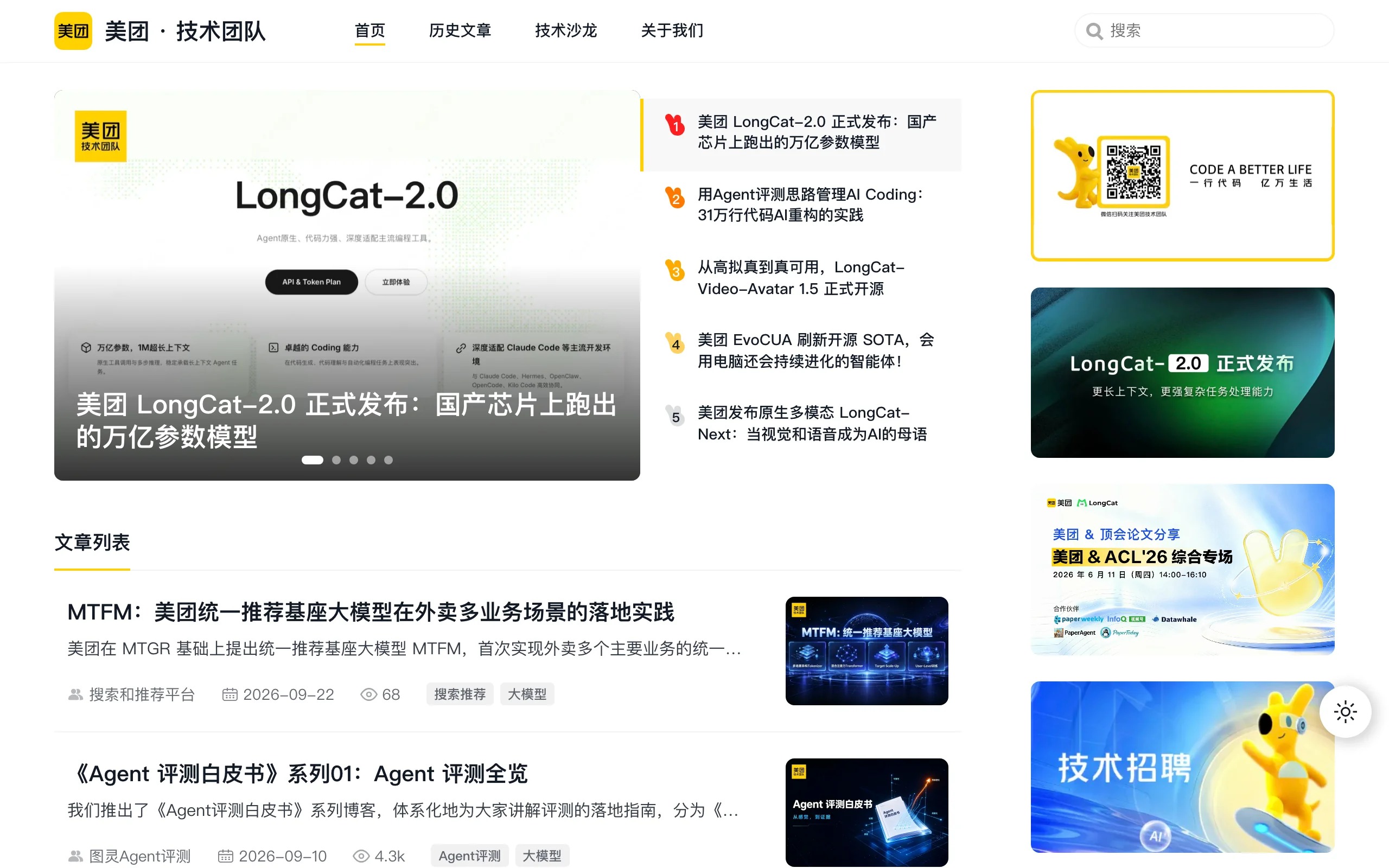
Executive Summary:
The Meituan GEO Marketing Portal is a Generative Engine Optimization (GEO) platform born from Meituan's commercial ecosystem, built for the AI search era. It helps brands increase exposure and recomme...
1. What Is the Meituan GEO Marketing Portal
The Meituan GEO Marketing Portal is a Generative Engine Optimization (GEO) platform born from Meituan's commercial ecosystem, built for the AI search era. It helps brands increase exposure and recommendation quality in conversational outputs from major LLMs such as Doubao, DeepSeek, ERNIE Bot, and Qwen. Unlike traditional SEO focused on search rankings, GEO optimizes how brands are mentioned, perceived, and contextualized in AI answers. The platform delivers a closed loop of strategy, content generation, performance tracking, and monitoring across 4+ domestic AI platforms and 1000+ keywords—helping businesses capture AI traffic when users ask assistants for recommendations.
Image source: Official article
Technical positioning and domain: GEO sits at the intersection of AI marketing and NLP—optimizing structured data, source strategy, and content so brand information is cited more often and presented positively in model reasoning. Unlike SEO for crawlers, GEO targets training distributions and inference preferences of LLMs—a new discipline.
Development background: Built by Meituan's commercial technology team, leveraging local-life data and AI capabilities. As users shift from classic search to conversational AI, brand visibility in answers directly affects decisions. Meituan productized GEO for merchants and external brands.
Core value: Solves "being seen" in AI search. LLMs don't show ranked links—they synthesize multi-source answers. GEO analyzes citation preferences and guides high-quality source placement so models cite your brand when relevant—authority at the decision moment, boosting trust and conversion.
Technical characteristics: Deep local-life knowledge for dining, retail, and hospitality; real-time monitoring on 1000+ keywords; semantic analysis of positive/negative brand mentions for data-driven iteration.
2. Key Features
Strategy recommendations: Identifies high-value sources and content opportunities for GEO roadmaps based on Meituan's research into how major models cite information—official encyclopedias, vertical media, quality blogs—prioritizing where to publish.
Content generation: Built-in AI engine produces structured data suggestions, keyword plans, and platform-specific copy templates—e.g., concise summaries for Doubao vs. full paragraphs for ERNIE—to raise citation odds.
Performance tracking: Monitors brand exposure changes on Doubao, DeepSeek, etc.; periodic reports compare against baselines with mention frequency, context relevance, and competitive rank shifts.
Monitoring and analytics: Tracks mentions across platforms, citation sources, content types, and competitor gaps on 1000+ keywords—positive recommendation, neutral mention, or negative association—with semantic matching.
Competitive benchmarking: Set competitors; reports on mention frequency, source mix, and content types vs. your brand to target weak areas.
Source penetration analysis: Traces which original sources (site, press, social, forums) models use when citing your brand—Meituan's provenance algorithm maps each claim in AI answers back to origins.
3. How to Use
Requirements: SaaS—no local deploy. Stable network (≥10Mbps), Chrome 90+/Edge 90+/Safari 14+, enterprise email or Meituan merchant account. Not open to individual self-signup—enterprise partnership required.
Access: Visit https://geo.meituan.com/, submit cooperation request with brand info, target AI platforms (default: Doubao, DeepSeek, ERNIE, Qwen), keyword count (500 basic, 1000+ pro). Meituan evaluates within ~3 business days.
Create project: In console, set core + 3–5 long-tail keywords, select ≥2 AI platforms, add up to 10 competitors. System generates baseline mention frequency and citation quality.
Content placement: Follow strategy report—use generation module for Schema.org, FAQ, knowledge graph templates; publish on site, industry wikis, media per priority list.
Review: Weekly check exposure and citations; export weekly/monthly reports (mentions, sources, competitor trends). Adjust sources and keyword phrasing from results.
Best practices: GEO is ongoing—expect 2–4 weeks for visible lift; avoid spam sources; keep content fresh; use negative-mention alerts for crisis response.
4. Pros and Cons
| Pros |
|---|
| AI traffic entry: Early presence in Doubao, DeepSeek, etc.—continuous AI recommendations where SEO underperforms in chat. |
| Authority signal: AI citation acts as third-party endorsement at decision time—often stronger than display ads. |
| One-stop loop: Strategy → content → tracking → analytics without tool hopping. |
| Precise monitoring: Real citation data on 1000+ keywords plus competitor benchmarks. |
| Negative alerts: Real-time warnings for bad associations—faster PR response. |
5. Comparison with Similar Tools
| Dimension | Meituan GEO Portal | Newrank Geowise |
|---|---|---|
| Positioning | Meituan GEO for local-life AI visibility | Newrank enterprise GEO lifecycle |
| AI platforms | 4+ domestic (Doubao, DeepSeek, ERNIE, Qwen) | 6 engines incl. Kimi, Zhipu; 150+ collaborators |
| Monitoring | 1000+ keywords, real-time mentions | 10M+ Q&A/day, >95% semantic accuracy, 24/7 |
| Core features | Strategy, content, tracking, analytics loop | Query mining, high-citation content, source backtrace |
| Differentiator | Meituan local-life data + citation preferences | Enterprise collaboration at scale |
| Audience | Dining, retail, hotel SMBs | Large brands needing org-wide GEO |
| Model | Partnership application | Enterprise pricing |
Selection advice: Local-life brands—Meituan GEO first. Other industries with budget—Geowise for breadth and collaboration. Budget SMBs—AIDSO free tier plus DSO.
6. Editor's Review
Meituan GEO productizes generative engine optimization for local commerce—source penetration and citation modeling are genuinely novel vs. classic SEO tools. GEO requires understanding LLM training and reasoning; Meituan turned that into actionable playbooks.
The full loop lowers GEO entry for merchants—being recommended in Doubao/DeepSeek when users ask "best Sichuan near me" beats many ad formats. Optimized brands reportedly see 3–5× mention lift with better sentiment mix.
Gaps: no overseas LLMs; content still partly manual. Deeper tie-in with Meituan merchant tools for auto-updates would boost efficiency.
Best for local-life marketing teams and SMBs building AI-era authority; enterprises may pair with Geowise-class tools.
— Innovation 4.5, utility 4.5, ease 4.0, ecosystem 4.5, potential 4.5; deductions for no global platforms and partial automation.
7. Use Cases
Local-life acquisition: Restaurants, retail, hotels surfaced when users ask AI for nearby recommendations—optimize Meituan/Dianping signals and reviews.
Brand authority: Skincare, tech startups cited for ingredients/R&D when users ask category questions—AI "certification" effect.
Competitive monitoring: Coffee chain sees rival promoted for "cold brew" in AI answers—trace their sources and counter with targeted content.
Launch and campaigns: Seasonal drinks—structured copy across AI-friendly sources and Xiaohongshu so queries like "new milk tea" return your brand.
Crisis PR: Negative news cited by models—alerts plus positive source placement to dilute bad associations.
8. FAQ
Q: GEO vs SEO—which matters more?
A: SEO optimizes web rankings (Baidu, Google). GEO optimizes citations in LLM answers via source quality, structured data, and credibility. Both matter; GEO rises as chat search grows—especially for decision-heavy local services.
Q: How to measure GEO success?
A: Mention frequency, citation quality (positive/neutral/negative), source distribution, competitor rank on same queries—weekly vs baseline.
Q: Overseas platforms (ChatGPT, Claude)?
A: Not yet—domestic LLMs only. Global brands need other GEO tools or DIY research; expansion possible later.
Q: Data accuracy?
A: Simulated user queries—not official APIs—hour-level lag and sampling error. Meituan claims >90% citation ID accuracy via semantic matching; cross-check for critical decisions.
Q: Who should use it? Need a big team?
A: Local-life and SMBs building AI visibility; 1–2 content-savvy operators enough with templates. Large orgs may add enterprise GEO stacks.
Q: Time to results?
A: Typically 2–4 weeks—models refresh slowly; new content must enter crawl/training pipelines. Stay consistent; avoid whipsaw strategy changes.
9. Project Links
- Meituan tech blog: https://tech.meituan.com/
Related AI Model Articles
T3PO – NetEase Youdao's Open-Source Streaming Simultaneous Interpretation Model
T3PO (simulTaneous Translation via pareTo Policy Optimization) is an open-source streaming simultaneous interpretation model developed by NetEase Youdao. Its core focus is on dynamically balancing tra...
In-Depth Review of GPT-6 Sol: A Cost-Effective Revolution in OpenAI's Mid-to-High-End Large Model
GPT-6 Sol is a mid-to-high-end large model introduced by OpenAI, derived from the GPT-6 Astra base model. It brings Astra's reasoning, programming, factual accuracy, and Agent capabilities down to a m...
Qwen3.8-LiveTranslate – A Real-Time Simultaneous Interpretation Model Launched by Alibaba Tongyi
Qwen3.8-LiveTranslate is a real-time simultaneous interpretation large model launched by the Tongyi Qianwen team at Alibaba. Based on the Interleave single-stream architecture, it processes audio and ...
Iris Review: In-Depth Analysis of Xiaohongshu AllSpark Team's Open-Source Search Agent
Iris is a search agent open-sourced by the Xiaohongshu AllSpark team, featuring two versions: 35B (Iris-mini) and 397B (Iris-pro). It utilizes a MoE architecture, with activated parameters of 3B and 1...
© All Rights Reserved. Some content on this site is partially generated by AI with human review.