
Gemini 3.5 Flash – Google's Next-Generation AI Foundation Model
Executive Summary:
Gemini 3.5 Flash is Google's next-generation AI foundation model, positioned around "frontier intelligence + action capability," marking a major breakthrough in efficient inference and Agent capabilit...
1. What Is Gemini 3.5 Flash
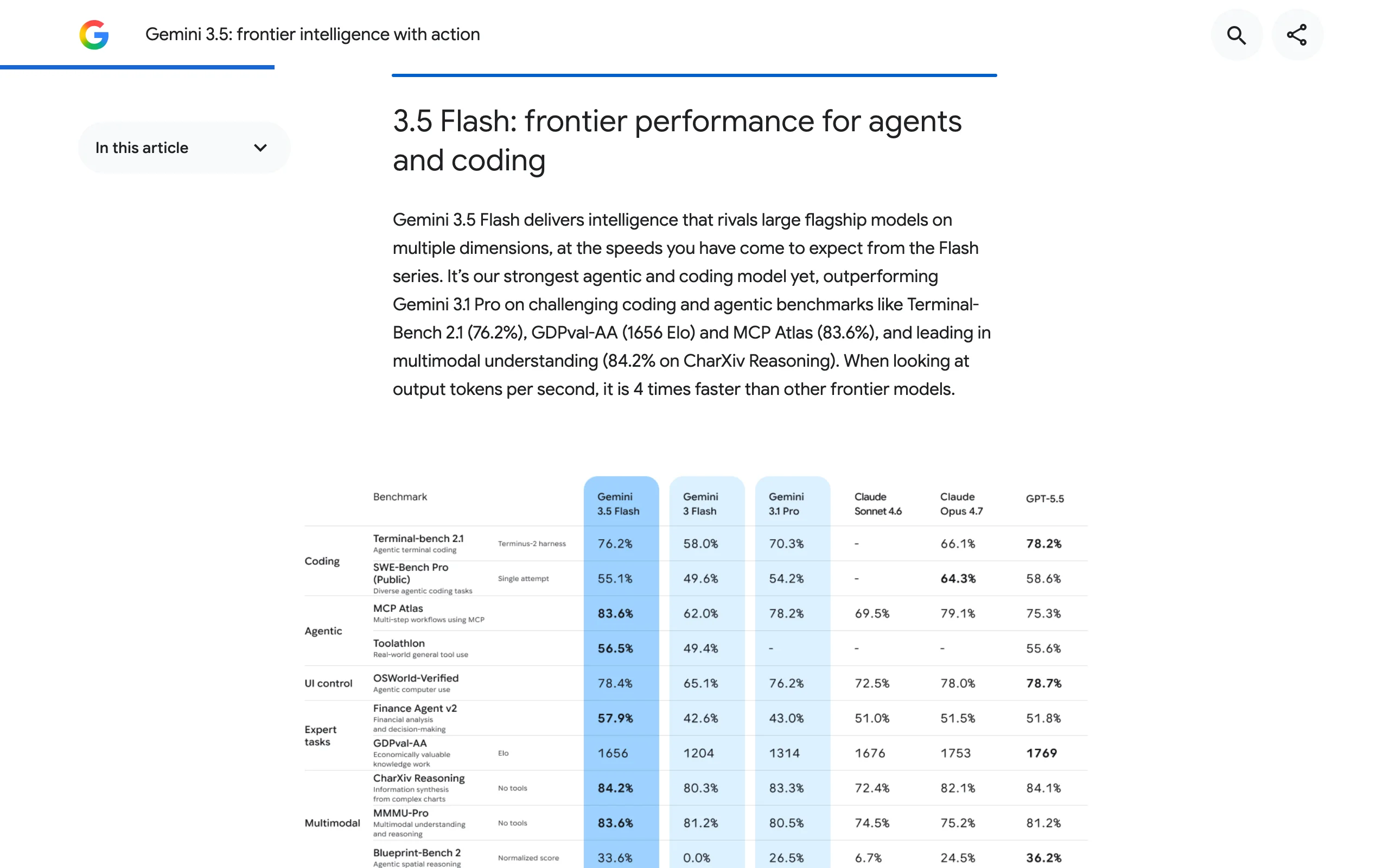
Gemini 3.5 Flash is Google's next-generation AI foundation model, positioned around "frontier intelligence + action capability," marking a major breakthrough in efficient inference and Agent capability fusion. It scores 76.2% on Terminal-Bench 2.1 coding, 1656 Elo on GDPval-AA agent tasks, and 83.6% on MCP Atlas—three key metrics all exceeding flagship Gemini 3.1 Pro. Output speed reaches 4× the frontier model average at less than half the cost, with native support for a 1M-token multimodal context window. Gemini 3.5 Flash is now globally available in Gemini App and Search AI Mode for consumers, developers, and enterprise users.
Image source: Official article
Technical positioning and domain: Belongs to NLP and multimodal AI, positioned as an efficient inference Agent model. Unlike traditional LLMs focused on general dialogue, Gemini 3.5 Flash specializes in complex coding, tool calling, and multi-step reasoning at extremely low latency—an "action-oriented" model designed for the Agent era.
R&D background: Developed by Google DeepMind on the new Gemini 3.5 architecture. Motivation came from the "reasoning speed vs. cost" bottleneck in Agent applications—frontier models are capable but high-latency and expensive, hindering large-scale Agent deployment. Advanced distillation and dynamic reasoning budget allocation preserve near-Pro capability while greatly reducing compute overhead.
Core value: Solves the long-standing capability-speed-cost triangle in Agent scenarios. While maintaining top coding and tool-calling ability, it achieves 289 tokens/second inference; API pricing is $1.50/$9.00 per million tokens (input/output)—more than half cheaper than Claude Opus 4.7, GPT-5.5, and similar competitors. Google estimates top Cloud customers migrating 80% of frontier workloads to 3.5 Flash could save over $1B annually.
Technical characteristics: Core advantages include distillation-compressed lightweight architecture for near-Pro capability at much smaller size; dynamic reasoning budget allocation (thinking_level parameter) auto-allocating compute by task type; native multimodal unified encoder embedding text, image, audio, and video in one semantic space; 1M-token ultra-long context for entire novels or hundred-page legal contracts in one pass.
2. Key Features
Ultra-fast inference and generation: 289 tokens/second output—4× other frontier models. After Antigravity internal co-optimization, specific Agent workflows achieve 12× end-to-end improvement, greatly reducing multi-round Agent call perceived latency for near-natural-dialogue real-time interaction.
Top-tier coding and Agent capability: Exceeds Gemini 3.1 Pro on Terminal-Bench 2.1 (76.2%), SWE-Bench Pro (55.1%), MCP Atlas (83.6%), and Toolathlon (56.5%). MCP Atlas 83.6% is current best on that benchmark, showing leadership in complex tool orchestration and multi-step reasoning.
Multimodal long-context understanding: Native 1M-token input window uniformly processes text, image, video, audio, and PDF. CharXiv Reasoning 84.2%, MMMU-Pro 83.6%—strong cross-modal reasoning for legal document review, long video analysis, and similar scenarios.
Sub-agent collaborative orchestration: Deploy parallel sub-agents via Antigravity 2.0 for large-scale Agent collaboration. Official demo: 93 subagents completed a full operating system in 12 hours for under $1,000, demonstrating practical value in large-scale Agent orchestration.
Dynamic reasoning level control:
thinking_levelparameter supports standard and extended modes. Switch thinking depth by task: code generation and tool calling default to low for speed; complex reasoning can use high for deeper analysis.Full-platform ecosystem coverage: Integrated into Gemini App, Search AI Mode, Antigravity 2.0, AI Studio, Android Studio, and Google products. Consumer, developer, and enterprise availability lowers deployment and usage barriers.
3. How to Use
Choose access platform: Consumers use Gemini App or Google Search AI Mode; developers prefer Google AI Studio or Antigravity 2.0 desktop; enterprises deploy via Vertex AI at scale.
Update API model identifier: Replace old preview API model names with official
gemini-3.5-flash. Check API version compatibility; ensure SDK is latest.Configure reasoning level (
thinking_level): Set by task type for optimal performance. Code generation and tool calling:lowfor maximum speed; general dialogue:mediumfor speed-quality balance; complex reasoning:highfor deep analysis.Remove sampling parameter overrides: Delete manual
temperature,top_p,top_kdefaults; let the model use internal optimized configs. Gemini 3.5 Flash optimizes defaults per task type—manual override may hurt results.Note feature migration exceptions: Workflows depending on Computer Use browser control must continue
gemini-3-flash-preview. Gemini 3.5 Flash does not yet support this—verify compatibility before migration.Performance tuning: For high-concurrency Agent scenarios, use Antigravity 2.0 parallel sub-agents leveraging low latency for parallel multi-task processing. Monitor token consumption; set context window size appropriately for cost optimization.
4. Pros and Cons
| Pros |
|---|
| Ultra-fast inference: 289 tokens/second—4× frontier models; up to 12× with Antigravity optimization—greatly reduces Agent multi-round call latency. |
| Significant cost advantage: API $1.50/$9.00 per million tokens—more than half cheaper than Claude Opus 4.7, GPT-5.5—strong advantage for large-scale deployment. |
| Leading Agent capability: MCP Atlas 83.6%; 93 parallel sub-agents; full OS in 12 hours under $1,000—optimized for complex Agent tasks. |
| Ultra-long context: 1M-token multimodal input for entire novels, hundred-page contracts, or long video—strong long-document analysis. |
5. Comparison with Similar Tools
| Dimension | Gemini 3.5 Flash | Claude Opus 4.7 | GPT-5.5 |
|---|---|---|---|
| Core architecture | Distillation-compressed, dynamic reasoning budget | Large Transformer, static compute budget | MoE, dynamic routing |
| Output speed | ~289 tokens/sec (4× lead) | ~67 tokens/sec | ~71 tokens/sec |
| Terminal-Bench 2.1 | 76.2% | Not published | 78.2% |
| MCP Atlas | 83.6% (leading) | 79.1% | 75.3% |
| Context window | 1M tokens | 200K tokens | 128K tokens |
| API pricing (in/out) | $1.50 / $9.00 per M tokens | ~$3.00 / $15.00 per M tokens | ~$2.50 / $10.00 per M tokens |
| Deployment | Cloud API + full platform ecosystem | Cloud API | Cloud API + Azure |
Selection advice: For Agent applications prioritizing extreme speed and cost efficiency, Gemini 3.5 Flash is optimal—MCP Atlas and Terminal-Bench 2.1 leadership plus 4× speed and half the cost make it the first choice for large-scale Agent deployment, especially frequent coding, tool operation, and multi-step reasoning.
For strongest complex reasoning, GPT-5.5 leads on GDPval-AA and similar agent benchmarks. Teams deeply in Google ecosystem (Google Cloud, Android Studio) gain significant dev efficiency from full integration. Users depending on Claude ecosystem or Computer Use still need Claude Opus 4.7.
6. Editor's Take
Gemini 3.5 Flash marks a key shift from "general dialogue" to "efficient action." Technically, distillation compression breakthrough is notable—compressing Gemini 3.1 Pro capability into smaller size with 4× speed gain is industry-first. Dynamic reasoning budget (thinking_level) cleverly resolves speed-quality trade-offs, letting users flexibly allocate compute by task.
Practically, Gemini 3.5 Flash excels in Agent scenarios. MCP Atlas 83.6% and 93 parallel sub-agent demo prove practical capability in complex tool orchestration and large-scale Agent collaboration. Enterprise Agent automation, financial document review, and real-time coding assistants will see significant efficiency gains from speed and cost advantages.
Audience fit: best for developers needing high-frequency AI coding and tool operation; enterprises deploying large-scale Agent automation; professionals handling ultra-long documents or multimodal content. For casual dialogue, capability may exceed needs—lighter models may suffice.
Future potential is strong. As Agent applications explode, demand for efficient inference models will rise. Google's compression and dynamic reasoning budget expertise should further optimize future versions. Watch Antigravity 2.0 updates and Computer Use return timeline.
Rationale: Excellent on speed, cost, and Agent capability; complex reasoning still has room; missing Computer Use affects some migrations. Highly competitive in specific scenarios.
7. Application Scenarios
Real-time AI coding assistant: Low latency suits IDE autocomplete, code review, and interactive debugging. Antigravity 2.0 defaults to this model for near-real-time suggestions and error detection during coding.
Enterprise Agent automation: Deploy parallel sub-agents for multi-week workflows—e.g., Xero automating 1099 vendor identification and collection. Antigravity 2.0 breaks complex business automation into parallel sub-agents, greatly shortening cycles.
Financial document intelligent review: Macquarie Bank uses Gemini 3.5 Flash for 100+ page complex financial documents, accelerating onboarding and compliance. Multimodal long context processes entire contracts, extracts key clauses, generates review reports.
Multimodal invoice and OCR processing: Ramp uses multimodal understanding and historical pattern reasoning for complex invoice recognition and classification—extracting text, understanding structure, detecting anomalies for financial automation.
Long video content analysis: 1M-token context processes entire long videos for key info extraction, summarization, or semantic search—for content moderation, educational video analysis, and more.
Academic research and literature review: Process entire academic books or large paper sets for cross-document semantic analysis and knowledge integration. Multimodal capability analyzes text, charts, and formulas together.
8. FAQ
Q: What are Gemini 3.5 Flash's main advantages over Gemini 3.1 Pro?
A: Speed, cost, and Agent capability. Output is 2×+ faster (289 vs 135 tokens/sec), API pricing lower, and it exceeds 3.1 Pro on Terminal-Bench 2.1, MCP Atlas, and key Agent benchmarks. 3.1 Pro may still lead on some complex reasoning tasks.
Q: Does it support local deployment?
A: Currently via Google Cloud API only—no local deployment. Access through Gemini App, Google AI Studio, Antigravity 2.0. Watch Google's future open-source plans for local scenarios.
Q: How to choose thinking_level?
A: Code generation and tool calling: low for max speed; general dialogue: medium for balance; complex reasoning: high for depth. Start with medium if unsure.
Q: How does the 1M-token context perform in practice?
A: Model handles 1M-token input effectively, but inference speed drops on very long context. Set context size appropriately; consider segmenting ultra-long documents for better performance.
Q: Why remove sampling parameter defaults?
A: Gemini 3.5 Flash optimizes internal sampling per task type. Manual temperature, top_p, top_k may override optimized configs and hurt results. Use defaults unless fine-tuning for specific scenarios.
Q: When will Computer Use be supported?
A: Google has not announced a timeline. Users needing Computer Use must continue gemini-3-flash-preview. Follow Google AI blog and API changelog for updates.
9. Project Links
- Project site: https://blog.google/innovation-and-ai/models-and-research/gemini-models/gemini-3-5/#gemini-3-5-flash
- Google AI Studio: https://aistudio.google.com/
- Gemini API docs: https://ai.google.dev/gemini-api/docs/models#gemini-3-5-flash
- Antigravity 2.0: https://antigravity.google/
Related AI Model Articles
OpenMuse – CopilotKit Open-Source Personal AI Assistant
OpenMuse is an open-source personal AI assistant project developed by the CopilotKit team. Its core design philosophy is "giving an Agent a computer" — by combining a persistent browser, optional Linu...
In-Depth Review of Longcat-2.5-preview: Meituan's Next-Generation Multimodal Long-Range Agent Model
LongCat-2.5-preview is Meituan's latest next-generation large model. Building upon the 1.6T total parameters, approximately 48B active parameters, and native 1M token context of LongCat-2.0, it marks ...
Review of DeepSeek Harness Desktop: How the Official GUI Client Lowers the Bar for Agent Usage
DeepSeek Harness Desktop is the official graphical client launched by DeepSeek, designed to provide a visual interface for the originally command-line-based DeepSeek Harness framework. After users log...
Step Code – In-Depth Review of StepFun's Open-Source Terminal Programming Agent
Step Code is an open-source terminal programming agent launched by StepFun, licensed under the MIT License, which allows developers to complete the full workflow of code writing, debugging, execution,...
© All Rights Reserved. Some content on this site is partially generated by AI with human review.