
ZCube – Zhipu AI and Tsinghua's Next-Generation LLM Inference Network Architecture
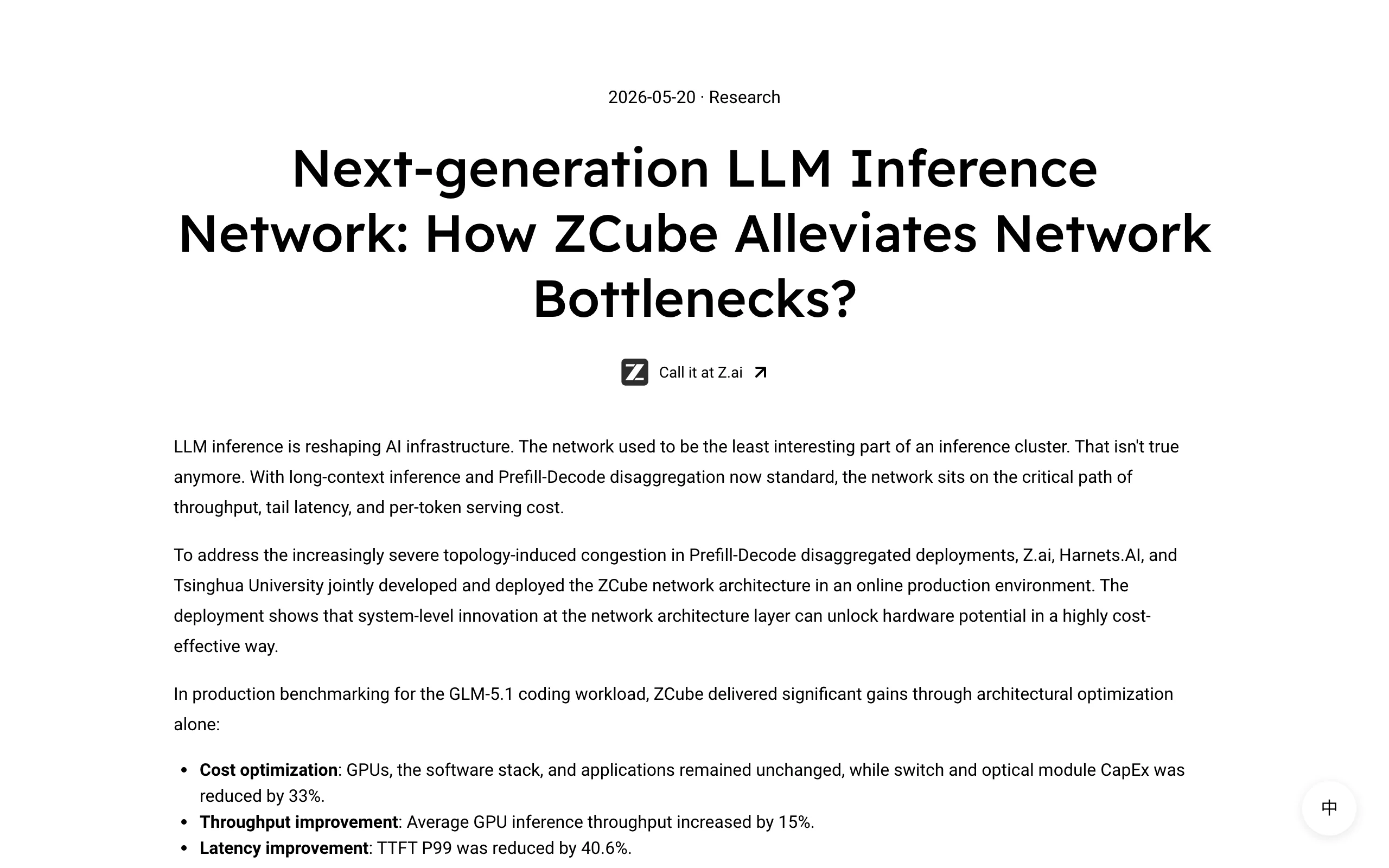
Executive Summary:
ZCube is a next-generation large model inference network architecture jointly launched by Zhipu AI, Yuxun Network, and Tsinghua University, designed to solve the structural network congestion inherent...
1. What Is ZCube
ZCube is a next-generation large model inference network architecture jointly launched by Zhipu AI, Yuxun Network, and Tsinghua University, designed to solve the structural network congestion inherent in PD (Prefill-Decode) disaggregated deployment. By eliminating Spine-layer switches in traditional Clos networks and adopting a fully flat topology with single/multi-rail hybrid access, ZCube achieves structural decoupling and discretized routing of global traffic. In production testing on the GLM-5.1 coding environment, ZCube reduced switch and optical module CapEx by 33% while keeping GPU hardware and software stacks unchanged, increased average GPU inference throughput by more than 15%, and cut TTFT (Time To First Token) P99 by 40.6%.
Image source: Official article
Technical positioning and domain: ZCube belongs to high-performance data center network architecture, optimized for large-scale LLM inference clusters with PD disaggregated deployment. Unlike general-purpose network architectures, it customizes for AI inference workload traffic patterns—especially cross-node KV Cache transmission—representing key innovation at the AI infrastructure layer.
R&D background: Jointly developed by Zhipu AI, Yuxun Network, and Tsinghua's computer network team. Motivation came from Clos/ROFT architectures failing to handle dynamic asymmetric traffic in PD disaggregation, causing local link congestion and PFC backpressure that severely limits inference performance and scalability. The team sought a fundamental solution at the network topology level.
Core value: ZCube eliminates structural network congestion in PD disaggregated deployment through architectural innovation without relying on complex transport-layer adaptive routing. It dramatically reduces network cost (saving hundreds of millions on 10K-GPU clusters), significantly improves inference performance (throughput +15%, TTFT P99 −40.6%), and requires zero changes to existing hardware and software stacks—direct replacement of current network architecture.
Technical characteristics: ZCube replaces traditional Clos hierarchical structure with a complete bipartite graph topology, compressing network diameter from 3 hops to 2. Through single-rail/multi-rail differentiated access on dual GPU NIC ports, it achieves deterministic shortest-path routing and global load balancing, fundamentally eliminating traffic conflicts and structural congestion from multi-path routing.
2. Key Features
Flat bipartite networking: Breaks traditional Clos Spine-Leaf hierarchy by eliminating the Spine layer, retaining only Leaf switches connected in a complete bipartite graph. All Leaf switches split into odd/even groups with no intra-group connections; every switch in one group fully connects to all switches in the other, compressing network diameter from 3 to 2 hops, reducing latency and path complexity.
Single/multi-rail hybrid access: Configures GPU NIC dual ports with single-rail (odd-numbered Leaf switches) and multi-rail (even-numbered Leaf switches) access. Single-rail connects consecutive GPU IDs to the same Leaf group; multi-rail connects same-ID GPUs to the other group, naturally discretizing dynamic asymmetric traffic from PD disaggregation at the topology level.
Deterministic shortest-path routing: Based on modulo and ceiling mathematical mapping between GPU IDs and Leaf switch IDs, ensuring exactly one optimal path between any two GPUs. This deterministic routing avoids multi-path conflicts and load imbalance, achieving ideal global load balance in both training and inference.
Structural congestion elimination: Through architectural innovation, globally decouples and discretizes dynamic asymmetric traffic from cross-node KV Cache transmission. Unlike transport-layer adaptive routing or packet spraying, ZCube eliminates local hotspot links and PFC (Priority Flow Control) backpressure conditions from topology itself.
Zero-intrusion deployment: No changes to GPU hardware, network software stack, or application logic—performance gains through topology and access configuration alone. Existing inference clusters can upgrade smoothly without repurchasing hardware or modifying inference framework code.
Hyperscale expansion: Based on mainstream 51.2T switch chips, ZCube can build flat networks connecting 16,384 400Gbps NICs. Multi-plane partitioning further supports tens of thousands to hundreds of thousands of GPU interconnections for hyperscale AI compute centers.
3. How to Use
Network architecture planning: Determine Leaf switch count from GPU cluster scale; split Leaf switches into odd/even groups (e.g., Leaf 0,2,4... odd; Leaf 1,3,5... even). Design complete bipartite interconnection—no intra-group connections; every switch fully connects to the other group. Eliminate traditional Spine layer, compressing diameter from 3 to 2 hops.
GPU NIC port access configuration: Configure dual GPU NIC ports with single-rail and multi-rail hybrid access. One port (e.g., Port 0) single-rails to odd Leaf switches; the other (e.g., Port 1) multi-rails to even Leaf switches. Use mathematical mapping (GPU ID modulo Leaf ID) for specific connections, ensuring deterministic routing.
Automated deployment toolchain: Use ZCube's controller, datacenter layout design tool, and connection verification program for auto-generated configuration and batch deployment. The controller generates optimal Leaf allocation from GPU count and topology parameters; layout tools assist physical wiring; verification validates all connections post-deployment.
Production validation and monitoring: Before inference service launch, run comprehensive bandwidth, latency, and PFC event monitoring. Check for structural congestion hotspots; confirm load balance across all links. After validation, gradually migrate inference traffic from legacy network to ZCube architecture, continuously monitoring TTFT, throughput, and other KPIs.
Notes: Run ZCube simulation tools pre-deployment to verify topology parameters match actual inference load. For existing Clos clusters, plan migration windows to avoid service interruption.
4. Pros and Cons
| Pros |
|---|
| Major cost reduction: At same scale, ZCube reduces switch and optical module investment ~33% vs. traditional Clos/ROFT. 10K-GPU AI centers save ~210M–640M CNY in network hardware—significant economic benefit. |
| Significant inference gains: GLM-5.1 coding production tests show 15%+ average GPU inference throughput and 40.6% TTFT P99 reduction—more concurrent requests or lower response latency on same hardware. |
| Zero-intrusion upgrade: No GPU hardware, network software, or application changes—unlock existing hardware potential through network-layer tuning alone, greatly reducing migration risk and technical barriers. |
| Strong scalability: 51.2T switches build flat 16,384-GPU networks; multi-plane partitioning supports tens to hundreds of thousands of GPUs— ample headroom for future large clusters. |
5. Comparison with Similar Tools
| Dimension | ZCube | ROFT (Rail-Optimized Fat-Tree) | Traditional Clos |
|---|---|---|---|
| Network architecture | Flat bipartite, no Spine | Two-layer Fat-Tree, Spine retained | Multi-layer Clos, Spine-Leaf hierarchy |
| Network diameter | 2 hops | 3 hops | 3–5 hops |
| Load balancing | Global ideal balance, conflict-free single path | Static Rail mapping, inference imbalance prone | ECMP multi-path, hash conflicts common |
| Congestion control | Eliminates structural congestion at architecture layer | Local hotspots and PFC backpressure prone | Relies on global load balance, limited effect |
| Hardware cost | 33% lower switches and optics | Standard Clos cost | Standard cost |
| Inference throughput | +15% (measured) | Baseline | Baseline |
| TTFT P99 | −40.6% (measured) | Baseline | Baseline |
| Scale | Tens to hundreds of thousands of GPUs | Limited by Spine capacity | Limited by Spine capacity |
| Deployment complexity | Medium (precise math mapping) | Low (standard Fat-Tree) | Low (mature) |
Selection advice: For large-scale AI centers (1K–10K GPUs) with PD disaggregated inference as primary workload, ZCube is optimal—clear advantages in inference performance, cost control, and scalability, especially for extreme inference efficiency and lower TCO. Ideal for MaaS providers or large AI companies' high-density inference clusters.
For training-heavy mixed workloads or small clusters (100 GPUs) prioritizing deployment simplicity, traditional Clos or ROFT may suit better—more mature ecosystems and ops experience. Performance lags ZCube optimization but lower deployment and maintenance cost. ROFT especially suits training-heavy scenarios with Rail mapping friendly to training traffic.
6. Editor's Take
ZCube represents an important innovation in data center network architecture for LLM inference. Technically, it is not a simple improvement but a rethink of PD disaggregated deployment network requirements from topology. The complete bipartite topology plus single/multi-rail hybrid access cleverly solves long-standing dynamic asymmetric traffic problems; deterministic routing via mathematical mapping is elegant and concise.
In practical value, ZCube's most impressive aspect is verified production results. GLM-5.1 coding measured data (throughput +15%, TTFT P99 −40.6%) is highly credible—especially gains without changing GPU hardware or software. 33% network cost reduction on 10K-GPU clusters means hundreds of millions in savings—precious amid growing AI infrastructure investment.
However, ZCube faces challenges. Architecture is highly specialized for PD disaggregated inference; universality for training or mixed workloads needs further validation. Complete bipartite wiring and precise mapping increase deployment complexity, potentially limiting adoption in ops-weaker enterprises. As emerging architecture, ecosystem and community support remain thin.
Target audience: ZCube best suits large AI companies, cloud providers, and AI center operators building or upgrading large inference clusters. Smaller teams and research institutions should wait for ecosystem maturity.
Future potential: As LLM inference demand grows and PD disaggregation becomes mainstream, ZCube could become a leading next-gen inference network architecture candidate. Zero-intrusion upgrade offers a smooth migration path; future combination with RDMA and congestion control could further improve performance.
Rationale: Outstanding technical innovation (5/5), high practical value (4/5), immature ecosystem (3/5), strong scalability (5/5). Deductions for scene specialization and deployment complexity.
7. Application Scenarios
Hyperscale LLM inference clusters: For 1K–10K GPU PD disaggregated inference clusters. ZCube eliminates network bottlenecks from cross-node KV Cache transmission, significantly reducing first-token latency and improving overall throughput so same hardware handles more concurrent inference requests.
Long-context inference services: For inference handling 10K+ token contexts (document analysis, code understanding), ZCube effectively mitigates network bandwidth constraints on TTFT and throughput. Flat topology and deterministic routing prevent KV Cache transmission from forming local hotspots on long sequences.
High-density AI compute centers: Provides high-balance, low-latency, high-bandwidth network foundation for mixed training and inference workloads. ZCube achieves global load balance in training too, avoiding multi-path conflicts—suitable for centers running both training and inference.
MaaS cloud platforms: Reduces comprehensive network cost for inference services (33% less hardware) while improving tail latency stability in multi-tenant high-concurrency scenarios. Lower TTFT P99 means more stable SLA and better user experience for usage-based MaaS platforms.
8. FAQ
Q: Does ZCube support existing GPU and network hardware?
A: Yes. ZCube has no special GPU, NIC, or switch requirements—only dual-port GPU NIC access (most modern GPUs like NVIDIA ConnectX support this). Architecture changes only topology and access; no hardware or driver modifications.
Q: How does ZCube deployment difficulty compare to traditional Clos?
A: ZCube deployment complexity is medium-high. Main challenges: precise mathematical mapping for GPU NIC port to Leaf connections, and stricter complete bipartite physical wiring. ZCube provides controller and layout tools for automated deployment, reducing manual configuration errors.
Q: How does ZCube perform in training scenarios?
A: Deterministic single-path routing achieves global load balance in training too, avoiding ECMP multi-path hash conflicts. But training traffic patterns differ from inference; ZCube advantages mainly appear in PD disaggregated inference. ROFT may suit pure training loads better.
Q: Is ZCube open source? Can I deploy it myself?
A: Architecture design and technical details are public on the project site and paper, but controller, layout tools, and supporting software open-source status is pending confirmation. Follow https://z.ai/blog/zcube for updates.
Q: What is ZCube's scalability ceiling?
A: With current 51.2T switch chips, ZCube builds flat networks connecting 16,384 400Gbps NICs. Multi-plane partitioning theoretically supports tens to hundreds of thousands of GPUs. Actual scale limits depend on switch port density and physical wiring constraints.
9. Project Links
- Project site: https://z.ai/blog/zcube
Related AI Model Articles
In-Depth Review of Longcat-2.5-preview: Meituan's Next-Generation Multimodal Long-Range Agent Model
LongCat-2.5-preview is Meituan's latest next-generation large model. Building upon the 1.6T total parameters, approximately 48B active parameters, and native 1M token context of LongCat-2.0, it marks ...

In-Depth Review of Spark-ASR-2.0: A New Paradigm in Speech Recognition with Non-Autoregressive Architecture
Spark-ASR-2.0 is the latest generation speech recognition large model launched by iFLYTEK based on its proprietary Spark-Audio speech foundation model. This model continues the non-autoregressive para...
Step Code – In-Depth Review of StepFun's Open-Source Terminal Programming Agent
Step Code is an open-source terminal programming agent launched by StepFun, licensed under the MIT License, which allows developers to complete the full workflow of code writing, debugging, execution,...
Xiaomi MiMo-V2.6 – Xiaomi's Open-Source Multimodal Model Series
Xiaomi MiMo-V2.6 is a series of fully multimodal models released and open-sourced by Xiaomi, comprising two native full-modal models: Pro and Flash. It is centered on large-scale Agentic reinforcement...
© All Rights Reserved. Some content on this site is partially generated by AI with human review.