
Dubbing v2 – ElevenLabs' AI Dubbing Model
Executive Summary:
Dubbing v2 is ElevenLabs' latest offering in AI dubbing—an end-to-end multilingual dubbing platform that integrates speech recognition, neural machine translation, voice cloning, and synthesis. It can...
1. What Is Dubbing v2
Dubbing v2 is ElevenLabs' latest offering in AI dubbing—an end-to-end multilingual dubbing platform that integrates speech recognition, neural machine translation, voice cloning, and synthesis. It can automatically translate and dub video or audio content into 29 languages while preserving the original speaker's timbre, emotion, and intonation, fundamentally changing the high-cost, low-efficiency workflow of traditional dubbing. With a dual-workflow design (fast auto-dubbing and fine-grained project editing), it balances efficiency and quality for content creators and delivers an unprecedented solution for global content localization.
Technical positioning and domain: Dubbing v2 sits at the intersection of AI speech synthesis and natural language processing, focused specifically on multilingual AI dubbing. Unlike basic TTS, it unifies multi-speaker recognition, voice cloning, context-aware translation, and timeline editing into a single, easy-to-use product.
Development background: Dubbing v2 was developed by the ElevenLabs team. Since its founding in 2022, ElevenLabs has focused on high-quality AI speech synthesis, with its Prime Voice models leading the industry in realism and emotional expression. Dubbing v2 merges core speech synthesis with machine translation and audio processing to solve the "voice consistency" challenge in multilingual content distribution.
Core value: Dubbing v2 enables "cross-language voice transfer." It eliminates the need to rehire voice actors, high recording costs, and long production cycles. Creators can convert source content into many languages with one click while keeping the original voice's character, giving audiences in different languages an experience close to the original.
Technical characteristics: Dubbing v2 uses a multimodal pipeline integrating deep-learning ASR, context-aware NMT, advanced Speaker Encoder, and TTS models. It automatically separates and identifies multiple speakers, preserves each speaker's timbre and emotional prosody during translation and synthesis, and provides fine-grained timeline editing for lip-sync quality and high output quality.
2. Key Features
High-quality voice cloning and synthesis: The core capability. Speaker Encoder extracts unique timbre features from source audio; ElevenLabs' TTS generates natural target-language speech in that voice, preserving emotion, intonation, and rhythm for highly realistic dubbing.
Automatic multi-speaker recognition and separation: Built-in multi-speaker detection analyzes audio or video, identifies speakers, and splits independent tracks. It handles multi-person dialogue and overlapping speech, accurately cloning and replacing each role without manual segmentation.
Dual workflow modes: "Auto Dub" for fast preview and initial screening—upload, choose languages, get a full dub in minutes. "Dubbing Project" provides a full timeline editor for segment-by-segment adjustment of transcription, translation, timestamps, and generated speech.
Timeline editor: Enables professional dubbing. Users see waveforms and text per utterance, edit transcription, refine translation, adjust alignment, or regenerate individual segments instead of the entire file.
Multi-format import and export: Supports MP3, MP4, WAV, MOV, and direct links from YouTube, TikTok, Vimeo, X (formerly Twitter). Exports MP4 (with video), AAC/WAV (audio only), SRT (subtitles), and AAF (professional audio engineering).
API integration and batch processing: A full API lets developers and enterprises integrate Dubbing v2 into workflows for automated, large-scale localization. Supports up to 2.5 hours of continuous audio/video per request.
3. How to Use
Requirements: An ElevenLabs account. Dubbing v2 is cloud SaaS—no local software or GPU setup. Access via a modern browser (Chrome, Edge, Safari). API integration requires an API key.
Quick dubbing workflow:
- Log in at the ElevenLabs site and open Dubbing Studio.
- Choose "Auto Dub," upload audio/video (MP3/MP4/WAV/MOV), or paste a YouTube/TikTok link.
- Select source and target language(s)—multiple targets in parallel.
- Click "Dub," wait for processing, then preview and download.
Fine editing workflow:
- Choose "Dubbing Project" in Dubbing Studio.
- Upload or paste a link, select languages, create a project.
- After automatic transcription, translation, and dubbing, enter the timeline editor.
- Check transcription, edit translation, adjust alignment, or click "Regenerate" for specific segments.
Key configuration:
- Speaker identification: Auto-labels speakers; manually merge, split, or rename tracks in the editor.
- Voice cloning modes: Segment-level clone, track-level clone, or pick a voice from a pre-built library.
Tips:
- Use clear source audio with low background noise for best recognition and cloning.
- Single projects/API calls support up to 2.5 hours; split longer content.
- Review translation and dubbing before publishing, especially for professional projects.
4. Pros and Cons
| Pros |
|---|
| Exceptional timbre fidelity: Industry-leading voice cloning preserves timbre, emotion, and intonation far beyond mechanical TTS. |
| Strong multi-speaker handling: Automatic separation is a core differentiator, simplifying multi-voice dubbing. |
| Flexible editing workflow: Dual modes balance speed and quality; timeline editor enables full control. |
| Significant cost savings: Far lower cost and time vs. traditional dubbing, accessible to creators and small studios. |
5. Comparison with Similar Tools
| Dimension | Dubbing v2 (ElevenLabs) | Speechify | Respeecher |
|---|---|---|---|
| Core architecture | End-to-end pipeline: ASR, NMT, voice clone | TTS/read-aloud focused; basic dubbing | Voice clone/conversion; not full dubbing platform |
| Translation | Built-in 29 languages, context-aware | Multilingual read-aloud; limited built-in translation | No built-in translation |
| Timbre preservation | Very high—precise Speaker Encoder clone | Medium—presets or simple clone | Very high—specialized high-fidelity clone |
| Multi-speaker | Auto ID and separation | Not supported—single voice | Manual specification |
| Editing | Fine—per-sentence timeline, segment regenerate | Basic—speed, tone adjustments | Limited—conversion focused |
| Target users | Creators, marketers, small studios | Individuals, students, business | Games, film, animation teams |
Selection advice:
- Independent creators and marketers needing speed: For YouTube, podcasts, or social localization while keeping your voice, Dubbing v2 is the top choice with auto multi-speaker ID and dual workflows.
- Professional film/game teams: For complex multi-role, long-form content with lip-sync and emotional nuance, Deepdub fits better. For replacing a character in existing audio, Respeecher excels at high-fidelity cloning.
6. Editor's Review
Dubbing v2 is a major leap in AI dubbing. It integrates multi-speaker recognition, high-fidelity cloning, context-aware translation, and fine editing into one cohesive product—not feature stacking, but systematic innovation addressing localization pain points. Auto multi-speaker separation and emotional preservation lead the category.
It dramatically lowers the barrier to global content. Traditional dubbing cost and timelines blocked many creators and SMBs. Now they can translate videos into nearly 30 languages in minutes at low cost while keeping original voices—revolutionary for podcasts, online education, and cross-border e-commerce ads. "Create once, distribute globally" becomes practical.
Target audience: Video creators, podcasters, course instructors, cross-border sellers, social media operators, small film studios, and global marketing teams.
Future potential: Better translation, richer clone details (breath, accent), longer/complex content handling, and possibly real-time multilingual live dubbing.
Rationale: Excellent across technology, product experience, and business value. Minor issues (source sensitivity, manual translation tweaks) don't outweigh disruptive efficiency gains. Essential for anyone with global content needs.
7. Use Cases
Podcast localization: Translate episodes into 29 languages without re-recording per language, expanding audience while keeping host voice and warmth.
Cross-border e-commerce ads: One high-quality ad localized to target markets via Dubbing v2, cutting multi-market production cost and preserving brand voice globally.
Online education: Batch-translate course videos while keeping instructor voice for better immersion and comprehension for non-native learners.
Film distribution: Independent filmmakers generate multilingual dubs affordably for international release without professional voice studios.
Corporate training: Multinationals dub internal training, demos, and culture content for local offices with consistent messaging and brand voice.
8. FAQ
Q: Does Dubbing v2 really preserve original emotion?
A: Yes. ElevenLabs leads in prosody preservation—intonation, stress, pace, and emotional variation reproduced in the target language. Extreme performances may not be 100% replicated; manual fine-tuning helps for perfection.
Q: How long to process a 1-hour video?
A: Depends on complexity (speaker count, audio quality) and server load. Auto Dub typically finishes in tens of minutes; Dubbing Project may take longer due to deeper analysis.
Q: How does ElevenLabs handle copyrighted uploads?
A: Per privacy policy, uploads are used only for your dubbing request, not for model training or third-party disclosure. Ensure you have rights to uploaded content and read terms carefully.
Q: Which languages are supported?
A: 29 languages including English, Chinese (Simplified and Traditional), Spanish, French, German, Japanese, Korean, Portuguese, Arabic, Russian, Hindi, and more. See the official site for the full list.
Q: How to batch process via API?
A: Generate an API key, follow docs, call /v1/dubbing with source file, languages, and optional callback URL for async completion notifications. Supports multiple concurrent tasks.
Q: What is the pricing?
A: Tiered plans from free to pro and enterprise. Free tier has monthly character limits and feature caps. Paid plans add duration, concurrency, Dubbing Project, API access, etc. See official pricing.
9. Project Links
- Official site: https://elevenlabs.io/dubbing-studio
Related AI Model Articles
Xiaomi MiMo-V2.6 – Xiaomi's Open-Source Multimodal Model Series
Xiaomi MiMo-V2.6 is a series of fully multimodal models released and open-sourced by Xiaomi, comprising two native full-modal models: Pro and Flash. It is centered on large-scale Agentic reinforcement...
In-Depth Review of Step 5 Preview: A 600B Sparse MoE Flagship with 1M Token Context and 1/8 Cost Advantage
Step 5 Preview is a new-generation flagship foundation model launched by StepFun, designed for real-world Agentic tasks. Based on a sparse MoE architecture, the model has a total of 600B parameters bu...
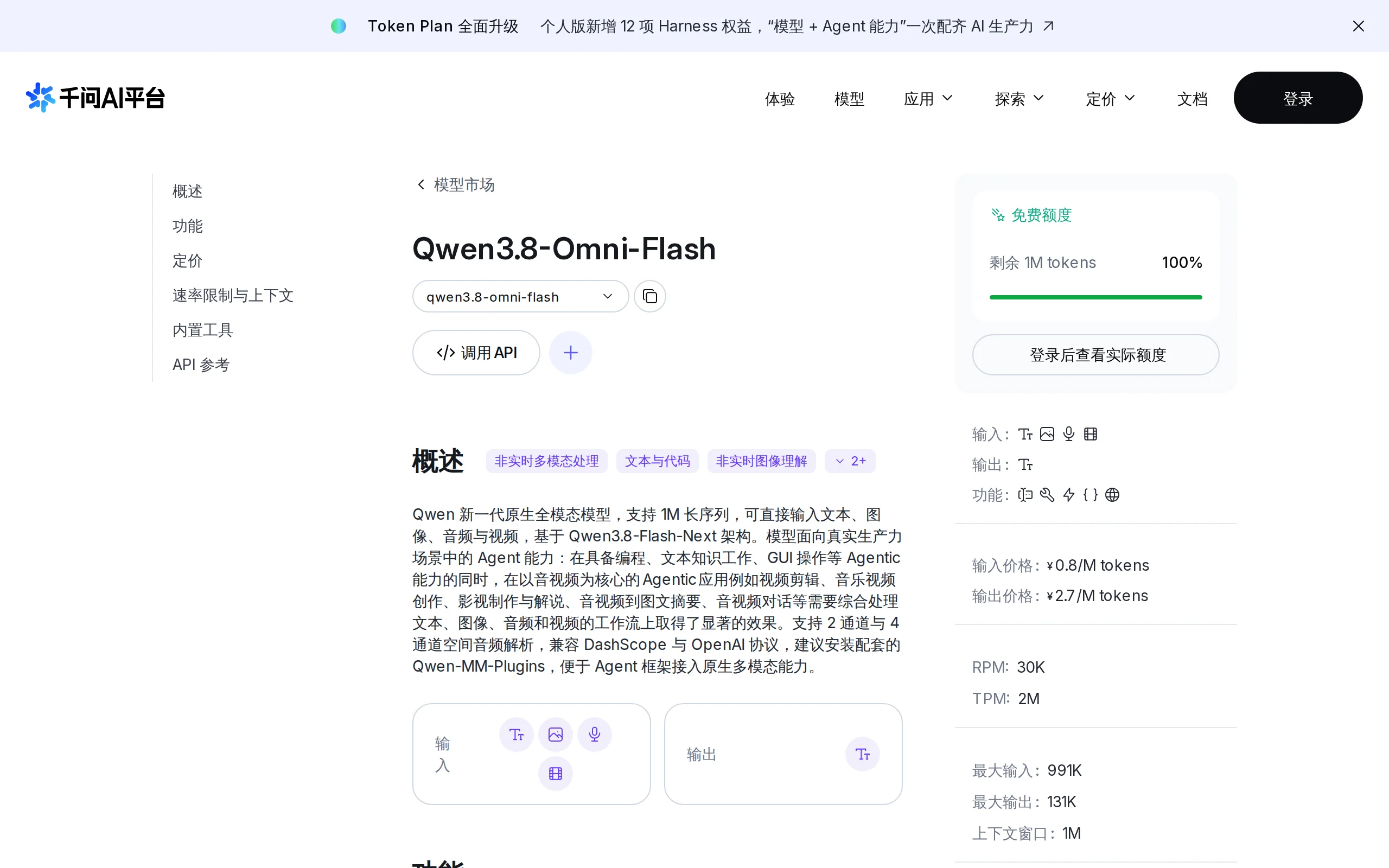
Qwen3.8-Omni-Flash – A Native Multimodal Model Launched by Alibaba Qwen
Qwen3.8-Omni-Flash is a native multimodal model launched by Alibaba Qwen. It jointly models four modalities—text, image, audio, and video—within a single architecture, supporting a context length of u...
Union Alpha – A Mysterious Multimodal Large Model with Unlimited Free Access for a Limited Time
Union Alpha is a multimodal large language model released in "stealth" mode, recently launched on mainstream AI service platforms such as OpenRouter, Cline, and OpenCode. The model supports dual-modal...
© All Rights Reserved. Some content on this site is partially generated by AI with human review.