
DiffusionGemma – Google’s Experimental Open-Source Text Diffusion Model
Executive Summary:
DiffusionGemma is an experimental open-source text diffusion model from Google DeepMind, built on Gemma 4 architecture and Gemini Diffusion research. The 26B-parameter MoE design denoises 256-token te...
1. What Is DiffusionGemma?
DiffusionGemma is an experimental open-source text diffusion model from Google DeepMind, built on Gemma 4 architecture and Gemini Diffusion research. The 26B-parameter MoE design denoises 256-token text blocks in parallel, achieving 1,000+ tokens/s on a single NVIDIA H100—about 4× faster than comparable autoregressive models. Bidirectional attention and real-time self-correction are supported; quantized runs need only 18GB VRAM on consumer GPUs—a major shift from autoregressive text generation toward diffusion.
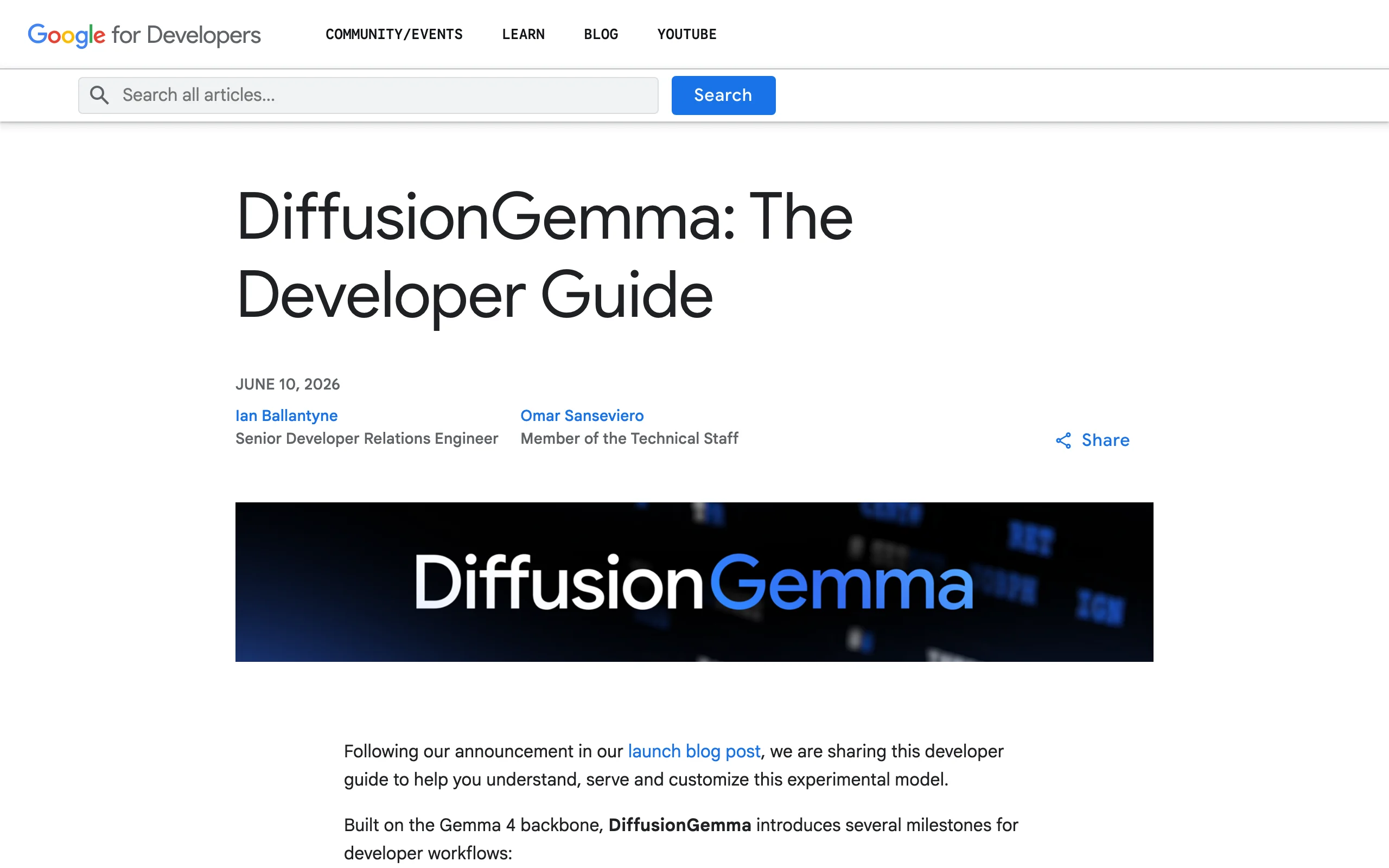
Image source: Official article
Technical positioning and domain: Discrete text diffusion in NLP text generation. Unlike GPT/Llama-style autoregressive models, it uses non-autoregressive parallel generation, migrating image-diffusion success to text for low-latency, high-throughput local inference and nonlinear tasks (code infilling, structured output) with global constraints.
Research background: Google DeepMind, leveraging Gemma 4 MoE and Gemini Diffusion. Motivation: autoregressive local inference is memory-bandwidth bound—GPUs idle while generating token-by-token; diffusion parallel denoising shifts the bottleneck to compute and raises utilization.
Core value: Faster, lower-latency local inference for single-user scenarios; bidirectional attention enables in-task correction and global context for code infilling and constraint satisfaction. Apache 2.0 and day-zero framework support lower adoption friction.
Technical characteristics: Uniform State Diffusion (random placeholder canvas → iterative token locking); hybrid attention (causal prefill, bidirectional denoising); compute-bound parallel workloads keeping Tensor Cores busy.
2. Key Features
Parallel text generation: One forward pass denoises 256 tokens at once—O(n/256) latency scaling; 1,000+ tokens/s on H100.
Bidirectional context: Tokens attend within the block—code infilling, inline edits, global constraints vs left-to-right-only autoregression.
Real-time self-correction: Low-confidence tokens can be re-noised and replaced in later steps—avoids autoregressive “one mistake propagates forever.”
Multimodal input: Text, image, video interleaving → text out; 256K context (current focus remains text diffusion).
Long-sequence block generation: Block-autoregressive diffusion commits denoised 256-token blocks to KV cache, then continues—parallel speed with sequence stability beyond one block.
Consumer hardware: ~18GB VRAM quantized on RTX 4090/5090 and DGX Spark; sparse MoE activation (~3.8B active) plus quantization.
Day-zero ecosystem: vLLM, Hugging Face Transformers, MLX, Unsloth, SGLang at launch.
Hackable Diffusion toolbox: JAX research stack and official recipes for fine-tuning experiments.
3. How to Use
Environment: H100, A100, or RTX 5090/4090 with FP16/BF16; ≥18GB VRAM (quantized) or 24GB+ (full). Linux (Ubuntu 22.04+) or macOS (MLX on Apple Silicon). Python 3.10+, CUDA 12.1+, PyTorch 2.1+; vLLM 0.6.0+ for vLLM deployment.
vLLM local server:
pip install vllmthen:python -m vllm.entrypoints.openai.api_server --model google/diffusiongemma-26B-A4B-it --diffusion-sampler --canvas-size 256
OpenAI-compatible API thereafter.Hugging Face weights: https://huggingface.co/google/diffusiongemma-26B-A4B-it — ~50GB disk;
git lfsor Transformers auto-download.Other frameworks: Transformers, SGLang (
--diffusion), MLX (mlx_lm.generate --model google/diffusiongemma-26B-A4B-it --diffusion).Fine-tuning: Clone JAX research repo (see project links); follow official
train.pyrecipes.Tips: Best for low-concurrency interactive use—not high-concurrency production. Quantize with bitsandbytes/GPTQ if VRAM-tight. Code infilling: canvas 256 + bidirectional attention. Reduce
max_tokensor canvas (e.g., 128) if OOM.
4. Pros and Cons
| Pros |
|---|
| Extreme local speed: ~4× vs same-class autoregressive; 1,000+ tokens/s H100; 700+ RTX 5090. |
| Runs on consumer GPUs: 18GB quantized; no server cluster required. |
| Bidirectional attention + self-correction: Strong for infilling and structured output. |
| Day-zero framework support: vLLM, Transformers, MLX, etc. |
5. Comparison with Similar Tools
| Dimension | DiffusionGemma | Gemma 4 (autoregressive) | Llama 3 70B |
|---|---|---|---|
| Architecture | Discrete text diffusion; 26B MoE (~3.8B active) | Autoregressive MoE | Autoregressive dense 70B |
| Bottleneck | Compute-bound | Memory-bandwidth-bound | Memory-bandwidth-bound |
| Speed (H100, single GPU) | 1,000+ tokens/s | ~250–300 tokens/s | ~200–250 tokens/s |
| Attention | Bidirectional (denoise) | Causal | Causal |
| Self-correction | Yes | No | No |
| Output quality | Lower; not production-grade primary | High | High |
| Deployment | Local ~18GB quantized | Local 200GB+ VRAM | Local 140GB+ VRAM |
| License | Apache 2.0 | Custom (commercial limits) | Llama 3 community |
| Best for | Local, low-concurrency, speed-sensitive | High-concurrency cloud, quality-sensitive | Cloud/research |
Selection advice: DiffusionGemma for IDE completion, live editing, speed-first local workflows and nonlinear tasks. For news, academic, or highest-quality prose, prefer autoregressive Gemma 4 or Llama 3 70B. Cloud high-concurrency production still favors autoregressive stacks. Budget local users: DiffusionGemma quantized vs multiples of VRAM for dense autoregressive models.
6. Editor’s Take
DiffusionGemma is a bold move: discrete denoising at 256-token parallelism changes the autoregressive bottleneck. Hybrid causal-then-bidirectional attention is elegant for prompts vs in-block constraints. Shifting GPUs from bandwidth-idle to compute-saturated yields ~4× speedups.
Practical value: 18GB opens local generation to RTX 4090 owners and privacy-sensitive workflows. Quality remains the gap—coherence, facts, style trail autoregressive peers. Use as a speed-first assistant, not the quality anchor.
Audience: IDE/plugin developers, diffusion researchers, local prototyping teams—not yet general content creators.
— Full marks for innovation; −1 for quality; −0.5 for ecosystem. Five stars for local speed-sensitive nonlinear tasks.
7. Use Cases
Live code assistance: Inline completion, block infill, Markdown formatting with bidirectional syntax awareness.
Interactive editing: Insert/rewrite paragraphs with global consistency across surrounding context.
Constraint-heavy generation: Sudoku, math graphs, amino-acid sequences with simultaneous constraints and correction.
Structured fills: Tables, configs, templated docs—multiple fields denoised together.
Privacy-sensitive local workflows: Offline on consumer GPUs for medical/finance/internal docs.
Research / fine-tuning: Hackable Diffusion toolbox for domain experiments.
8. FAQ
Q: Why faster than autoregressive?
A: One forward pass handles 256 tokens in parallel; autoregressive repeats single-token passes and hits memory bandwidth limits. Diffusion keeps compute units busy—~4× throughput shift.
Q: Quantization quality and VRAM?
A: 4-bit (GPTQ/bitsandbytes) → ~18GB from ~50GB; usually acceptable except hard reasoning; tune for sensitivity.
Q: Improve quality vs autoregressive?
A: More diffusion steps (default ~50, try 100) helps but slows; domain fine-tuning via JAX toolbox; future versions may close the gap.
Q: Chinese generation?
A: English-centric training; Chinese works but below English quality—prefer Qwen/DeepSeek or wait for community Chinese fine-tunes.
Q: vLLM “diffusion-sampler not found”?
A: vLLM ≥0.6.0; try pip install vllm[diffusion]. Fallback: Transformers diffusion generate path.
Q: Batch / concurrency?
A: Batch supported; latency grows with batch under multi-step denoising—single-user ideal; multi-user needs tolerance for higher latency.
Q: Apple Silicon?
A: MLX ~200–300 tokens/s on M2 Ultra; mlx_lm.generate --model google/diffusiongemma-26B-A4B-it --diffusion; 18GB unified memory typically sufficient quantized.
9. Project Links
- Developer guide: https://developers.googleblog.com/diffusiongemma-the-developer-guide/
- Hugging Face: https://huggingface.co/google/diffusiongemma-26B-A4B-it
Related AI Model Articles
Hy Image3.5 preview – A High-Value Professional-Level Image Generation Model from Tencent HunYuan
Hy Image3.5 preview is a high-value professional-level image generation model launched by Tencent HunYuan, designed to address the complex needs of high-quality image generation, precise text renderin...
Qwen-Image-2.1 Review: How a 7B Lightweight Open-Source Model Balances Text-to-Image Generation, Image Editing, and Native Transparency Channels
Qwen-Image-2.1 is a new generation of open-source image generation model developed by the Qwen team at Alibaba. Despite having only 7B parameters in its visual generation component, it achieved a comp...
AuK – Tencent HunYuan's Open-Source Foundation Model for Speech Generation and Editing
AuK is an open-source foundation model for speech generation and editing developed by the Tencent HunYuan team, featuring 1.5 billion parameters and utilizing a flow-matching diffusion architecture in...
LLaDA-Image – A Unified Image Generation and Editing Model Open-Sourced by Ant Group
LLaDA-Image is a 6B parameter unified image generation and editing model open-sourced by the inclusionAI Lab at Ant Group. This model adopts an innovative training approach, first pre-training purely ...
© All Rights Reserved. Some content on this site is partially generated by AI with human review.