
DataBuddy – Tencent Cloud's Big Data Agent Workbench
Executive Summary:
DataBuddy is Tencent Cloud's native AI Agent workbench for enterprise data infrastructure, built on the same Harness framework as WorkBuddy. It covers data analytics, data governance, and data enginee...
1. What Is DataBuddy
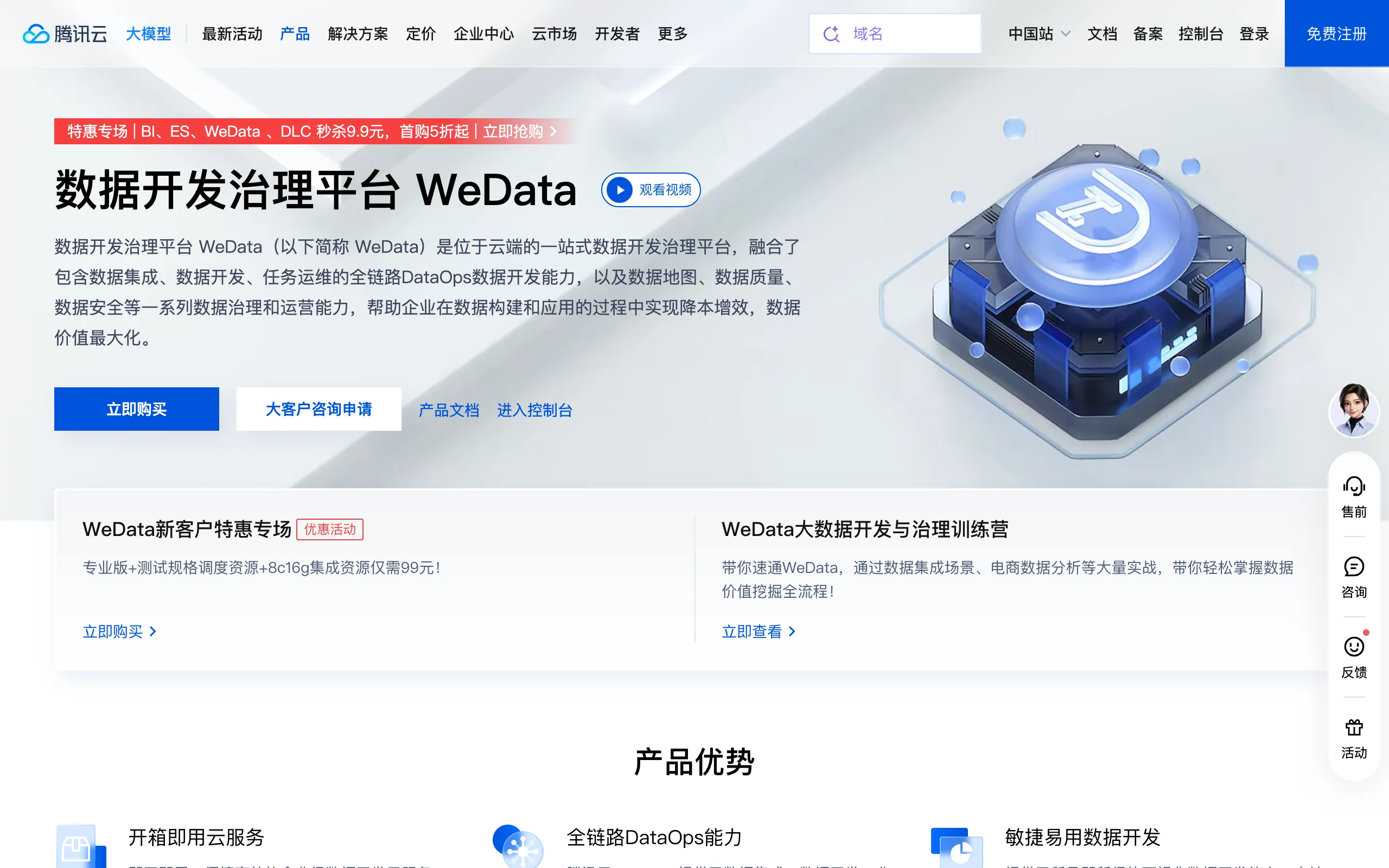
DataBuddy is Tencent Cloud's native AI Agent workbench for enterprise data infrastructure, built on the same Harness framework as WorkBuddy. It covers data analytics, data governance, and data engineering. Users state goals in natural language; the Agent decomposes tasks, invokes Skills, plans workflows, and delivers results—without switching across multiple consoles. A six-layer unified semantic knowledge layer and data flywheel support automated inspection, intelligent repair, auto ETL generation, and other enterprise capabilities—compressing work that once took person-days into hour-level delivery and improving data asset management efficiency.
Image source: Official article
Technical positioning and domain: DataBuddy sits at the intersection of enterprise AI Agent platforms and big data infrastructure, automating the full data development, governance, and analytics pipeline via agents. Unlike traditional platforms where humans lead and AI assists, the Agent is the autonomous executor—from decomposition and skill invocation to delivery.
Development background: Built by Tencent Cloud's big data team on internal WeData platform experience and the Harness Agent framework. Motivation: data teams face efficiency bottlenecks—multi-system switching, repetitive ops, manual coordination—making person-day workloads hard to compress. Tencent Cloud embeds agent capabilities into data infrastructure to address core pain points in asset management and utilization.
Core value: Addresses three problems: high analytics barrier for non-technical users; low governance automation relying on manual inspection; long data engineering chains requiring multi-role collaboration. Innovation: six-layer semantics reduce ambiguity; data flywheel makes agents learn the business over time; tiered execution balances efficiency and safety—raising delivery efficiency by an order of magnitude.
Technical characteristics: Harness Agent framework for autonomous planning and tool use; six-layer semantic knowledge for consistent analytics; natural-language-driven analytics, governance, and ETL; Agent Guardrail, full-chain audit, and least-privilege execution for enterprise security.
2. Key Features
Intelligent data analytics: Natural-language Q&A, metric attribution, report generation, and dashboard building. Six-layer semantics ensure consistent metric definitions across roles. Example: "Analyze core metrics over the last 7 days" triggers query, trend analysis, and report generation automatically.
Automated data governance: Cataloging, semantic modeling, quality, security, and lineage. Auto-inspection with AI diagnosis for missing metadata, quality issues, and compliance risks; tiered repair plans—low-risk auto-fix, high-risk human confirmation—shifting governance from reactive to proactive.
Conversational data engineering: Natural language for ingestion, layered modeling, ETL, workflow orchestration, and fault diagnosis. Describe sources and targets; Agent generates ETL, schedules, and deploys—compressing warehouse builds from days to hours.
Knowledge flywheel: Six-layer knowledge from schema and metric definitions to business terms and personal memory. Auto-extract and dedupe insights into persistent assets; agents learn after each interaction—"smarter with use," lowering future communication cost.
Enterprise security: Agent Guardrail against prompt injection and jailbreaks; full-chain audit; least-privilege access without bypassing existing data security—meeting finance and government compliance.
Multi-engine scheduling: Native Tencent Cloud DLC lake engine integration; inherits WeData assets, permissions, and schedules. Plug-and-play for existing big data infrastructure with lower migration cost.
3. How to Use
Requirements: Tencent Cloud account with WeData enabled. Chrome or Edge recommended. Target workspace configured with assets registered in WeData.
Login: Visit https://wedata.cloud.tencent.com/website/showcase, sign in with Tencent Cloud, select workspace—assets, permissions, and schedules load automatically.
Describe tasks: Natural language in the input box, e.g., "Analyze core metrics over the last 7 days" or "Run quality inspection on sales tables." System identifies task type and matches Skills. Include time ranges and metric names for accuracy.
Agent execution: Tasks decompose into steps; Skills run queries, analysis, or code generation. Progress and intermediate results appear in chat. Low-risk authorized queries complete in seconds; high-risk ops (delete table, change permissions) require confirmation.
Confirm and deliver: High-risk steps need human review. Final outputs in chat—reports, dashboards, ETL code—download or one-click deploy. Validate in test environment before production.
4. Pros and Cons
| Pros |
|---|
| Autonomous delivery: Users state goals; Agent completes end-to-end without page hopping—lower barrier. |
| Six-layer semantics: Aligns metric understanding across roles—fixes long-standing inconsistent reporting. |
| Order-of-magnitude efficiency: Person-day warehouse/governance work compressed to hours—major savings in large enterprises. |
| Enterprise security: Guardrail, audit, least privilege—automation without bypassing security policies. |
| Knowledge flywheel: Insights accumulate; agents learn business context over time. |
5. Comparison with Similar Tools
| Dimension | DataBuddy (Tencent) | DataWorks Agent (Alibaba) |
|---|---|---|
| Architecture | Harness Agent + six-layer semantics + flywheel | Big data platform agent, metadata-driven |
| Interaction | Agent autonomous delivery | AI assist + auto governance actions |
| Coverage | Analytics + governance + engineering | Development + governance + quality |
| Semantics | Six-layer knowledge flywheel | Metadata and asset catalog |
| Execution | Tiered: auto low-risk, confirm high-risk | Auto with partial review |
| Security | Guardrail + least privilege + audit + injection block | RBAC + audit + policies |
| Integration | Tencent DLC + WeData | MaxCompute, Hologres, EMR |
| Users | Analysts, governance, engineers, business | Engineers, governance, ops |
Selection advice: Tencent big data users get the best fit—six-layer semantics excel at eliminating ambiguity in large multi-role teams. DataWorks Agent suits Alibaba users with mature dev/governance automation but more assistive than fully autonomous interaction. Snowflake Cortex fits Snowflake warehouses for NL/SQL but narrower on governance and engineering.
6. Editor's Review
DataBuddy shows significant enterprise agent innovation. Six-layer semantics and the flywheel address the long-standing "semantic gap"—different roles interpreting the same metric differently. Harness autonomous decomposition and Skill invocation enable "one sentence drives the full pipeline" vs describing operational steps.
Practically, it compresses multi-role, multi-step data work from person-days to hours—valuable in finance and retail. Security (Guardrail, least privilege, audit) keeps automation compliant.
Best for analysts, governance staff, warehouse engineers, and business users needing self-serve insights. Future expansion to streaming, ML training, and as Tencent data ecosystem hub is plausible; flywheel-built knowledge assets are scarce among peers.
— strong innovation, value, and compliance; room to grow on complex scenarios and cross-platform support. Highly competitive for Tencent ecosystem users.
7. Use Cases
Business self-serve analytics: Non-technical users query GMV, retention, etc.; Agent produces reports and dashboards without SQL/BI tools.
Governance automation: Daily scans for metadata gaps, quality issues, compliance risks; tiered auto-fix with human confirm for sensitive cases.
Rapid warehouse build: Engineers describe sources and goals; Agent outputs layered design (ODS/DWD/DWS/ADS), ETL, and workflows in hours vs days.
Cross-domain diagnosis: Trace metric anomalies via lineage; Agent reports completeness, health, and cost optimization across upstream/downstream tables.
8. FAQ
Q: Client install or on-prem required?
A: SaaS only—browser access with Tencent Cloud login. Compute in cloud; data stays in Tencent Cloud.
Q: Data security—will Agent leak sensitive data?
A: Guardrail blocks injection/jailbreak; full audit; least privilege on authorized resources only. Does not bypass existing policies.
Q: Supported data sources? Non-Tencent platforms?
A: Native DLC/WeData integration. Other sources must be ingested/registered via WeData first. More third-party sources may come later.
Q: Learning curve for non-technical users?
A: Low for natural-language queries once data team configures metrics and Skills. Initial six-layer/Skill setup needs technical staff.
Q: Performance on large data?
A: Distributed cloud compute—seconds to minutes for typical tasks. TB-scale ETL depends on volume and resources but still far faster than manual dev. Stable network recommended.
Q: Private deployment?
A: SaaS only today—no on-prem. Contact sales for custom options if required.
9. Project Links
- Showcase: https://wedata.cloud.tencent.com/website/showcase
- WeData product: https://cloud.tencent.com/product/wedata
Related AI Model Articles
OpenMuse – CopilotKit Open-Source Personal AI Assistant
OpenMuse is an open-source personal AI assistant project developed by the CopilotKit team. Its core design philosophy is "giving an Agent a computer" — by combining a persistent browser, optional Linu...
In-Depth Review of Longcat-2.5-preview: Meituan's Next-Generation Multimodal Long-Range Agent Model
LongCat-2.5-preview is Meituan's latest next-generation large model. Building upon the 1.6T total parameters, approximately 48B active parameters, and native 1M token context of LongCat-2.0, it marks ...
Review of DeepSeek Harness Desktop: How the Official GUI Client Lowers the Bar for Agent Usage
DeepSeek Harness Desktop is the official graphical client launched by DeepSeek, designed to provide a visual interface for the originally command-line-based DeepSeek Harness framework. After users log...
Step Code – In-Depth Review of StepFun's Open-Source Terminal Programming Agent
Step Code is an open-source terminal programming agent launched by StepFun, licensed under the MIT License, which allows developers to complete the full workflow of code writing, debugging, execution,...
© All Rights Reserved. Some content on this site is partially generated by AI with human review.