
Cosmos 3 – NVIDIA's Open-Source Full-Modality Physical AI Foundation Model
Executive Summary:
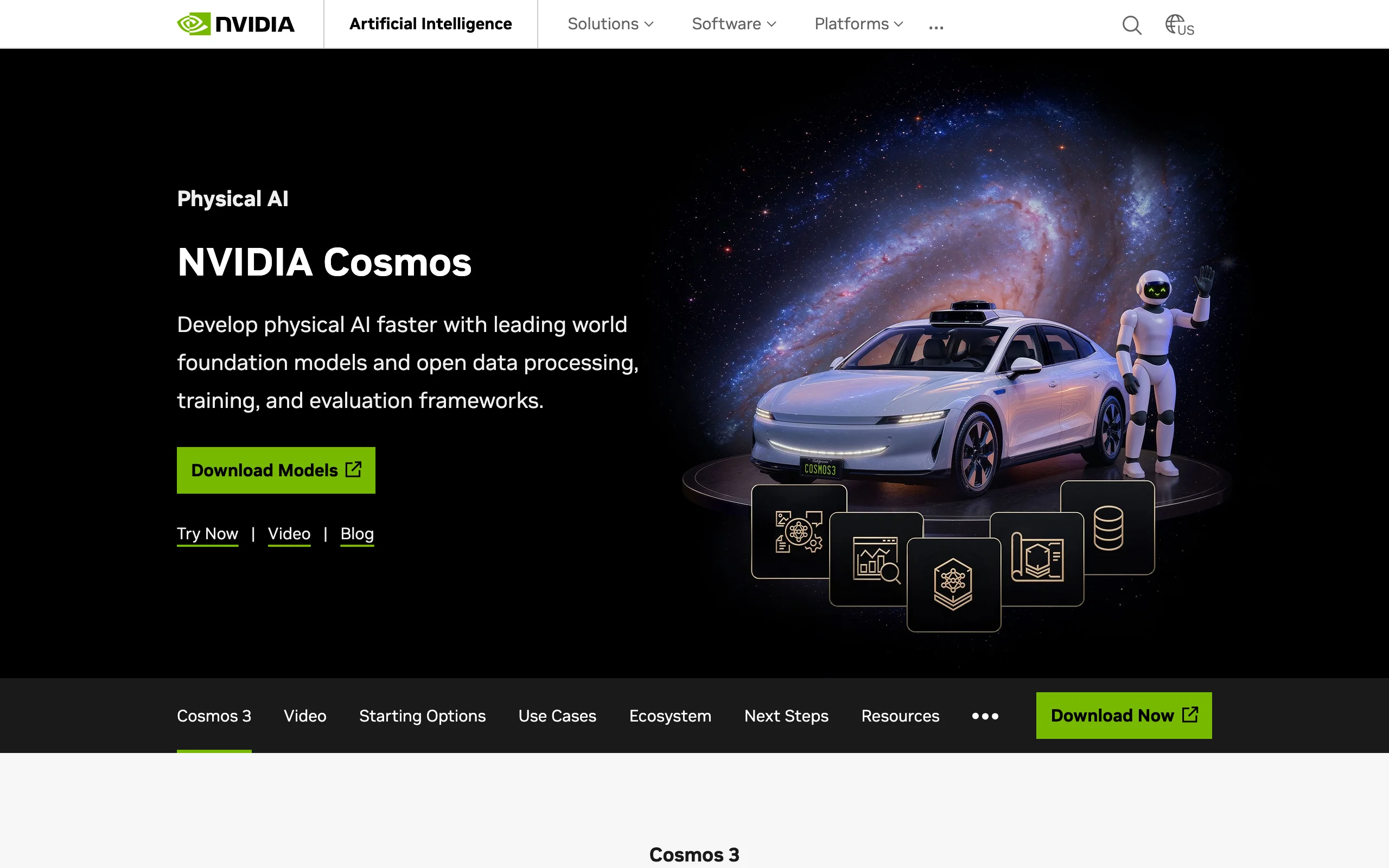
Cosmos 3 is NVIDIA's first fully open-source, full-modality physical AI foundation model. Built on an innovative hybrid Transformer architecture, it natively fuses visual reasoning, world generation, ...
1. What Is Cosmos 3
Cosmos 3 is NVIDIA's first fully open-source, full-modality physical AI foundation model. Built on an innovative hybrid Transformer architecture, it natively fuses visual reasoning, world generation, and action prediction. The model uniformly processes and generates text, images, video, ambient sound, and action trajectories, achieving industry-leading physical simulation accuracy. NVIDIA also launched the Cosmos Coalition with Runway, Black Forest Labs, and leading AI labs and robotics companies to advance next-generation world models. Super and Nano versions are live; an Edge variant for high-performance and lightweight scenarios is coming soon.
Image source: Official article
Technical positioning and domain: Cosmos 3 sits at the frontier of multimodal foundation models and world models, purpose-built for physical AI. It is not only a traditional multimodal LLM but a world-model system that understands, simulates, and predicts physical dynamics—critical for embodied AI, robot training, and autonomous driving.
Development background: Developed by NVIDIA's core research team, leveraging deep expertise in GPU computing, deep learning frameworks (PyTorch, TensorRT), and AI infrastructure. Motivation: most AI systems process information without truly "understanding" physics. Cosmos 3 fills that gap as a cognitive foundation for physical AI.
Core value: Cosmos 3 addresses two pain points: extremely high cost of high-quality physical simulation data, and lack of deep causal understanding of the physical world in existing models. Full open sourcing plus leading physical accuracy compresses physical AI training and evaluation from months to days, lowering research barriers and development cost.
Technical characteristics: Hybrid Transformer architecture combines reasoning and generative Transformers into an understand-generate loop. Trained on billions of multimodal physical AI samples, it ranks #1 among open models on Physics-IQ, PAI-Bench, and similar world-generation benchmarks, with superior physical simulation and action prediction vs. peers.
2. Key Features
Native full-modality understanding and generation: Uniformly handles five modalities—text, image, video, ambient sound, action trajectories—without separate module stitching or post-processing. Native multimodality preserves semantic and physical consistency across modalities.
Physical world simulation: As a world model, simulates object interaction, motion laws, and spatiotemporal evolution from current scene state and predicts future states. Provides high-fidelity virtual environments for robot training and autonomous driving, reducing real-world data collection.
Action policy generation: Natively generates robot and autonomous driving action trajectories aligned with physics from task goals. Directly usable for industrial robots, humanoids, and self-driving systems to accelerate policy iteration.
Multimodal visual reasoning: Cross-modal understanding of object interaction—spatial relations, motion patterns, causality from images, video, and text—for intelligent decision-making in complex scenes.
Synthetic data generation: Batch-generates physically consistent high-quality training samples across complex scenes and edge cases, reducing reliance on expensive, scarce real-world data—especially for autonomous driving and robotics.
Real-time physical interaction simulation: Interactive simulation where users input actions or change environment parameters and observe predicted physical outcomes—fast hypothesis and algorithm validation.
3. How to Use
Requirements: CUDA-capable NVIDIA GPU; recommended A100 (80GB) or higher, ≥32GB VRAM. Ubuntu 20.04+, Python 3.8+, PyTorch 2.0+, NVIDIA driver 525+.
Platform access: Visit NVIDIA Cosmos (https://www.nvidia.com/en-us/ai/cosmos/) for online demos: text-to-video, image understanding, action prediction.
Model weights: Download from Hugging Face (https://huggingface.co/collections/nvidia/cosmos3). Choose Super for high performance or Nano for constrained resources.
Customization and deployment: Use Hugging Face Diffusers and GitHub resources for fine-tuning. Adjust data, parameters, or task-specific fine-tuning. Deploy via NVIDIA NIM microservices or cloud partners (Baseten, CoreWeave, Microsoft Azure).
Key configuration: Set model path and inference params (batch size, max sequence length, steps). Tune for hardware to avoid OOM. For long video, enable memory optimizations (e.g., gradient checkpointing).
Tips: Large models load slowly—SSD storage helps. Use default physics constraints for realistic output. For action policies, validate on small datasets before scaling to complex scenes.
4. Pros and Cons
| Pros |
|---|
| Native full-modality architecture: Five modalities fused without module stitching; efficient cross-modal reasoning and alignment; strong generation quality and physical consistency. |
| Leading physical accuracy: #1 among open models on Physics-IQ, PAI-Bench; high-fidelity environments for robotics and AV. |
| Fully open: Weights and architecture under Apache 2.0; commercial and academic use; democratizes physical AI research. |
| Ecosystem alliance: Cosmos Coalition with Runway, Black Forest Labs, robotics firms supports iteration and ecosystem growth. |
| Training efficiency: Compresses physical AI cycles from months to days; lower cost and resource use. |
5. Comparison with Similar Tools
| Dimension | Cosmos 3 | Google Gemini 2.5 Pro | Meta Video Joint Embedding (V-JEPA) |
|---|---|---|---|
| Core architecture | Hybrid Transformer (reasoning + generation) | Single Transformer | Joint embedding |
| Modality coverage | Text, image, video, sound, action (full) | Text, image, audio, video | Video only (self-supervised) |
| Physical simulation | Purpose-built; action generation | General multimodal; no dedicated physics | Video features; no physics |
| Action generation | Native robot/AV trajectories; leading accuracy | No native action output | No action generation |
| Open license | Fully open (Apache 2.0) | Closed API | Open (CC BY-NC 4.0) |
| Deployment | NIM, cloud partners, on-prem | Vertex AI API | Local (GPU) |
| Physical benchmarks | Physics-IQ, PAI-Bench open #1 | Not specialized for physical AI | Not on physical benchmarks |
Selection advice: For robotics, AV, and embodied AI teams needing deep customization, Cosmos 3 is the best choice—open, physically accurate, native action generation. For general multimodal without heavy physics, Gemini 2.5 Pro is mature but closed and costly. For academic self-supervised video, V-JEPA is lightweight but lacks physics and actions. Sora excels at video quality but is closed and not physical-AI focused.
6. Editor's Review
Cosmos 3 marks a milestone in physical AI. The hybrid Transformer links reasoning and generation into a closed loop—a notable world-model design direction. Open #1 on Physics-IQ validates leading simulation accuracy, valuable for robotics and AV.
Full open sourcing and training cycles compressed from months to days lower barriers for smaller teams and academia. Synthetic data helps teams lacking real-world resources and may accelerate industrialization.
Best for robotics labs, AV companies, embodied AI research, and platforms needing high-fidelity simulation. Nano offers a lighter option, but overall onboarding remains demanding.
Cosmos Coalition supports ecosystem building. Edge release and community growth may expand edge deployment. Documentation, Chinese support, and community maturity still need work.
Rationale: Innovation (5/5), practical value (4.5/5), ease of use (3.5/5), ecosystem (4/5), future potential (4.5/5). Half-star deduction for documentation gaps and hardware requirements affecting beginners.
7. Use Cases
Robot training and simulation: High-fidelity virtual environments for industrial, humanoid, and service robots—physically plausible trajectories and interactions for grasping, locomotion, manipulation.
Autonomous driving development: Simulate complex traffic—rain, night, edge cases. Physically consistent video and actions for perception and planning training.
Visual AI agents: Perception-reasoning-decision loops for inspection, security, warehousing—object interaction and spatial reasoning.
Synthetic data factories: Batch physically consistent samples when real data is scarce—for vision, action prediction, and simulation models.
Physical AI research and teaching: Open models for embodied AI, world models, physical reasoning; teaching tool for core concepts.
8. FAQ
Q: How does Cosmos 3 differ from general multimodal models like GPT-4V?
A: Cosmos 3 is built for physical AI—understanding, simulating, and predicting physical dynamics. General models lack deep physical causality modeling. Cosmos 3 ensures outputs obey physics and natively generates action trajectories.
Q: What hardware is required?
A: Recommended A100 (80GB)+, ≥32GB VRAM. RTX 4090 (24GB) can run Nano but may struggle with long video or complex simulation. SSD for model files speeds loading.
Q: Does it support Chinese input/output?
A: Optimized for English; Chinese performance has gaps. Extra fine-tuning recommended for Chinese users. NVIDIA plans improved Chinese support in future versions.
Q: How to integrate into existing robot training?
A: Load via Hugging Face Diffusers APIs for trajectories and simulation. ROS integration possible via custom interfaces. Start with simple simulation before complex scenes.
Q: How is physical accuracy validated?
A: #1 among open models on Physics-IQ and PAI-Bench (interaction, motion, temporal consistency). Custom tests comparing outputs to real physics data also work.
Q: When will the Edge version launch?
A: In development; expected within months. Optimized for resource-constrained edge devices and embedded/mobile deployment.
9. Project Links
- Official site: https://www.nvidia.com/en-us/ai/cosmos/
- Hugging Face: https://huggingface.co/collections/nvidia/cosmos3
- GitHub: https://github.com/NVIDIA/Cosmos (coming soon—watch official announcements)
Related AI Model Articles
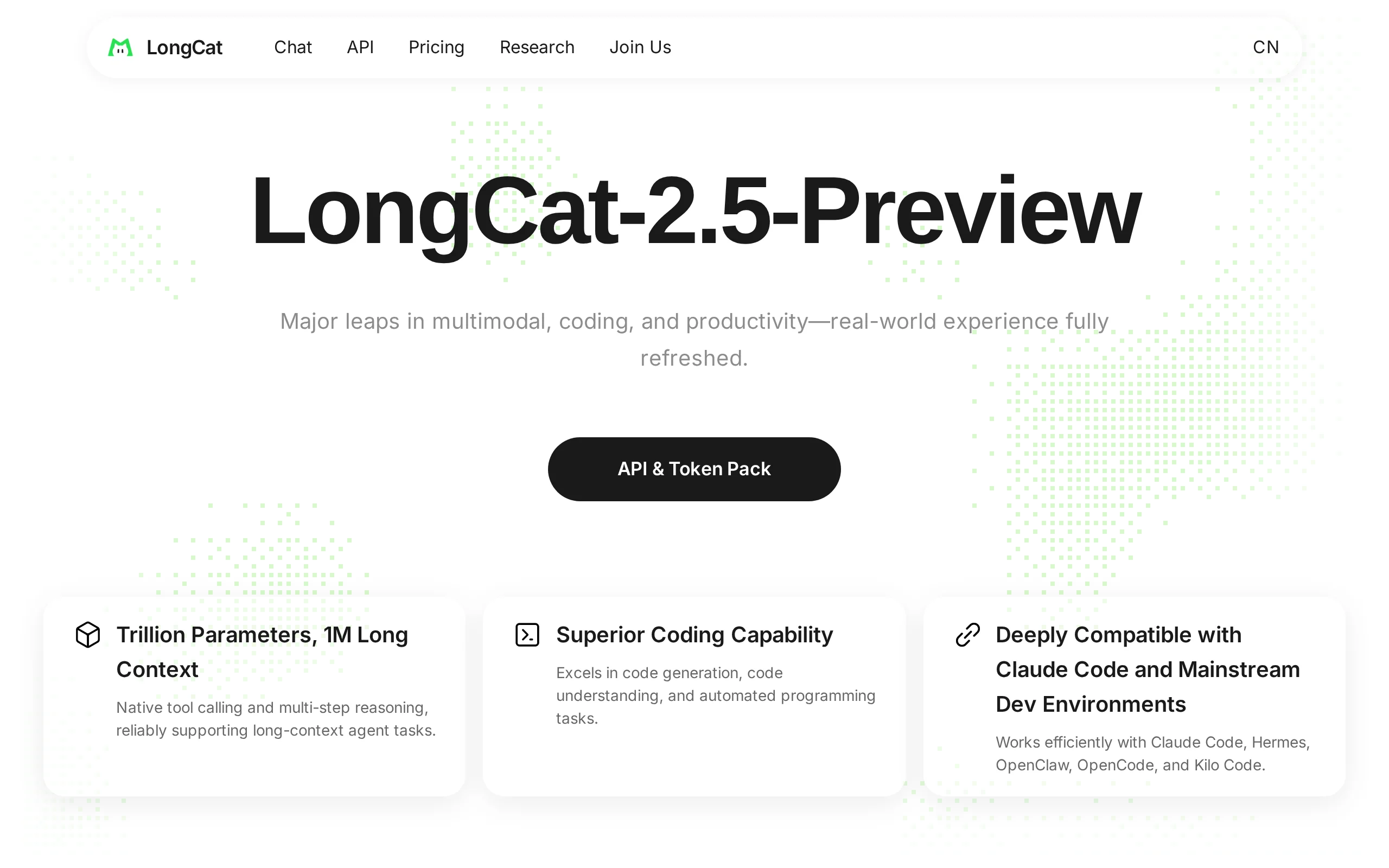
In-Depth Review of Longcat-2.5-preview: Meituan's Next-Generation Multimodal Long-Range Agent Model
LongCat-2.5-preview is Meituan's latest next-generation large model. Building upon the 1.6T total parameters, approximately 48B active parameters, and native 1M token context of LongCat-2.0, it marks ...
Xiaomi MiMo-V2.6 – Xiaomi's Open-Source Multimodal Model Series
Xiaomi MiMo-V2.6 is a series of fully multimodal models released and open-sourced by Xiaomi, comprising two native full-modal models: Pro and Flash. It is centered on large-scale Agentic reinforcement...
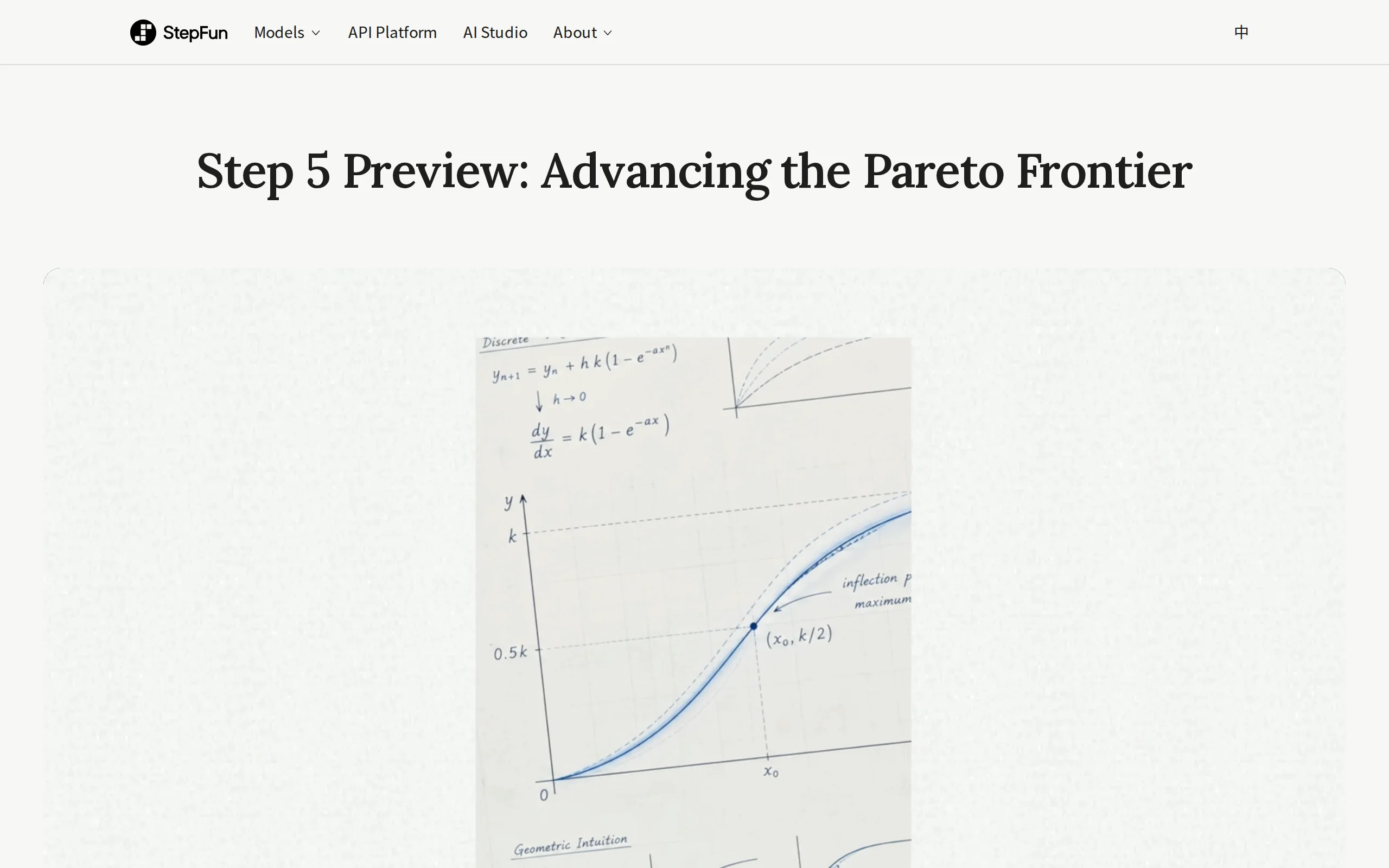
In-Depth Review of Step 5 Preview: A 600B Sparse MoE Flagship with 1M Token Context and 1/8 Cost Advantage
Step 5 Preview is a new-generation flagship foundation model launched by StepFun, designed for real-world Agentic tasks. Based on a sparse MoE architecture, the model has a total of 600B parameters bu...
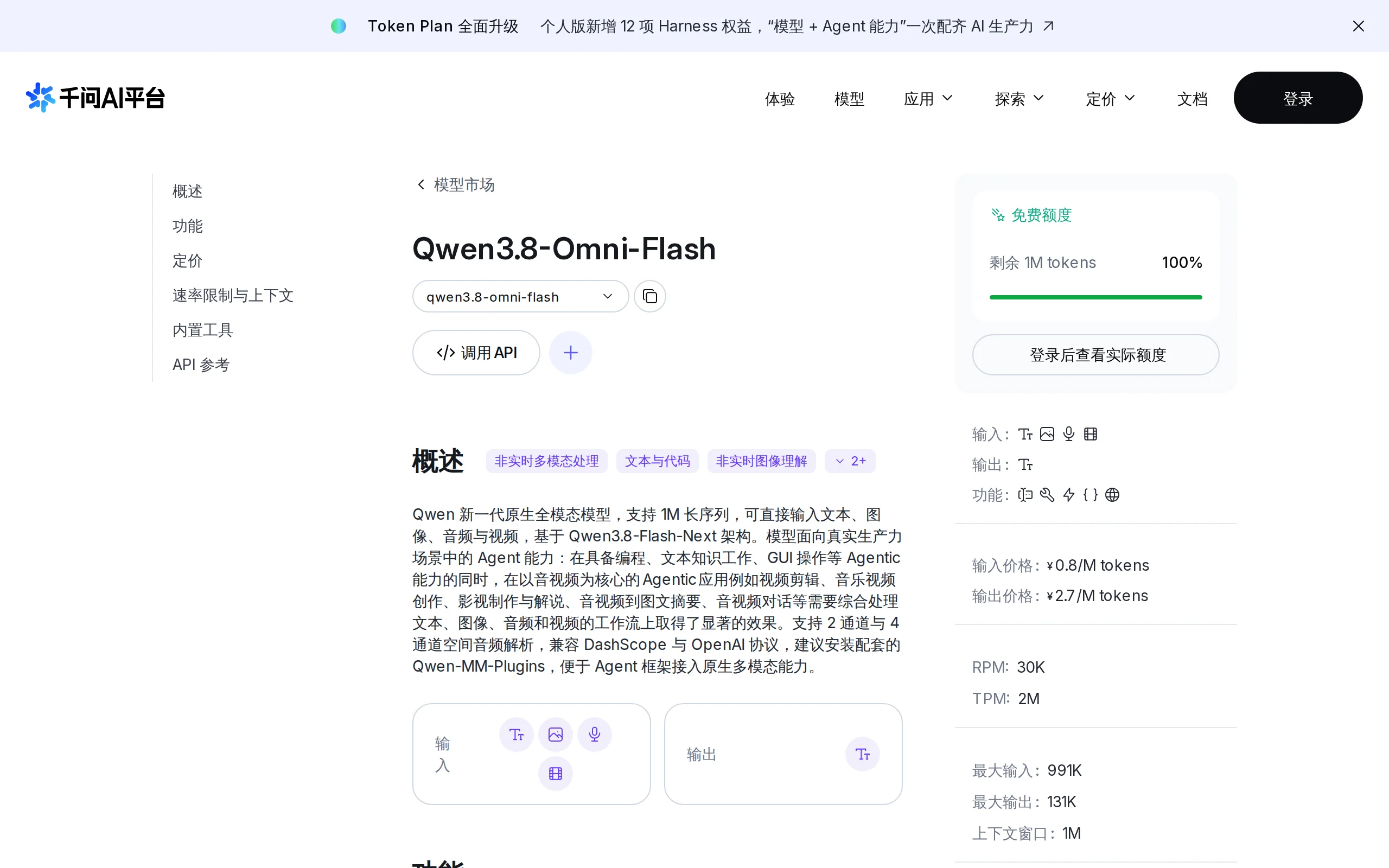
Qwen3.8-Omni-Flash – A Native Multimodal Model Launched by Alibaba Qwen
Qwen3.8-Omni-Flash is a native multimodal model launched by Alibaba Qwen. It jointly models four modalities—text, image, audio, and video—within a single architecture, supporting a context length of u...
© All Rights Reserved. Some content on this site is partially generated by AI with human review.