
Union Alpha – A Mysterious Multimodal Large Model with Unlimited Free Access for a Limited Time
Executive Summary:
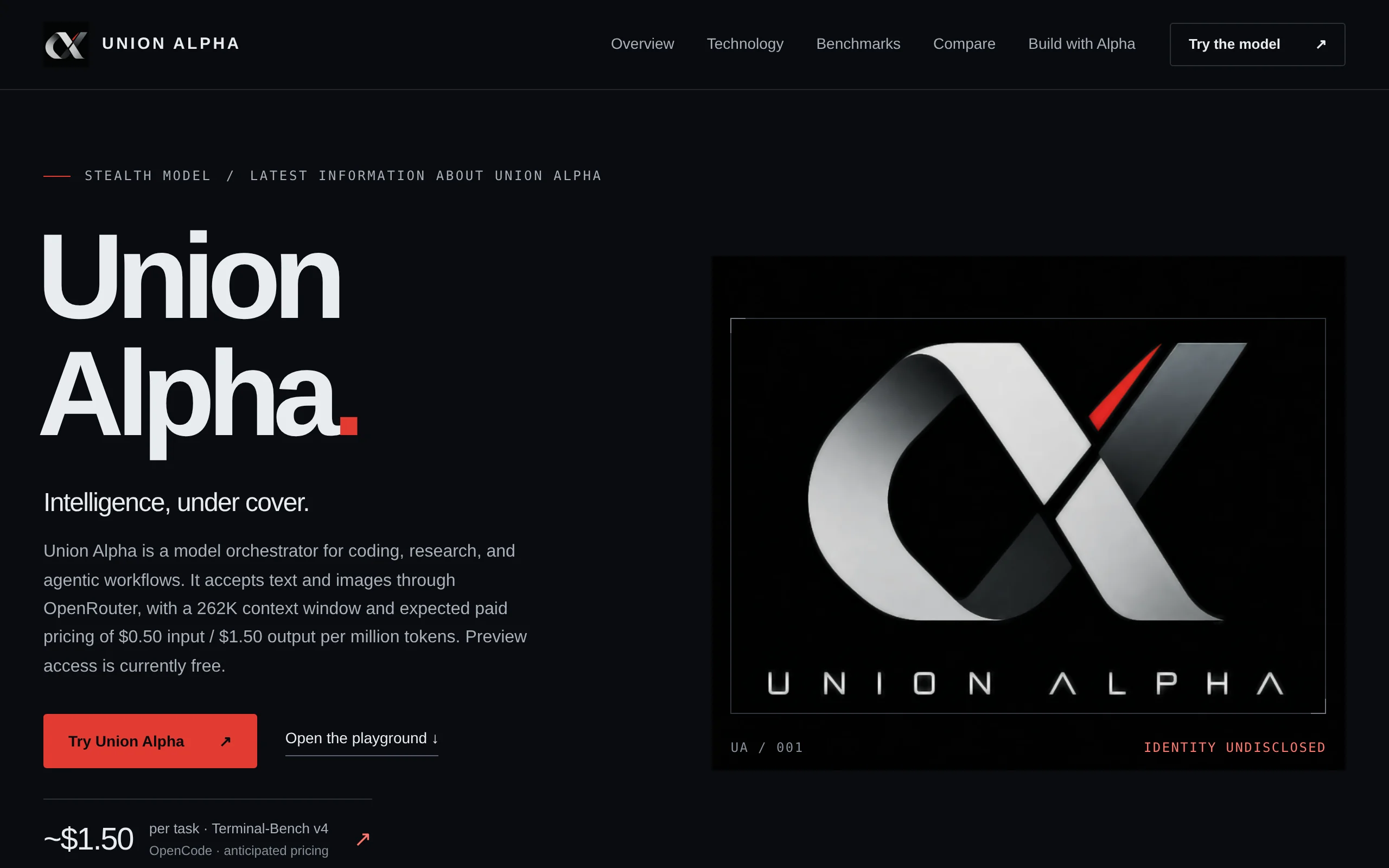
Union Alpha is a multimodal large language model released in "stealth" mode, recently launched on mainstream AI service platforms such as OpenRouter, Cline, and OpenCode. The model supports dual-modal...
1. What is Union Alpha
Union Alpha is a multimodal large language model released in "stealth" mode, recently launched on mainstream AI service platforms such as OpenRouter, Cline, and OpenCode. The model supports dual-modal input of text and images, has full tool calling capabilities, and features a context window of 262,144 tokens and a maximum output length of 131,072 tokens. It is primarily aimed at general task scenarios such as research analysis, code generation, and Agentic workflows. During the preview period, it offers completely free usage quotas (both input and output at $0/M token), and it promises zero data retention, making it highly attractive for privacy-sensitive applications.
Image source: Official article
Image source: official article
Technical positioning and domain: Union Alpha belongs to the category of multimodal large language models (Multimodal LLM). Its core capabilities cover natural language understanding, code generation, image semantic analysis, and structured reasoning. It is not merely a language model but a general-purpose Agent base model designed for complex task execution, emphasizing long-context processing and the reliability of tool calling.
Development background: The developer information of this model remains anonymous and has not been officially claimed. It is distributed through the OpenRouter platform and simultaneously integrated into the Cloudflare AI Gateway. It also appears as a recommended model in the Zen/Go gateway of OpenCode. From its technical features, it can be inferred that the development team possesses strong capabilities in large model training and inference optimization. However, specific institutional information is still pending official disclosure.
Core value: During the preview period, Union Alpha is offering long-context capabilities (256K context + 131K output) that were previously only available in high-cost commercial models, at zero cost. For developers, researchers, and enterprise users, this means they can test the practical effectiveness of ultra-long text processing, full-library code analysis, and multi-step Agent tasks without any financial investment.
Technical features: The model uses a unified Transformer architecture for multimodal processing, supporting joint reasoning between images and text. Its output length reaches up to 131K tokens, placing it at a relatively high level among models of similar scale. Another notable feature is its "stealth" release strategy — it does not disclose parameter count, training data, or evaluation details, but its actual API is open for public testing. According to third-party evaluation data, the model achieves a pass rate of approximately 51% on the OpenCode Terminal-Bench v4, indicating that it has a certain level of practicality in real-world terminal tasks.
2. Key Features
Extended Context Window: Supports input of up to 262,144 tokens, equivalent to processing approximately 200,000 English words or an entire medium-sized code repository in a single session. This allows users to load the entire project's source code, dependency configuration files, and documentation into a conversation at once, without the need for segmenting or manually maintaining external memory. It demonstrates clear advantages in scenarios involving cross-file dependency analysis, global code refactoring, and architectural review.
Enhanced Output Length: Maximum output reaches 131,072 tokens, over 16 times longer than typical models (which usually output 4K–8K tokens). This capability enables the model to directly generate full-length reports, multi-page code files, or aggregated results from multi-step tasks, reducing the cost and complexity of multi-round writing and concatenation caused by output truncation. This is especially useful for Agent tasks that require complete deliverables, such as generating scaffolding code for an entire project.
Multimodal Input Support: Accepts both text and image input modalities, with output as plain text. Users can directly upload UI screenshots, architecture diagrams, flowcharts, or error messages, and the model can reason based on the image content to provide repair suggestions or implementation code. This capability integrates visual information into the process of programming assistance and document understanding, expanding the application boundaries of pure text models.
Native Tool Calling Interface: Fully supports API interface parameters such as
tools,tool_choice, andresponse_format, compatible with the OpenAI function calling format. The model can autonomously decide to call external tools (e.g., search, code execution, database queries) based on user instructions and return structured results in the specified format. This makes it suitable as a core decision-making model within Agent workflows.Agentic Workflow Optimization: The provider explicitly states that the model has been specifically optimized for continuous Agent tasks, showing high stability in multi-step reasoning, state retention, and tool selection. Combined with its long context capability, the model can maintain contextual consistency during extended task cycles, reducing errors caused by attention drift.
Zero Data Retention (ZDR) Commitment: The service provider commits to not using user data for training and not storing user session records. This data governance strategy is relatively rare in cloud-based large model services. For enterprise users handling private code repositories, unpublished papers, or compliance-sensitive data, this commitment significantly reduces the risk of data leakage.
3. How to Use
Register for an OpenRouter account and obtain an API Key: Visit the OpenRouter official website (openrouter.ai) and register or log in using your email or GitHub account. Generate a dedicated API Key on the "Keys" page in the user console, which will be used for authentication in all subsequent API requests. If using OpenCode's Zen gateway, you can also generate the corresponding access credentials in the OpenCode Zen console.
Find the model and confirm its availability: Search for "union-alpha" in the model list on OpenRouter. Select the
stealth/union-alphaentry. On the model details page, you can view the current pricing information (free during the preview period), context length specifications, and supported feature tags. Note that since the model is in preview, its availability on OpenRouter may change. It is recommended to check the status indicator in the model list before making any calls.Quick web-based experience: The main OpenRouter website provides a chat testing page, allowing users to directly select
stealth/union-alphafor conversation without writing any code. This page supports uploading image attachments, enabling quick testing of the model's multimodal understanding capabilities. For example, you can upload an architecture diagram and ask for implementation suggestions, or upload an error screenshot for analysis.Calling via API: Use an OpenAI-compatible interface in your local environment or server, directing requests to the OpenRouter API endpoint (link to be updated after official release).
curl (link to be updated after official release) \
  -H "Authorization: Bearer $OPENROUTER_API_KEY" \
  -H "Content-Type: application/json" \
  -d '{
    "model": "stealth/union-alpha",
    "messages": [{"role": "user", "content": "Analyze the module dependencies of the following codebase"}],
    "tools": [{"type": "function", "function": {"name": "search_web", "description": "Search the web", "parameters": {"type": "object", "properties": {}}}]
  }'
You can pass custom tool definitions in the tools field, and the model will autonomously call them as needed.
Integrate with the Cline plugin: After installing the Cline plugin in VS Code, select OpenRouter as the Provider in the settings interface and enter your OpenRouter API Key. Search for and select Union Alpha in the model dropdown list, and you can then directly use this model within the IDE to perform Agent tasks such as code generation, file editing, and terminal command execution.
Integrate with OpenCode terminal tool: OpenCode is a terminal-native AI coding Agent tool. Users can use Union Alpha directly through OpenCode's Zen gateway (by specifying
union-alphain the model configuration), or they can configure a custom OpenRouter endpoint and input the API Key to make the same model available in the terminal environment.
4. Pros and Cons Analysis
| Pros |
|---|
| Outstanding Long-Context Capability: With 262K context and 131K output, this is a high configuration among similar models, suitable for processing entire codebases or hundreds of pages of documents in one go, reducing context fragmentation caused by segmented processing. |
| Fully Free During Preview Period: Both input and output are $0 per million tokens. Developers can test the model's capability boundaries at zero cost, validate its effectiveness in real business scenarios, and avoid the cost of trial and error. |
| Zero Data Retention Commitment: Explicitly promises not to store or train on user data, making it suitable for analyzing sensitive content such as private code repositories or unpublicized commercial documents, reducing data compliance risks. |
| High Agent Task Compatibility: Natively supports key Agent interfaces such as tool calling and structured output, and achieved a pass rate of approximately 51% on Terminal-Bench v4, demonstrating the ability to complete real terminal tasks. |
| Instantly Available Across Multiple Platforms: Launched simultaneously on OpenRouter, Cline, and OpenCode, allowing users to experience it in common development environments without additional configuration, lowering the barrier to entry. |
| OpenCode Ecosystem Integration: Deep integration with the OpenCode Zen gateway allows terminal users to call the model directly in the command line with simple configuration, enhancing convenience in coding scenarios. |
5. Comparative Analysis with Similar Tools
| Comparison Dimension | Union Alpha | Ox Alpha (GLM-5.3-Flash) | Claude Sonnet 4.5 |
|---|---|---|---|
| Core Architecture | Parameters not disclosed, multimodal Transformer architecture, speculated to be a sparse MoE structure (not officially confirmed) | Zhipu GLM series, sparse activation MoE architecture, parameter count around hundreds of billions (not fully disclosed by the provider) | Anthropic's proprietary architecture, details not disclosed, emphasizes safety alignment and long-range reasoning |
| Context Window | 262,144 tokens | 1,048,576 tokens (1M) | 200,000 tokens |
| Maximum Output Length | 131,072 tokens | 131,072 tokens | 64,000 tokens |
| Input Modalities | Text + Image (no video) | Text + Image + Video | Text + Image |
| Tool Calling Capability | Full support for tools, tool_choice, and response_format, natively compatible with Agent workflows | Supports tool calling, Zhipu has optimized for Agent scenarios | Supports tool calling, with a relatively mature Agent development kit (MCP support) |
| Data Privacy Policy | Zero data retention (no storage or training) | Provider retains logs, but not used for model training | Data may be used for service quality improvement, enterprise API can negotiate not to use for training |
| Price (per million tokens) | Free during preview period; expected official price $0.50 input / $1.50 output | $0.15 input / $0.50 output (now charged) | $3.00 input / $15.00 output |
| Deployment Method | OpenRouter API / OpenCode Zen / Cloudflare AI Gateway / ModelsLab | Zhipu Open Platform API / Third-party platforms like Baidu Qianfan | Anthropic API / AWS Bedrock / Azure |
| Community and Ecosystem | Anonymously released, X account @unionalphaai, active discussions in OpenCode community, no searchable technical community available | Zhipu ecosystem, active domestic developer community, with public technical blogs and documentation | The most active global AI developer ecosystem, with a large number of tutorials, toolchains, and commercial cases |
Selection Recommendations
For developers sensitive to budget and needing to validate long context core capabilities, Union Alpha is an extremely cost-effective choice during its free preview period — its 262K context is comparable to Ox Alpha in areas such as code analysis and long document processing, and its zero-cost entry significantly enhances its practical value. It should be noted that after the preview period ends, its pricing will exceed that of Ox Alpha, so for long-term use, it is advisable to switch to Zhipu GLM-5.3-Flash.
For enterprise users requiring video input or higher concurrent service capabilities, Ox Alpha (GLM-5.3-Flash) is a more suitable recommendation for production environments, thanks to its 1M context, video understanding capabilities, and lower pricing. Union Alpha's anonymous nature may introduce uncertainty in enterprise compliance reviews, while Zhipu, as a well-known Chinese AI company, can provide formal commercial contracts and technical support.
For teams seeking top-tier performance and a mature ecosystem, Claude Sonnet 4.5 and GPT-5 remain industry benchmarks, but their costs are significantly higher than the aforementioned models. If the project requires the highest inference quality and has a sufficient budget, these two models are still reliable choices. If a balance between cost and performance is desired, the free preview period of Union Alpha can serve as a low-cost way to evaluate its capabilities.
6. Editor's Summary
Union Alpha entered the market with a rare "anonymous + limited-time free" dual strategy, launching simultaneously on OpenRouter, Cline, and OpenCode. This approach carries a strong experimental flavor within the industry ecosystem. From a technical perspective, the model maintains a comparable level to international leading models in two key metrics: context window (262K) and output length (131K). Moreover, it fully supports the tool calling interface, indicating that its development team has accumulated certain technical expertise in long-text modeling and instruction-following. Third-party evaluations show that it achieves approximately a 51% pass rate on the OpenCode Terminal-Bench v4. While this performance does not reach the top tier, combined with its free positioning, it provides developers with a usable Agent execution capability at a low cost.
In terms of practical value, Union Alpha's commitment to zero data retention, paired with its free calling quota, forms a combined advantage, making it particularly suitable for research institutions and small-to-medium development teams that need to process private data. Its emergence offers the market a low-risk entry point for experimentation: companies can evaluate the actual benefits of ultra-long context models in their business scenarios without upfront budget investment, thereby providing data support for subsequent technology selection. At the same time, its anonymous release and limited free period introduce uncertainty—the model's long-term availability, pricing trends, and continuity of technical support remain to be tested by time.
The primary target users for this model are: R&D teams currently evaluating model technology options, individual developers who need to process ultra-long documents and full codebases, and independent researchers concerned with data privacy. It is not suitable for enterprises with strict supplier qualification audits or for business scenarios requiring multimodal generation (such as video understanding).
Overall, Union Alpha presents a valuable opportunity for free capability sampling during its preview period. Its technical potential is worth noting, but users should clearly understand its official pricing, service terms, and update support policies before actual deployment, to avoid disruptions to existing workflows due to the end of the free period or service adjustments. If the development team can later disclose technical details and refine commercial service terms, the model has the potential to establish a foothold in the domain of long-context Agent tasks.
7. Application Scenarios
Full-Codebase Understanding and Refactoring Analysis: Developers can submit the entire source code directory of a medium-sized project to Union Alpha in one go, leveraging its 262K context window for cross-file dependency analysis, module coupling assessment, and architecture bottleneck identification. The model can generate refactoring recommendations, migration strategies, and impact scope descriptions, providing reference for code architecture upgrade decisions and reducing the time cost of manually reviewing tens of thousands of lines of code.
Agent-Driven Multi-Step Development Tasks: In Cline or OpenCode environments, Union Alpha can act as the core model to drive Agent workflows for executing multi-step development tasks, such as automatically generating project scaffolding based on requirement documents, reading the current file status and outputting modification patches, or running terminal commands and adjusting the execution plan based on the output. Its long-output capability ensures the generation of complete code modules in one go, avoiding frequent interruptions and resumptions.
Long Document Research and Summary Generation: Ideal for handling hundreds of pages of academic papers, industry reports, financial statements, or legal documents. Users can upload the full document in a single session and request the model to generate in-depth analysis reports of up to 100,000 words, including core viewpoints extraction, key arguments organization, literature comparison, and conclusion recommendations, without the need for manual segmentation of long documents, preserving the coherence and integrity of the arguments.
Visual-Aided Programming and Bug Fixing: Front-end developers can directly upload screenshots of UI design drafts or interface diagrams exported from Figma, requesting the model to generate corresponding HTML/CSS implementation code; back-end engineers can also upload error screenshots or monitoring panel images, and the model, combining the error information in the image with the code context, can output localization suggestions and repair plans, integrating visual information into the debugging process.
Structured Data Processing and API Integration: Through the tool calling interface, Union Alpha can be configured as an intelligent agent with the ability to access external APIs, such as automatically reading database schemas to generate SQL queries, calling external calendar APIs to schedule meetings, or integrating with internal corporate knowledge bases for information retrieval and summarization. Its
response_formatsupport ensures that the output can be directly parsed by downstream systems.
8. FAQ
Q: How long is the free trial period for Union Alpha? What is the price after it expires?
A: According to the information on the OpenRouter page, Union Alpha is in a free preview period, with the official announcement indicating that the free period lasts approximately one week. As recorded in GitHub Issue #412, the free period is expected to end around September 23, 2026. After the free period ends, based on the modeling pricing information provided by union-alpha.com, the estimated cost is $0.50 per million input tokens and $1.50 per million output tokens (the final pricing will be subject to official announcements).
Q: How significant is the performance difference between Union Alpha and other models (such as Ox Alpha)?
A: In terms of long context capabilities, Ox Alpha (GLM-5.3-Flash) provides 1M context, which is four times that of Union Alpha (262K), making it more suitable for handling larger documents or codebases. In terms of tool calling and Agent completion rates, Union Alpha has a pass rate of approximately 51% on the OpenCode Terminal-Bench v4. Direct comparative data between Ox Alpha and Union Alpha on terminal tasks has not yet been publicly released. It is recommended that users test and evaluate based on specific task types.
Q: What API interface formats does Union Alpha support? Can it be integrated with existing OpenAI SDKs?
A: Union Alpha provides OpenAI-compatible Chat Completions interfaces through OpenRouter, supporting standard parameters such as model, messages, tools, tool_choice, and response_format. As a result, it can be directly called using the official OpenAI Python/Node.js SDKs, by simply pointing the base_url to the OpenRouter endpoint and replacing the API Key. Additionally, this model can also be accessed via the Cloudflare AI Gateway.
Q: Does Union Alpha really not retain user data? How can this be verified?
A: The model description for Union Alpha on the OpenRouter platform explicitly states a Zero Data Retention commitment, indicating that the model provider does not store user prompts or outputs and does not use them for training. However, the specific log retention policies are defined by the actual deployment party (such as OpenCode Zen or Cloudflare AI Gateway), and data terms may vary between different access providers. It is recommended to read the service agreement of the corresponding platform before handling highly sensitive data.
Q: Does Union Alpha support processing PDF or other document formats?
A: When calling Union Alpha directly through the OpenRouter API, it does not support uploading PDF files directly. Users need to first convert the PDF into text (or convert it page by page into images) and then input the content via the text or image modality. With the help of tools like Cline or OpenCode, the tool calling feature can automatically parse and extract content from PDFs, which can then be analyzed by the model.
Q: What should I do if I cannot find the Union Alpha model in Cline?
A: Please confirm that the Cline plugin has been upgraded to the latest version, and that OpenRouter is selected in the Provider settings with the correct API Key entered. If the model still does not appear in the list, you can manually enter the model identifier stealth/union-alpha in the custom model configuration within Cline. Alternatively, you can directly specify this model ID in the configuration file of OpenCode for calling.
9. Project Links
- Product Official Website: https://union-alpha.com/
- Official Experience Entry (OpenRouter Model Page): https://openrouter.ai/stealth/union-alpha
- Official X Account (@unionalphaai): https://x.com/unionalphaai
- ModelsLab Third-party API Integration Page (non-official, for reference only): https://modelslab.com/models/stealth/stealth-union-alpha
Related AI Model Articles
Review of DeepSeek Harness Desktop: How the Official GUI Client Lowers the Bar for Agent Usage
DeepSeek Harness Desktop is the official graphical client launched by DeepSeek, designed to provide a visual interface for the originally command-line-based DeepSeek Harness framework. After users log...
Step Code – In-Depth Review of StepFun's Open-Source Terminal Programming Agent
Step Code is an open-source terminal programming agent launched by StepFun, licensed under the MIT License, which allows developers to complete the full workflow of code writing, debugging, execution,...
In-Depth Review of Claude Opus 5.5: A Revolution in Programming Efficiency and Safety for Anthropic's Flagship Model
Claude Opus 5.5 is the first flagship model in Anthropic's Claude 5.5 series, launched in June 2026. It is positioned as a high-end AI model designed for enterprise-level agent programming, complex kn...
In-Depth Review of GPT-6 Sol: A Cost-Effective Revolution in OpenAI's Mid-to-High-End Large Model
GPT-6 Sol is a mid-to-high-end large model introduced by OpenAI, derived from the GPT-6 Astra base model. It brings Astra's reasoning, programming, factual accuracy, and Agent capabilities down to a m...
© All Rights Reserved. Some content on this site is partially generated by AI with human review.