
Xiaomi Auto World Model – Xiaomi's Assisted-Driving World Model
Executive Summary:
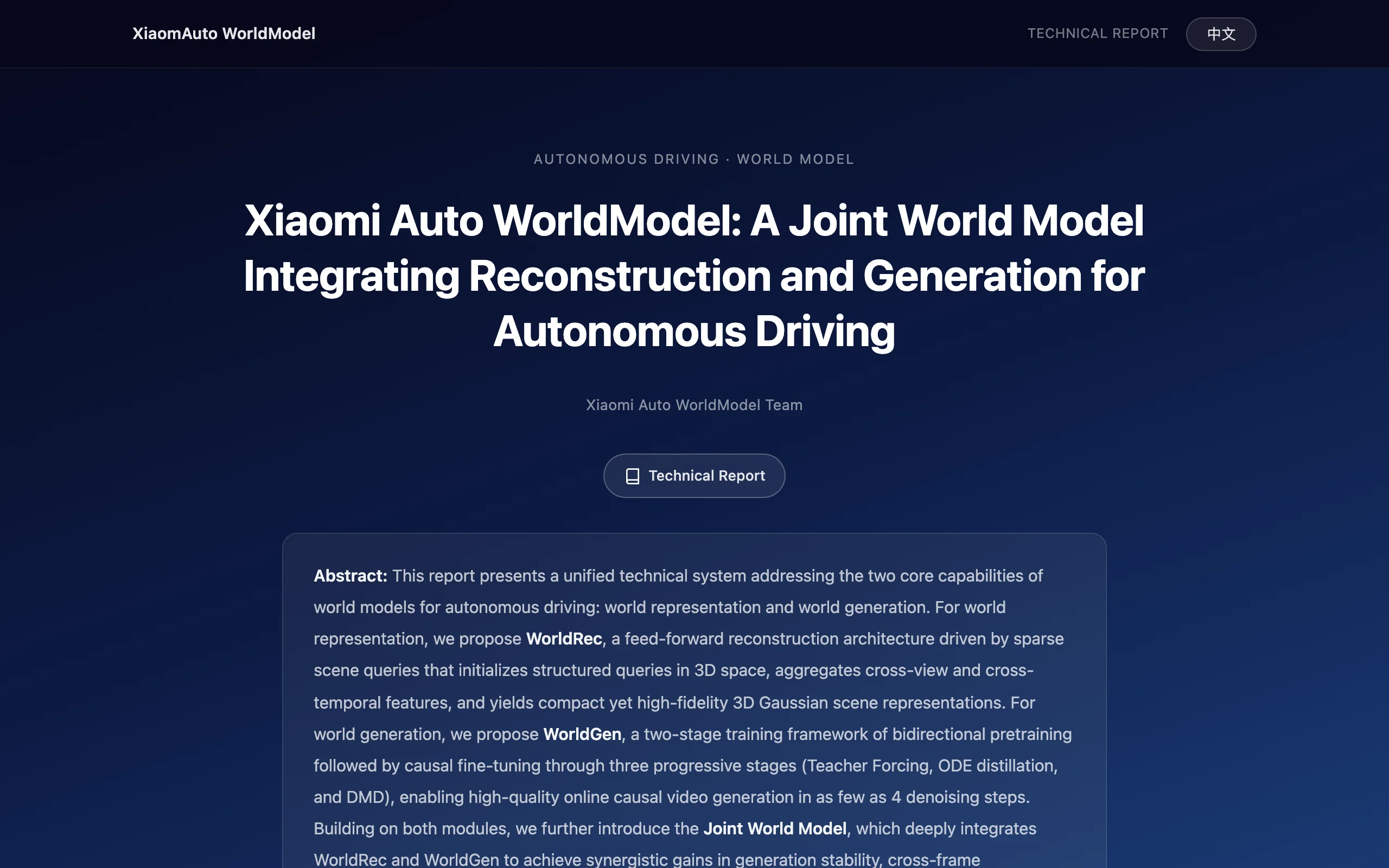
Xiaomi Auto's assisted-driving world model (Xiaomi Auto World Model) is the first to deeply couple 3D reconstruction (WorldRec) with video generation (WorldGen) into one driving-scene understanding an...
1. What Is the Xiaomi Auto World Model
Xiaomi Auto's assisted-driving world model (Xiaomi Auto World Model) is the first to deeply couple 3D reconstruction (WorldRec) with video generation (WorldGen) into one driving-scene understanding and simulation stack. Sparse 3D anchors reconstruct 10 seconds of video in 10 seconds; two-stage training plus ODE distillation cuts denoising to 4 steps (~0.19 s/frame) with up to ~1 minute continuous generation. Waymo reconstruction PSNR 28.48; nuScenes generation FVD 64.97—both leading benchmarks. Deployed for synthetic data, closed-loop simulation, and assisted-driving training academy—moving world models from papers to production.
Image source: Official article
Technical positioning and domain: Autonomous-driving visual world model for 3D reconstruction + video generation—not pure generative fantasy, but geometry-accurate, consistency-aware scene modeling.
Development background: In-house Xiaomi Auto team addressing long-tail data scarcity and slow simulation—vision + AD stack experience from architecture through deployment.
Core value: Breaks the data-scarce → fragile model → insufficient testing loop: fast accurate geometry, controllable generation into unobserved space/time, feeding perception training, validation, and driver education with less real-road dependency.
Technical characteristics: Sparse 3D anchors vs dense Gaussians for multi-view consistency; two-stage training + ODE distillation (~12× faster inference); closed loop where reconstruction constrains generation and generation extends reconstruction boundaries.
2. Key Features
WorldRec 3D reconstruction: Sparse query anchors aggregate multi-camera multi-time features with visibility weighting—10 s video → 10 s rebuild; Waymo PSNR 28.48 (~+1 vs DGGT).
WorldGen video generation: Bidirectional temporal pretrain + causal finetune; ODE distillation 50→4 steps; 0.19 s/frame single-view; up to 81 frames (~1 min) including future views and occluded regions; nuScenes FVD 64.97.
Rec–gen coupling: 3D priors stabilize generation; generation fills unseen spacetime; mutual loss structure reduces long-horizon drift.
Extreme scenarios: Heavy rain/snow/fog, animal intrusion, jaywalking—controllable synthesis with consistent geometry.
Synthetic data at scale: 100k+ driving clips with 3D labels for perception training.
Closed-loop simulation: Replay and stress-test accidents with tunable parameters for perception/planning validation.
3. How to Use
Requirements: Xiaomi vehicle (e.g., SU7) with assisted-driving academy software; network for updates; stationary safe parking to launch simulations.
Open academy: From AD/ intelligent driving menu → Assisted Driving Academy (exact UI naming may vary by firmware).
Pick scenarios: Urban, highway, rural templates plus weather/night/animal edge cases with previews.
Configure parameters: Weather intensity, traffic density, time of day—system renders first-person instructional video.
Learn: Play/pause/rewind with annotated hazards and recommended maneuvers.
Safety: Academy only when parked; rules tuned for China road standards; start basic before extreme cases.
4. Pros and Cons
| Pros |
|---|
| Rec+gen coupling innovation: Geometry guides generation; generation extends recon—less drift than pure gen. |
| SOTA metrics: Waymo PSNR and nuScenes FVD lead published baselines; strong zero-shot generalization claims. |
| Fast inference: 0.19 s/frame single-view vs ~1.06 s/frame autoregressive baselines (Epona). |
| Production loop: 100k+ synthetic clips, sim testing, in-car academy—proven deployment path. |
5. Comparison with Similar Tools
| Dimension | Xiaomi World Model | Waymo World Model | Tesla FSD World Model |
|---|---|---|---|
| Architecture | WorldRec + WorldGen coupled | Genie 3 generative | Transformer E2E gen |
| Reconstruction | Sparse anchors, 10s/10s, PSNR 28.48 | No dedicated recon module | Undisclosed |
| Gen speed | 0.19 s/frame (1-view) | Undisclosed | Undisclosed |
| Max duration | ~81 frames (~1 min) | Minutes (Genie 3) | Undisclosed |
| Sensors | Multi-camera focus | Camera + LiDAR | Camera + radar |
| Open source | No (in-vehicle) | Internal | Internal |
| Deployment | Synthetic data, sim, academy | Waymo Driver R&D | FSD R&D |
Selection guidance: Not directly usable outside Xiaomi—reference architecture for rec+gen coupling. Waymo/Tesla similarly closed. NVIDIA Drive Sim for open toolchain teams with budget for integration. Xiaomi's coupling excels when strict scene structure matters.
6. Editor's Take
Architecturally meaningful: rec and gen aren't bolted modules—they co-constrain through losses, reducing geometric drift while filling occlusions. SOTA on Waymo/nuScenes supports the thesis.
Industrial closure is the story: 100k clips, accident replay sims, and consumer-facing academy tie R&D to product and users. Third parties can't run it today; platform lock-in caps research reuse.
Worth watching if APIs or cloud services open; transferable to robotics/digital twin rec+gen patterns.
— strong tech and shipping proof; −1 for exclusivity and opacity.
7. Use Cases
- Synthetic long-tail data: Weather, night, rare hazards for perception training.
- Closed-loop sim: Directed tests on perception/planning under parameterized danger scenes.
- Driving academy: First-person lessons for complex maneuvers in-car.
- Cockpit assistant visuals: On-demand scenario playback from voice queries ("highway lane change in rain").
8. FAQ
Q: Need internet?
A: First load often online; some base scenes cache offline; complex weather gen may still need network updates.
Q: Third-party vehicles?
A: No—tied to Xiaomi hardware/sensor stack; no public third-party API announced.
Q: Commercial use of synthetic data?
A: Internal R&D asset; academy video for viewing only—not exportable for external commercial datasets.
Q: vs Waymo world model?
A: Xiaomi emphasizes rec+gen coupling for long-horizon stability and faster on-device-friendly inference (0.19 s/frame).
Q: Custom scenarios?
A: Limited sliders (weather, traffic, time); core geometry/rules preset for safety—no full user-authored worlds.
9. Project Links
- Project site: https://JointWM.github.io/
- arXiv paper: https://arxiv.org/pdf/2605.18137
Related AI Model Articles

Kimu: In-Depth Review of the Open-Source AI Video Editor from the trykimu Team
Kimu (officially named Kimu Studio) is an open-source AI video editor developed by the trykimu team. Its core concept lies in describing requirements through natural language, allowing AI to automatic...

Qwen-Audio-3.1: A Full-Stack Evaluation of the Qwen Audio Large Model Series
Qwen-Audio-3.1 is a series of large audio models launched by Alibaba's Qwen. It consists of five models: ASR speech recognition, ASR-Next audio understanding, TTS speech synthesis, TTS-Next audio crea...

Qwen3.8-LiveTranslate – A Real-Time Simultaneous Interpretation Model Launched by Alibaba Tongyi
Qwen3.8-LiveTranslate is a real-time simultaneous interpretation large model launched by the Tongyi Qianwen team at Alibaba. Based on the Interleave single-stream architecture, it processes audio and ...
Hypit – Open-Source AI Video Generation Tool, Automatically Replicates Viral Videos
Hypit is an open-source AI video generation tool, centered on the methodology of "Provide an Agent with a viral video, and it will automatically replicate the entire workflow." It breaks down viral vi...
© All Rights Reserved. Some content on this site is partially generated by AI with human review.