
Agora-1 – Odyssey's First Multi-Agent World Model
Executive Summary:
Agora-1 is Odyssey's first multi-agent world model, breaking past the single-user limits of traditional world models by enabling humans and AI to interact in the same real-time generated world simulat...
1. What Is Agora-1
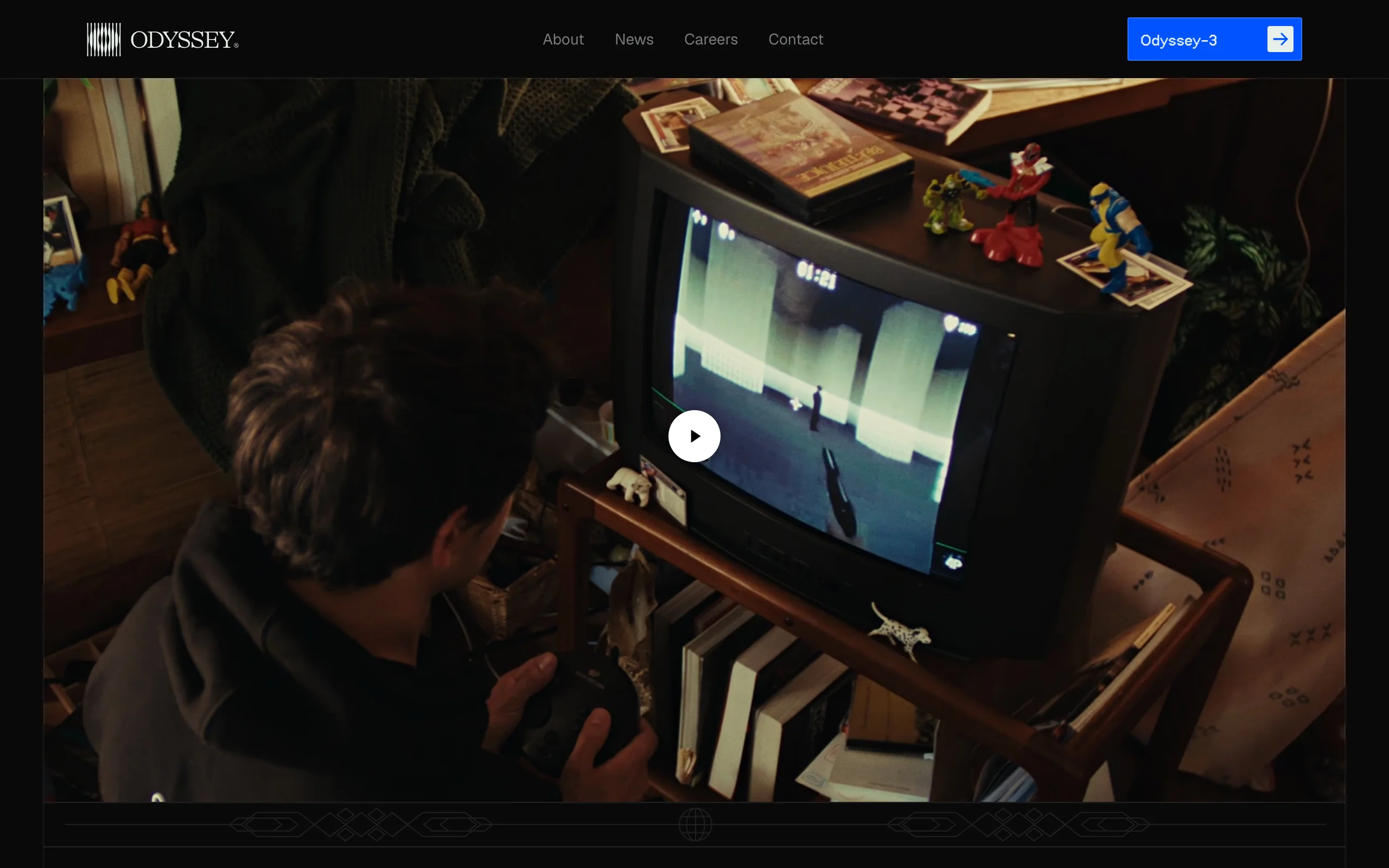
Agora-1 is Odyssey's first multi-agent world model, breaking past the single-user limits of traditional world models by enabling humans and AI to interact in the same real-time generated world simulation. Using the classic FPS game GoldenEye 007 as its research setting, it supports up to four participants sharing a deathmatch experience. Unlike conventional world models, Agora-1 decouples simulation dynamics from visual rendering while maintaining an explicit shared world state, achieving multi-view consistent generation. Its architecture resembles a modern game engine, but every component is learned—no hard-coded logic—opening new paths for game development, robot collaboration, reinforcement learning training, and foundation model research.
Image source: Official article
Technical positioning and domain: Agora-1 sits at the intersection of generative world models and multi-agent systems, focused on world-state consistency and visual generation in multi-user real-time interaction. Its distinctive positioning upgrades world models from single-user passive observation to multi-user active participation, making it core infrastructure for AI-native multiplayer games and collaborative robotics research.
R&D background: The Odyssey team includes top AI researchers from Google DeepMind, OpenAI, and similar institutions, with deep experience in generative models and multi-agent systems. The team observed that existing world models suffer serious consistency issues in multi-view, multi-participant scenarios, and designed Agora-1 from scratch as a fully data-driven, scalable multi-user world simulation platform.
Core value: Agora-1 addresses the hardest problem in multi-agent world simulation—"view splitting." Traditional methods generate separate world states per participant, causing visual inconsistency and logical contradictions. By introducing an explicit shared world state, the model ensures every participant sees the same simulated environment while supporting direct state manipulation to generate new levels and game rules, greatly lowering the barrier to AI-native game development.
Technical characteristics: Agora-1 uses a dual-model decoupled architecture separating simulation dynamics from visual rendering, with independent Simulation Model and Rendering Model connected via a shared World State. The core innovation is that the Simulation Model learns internal game state transitions rather than pixel-level prediction, enabling mastery of gameplay dynamics and player impact while supporting linear scaling—adding participants does not cause context length explosion.
2. Key Features
Multi-agent real-time interaction: Supports up to four human or AI participants sharing and interacting in the same generated world in real time. Each participant has an independent viewpoint and controls, but all actions affect the same shared world state, enabling genuine multiplayer cooperation or competition. This breaks the single-user limit of traditional world models and provides a foundation for multiplayer games and team collaboration research.
Shared world state maintenance: An explicit world state database ensures all participants see a consistent simulated environment. The system maintains discrete shared state including player positions, health, item status, and more. Any player's action updates state in real time and broadcasts to all participants. This is the core technique for multi-view consistency, avoiding logical contradictions from each participant maintaining separate world states.
Decoupled simulation and rendering: Separates dynamic simulation from visual generation modules, supporting consistent visuals from multiple independent viewpoints. The Simulation Model computes game logic and physics; the Rendering Model, based on DiT architecture, generates visuals conditioned on shared game state. This decoupling enables parallel multi-view rendering while guaranteeing all frames derive from the same underlying state, fundamentally solving multi-view consistency.
Learned game engine: Fully data-driven learning without hard-coded logic or rendering rules from traditional game engines. The Simulation Model learns internal state transitions including collision detection, ballistics, AI behavior, and other complex logic. Developers need not manually write game rules—provide game data and the model learns and generates playable worlds, greatly lowering game development barriers.
Playable demo experience: A web-based research preview using GoldenEye 007 deathmatch. Users need no software installation—access the experience page in a browser, create a character, and join multiplayer matches. The demo showcases real-world results and gives researchers and developers an intuitive validation platform.
Direct state manipulation: Modify underlying game state to generate new levels while preserving source gameplay consistency. For example, developers can adjust player spawn positions, item distribution, or health parameters, and the model automatically generates playable worlds matching the new state. Level design becomes as simple as editing configuration files while maintaining game logic consistency.
3. How to Use
Environment requirements: Access requires a modern browser (Chrome 90+, Firefox 88+, or Edge 90+) and a stable network connection (at least 10 Mbps recommended). No software installation or environment setup—all computation runs in the cloud. Note: model inference requires substantial GPU resources; first load may take 30–60 seconds.
Access the experience page: Open a browser and visit the Agora-1 project site (https://odyssey.ml/introducing-agora-1) or go directly to the online demo (https://agora.odyssey.ml/). The page shows a simple login interface with a player name field and match status display.
Create your character: Enter a custom player name in the input field (English or numbers recommended, 3–12 characters), then click "Join" or "Start" to enter the match waiting room. The waiting room shows current online player count and estimated wait time. The system supports 2–4 player matches; if wait is too long, choose "Start Anyway" for single-player mode.
Wait for match start: The system automatically matches other players; when successful, all participants enter the game world simultaneously. During matching, view the queue player list and ready status. In single-player mode, AI agents fill empty slots to ensure the match proceeds normally.
Learn controls: In-game, use WASD for movement, arrow keys or mouse for look direction, and spacebar to fire in deathmatch. The top-right UI shows real-time kills, deaths, and score. Classic FPS rules apply—killing enemies earns points; being killed loses points.
View results and rankings: After a match (typically 3–5 minutes or when a score threshold is reached), a detailed stats panel shows each player's kills, deaths, score, and K/D ratio. Choose "Replay" to restart or use the share button to send score screenshots to friends.
Notes: The demo is a research preview and may have latency and frame stutter. Use a good network environment. Multiplayer matching may require waiting for others; peak hours (e.g., weekday evenings) match faster. If connection issues occur, try refreshing or switching networks.
4. Pros and Cons
| Pros |
|---|
| Multi-view consistency breakthrough: Explicit shared world state ensures all participants see fully consistent simulated environments, fundamentally solving multi-view inconsistency and logical contradictions in traditional methods. |
| Linear scaling: Unlike chained sequence methods, adding participants does not cause context length explosion. The system scales linearly to support more players, laying groundwork for large-scale multi-agent applications. |
| Learned game engine: Fully data-driven game logic without hard-coded rules greatly lowers development barriers while supporting direct state manipulation for new levels with high flexibility. |
| Open-ended training: Supports multi-agent RL training, generating emergent behavior data traditional demos cannot cover, providing a new data generation paradigm for AI research. |
5. Comparison with Similar Tools
| Dimension | Agora-1 | PixVerse R1 | Genesis |
|---|---|---|---|
| Core architecture | Dual-model decoupling (Simulation + Rendering), explicit shared state | End-to-end video generation, diffusion-based | Unified world model, implicit state |
| Multi-user support | Up to 4 real-time participants, shared world state | Single-user video generation only | Single-user, no multiplayer |
| Scene applicability | FPS GoldenEye 007 research scene | General video generation, diverse content | Physics simulation, robot training |
| Real-time performance | Latency (100–200 ms), needs optimization | Non-real-time; generation takes seconds | Real-time, lower latency |
| Open source | Not open source; web demo only | Not open source; API service | Open source, code and models public |
| Developer ecosystem | Research preview stage, no ecosystem | Series C unicorn; API and paid tiers | Academic research, smaller community |
Selection advice: If your research or development needs multi-user real-time interactive world simulation, Agora-1 is currently the only option—but scene limitations and real-time gaps require trade-offs. For general video generation, PixVerse R1 offers a more mature commercial solution but cannot support multi-user interaction. If you prioritize open source and physics simulation, Genesis and GameNGen are better choices but lack multi-user support. Overall, Agora-1 is pioneering in multi-agent world models but still has distance to mature commercial use.
6. Editor's Take
From a technical innovation standpoint, Agora-1 is a milestone breakthrough. It first upgrades world models from single-user passive observation to multi-user active participation, solving multi-view consistency through explicit shared world state—a design with pioneering significance in academia and industry. The dual-model decoupled architecture separates simulation from rendering, letting the model work like a modern game engine where every component is learnable, offering a new paradigm for AI-native game development.
In practical value, Agora-1 remains in research preview with relatively limited direct applications. The demo shows potential, but real-time performance and scene limitations make immediate production deployment difficult. For AI researchers, game developers, and robotics engineers, Agora-1 provides a valuable research platform—especially in multi-agent RL training and collaborative robot policy learning—where open-ended training capability has irreplaceable value.
For audience fit, Agora-1 suits AI researchers and frontier technology explorers more than casual gamers or content creators. If you work on multi-agent systems, world models, or AI-native games, Agora-1 is worth deep study. Commercial developers should wait for maturity before adoption.
Future potential is substantial. As generalization to more game types improves, real-time performance optimizes, and commercial paths clarify, Agora-1 could become core infrastructure for AI-native games and collaborative robotics. Its linear scaling capability offers possibilities for large-scale multi-agent applications.
Rationale: Full marks for technical innovation; one star deducted for scene limitations and real-time gaps, but research platform value is undeniable. For the target audience, Agora-1 is a frontier tool worth attention and trial.
7. Application Scenarios
Multiplayer game development: Provides real-time world generation for AI-native multiplayer games without traditional engines. Developers can use Agora-1's learned game engine to quickly generate playable multiplayer worlds without complex game logic code. Direct state manipulation enables new levels and rules, greatly shortening development cycles.
Collaborative robotics: Supports multiple robots jointly reasoning about actions, space, and interaction in shared environments. In warehouse logistics, multiple robots must coordinate in the same space; Agora-1 can simulate complex interaction scenarios, training robots to learn avoidance, waiting, and cooperation strategies.
Reinforcement learning research: Provides multi-agent RL training environments, generating emergent interaction data for collisions, coordinated movement, and more. Traditional RL environments often require manually written interaction rules; Agora-1 automatically generates rich interaction data for exploring emergent behavior in multi-agent systems.
Foundation model training: Serves as a generative multi-agent simulator to train policies that generalize to new environments and new partners. For example, train a general multi-agent collaboration model to complete tasks across different game scenes and AI partner configurations, improving generalization.
Defense and education simulation: Build simulation environments for complex multi-participant scenarios for training and research. In military defense, simulate multi-branch coordinated operations; in education, create multiplayer collaborative learning environments to train teamwork skills.
8. FAQ
Q: What hardware does Agora-1 require?
A: The Agora-1 demo runs entirely in the cloud. Users only need a modern browser and stable network. Model inference requires NVIDIA A100 or higher GPUs, so local running is currently unavailable. The team may consider a local deployment version in the future, but timing is undetermined.
Q: How many players does the demo support online simultaneously?
A: Currently up to four players online for deathmatch. The system matches 2–4 players to start; if wait is too long, single-player mode fills empty slots with AI agents. Future versions may support more players but require real-time and resource optimization.
Q: Is the Agora-1 model open source?
A: Agora-1 is not currently open source—only a web demo is available. The team is evaluating open-source plans but has not announced a timeline. Academic researchers can contact the team via the project site for more technical details.
Q: How does Agora-1 differ from other world models like GameNGen?
A: The core difference is multi-user support. Traditional world models like GameNGen support only single users and use pixel-level prediction, easily causing multi-view inconsistency. Agora-1 achieves true multi-user real-time interaction through explicit shared world state and dual-model decoupling, and participant count does not cause context length explosion.
Q: What is the demo's visual quality?
A: As a research preview, visual quality lags commercial games—roughly 720p resolution at ~30 fps. The team is optimizing the rendering module; future versions may support higher resolution and frame rates. The current version primarily demonstrates feasibility, not perfect gameplay.
Q: Can Agora-1 be used for commercial game development?
A: Not recommended currently. The model remains in research with real-time, stability, and scene applicability issues. No commercialization plan, API, or SDK has been announced. Wait for maturity and official release before commercial application.
9. Project Links
- Project site: https://odyssey.ml/introducing-agora-1
- Online demo: https://agora.odyssey.ml/
Related AI Model Articles
OpenMuse – CopilotKit Open-Source Personal AI Assistant
OpenMuse is an open-source personal AI assistant project developed by the CopilotKit team. Its core design philosophy is "giving an Agent a computer" — by combining a persistent browser, optional Linu...
In-Depth Review of Longcat-2.5-preview: Meituan's Next-Generation Multimodal Long-Range Agent Model
LongCat-2.5-preview is Meituan's latest next-generation large model. Building upon the 1.6T total parameters, approximately 48B active parameters, and native 1M token context of LongCat-2.0, it marks ...
Review of DeepSeek Harness Desktop: How the Official GUI Client Lowers the Bar for Agent Usage
DeepSeek Harness Desktop is the official graphical client launched by DeepSeek, designed to provide a visual interface for the originally command-line-based DeepSeek Harness framework. After users log...
Step Code – In-Depth Review of StepFun's Open-Source Terminal Programming Agent
Step Code is an open-source terminal programming agent launched by StepFun, licensed under the MIT License, which allows developers to complete the full workflow of code writing, debugging, execution,...
© All Rights Reserved. Some content on this site is partially generated by AI with human review.