
Wall-OSS-0.5 – X Square Robot’s Open Embodied Intelligence Model
Executive Summary:
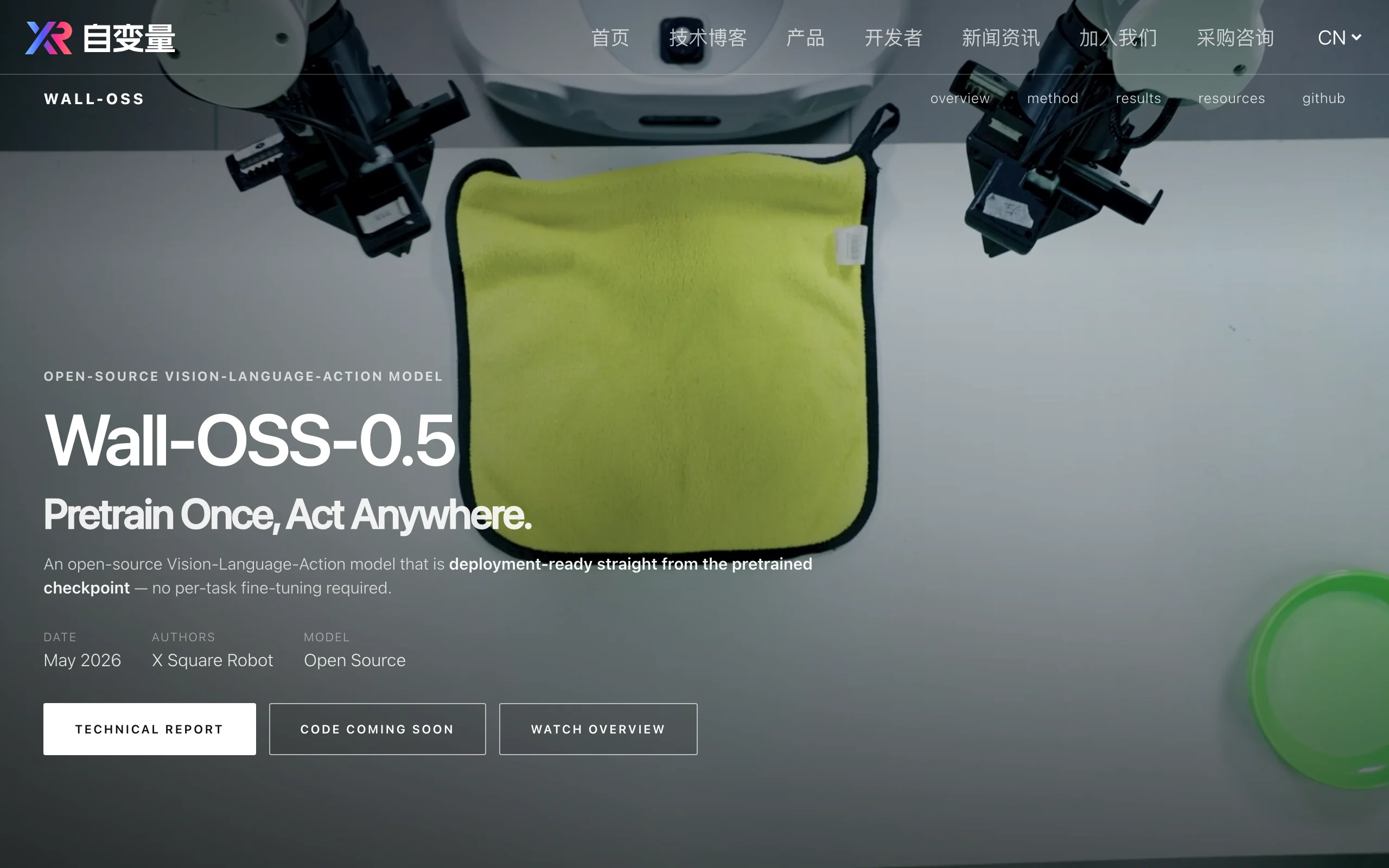
Wall-OSS-0.5 is X Square Robot’s open vision-language-action (VLA) model—a 4B-parameter stack on a 3B Qwen2.5-VL backbone achieving zero-shot real-robot deployment without per-task fine-tuning. Gradie...
1. What Is Wall-OSS-0.5
Wall-OSS-0.5 is X Square Robot’s open vision-language-action (VLA) model—a 4B-parameter stack on a 3B Qwen2.5-VL backbone achieving zero-shot real-robot deployment without per-task fine-tuning. Gradient-Bridge co-training merges action learning into the backbone so the robot runs 17 real tasks out of the box—four above 80% success—marking a strong open-source step in generalizable embodied AI.
Image source: Official article
Technical positioning and domain: General-purpose embodied foundation model—not “fine-tune every task/hardware.” Pretraining injects physical priors for pretrain-and-deploy vs traditional VLA fine-tune gates. Action and VL capabilities co-enhance rather than bolt together.
Development background: X Square Robot targets two VLA pains: costly per-robot/per-task adaptation and action training eroding VL semantics. Gradient-Bridge + Mixture-of-Transformers (MoT) keeps language while learning continuous control.
Core value: Shrinks lab-to-floor gap—download weights, run manipulation/sorting without dataset collection. Fine-tuned, 15 real tasks average 60.5% progress—+17.5 pts vs π0.5. Strong generalization on unseen tasks (e.g., 82% rope tightening).
Technical characteristics: Discrete action + multimodal + continuous flow-matching objectives bridged in one graph; MoT routes VL vs action tokens with joint attention; massive heterogeneous robot data (20+ morphologies, 1M+ trajectories/round, 90M+ multimodal samples).
2. Key Features
Zero-shot real-robot operation: Pretrained checkpoints deploy directly on physical hardware without task-specific fine-tuning for grasping, sorting, and organizing. Gradient-Bridge co-training instills general physical manipulation priors during pretraining, breaking the traditional VLA requirement to fine-tune before every new task.
Unified multi-morphology adaptation: One pretrained checkpoint adapts to 20+ robot morphologies—desktop dual-arm, mobile manipulators, and varied DOF configurations—thanks to heterogeneous training trajectories that teach cross-embodiment action representations without per-hardware retraining.
Gradient-Bridge tri-objective co-training: Discrete action prediction, multimodal prediction, and continuous flow matching serve as complementary optimization targets forming a "gradient bridge." Action policy learning and visual-language pretraining knowledge mutually enhance rather than conflict, avoiding catastrophic forgetting common in naive multi-task VLA training.
Mixture-of-Transformers (MoT) architecture: Visual-language tokens route through the VL Expert; continuous action computation routes through the Action Expert; joint attention enables end-to-end gradient flow. This preserves Qwen2.5-VL's strong semantics while providing a dedicated path for continuous control generation.
Visual-language capability preservation: Action training does not erode base VLM skills—entity grounding improves by 21.8 percentage points while general visual-language understanding and reasoning remain largely intact, a rare outcome among VLA models that often sacrifice language for control precision.
Efficient fine-tuning adaptation: After fine-tuning on the LeRobot dataset, average progress reaches 60.5% across 15 real robot tasks—17.5 points ahead of π0.5. LoRA and other lightweight methods run on consumer-grade GPUs for rapid domain adaptation.
Strong generalization and long-horizon execution: Maintains high progress on three unseen tasks (e.g., deformable object manipulation) and supports multi-stage continuous operations such as rope tightening, towel folding, and fruit-basket organization—reflecting deeper physical causality understanding beyond memorized trajectories.
3. How to Use
Environment: Python 3.10 conda env, PyTorch 2.0+, Flash Attention ≥2.7.4, Linux recommended, NVIDIA A100-class GPU ideal.
LeRobot: Clone HF LeRobot (compatible tag e.g. v0.1.0),
pip install -e .Wall-X toolchain: Clone
X-Square-Robot/wall-x,git submodule update --init --recursive, install editable.Weights: Download
x-square-robot/wall-oss-0.5from Hugging Face (~8 GB).Robot config: Edit
wall-x/configs/robot.yamlfor DOF, paths, hyperparameters.Optional fine-tune: LeRobot-format data →
bash ./workspace/lerobot_example/run.sh(LoRA or full).Deploy: Load checkpoint, connect inference API to controller; simulate (MuJoCo) before hardware.
4. Pros and Cons
| Pros |
|---|
| Zero-shot deploy: 17 tasks, 4 >80%—low integration friction. |
| VL + action synergy: +21.8 grounding; avoids “language forget.” |
| One checkpoint, many robots: Cross-embodiment transfer. |
| Strong fine-tune numbers: Beats π0.5 by 17.5 pts on 15 tasks. |
| Fully open Apache 2.0: Weights, code, recipes, ablations. |
5. Comparison with Similar Tools
| Dimension | Wall-OSS-0.5 | π0.5 |
|---|---|---|
| Org | X Square Robot | Physical Intelligence |
| Size | 4B (3B Qwen2.5-VL + action) | Undisclosed π0 lineage |
| Architecture | MoT + Gradient-Bridge | Hierarchical tokens + flow |
| Action gen | Discrete + flow matching joint | High discrete + low flow denoise |
| Training data | 20+ robots, 1M+ traj/round, 90M multimodal | Web + cross-robot + language |
| Zero-shot hardware | Yes—4/17 tasks >80% | Needs post-training |
| After FT | 60.5% avg on 15 real tasks | 60–88% home tasks reported |
| Openness | Full OSS stack | Partial research release |
| VL retention | +21.8 grounding, intact QA | Maintained via web data |
Selection guidance: Fast zero-shot on new arms → Wall-OSS-0.5. Open-world language-heavy home tasks → π0.5 (less open). Academic reproducibility/tooling → OpenVLA with weaker zero-shot.
6. Editor's Take
Gradient-Bridge is real co-training—not naive multi-task loss sharing—MoT joint attention prevents VL collapse while learning flow-matched actions. Numbers back the story.
Zero-shot “download and grasp” is the headline for startups and labs; LoRA fine-tune still beats π0.5 when you have data.
Watch 7B scaling, humanoid coverage, and sub-30 ms inference for factory floors.
— − for docs/community maturity and very long horizon stability.
7. Use Cases
Home service arms: Sorting blocks, fruit, drawers, ring stacks via NL or policy.
Deformables: Ropes, towels, flowers—generalizes beyond rigid pick-place.
Industrial pick/sort/return: Fine-tune for line changeovers with less teaching.
Dual-arm coordination: Two-hand assemblies and conveyor pick-place sequences.
Research/education: Open weights + ablations for VLA coursework and papers.
8. FAQ
Q: Supported hardware?
A: 20+ forms (Franka, KUKA, UR, dual-arm, mobile bases)—see robot.yaml; custom DOF supported.
Q: Zero-shot data prep?
A: None—load weights, set joint limits, stream actions to controller.
Q: Fine-tune GPUs?
A: LoRA on single A100 40 GB (~2–4 h); full FT wants multi A100 80 GB; 4090 LoRA only with small batches.
Q: Chinese commands?
A: Qwen2.5-VL backbone supports Chinese/English natively—e.g., “把红色积木放到左边盒子”.
Q: Custom task metrics?
A: Fine-tune on LeRobot format, run bundled eval.py for success/progress; sim-first for zero-shot.
Q: Inference speed?
A: ~50–100 ms/step on A100—TensorRT/ONNX or 224×224 inputs help realtime grabs.
9. Project Links
- Resources: https://x2robot.com/oss#resources
- GitHub (wall-x): https://github.com/X-Square-Robot/wall-x
- Paper: https://x2robot.com/api/files/file/wall_oss_05.pdf
- Hugging Face weights: https://huggingface.co/x-square-robot/wall-oss-0.5
Related AI Model Articles
In-Depth Review of Longcat-2.5-preview: Meituan's Next-Generation Multimodal Long-Range Agent Model
LongCat-2.5-preview is Meituan's latest next-generation large model. Building upon the 1.6T total parameters, approximately 48B active parameters, and native 1M token context of LongCat-2.0, it marks ...
Xiaomi MiMo-V2.6 – Xiaomi's Open-Source Multimodal Model Series
Xiaomi MiMo-V2.6 is a series of fully multimodal models released and open-sourced by Xiaomi, comprising two native full-modal models: Pro and Flash. It is centered on large-scale Agentic reinforcement...
In-Depth Review of Step 5 Preview: A 600B Sparse MoE Flagship with 1M Token Context and 1/8 Cost Advantage
Step 5 Preview is a new-generation flagship foundation model launched by StepFun, designed for real-world Agentic tasks. Based on a sparse MoE architecture, the model has a total of 600B parameters bu...
Qwen3.8-Omni-Flash – A Native Multimodal Model Launched by Alibaba Qwen
Qwen3.8-Omni-Flash is a native multimodal model launched by Alibaba Qwen. It jointly models four modalities—text, image, audio, and video—within a single architecture, supporting a context length of u...
© All Rights Reserved. Some content on this site is partially generated by AI with human review.