
VitaBench 2.0 – Meituan LongCat’s Long-Horizon Dynamic Agent Benchmark
Executive Summary:
VitaBench 2.0 from Meituan’s LongCat team is the first benchmark for long-horizon dynamic user modeling in real-life agent scenarios. It ships 56 statistically grounded synthetic users, 819 lifecycle-...
1. What Is VitaBench 2.0
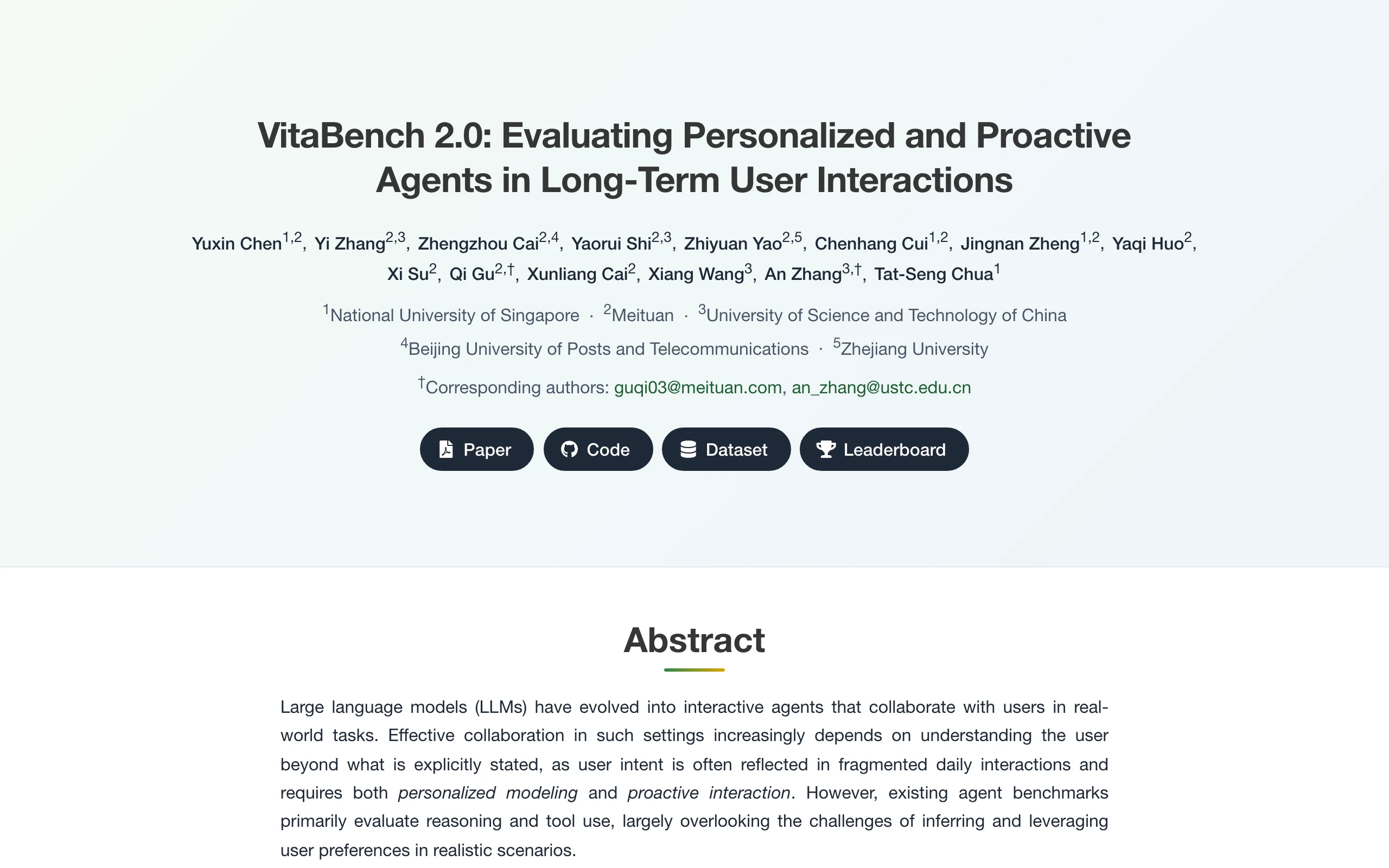
VitaBench 2.0 from Meituan’s LongCat team is the first benchmark for long-horizon dynamic user modeling in real-life agent scenarios. It ships 56 statistically grounded synthetic users, 819 lifecycle-spanning tasks, 2,000+ evolving preferences, and 66 executable tools—average interaction span 1,580 days (max 2,974)—to measure personalization, proactive service, and adaptation over years—not single-shot accuracy.
Image source: Official article
Technical positioning and domain: AI evaluation for longitudinal user modeling. Unlike SWE-bench or AgentBench one-offs, time is a first-class axis: models must track drifting tastes across multi-year event streams.
Development background: LongCat’s lifestyle-AI experience exposed a gap—no standard way to score “ remembers you five years later.” VitaBench 2.0 fills that for assistants, concierge bots, and local services.
Core value: Quantifies long-term personalization—memory, preference inference, proactive clarification—pushing models from Q&A to companionship.
Technical characteristics: 3D decomposition (profile, prefs, history, tasks) on a strict timeline; memory arena pitting Agentic Memory vs RAG Memory on identical trajectories for fair architecture comparisons.
2. Key Features
Realistic user trajectories: 56 users across delivery, in-store, travel, etc., with demographics mirroring real-world stats.
Dynamic preference evolution: 2,000+ preference shifts (~48+ per user)—taste, spend, life-stage changes models must track.
Complex task battery: 819 executable tasks tied to long-term prefs—decisions, retrieval, recommendations.
Dual memory showdown: Agentic vs RAG vs full-context baselines on the same data/tasks with standardized hooks.
Proactive tasks: Scenarios requiring clarifying questions when info is incomplete—mirrors real service dialogs.
Noise injection: ~20% irrelevant/exploratory interactions—tests signal extraction under realistic clutter.
3. How to Use
Environment: Python 3.8+, ~5 GB dataset, 16 GB RAM recommended; Linux/macOS preferred.
Clone framework:
git clone https://github.com/meituan-longcat/vitabench-2.0.gitDownload data:
from datasets import load_dataset
dataset = load_dataset("meituan-longcat/VitaBench-2.0")
Install deps:
cd vitabench-2.0
pip install -r requirements.txt
Pick memory mode: Full context, Agentic Memory, or RAG Memory baseline.
Plug in your agent/model:
python run_benchmark.py --model your_model_name --memory_mode agenticAnalyze reports: Review Avg@4, Pass@4, temporal decay curves for long-horizon weakness.
4. Pros and Cons
| Pros |
|---|
| First long-horizon lifestyle agent bench: Fills a major evaluation void. |
| Multi-year spans: Avg 1,580 days exposes drift invisible to short benchmarks. |
| Statistically grounded personas: 56 diverse synthetic users aid generalization claims. |
| Unified memory comparison: Arena design guides memory module R&D. |
5. Comparison with Similar Tools
| Dimension | VitaBench 2.0 | SWE-bench | AgentBench |
|---|---|---|---|
| Goal | Long-term user modeling & proactive service | Real GitHub SWE fixes | Multi-scenario general tasks |
| Tasks | Lifestyle decisions (food, travel, local) | Code patches | Web, games, code, chat |
| Time span | Avg 1,580 days | Single shot | Single/short dialog |
| User dimension | 56 personas + preference drift | None (repo/issue only) | None |
| Memory focus | Core metric (3 modes) | Current code context only | Dialog context only |
| Proactivity | Designed-in | N/A | Partial exploration |
| Noise | ~20% distractor events | Low | Low |
| Top scores | ~0.50 full-history (Claude Opus 4.6 class) | 40–60%+ pass rates | 60–80% task success |
Selection guidance: Long-term personalization research → VitaBench 2.0. Code automation → SWE-bench. Broad agent scenarios → AgentBench. Tool-use depth → ToolBench.
6. Editor's Take
Introducing time and preference drift to agent eval is a milestone—SWE/AgentBench can’t tell if your assistant still knows you after a lifestyle change.
Directly actionable for personal AI, concierge, and recommendation teams; the memory arena is especially valuable for architecture choices.
Audience: Researchers, LLM vendors, agent engineers, lifestyle platform algo teams.
Future: More industries, multimodal traces, richer social graphs.
— Foundational bench despite hardware/learning curve costs.
7. Use Cases
Personal assistant eval: Measure memory, habit tracking, proactive help.
Customer support tuning: Test preference recall under evolving users.
Recommendation QA: Realistic long-run behavior for food/travel/hotel stacks.
Memory R&D: Compare Agentic vs RAG head-to-head.
Long-context stress tests: Years of noisy events probe context limits.
8. FAQ
Q: vs VitaBench 1.0?
A: 2.0 scales users/tasks/time, adds dynamic prefs and noise separation vs smaller 1.0 scope.
Q: Integrate my model?
A: Implement the documented Agent API—ingest timed events, maintain memory, call tools, emit responses; samples in repo.
Q: Avg@4 and Pass@4?
A: Average success over 4 attempts vs at-least-once success in 4 tries—stability vs peak capability.
Q: Chinese models?
A: Dataset is Chinese lifestyle-centric; any model handling Chinese works; English-only models need adaptation.
Q: Runtime/hardware?
A: Hours in full-context mode; 16 GB+ RAM; GPU (A100/V100 class) recommended for local LLM inference.
Q: Privacy?
A: Fully synthetic users—no real PII; compliance-reviewed release.
Q: Can I run a subset of users or tasks for faster iteration?
A: Yes—the harness supports filtering by user ID, task category, or date range so you can smoke-test a new memory module on a handful of trajectories before launching the full 819-task sweep. Check run_benchmark.py flags and the README for --user_subset and --max_tasks options; partial runs still emit comparable Avg@4 metrics on the selected slice.
9. Project Links
- Site: https://vitabench2.github.io/
- GitHub: https://github.com/meituan-longcat/vitabench-2.0
- Hugging Face dataset: https://huggingface.co/datasets/meituan-longcat/VitaBench-2.0
- Paper: https://arxiv.org/pdf/2605.27141
Related AI Model Articles
OpenMuse – CopilotKit Open-Source Personal AI Assistant
OpenMuse is an open-source personal AI assistant project developed by the CopilotKit team. Its core design philosophy is "giving an Agent a computer" — by combining a persistent browser, optional Linu...
In-Depth Review of Longcat-2.5-preview: Meituan's Next-Generation Multimodal Long-Range Agent Model
LongCat-2.5-preview is Meituan's latest next-generation large model. Building upon the 1.6T total parameters, approximately 48B active parameters, and native 1M token context of LongCat-2.0, it marks ...
Review of DeepSeek Harness Desktop: How the Official GUI Client Lowers the Bar for Agent Usage
DeepSeek Harness Desktop is the official graphical client launched by DeepSeek, designed to provide a visual interface for the originally command-line-based DeepSeek Harness framework. After users log...
Step Code – In-Depth Review of StepFun's Open-Source Terminal Programming Agent
Step Code is an open-source terminal programming agent launched by StepFun, licensed under the MIT License, which allows developers to complete the full workflow of code writing, debugging, execution,...
© All Rights Reserved. Some content on this site is partially generated by AI with human review.