
Qwen3.5-LiveTranslate – Alibaba Tongyi's Real-Time Simultaneous Interpretation Model
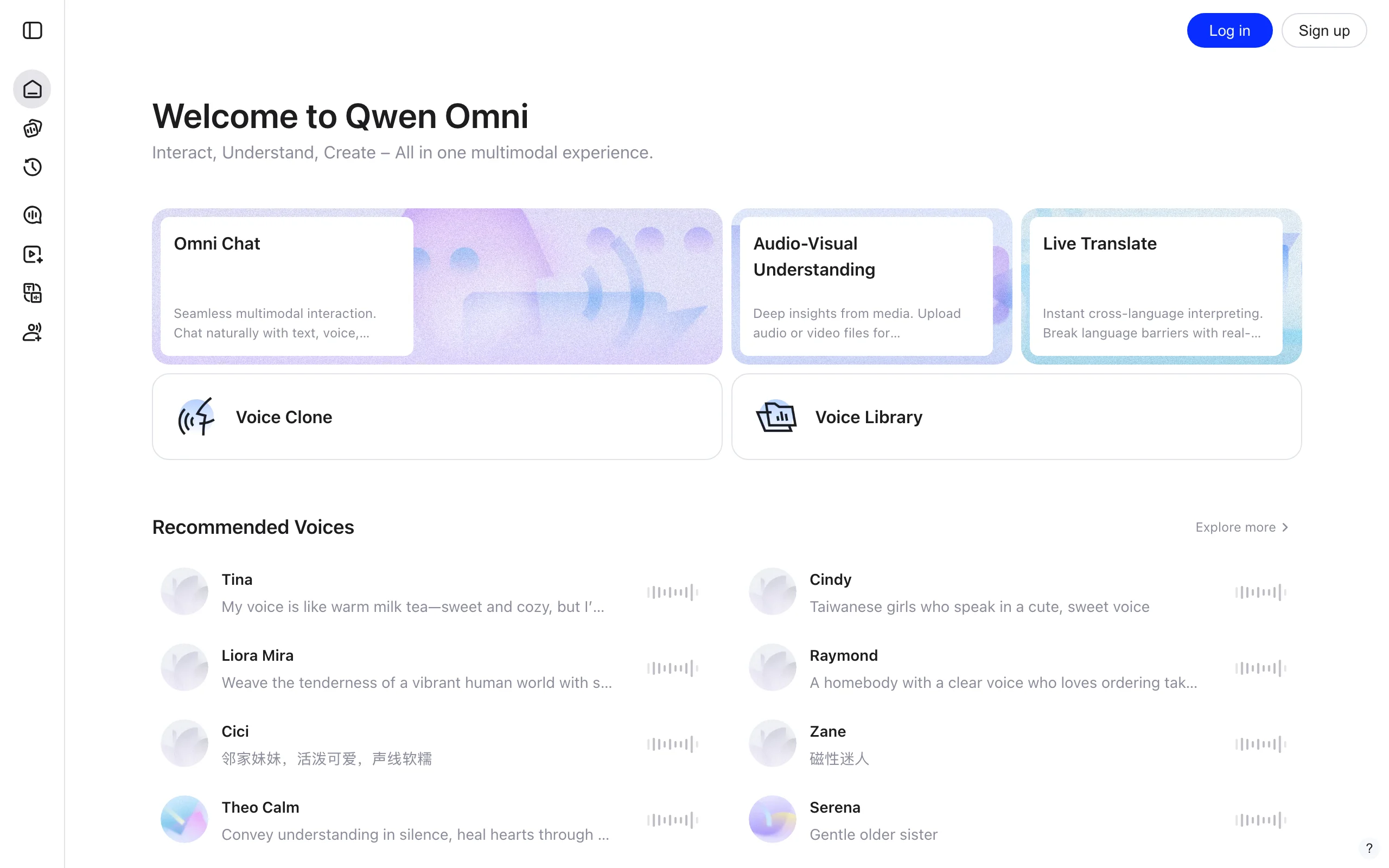
Executive Summary:
Qwen3.5-LiveTranslate is Alibaba Tongyi's next-generation real-time simultaneous interpretation model. It breaks the latency ceiling of traditional cascaded translation pipelines. Through an innovativ...
1. What Is Qwen3.5-LiveTranslate
Qwen3.5-LiveTranslate is Alibaba Tongyi's next-generation real-time simultaneous interpretation model. It breaks the latency ceiling of traditional cascaded translation pipelines. Through an innovative "streaming readable unit" architecture, the model compresses end-to-end average per-character delay to 2.8 seconds—approaching professional human interpreters. It is not a simple translation utility but an end-to-end multimodal AI system integrating speech recognition, machine translation, and speech synthesis. It supports 60 input languages, 29 output languages, and more than 3,500 translation pairs—built for cross-border meetings, live streaming for global audiences, and real-time collaboration where latency and naturalness matter most.
Image source: Official article
Technical positioning and domain: Qwen3.5-LiveTranslate sits at the intersection of NLP and speech technology in real-time speech translation (RTS-T). Unlike traditional cascaded systems (ASR → text translation → TTS), it is an end-to-end speech foundation model built on the Qwen3.5 multimodal base—directly mapping source-language speech to target-language speech. The goal is to solve high latency, error accumulation, and unnatural output that plague legacy simultaneous interpretation stacks.
R&D background: Developed by Alibaba's Tongyi Qwen team, drawing on massive multilingual data and global business scenarios from e-commerce and cloud computing. The team addressed real-time pain points in cross-border communication with a streaming "readable unit" processing scheme. Motivation came from a clear gap: incumbents such as iFlytek and Google could not meet the extreme latency and naturalness demands of live streaming and real-time meetings.
Core value: Qwen3.5-LiveTranslate moves real-time speech translation from "delayed and mechanical" to "synchronized and natural." Legacy systems force users to wait for sentence boundaries and produce emotionally flat, interchangeable voices. Ultra-low latency plus real-time voice cloning make cross-language conversation feel closer to native dialogue—lowering global communication cost and giving outbound commerce and multinational teams critical infrastructure.
Technical characteristics: Three pillars define the stack: (1) streaming readable units for near-human-interpreter timing; (2) end-to-end unified modeling that removes cascade error compounding and improves fluency; (3) real-time voice cloning and hotword boosting—preserving speaker identity while locking in domain terminology for professional settings.
2. Key Features
Ultra-low-latency streaming interpretation: Readable-unit technology segments incoming speech into minimal semantic chunks for encode-translate-decode without waiting for full sentences. End-to-end average delay drops to 2.8 seconds—enough for live co-hosting and real-time meetings without perceptible stutter. This is among the fastest published end-to-end simultaneous interpretation figures in the industry today.
Broad multilingual coverage: 60 spoken input languages and 29 spoken output languages combine into 3,500+ pairs—major business languages plus many long-tail locales. Most high-frequency global business routes are covered, supporting multinational go-to-market and multilingual customer operations without maintaining separate per-locale stacks.
Real-time voice cloning: A one-sentence enrollment sample lets the system reproduce the speaker's timbre, intonation, and emotional color in the target language. That breaks the "same robotic voice for everyone" stereotype of machine translation and preserves personal brand and rapport in cross-language live commerce or executive briefings.
Hotword precision boosting: Users dynamically inject names, brands, and domain terms. At inference time these entries are injected into model context to raise recognition priority and translation accuracy—critical for product launches, earnings calls, and technical keynotes where a single mistranslated trademark can derail trust.
End-to-end speech foundation architecture: Built on Qwen3.5 multimodal weights, ASR, MT, and TTS share one neural stack. Cascade stages that amplify errors are removed; semantic and acoustic continuity improve together, which shows up as smoother prosody and fewer "correct words, wrong delivery" failures.
Multimodal understanding and generation: As part of Qwen3.5, the model can leverage conversational history and optional contextual signals (e.g., slide titles) for disambiguation—useful when homophones or domain jargon appear in fast speech during hybrid online/offline events.
3. How to Use
Environment requirements: Any internet-connected PC or mobile device with a modern browser (Chrome, Edge recommended). No local Python stack or GPU required. Grant microphone permission on first use; use a wired or high-quality USB mic for best cloning fidelity in quiet rooms.
Access the experience: Open
https://omni.qwen.aiin your browser. In the model picker or chat UI, select Qwen3.5-LiveTranslate. The product is primarily Web-first today; Alibaba Cloud Bailian API access is planned for developers who need programmatic integration.Choose LiveTranslate mode and language pair: Switch the conversation UI to LiveTranslate (real-time translation). Set source language (what you speak) and target language (what listeners hear). Verify audio output device and volume before going live—browser tab focus can affect capture on some OS builds.
Configure hotwords (recommended): Before meetings or streams, open hotword settings. Type terms manually or upload a
.txtglossary of people, products, and acronyms. Even 20–50 curated entries materially improve recall on branded vocabulary compared with generic LM priors alone.Start interpretation and voice settings: Click Start interpretation, speak clearly at a steady pace. For cloned output, record a short enrollment phrase and enable Use my voice. The translated stream will carry your vocal identity in the target language—re-record enrollment if room acoustics change mid-event.
4. Pros and Cons
| Pros |
|---|
| Industry-leading latency: 2.8 s end-to-end average delay beats typical cascaded stacks (often 3–6 s) and approaches professional human interpreters—a decisive advantage in live scenarios. |
| High voice fidelity: Real-time cloning preserves speaker timbre and tone—competitors mostly ship fixed personas—boosting trust in executive and creator use cases. |
| Professional scene fit: Dynamic hotword injection fixes brand and technical term misses—a recurring failure mode in generic MT during B2B events. |
| End-to-end error reduction: Unified ASR-MT-TTS modeling avoids cascade amplification—output sounds more coherent in both meaning and delivery. |
5. Comparison with Similar Tools
| Dimension | Qwen3.5-LiveTranslate | iFlytek Simultaneous Interpretation | Google Live Translate |
|---|---|---|---|
| Core architecture | End-to-end speech LM (Qwen3.5 base) | Cascaded ASR + NMT + TTS | Cascaded + partial end-to-end experiments |
| Latency | 2.8 s (end-to-end avg.) | 3–5 s (cascade bound) | 3–6 s (device/network dependent) |
| Voice cloning | ✅ Real-time (one sentence) | ❌ Preset voices only | ❌ Preset voices only |
| Hotword customization | ✅ Dynamic context injection | ✅ Terminology libraries | ❌ No user hotwords |
| Output languages | 29 spoken | ~15 major | ~30 major |
| Deployment | Web + future API | Client/SDK/API | Mobile/system integration |
| Ecosystem | Alibaba Cloud / live commerce | Education & conferences | Android-wide |
Selection guidance:
Cross-border live commerce / creators needing zero-lag feel: Qwen3.5-LiveTranslate's 2.8 s delay and cloning are hard to beat for "same host, many languages" IP preservation. Start on the Web demo before API lock-in.
Highly confidential internal meetings with moderate latency tolerance: Mature SDK/private options from iFlytek or Microsoft may win on data residency today even if voice naturalness lags. Re-evaluate Qwen API tiers when Bailian ships enterprise isolation.
6. Editor's Take
Qwen3.5-LiveTranslate marks a phase change for RTS-T—not another cascade tweak but an architecture-level rethink. Readable units plus end-to-end speech modeling move the bar from "audible translation" to "conversational presence." 2.8 seconds and cloning are not vanity metrics; they reflect how humans tolerate delay and how much identity matters in live trust.
Commercially, the product lands where Alibaba already sells: outbound live streaming and cloud collaboration. Hotwords show B2B polish—terminology kills deals in localized launches. The half-star deduction reflects network coupling, uneven tail languages, and API gaps versus incumbents with decade-long enterprise sales motion.
Audience: Cross-border streamers, multinational executives, international educators, global support leads, and PMs running daily standups across time zones.
Outlook: Deeper DingTalk/Bailian integration and API access could make this default infra for Chinese outbound brands; multimodal slides/video context would unlock conference-keynote parity with human booths.
— Revolutionary latency/voice story minus early-ecosystem friction; mandatory trial for anyone living in live translation.
7. Application Scenarios
Cross-border business meetings: Participants speak native languages; listeners hear cloned, low-latency target speech—cutting booth cost while keeping executive tone intact versus generic TTS.
Live streaming & cross-border e-commerce: Hosts pitch in Mandarin; English, Spanish, Arabic streams carry the same voice—shortening psychological distance and improving conversion vs. dubbed third-person audio.
Global customer support: Agents work in one language; customer audio loops both ways in near real time—shrinks multilingual hiring while preserving CSAT on emotional calls.
International education: Instructors teach in mother tongue; students hear translated lecture audio with preserved cadence—better immersion than subtitle-only MOOCs for listening-heavy subjects.
Distributed engineering standups: Mixed-language squads sync on blockers without forcing English-only norms—technical hotwords keep service names accurate across locales.
8. FAQ
Q: What network do I need for the advertised 2.8 s delay?
A: Aim for stable broadband or 5G/Wi-Fi 6 with ≥10 Mbps up/down and RTT <100 ms. Packet loss shows up as stutter before raw bandwidth caps do—test from the same venue you will broadcast from, not just home Wi-Fi.
Q: Does voice cloning work for every output language?
A: Cloning is strongest on major pairs (zh, en, ja, ko, es, fr, etc.). Long-tail outputs may preserve gender/pitch but lose fine timbre; re-enroll with target-language sample text when quality matters.
Q: What if a new product name appears mid-meeting?
A: Hotwords are pre-session; unseen coined terms fall back to general LM guesses—often wrong once. Keep a live notepad of misses and refresh the glossary before the next session; there is no magic mid-call admin API in the Web demo yet.
Q: Can it handle crosstalk or noisy expo halls?
A: Optimized for single clear speaker near the mic. Overlapping voices and hall noise degrade WER quickly—use directional mics, push-to-talk, or physical booths for mission-critical audio.
Q: Can I export translated audio?
A: Web mode is interactive-only today; use OS-level recorders if you need archives. Future API streams should expose PCM/Opus callbacks for DVR and compliance workflows—watch Bailian release notes.
Q: Is it free?
A: Public Web trials typically include free quota during beta. Commercial API pricing on Bailian is not final—expect usage-based billing similar to other Tongyi speech SKUs once GA.
9. Project Links
- Official experience (Qwen Chat): https://omni.qwen.ai/
- Alibaba Cloud Bailian (API forthcoming): https://bailian.console.aliyun.com/
Related AI Model Articles
In-Depth Review of Longcat-2.5-preview: Meituan's Next-Generation Multimodal Long-Range Agent Model
LongCat-2.5-preview is Meituan's latest next-generation large model. Building upon the 1.6T total parameters, approximately 48B active parameters, and native 1M token context of LongCat-2.0, it marks ...
Xiaomi MiMo-V2.6 – Xiaomi's Open-Source Multimodal Model Series
Xiaomi MiMo-V2.6 is a series of fully multimodal models released and open-sourced by Xiaomi, comprising two native full-modal models: Pro and Flash. It is centered on large-scale Agentic reinforcement...
In-Depth Review of Step 5 Preview: A 600B Sparse MoE Flagship with 1M Token Context and 1/8 Cost Advantage
Step 5 Preview is a new-generation flagship foundation model launched by StepFun, designed for real-world Agentic tasks. Based on a sparse MoE architecture, the model has a total of 600B parameters bu...
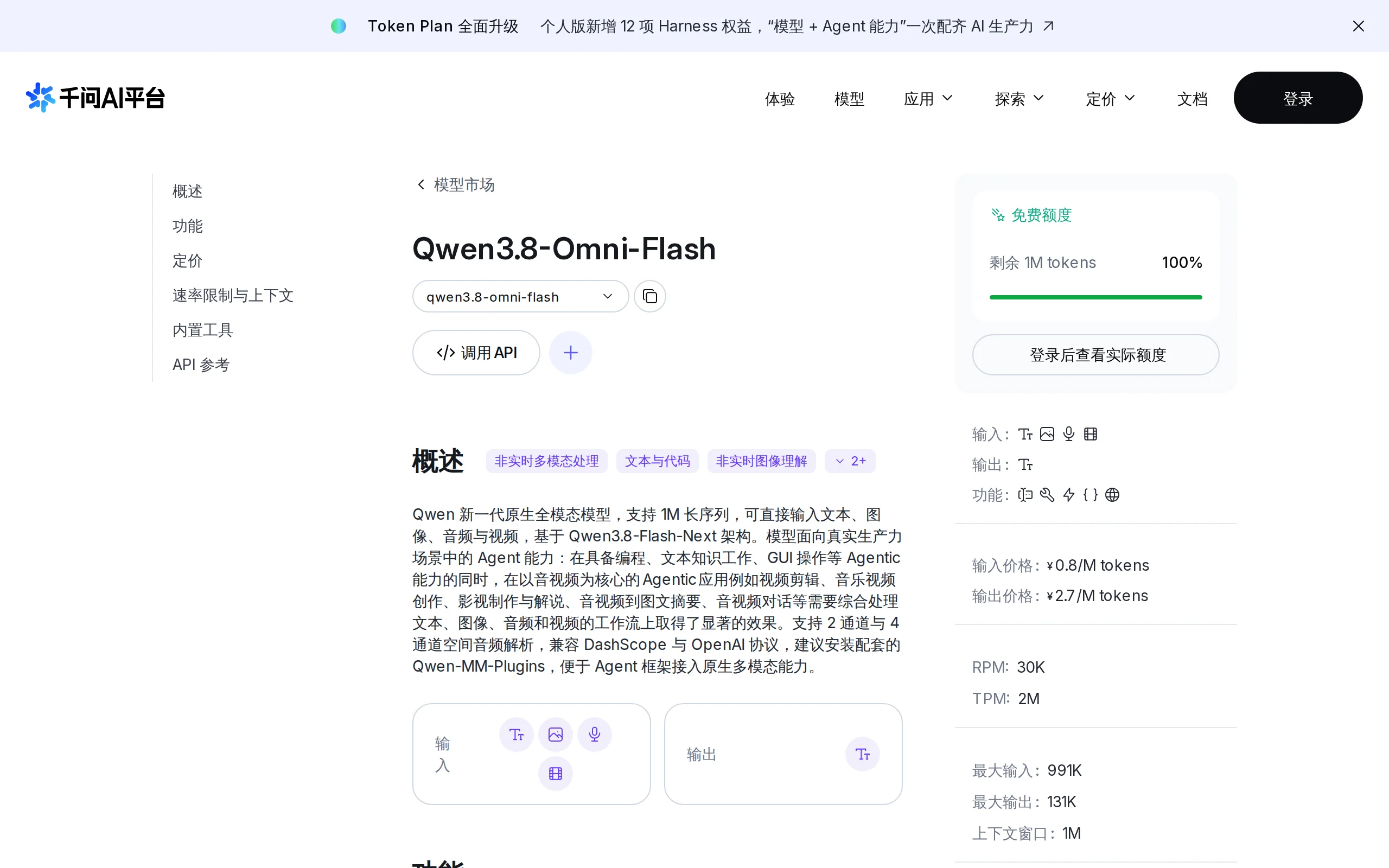
Qwen3.8-Omni-Flash – A Native Multimodal Model Launched by Alibaba Qwen
Qwen3.8-Omni-Flash is a native multimodal model launched by Alibaba Qwen. It jointly models four modalities—text, image, audio, and video—within a single architecture, supporting a context length of u...
© All Rights Reserved. Some content on this site is partially generated by AI with human review.