
PP-OCRv6 – PaddleOCR's Sixth-Generation Open OCR Model
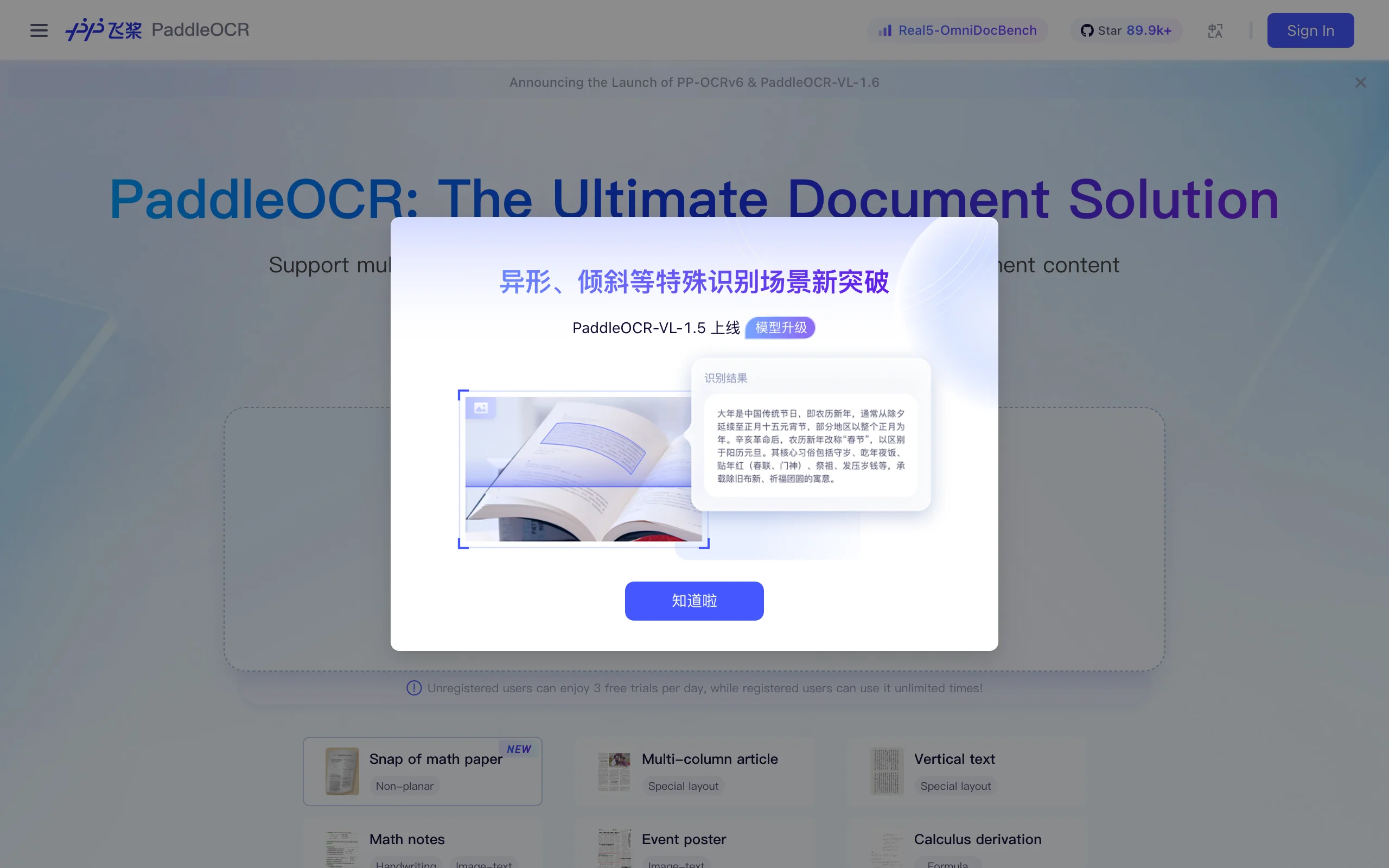
Executive Summary:
PP-OCRv6 is Baidu PaddlePaddle PaddleOCR team's sixth-generation open OCR model, offered in three tiers—Tiny 1.5M, Small 7.7M, Medium 34.5M—covering browser to server compute. vs. the previous generat...
1. What Is PP-OCRv6
PP-OCRv6 is Baidu PaddlePaddle PaddleOCR team's sixth-generation open OCR model, offered in three tiers—Tiny 1.5M, Small 7.7M, Medium 34.5M—covering browser to server compute. vs. the previous generation: +4.9% detection accuracy, +5.1% recognition accuracy. Medium achieves 1.40s end-to-end on Intel Xeon CPU—5.2× faster than v5_server; Tiny reaches 97ms per image in the browser for real-time lightweight OCR. Single-model language support expands from 4 to 50, with industrial optimizations for PCBs, seven-segment displays, CAD drawings, and inkjet dot-matrix text—among the strongest open OCR balances of size, accuracy, and robustness.
Image source: Official article
Technical positioning and domain: PP-OCRv6 is computer vision + NLP OCR—end-to-end text detection and recognition. Unified architecture (MetaFormer backbone + RepLKFPN + LightSVTR) fuses detection and recognition; three parameter tiers adapt mobile to server, filling the gap for ultra-light high-accuracy OCR.
Development background: PaddleOCR's five prior generations built industrial experience. PP-OCRv6 targets compute bottlenecks on browser/embedded devices, multilingual mixed documents, and industrial scenes (PCB silkscreen, seven-segment reads). Built on LCNetV4, RepLKFPN large-kernel fusion, and LightSVTR lightweight Transformer recognizer for generational accuracy gains at tiny parameter counts.
Core value: Solves the accuracy–speed–size trilemma. Medium (34.5M) exceeds hundred-billion-parameter VLMs like Qwen3-VL-235B and GPT-5.5 on detection Hmean 86.2% and recognition 83.2% with very low hallucination (93.2% faithful reproduction). Three tiers share one API, auto-download weights, and multi-backend inference (OpenVINO/ONNX/TensorRT)—low deploy friction.
Technical characteristics: MetaFormer shared feature extractor reduces redundant compute; multi-scale training and edge perturbation augmentation yield 5.19% detection size-consistency variance (−35% vs. v5) and +20.5% recognition edge robustness; 50 languages in one model for mixed CN/EN/JP + 46 Latin scripts without model switching.
2. Key Features
Three-tier flexible deployment: Tiny/Small/Medium for browser, embedded, and server—97ms browser (Tiny), 1.40s CPU end-to-end (Medium).
High-accuracy detection and recognition: End-to-end localization and recognition—Hmean 86.2%, accuracy 83.2%—generational leap; Medium beats massive VLMs at 34.5M params.
50-language single model: Chinese, English, Japanese, plus 46 Latin languages—important for cross-border e-commerce, multilingual manuals, international moderation—lower ops cost.
Industrial scene enhancements: PCBs, seven-segment, CAD, inkjet dot-matrix, tire printing—>10% accuracy gain vs. general models via targeted data and training.
Ultra-fast inference: Tiny 97ms in browser; Medium 1.40s on Xeon CPU—5.2× vs. v5_server—thanks to MetaFormer and LightSVTR.
High robustness: Detection size variance 5.19%; recognition edge consistency +20.5% vs. v5—stable under resolution changes and crop offsets (scanned doc edges).
Multi-backend private deploy: OpenVINO, ONNX Runtime, TensorRT for intranet/offline; C++ APIs for industrial low latency.
Structured document parsing: With PP-StructureV3, convert complex PDFs/images to Markdown/JSON with text boxes and layout hierarchy—for digitization, archives, data entry.
3. How to Use
Environment: Python 3.8+, PaddleOCR 3.7.0+—
pip install paddleocr. For GPU: CUDA 11.2+, cuDNN 8.2+, paddlepaddle-gpu. Linux/Windows/macOS supported.CLI quick start:
paddleocr ocr -i image.png --text_detection_model_name PP-OCRv6_medium_det --text_recognition_model_name PP-OCRv6_medium_recWeights auto-download from HuggingFace or ModelScope. Swap
tiny/smallmodel names as needed.Python API:
from paddleocr import PaddleOCR
ocr = PaddleOCR(text_detection_model_name="PP-OCRv6_medium_det",
                text_recognition_model_name="PP-OCRv6_small_rec")
result = ocr.ocr("image.png")
print(result)
Returns text, confidence, coordinates; supports batch images.
Browser (Tiny): Export Tiny to ONNX; ONNX Runtime Web or OpenVINO in-browser ~97ms—no backend—for online scan and instant text extraction.
Backend acceleration:
paddleocr ocr -i image.png --backend openvinoTensorRT needs separate install and env config for GPU speedup.
Structured parsing:
pip install paddleocr-structure:from paddleocr import PPStructure engine = PPStructure() result = engine("document.pdf")Tips: Medium for multilingual accuracy; Tiny for mobile/browser. Pre-download from ModelScope if first fetch is slow. Offline: local
--model_dir.
4. Pros and Cons
| Pros |
|---|
| Accuracy at tiny size: Medium 34.5M beats huge VLMs on Hmean 86.2% / rec 83.2%. |
| Full compute spectrum: Tiny to Medium one API—easy tier switching. |
| Low hallucination: 93.2% faithful reproduction—including intentional typos—vs. general LLMs; good for finance/healthcare. |
| Very fast inference: 97ms browser Tiny; 1.40s CPU Medium. |
| Multi-backend private deploy: OpenVINO/ONNX/TensorRT offline. |
5. Comparison with Similar Tools
| Dimension | PP-OCRv6 | EasyOCR | MMOCR |
|---|---|---|---|
| Architecture | MetaFormer (LCNetV4 + RepLKFPN + LightSVTR) | CRAFT/DB + CRNN | Modular DB/PSENet + CRNN/SAR/NRTR |
| Model size | 1.5M–34.5M | Det ~10M+; rec per-lang 50M+ | 10M–100M+ configurable |
| Languages | 50 (CN/EN/JP + 46 Latin) | 80+ incl. non-Latin | Model-dependent |
| Chinese optimization | Strong vertical/classical/pinyin | Weaker Chinese | Tunable |
| Industrial | PCB, seven-segment, CAD, dot-matrix | General | General |
| CPU speed | Tiny 97ms browser; Medium 1.40s | Often seconds | Often seconds |
| Browser | Native Tiny ONNX/Web | No | No |
| License | Apache 2.0 | Apache 2.0 | Apache 2.0 |
Selection advice: Browser/mobile with <100ms latency: PP-OCRv6 Tiny is the practical choice. Many non-Latin scripts: EasyOCR broader but weaker Chinese/industrial. Research/custom pipelines: MMOCR modular but heavier ops. Tesseract for legacy/simple offline only—speed and accuracy lag.
6. Editor's Review
PP-OCRv6 marks a phase where lightweight OCR can beat hundred-billion VLMs—“small beats big” via MetaFormer shared features, RepLKFPN receptive fields for small/dense text, and LightSVTR sequence modeling with few params. 34.5M Medium at 86.2% Hmean with low hallucination matters for receipts and prescriptions.
Three tiers mean one codebase from browser (Tiny) to server (Medium). Fifty languages, PP-StructureV3, and multi-backend make it among the strongest open OCR stacks.
Audience: front-end (Tiny browser OCR), backend (Medium digitization), industrial QC (built-in scenes), researchers (efficient fusion baseline).
Future: add non-Latin to single model, improve vertical Chinese docs, expand industrial fine-tune guides; deeper PP-StructureV3 (tables, formulas) for full document intelligence.
−0.5 for non-Latin, vertical Chinese, industrial docs—but best overall open OCR on accuracy, speed, size, robustness.
7. Use Cases
Mobile/edge real-time OCR: Tiny 1.5M on phones/IoT—offline scanning, shipping labels, warehouse barcodes.
Browser frontend: ONNX Runtime Web Tiny ~97ms—upload-to-text without server.
Document digitization/archives: IDs, licenses, invoices, contracts—PP-StructureV3 JSON/Markdown into DBs.
Finance/healthcare entry: Low hallucination for bills, records, prescriptions—compliance-sensitive text.
Industrial QC: PCB silkscreen, seven-segment, CAD labels, dot-matrix, tire print, nameplates on production lines.
Multilingual international: 50 languages—e-commerce listings, trade docs, manuals, moderation, translation prep—no model switching.
8. FAQ
Q: GPU support?
A: Yes—pip install paddlepaddle-gpu with CUDA 11.2+ and cuDNN 8.2+; framework auto-detects GPU.
Q: Browser Tiny deployment?
A: Use official pre-exported ONNX + ONNX Runtime Web; see PaddleOCR “Web deployment” docs.
Q: Handwriting?
A: Optimized for print; handwriting limited—use PP-OCRv3_hand or fine-tune PP-OCRv6 on handwriting data.
Q: Integrate into my project?
A: Python PaddleOCR class; C++ via ONNX Runtime or Paddle Inference—see GitHub “Deployment”.
Q: Languages and adding new ones?
A: CN/EN/JP + 46 Latin official; Thai/Arabic etc. need labeled data and PaddleOCR training scripts.
Q: vs. PP-OCRv5?
A: +4.9% det, +5.1% rec; 5.2× Medium vs v5_server speed; three tiers; 4→50 languages; industrial scenes; −35% det size variance.
Q: PDF input?
A: Not native—use PP-StructureV3 to rasterize PDF pages then OCR; prefer PPStructure over raw PaddleOCR for PDFs.
9. Project Links
- Official site: https://paddleocr.com
- ModelScope collection: https://modelscope.cn/collections/PaddlePaddle/PP-OCRv6
- GitHub: https://github.com/PaddlePaddle/PaddleOCR
Related AI Model Articles
Kimu: In-Depth Review of the Open-Source AI Video Editor from the trykimu Team
Kimu (officially named Kimu Studio) is an open-source AI video editor developed by the trykimu team. Its core concept lies in describing requirements through natural language, allowing AI to automatic...
Ok Work – Baidu's AI On-the-Go Office Tool
Ok Work is Baidu's lightweight AI on-the-go office tool, running in the form of a WeChat Mini Program, targeting students and new professionals, and focusing on fragmented office scenarios. The produc...
In-Depth Evaluation of TeleOCR – The Open-Sourced Document Parsing Model by China Telecom's XingChen Lab
TeleOCR is an open-sourced document parsing model developed by China Telecom's XingChen Lab. It employs a lightweight vision-language architecture with approximately 1.2B parameters, unifying the proc...
Jev Chat Assistant – Open-Source AI Chat Companion for Generating the Most Appropriate Responses
Jev Chat Assistant is an open-source, non-intrusive AI chat assistance application that provides real-time reply suggestions in popular messaging scenarios such as WeChat, QQ, X, and Feishu. The tool ...
© All Rights Reserved. Some content on this site is partially generated by AI with human review.