
PawBench – Tongyi Lab's General Agent Evaluation Benchmark

Executive Summary:
PawBench is a general agent evaluation benchmark from Tongyi Lab for personal assistant and agent scenarios, evaluating base models and runtime frameworks (Harness) together. PawBench v1.0 includes 15...
1. What Is PawBench
PawBench is a general agent evaluation benchmark from Tongyi Lab for personal assistant and agent scenarios, evaluating base models and runtime frameworks (Harness) together. PawBench v1.0 includes 150 real tasks and 4,050 test units across 9 models × 3 Harnesses, surfacing best model+Harness pairings, helping Harness developers pinpoint issues and validate fixes—a quantifiable, reproducible benchmark for co-evolution of agent systems.
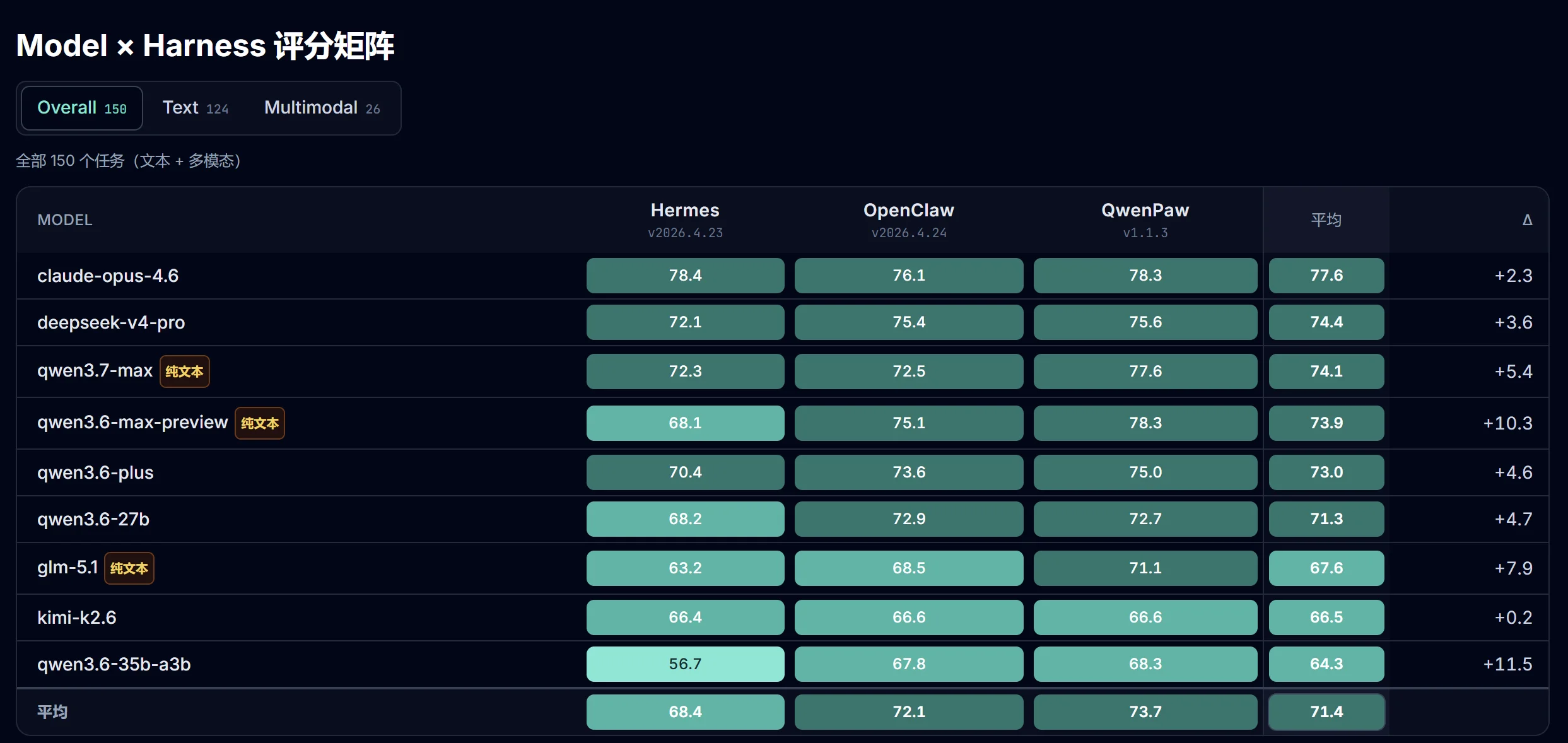
Technical positioning and domain: AI evaluation that goes beyond model-only scores by including Harness in the same framework—first systematic quantification of whole agent system performance, filling the model–framework joint evaluation gap.
Development background: Tongyi Lab with deep NLP, LLM training, and agent building experience. Motivation: fast agent growth makes it hard to separate model vs framework failures—PawBench attributes failures and guides systemic evaluation.
Core value: PawBench resolves attribution when tasks fail—model reasoning vs framework misconfiguration. Cross-eval matrix and five-dimensional tagging quantify Harness impact (up to 6.4-point gaps), pinpointing Skill loading, path awareness, tool config defects, and optimization direction.
Technical characteristics: Docker sandbox isolation for reproducibility and traceability; hybrid scoring with deterministic assertions plus LLM-as-judge; five-dimensional tags for multi-axis drill-down (scenario, capability, complexity, modality, environment).
2. Key Features
Joint evaluation: Models and Harness in one framework via 9×3 cross matrix—Harness gaps up to 6.4 points comparable to major model upgrades, enabling smaller models to win with better Harness.
Real task set: 150 tasks, 4,050 units aggregated from six quality agent benchmarks (GAIA, WebArena, etc.) covering office collaboration, software engineering, automation, web search, Skill invocation—practical relevance.
Five-dimensional tagging: Each item tagged by scenario, atomic capability, complexity (L1–L3), input modality, runtime environment—for sliced analysis of Harness defects per scenario.
Hybrid scoring: Rule assertions plus LLM-as-judge semantic quality, score 0–1. Rules check files, fields, exit codes; LLM judges semantics—weighted final score balances objectivity and flexibility.
Multi-slice leaderboards: Overall (150), Text (124), Multimodal (26)—focus text-only or multimodal teams separately.
Full trajectory retention: Docker runs preserve trajectories, grader artifacts, environment snapshots—layered replay on failures for root cause.
Deep diagnostic analysis: Slice by model size, modality, task type, skill domain to find Harness bugs in Skill loading, path sensing, default web tool config, etc.
3. How to Use
Prerequisites: Docker (Linux recommended; Docker Desktop on macOS/Windows). At least one model API key (Qwen, GPT-4, etc.) and Harness deps (Python 3.8+, Node.js, etc.).
Clone:
git clone https://github.com/agentscope-ai/PawBench.git, thenpip install -r requirements.txt.Configure: Create
.envwith API keys (e.g.,OPENAI_API_KEY=sk-xxx) and Harness env (endpoints, hyperparameters). Supports AgentScope, AutoGPT, etc.Run slices:
python run_benchmark.py --slicing text(text),--slicing multimodal(multimodal),--all(full). Docker preserves trajectories automatically.Reports: Per-task rule score, LLM judge score, weighted total.
python report.py --output report.htmlfor HTML diagnostics with dimensional slices.Submit results: Upload to https://agentscope-ai.github.io/PawBench/ per instructions to update Overall/Text/Multimodal leaderboards.
Notes: First run with default config (not max API keys) to mirror fresh clone experience. Keep model/Harness versions fixed across runs for comparability. ~500 MB disk per test unit during Docker runs.
4. Pros and Cons
| Pros |
|---|
| Joint evaluation: First quantification of Harness contribution (up to 6.4 points)—clear optimization targets for Harness developers. |
| Real reproducibility: Docker + full trajectories/snapshots enable layered failure replay. |
| Zero-friction default eval: Mirrors first clone defaults—not requiring every API key—lowers entry barrier. |
| Deep diagnostics: Multi-axis slices pinpoint Skill loading, paths, tool defaults—beyond simple rankings. |
| Regression validation: Re-run slices after Harness fixes to verify targeted improvements. |
5. Comparison with Similar Tools
| Dimension | PawBench | SWE-bench | GAIA |
|---|---|---|---|
| Core positioning | Model + Harness joint effect | Model solving real code issues | General assistant tasks |
| Harness evaluation | ✅ Core, isolates framework contribution | ❌ Model only | ❌ Model only |
| Task source | 6 agent benchmarks (150 tasks) | Real GitHub issues/PRs (2000+) | Human-designed (165) |
| Typical tasks | Office, SWE, automation, web, Skills | Bug fix, features, tests | Multi-step reasoning, tools |
| Scoring | Rules + LLM-as-judge hybrid | Unit tests pass/fail | Human + auto checks |
| Isolation | Docker sandbox + artifact checks | Code sandbox + git snapshot | Weak isolation |
| Tag system | Five dimensions | Language/repo slices | Type/difficulty |
| Leaderboards | Overall/Text/Multimodal | Verified/Multimodal/Full | L1–L3 difficulty |
| Failure diagnosis | Trajectories, snapshots, env state | Patches + test logs | Human score records |
| Zero-config eval | Default post-clone experience | Repo env setup | API keys |
| Best for | Harness optimization, model+framework selection | Code model eval | General assistant eval |
Selection advice:
Harness builders and agent integrators should choose PawBench first—joint eval and diagnostics separate model vs framework failures unlike SWE-bench/GAIA. Multi-slice leaderboards help pick model+Harness by task type.
Code generation researchers: SWE-bench's 2000+ GitHub tasks richer for code but no Harness eval. GAIA: high-quality human tasks but small count and weak isolation. AgentBench: strong multi-env sim but simple scoring, no Harness focus. PawBench leads on Harness eval, failure diagnosis, and zero-config defaults.
6. Editor's Take
PawBench innovates by evaluating model+Harness jointly—first quantifying framework contribution to whole-system performance, addressing the key bottleneck of attributing failures. The 9×3 matrix isolates model vs framework via controlled comparison—methodologically novel in AI eval.
Diagnostic depth stands out: five-dimensional slicing quickly finds Skill loading, path, web tool defaults—"diagnose not just rank" makes it a Harness developer tool, not only a leaderboard. Docker isolation and full trajectories ensure reproducibility for research and industry.
Audience: Harness developers, model selection decision-makers, agent system researchers. Zero-config helps casual users; deep use needs technical background.
Future: could become agent eval standard as model–framework co-optimization matters; expanding vertical tasks and Harness support (LangChain, CrewAI) would widen impact.
Rationale: Excellent innovation and utility; − for 150 tasks and three Harnesses limiting vertical/professional coverage. Among the most innovative practical agent eval tools today.
7. Use Cases
Harness optimization: Slice by atomic capability to fix Skill loading, path parsing, web tool defaults.
Model selection: Pick best model+Harness for text, multimodal, Skill, or web search via Text/Multimodal boards.
Regression testing: Re-run relevant slices after fixes to confirm improvement on targeted dimensions.
Academic research: Reproducible cross-eval for model–framework co-evolution studies.
Agent integration testing: Pre-deploy end-to-end tests on office, SWE, automation scenarios.
8. FAQ
Q: vs MMLU/HellaSwag?
A: Those test model reasoning only; PawBench evaluates model+Harness jointly and quantifies framework impact on success rate.
Q: Submit results?
A: Run locally, generate report, upload per https://agentscope-ai.github.io/PawBench/ instructions for leaderboard updates.
Q: Extend task set?
A: v1.0 fixed 150 tasks but framework supports custom tasks with five-dimensional tags locally; custom sets cannot join official leaderboard directly.
Q: Balance objectivity and flexibility in scoring?
A: Rules for hard checks; LLM-as-judge for semantics; weighted 0–1 score with tunable weights per task type.
Q: GPU needed?
A: No for the framework—inference via model APIs in cloud. Local needs Harness + Docker (~8 GB RAM, 50 GB disk).
Q: Supported Harnesses?
A: v1.0: AgentScope, AutoGPT, BabyAGI; LangChain Agent and CrewAI planned.
Q: What is "zero-config eval"?
A: Default post-clone setup—one API key, no max-key or heavy hyperparameter tuning required.
9. Project Links
- Official site: https://agentscope-ai.github.io/PawBench/
- GitHub: https://github.com/agentscope-ai/PawBench
Related AI Model Articles
OpenMuse – CopilotKit Open-Source Personal AI Assistant
OpenMuse is an open-source personal AI assistant project developed by the CopilotKit team. Its core design philosophy is "giving an Agent a computer" — by combining a persistent browser, optional Linu...
In-Depth Review of Longcat-2.5-preview: Meituan's Next-Generation Multimodal Long-Range Agent Model
LongCat-2.5-preview is Meituan's latest next-generation large model. Building upon the 1.6T total parameters, approximately 48B active parameters, and native 1M token context of LongCat-2.0, it marks ...
Review of DeepSeek Harness Desktop: How the Official GUI Client Lowers the Bar for Agent Usage
DeepSeek Harness Desktop is the official graphical client launched by DeepSeek, designed to provide a visual interface for the originally command-line-based DeepSeek Harness framework. After users log...
Step Code – In-Depth Review of StepFun's Open-Source Terminal Programming Agent
Step Code is an open-source terminal programming agent launched by StepFun, licensed under the MIT License, which allows developers to complete the full workflow of code writing, debugging, execution,...
© All Rights Reserved. Some content on this site is partially generated by AI with human review.