
OpenClacky – Li Yafei Team's Open-Source Low-Cost AI Agent
Executive Summary:
OpenClacky is an open-source AI Agent from the Li Yafei team aimed at professional users who need low ongoing API cost. Through a lean architecture and smart scheduling, it sharply cuts continuous-run...
1. What Is OpenClacky
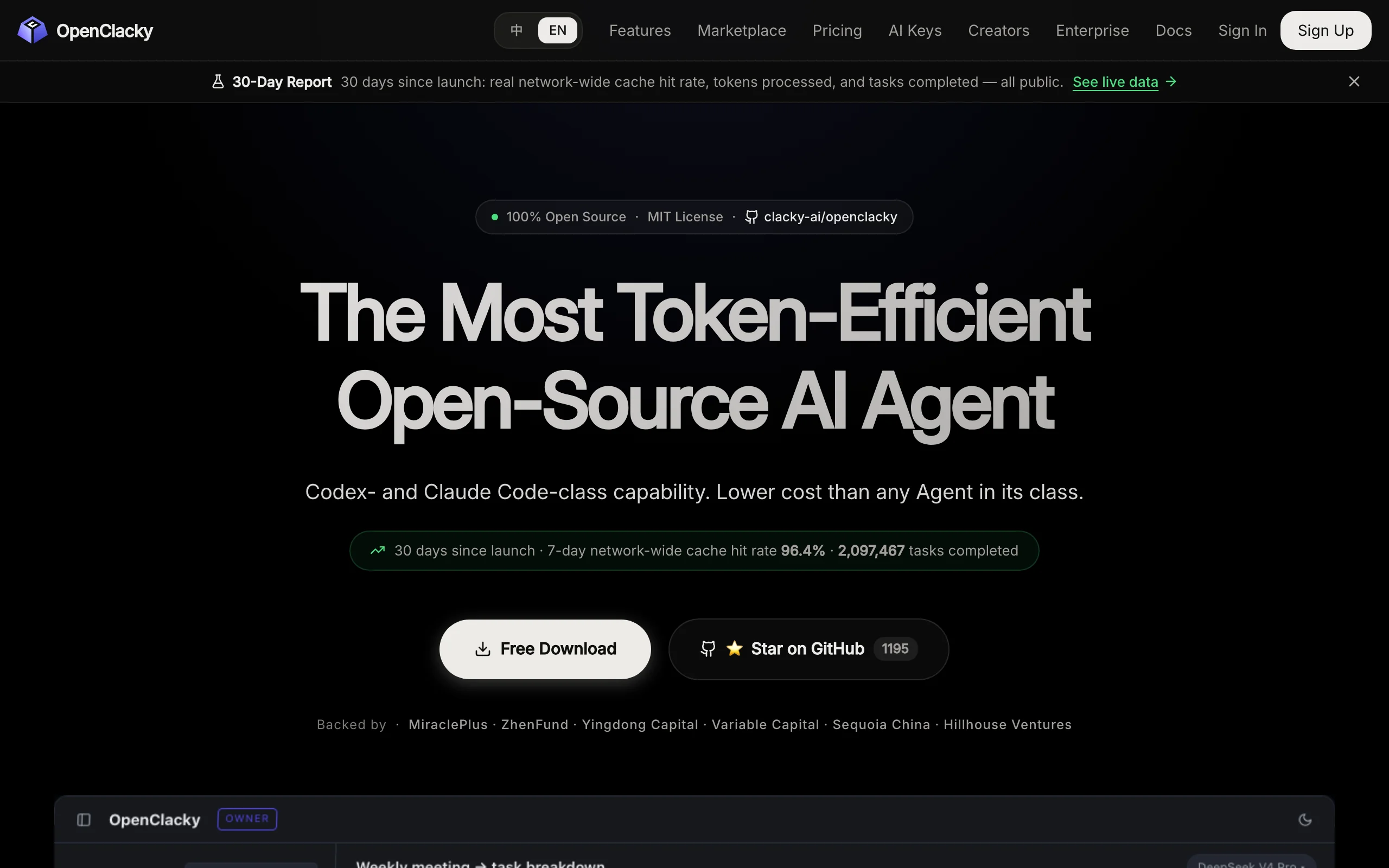
OpenClacky is an open-source AI Agent from the Li Yafei team aimed at professional users who need low ongoing API cost. Through a lean architecture and smart scheduling, it sharply cuts continuous-run API spend. One-click install runs cross-platform; built-in browser automation and IM integrations; an innovative Skill marketplace lets users package industry know-how as sellable micro-SaaS apps. Its philosophy is extreme token efficiency—context compression, high hit-rate caching, and model routing compress total cost to a fraction of peers so professionals can run AI assistants 24/7 without cost anxiety.
Image source: Official article
Technical positioning and domain: OpenClacky sits in the AI Agent space as a general task automation and workflow orchestration framework—not pure code completion or a thin API wrapper. It combines execution, tool use, knowledge capture, and ecosystem distribution in a low-cost, highly available Agent platform.
Research background: Led by the Li Yafei team after observing that most Agents are expensive and hard to deploy—bloated tool sets, coarse context management, and single-model routing inflate API bills and block "always-on" workflows. OpenClacky targets that core pain.
Core value: Engineering-level token savings—same-task cost reportedly ~1/6 of Hermes Agent and ~1/3 of OpenClaw—breaks the barrier to sustained Agent operation. Zero-friction install plus Skill economy lets domain experts create and sell AI solutions without coding, shifting from tool consumer to solution provider.
Technical characteristics: Sixteen core tools (not dozens), intelligent context compression, BYOK model routing by task complexity, and high hit-rate caching systematically reduce tokens. Two "self-evolution hooks" distill frequent operation sequences into reusable Skills during execution so the Agent improves with use.
2. Key Features
Intelligent task execution: Sixteen curated core tools handle programming, data analysis, content creation, and more. A "small but sharp" design avoids useless tool schemas eating context tokens while preserving core capability at lower per-task cost.
Multimodal generation: One-shot text, image, and video generation and editing from natural language—upgrading from text-only assistant to full digital creation partner across copy and visual design.
Browser automation: Built-in browser engine simulates real users to scrape pages, search intelligence, and structure output—market research, competitive analysis, and data collection in minutes instead of hours.
IM integration: Feishu, WeChat, DingTalk, Discord, and more—results push to channels or contacts for execute-deliver-notify unattended loops and faster team sync.
Skill marketplace: Package workflows as reusable Skills for distribution, updates, and monetization—domain experts become micro-SaaS founders without code.
Model switching: BYOK for Claude, GPT, Alibaba Bailian, etc. Routing picks strong models for hard tasks and cheap models for simple ones—fine cost/quality balance.
Scheduled hosting: Background runs with cron-style tasks—e.g., daily morning scans of frontier AI news on chosen platforms—24/7 assistant for repetitive work.
Self-evolution: Two hooks analyze frequent sequences during tasks and convert them into custom Skills—"gets smoother with use," less repeat token burn over time.
3. How to Use
Install: Windows, macOS, Linux supported. No Python or Docker required—download the installer from the site or GitHub and double-click to run.
Configure model keys: On first launch, add API keys (BYOK)—OpenAI, Anthropic, Bailian, etc. Multiple models can coexist for routing.
Run tasks: In the main Agent dialog, describe tasks in natural language, e.g., "Scrape the top 10 bestselling phones on [e-commerce site] and summarize specs in a table." The Agent plans steps and invokes browser, code interpreter, and other tools.
IM binding and schedules:
- IM: In Integrations, authorize Feishu, WeChat, or DingTalk bots; results route to chosen groups or DMs.
- Schedules: In Tasks, create cron jobs, e.g., "Every day at 9:00, search Hacker News for AI news and summarize."
4. Pros and Cons
| Pros |
|---|
| Extreme cost control: Lean tools, context compression, routing—~1/3 OpenClaw cost; among the most economical sustained Agent options. |
| Zero-friction deploy: One-click install, no env setup—non-technical users can start quickly. |
| Innovative Skill economy: Sell packaged expertise—shift from using tools to selling solutions. |
| Self-evolution: Hooks turn frequent flows into Skills—iterative improvement and lower repeat token use. |
| Multimodal + automation: Text, image, video, browser, IM—end-to-end creation and delivery. |
| Open and customizable: Fully open source for forks, private tools, and custom business logic. |
5. Comparison with Similar Tools
| Dimension | OpenClacky | Claude Code | OpenClaw |
|---|---|---|---|
| Core positioning | Low-cost general Agent + Skill ecosystem | Official coding assistant for software dev | Full open Agent framework |
| Same-task total cost | $5.10 (lowest cited) | $5.49 | $15.70 (~3× OpenClacky) |
| Core tool count | 16 (lean) | 40+ (large) | 23 (medium) |
| Cache hit rate | 90.6% | 95.2% (highest) | 88.7% |
| Install friction | One-click, zero config | Node.js dev env | Docker/gateway, higher bar |
| Token strategy | Lean tools + compression + routing | Strong model native, higher cost | Full tools, heavy schemas |
| Ecosystem/monetization | Skill marketplace | None | None |
Selection advice:
Extreme cost + always-on + monetize expertise: OpenClacky first—token efficiency and zero-friction deploy plus Skill marketplace.
High-quality code generation in dev environments: Claude Code remains the coding benchmark with top cache hit rates—not ideal for 24/7 background runs.
Research and heavy customization with a technical team: OpenClaw offers richer tools and flexibility at higher deploy and run cost.
6. Editor's Take
OpenClacky brings a pragmatic counterpoint to "bigger is better" Agent hype. It attacks cost systematically—lean tools, compression, routing, caching—not model breakthroughs.
Innovation is systems engineering: a closed-loop cost stack plus self-evolving Skills turns usage into reusable assets—forward-looking design.
Practical value is the headline—it moves Agents from demo to production: background intel gathering, data cleanup, cron jobs; experts productize Skills. Low friction, high return for most value-seeking users.
Audience: indie devs, researchers, info workers automating drudge work; consultants and creators monetizing domain Skills. Power users wanting maximal breadth may look elsewhere.
Future: richer Skill marketplace and community contributions could make OpenClacky a knowledge-asset Agent platform as Agents go mainstream.
Rationale: Industry-leading cost control and ease of use; unique Skill evolution. Enterprise gaps remain but core value hits the market pain point—a near-ideal "always-on AI companion" for target users.
7. Use Cases
Software dev automation: "Build a Flask app with login and CRUD" → scaffold, code, debug—cheap enough for many iterations.
Content and multimodal creation: One prompt for blog hero images plus intro copy; long articles to PPT outlines with assets.
Web scraping and structuring: Top-N job posts → skills, salary ranges in Excel—minutes not manual copy-paste.
Scheduled intel: Daily arXiv LLM-Agent paper digests pushed to Feishu at 8 AM.
Office automation: End-of-day Jira summaries as DingTalk daily reports—track, summarize, notify unattended.
8. FAQ
Q: Is OpenClacky really cheaper than Claude Code?
A: Per cited benchmarks on the same task set, total cost $5.10 vs. $5.49 for Claude Code—thanks to lean tools, compression, and routing while maintaining task quality.
Q: Can I use it with no programming background?
A: Yes. Download, run, describe tasks in natural language. Sixteen core tools plus browser automation cover most daily work and creation needs.
Q: How do I create and publish Skills?
A: Repeated workflows auto-consolidate via self-evolution hooks. Manual creation in the Skill editor with natural language workflow descriptions; publish through the Skill marketplace review process.
Q: Which LLMs are supported?
A: BYOK—any API-compatible model. Official optimization for OpenAI GPT and Anthropic Claude; Alibaba Bailian and other domestic platforms supported.
Q: Is it open source? Can enterprises self-host?
A: Yes—GitHub, Apache 2.0. Download, modify, deploy on private infrastructure for security and compliance.
9. Project Links
- Official site: https://www.openclacky.com/
- GitHub: https://github.com/clacky-ai/openclacky
Related AI Model Articles
OpenMuse – CopilotKit Open-Source Personal AI Assistant
OpenMuse is an open-source personal AI assistant project developed by the CopilotKit team. Its core design philosophy is "giving an Agent a computer" — by combining a persistent browser, optional Linu...
In-Depth Review of Longcat-2.5-preview: Meituan's Next-Generation Multimodal Long-Range Agent Model
LongCat-2.5-preview is Meituan's latest next-generation large model. Building upon the 1.6T total parameters, approximately 48B active parameters, and native 1M token context of LongCat-2.0, it marks ...
Review of DeepSeek Harness Desktop: How the Official GUI Client Lowers the Bar for Agent Usage
DeepSeek Harness Desktop is the official graphical client launched by DeepSeek, designed to provide a visual interface for the originally command-line-based DeepSeek Harness framework. After users log...
Step Code – In-Depth Review of StepFun's Open-Source Terminal Programming Agent
Step Code is an open-source terminal programming agent launched by StepFun, licensed under the MIT License, which allows developers to complete the full workflow of code writing, debugging, execution,...
© All Rights Reserved. Some content on this site is partially generated by AI with human review.