
Open Code Review – Alibaba's Open-Source AI Code Review CLI
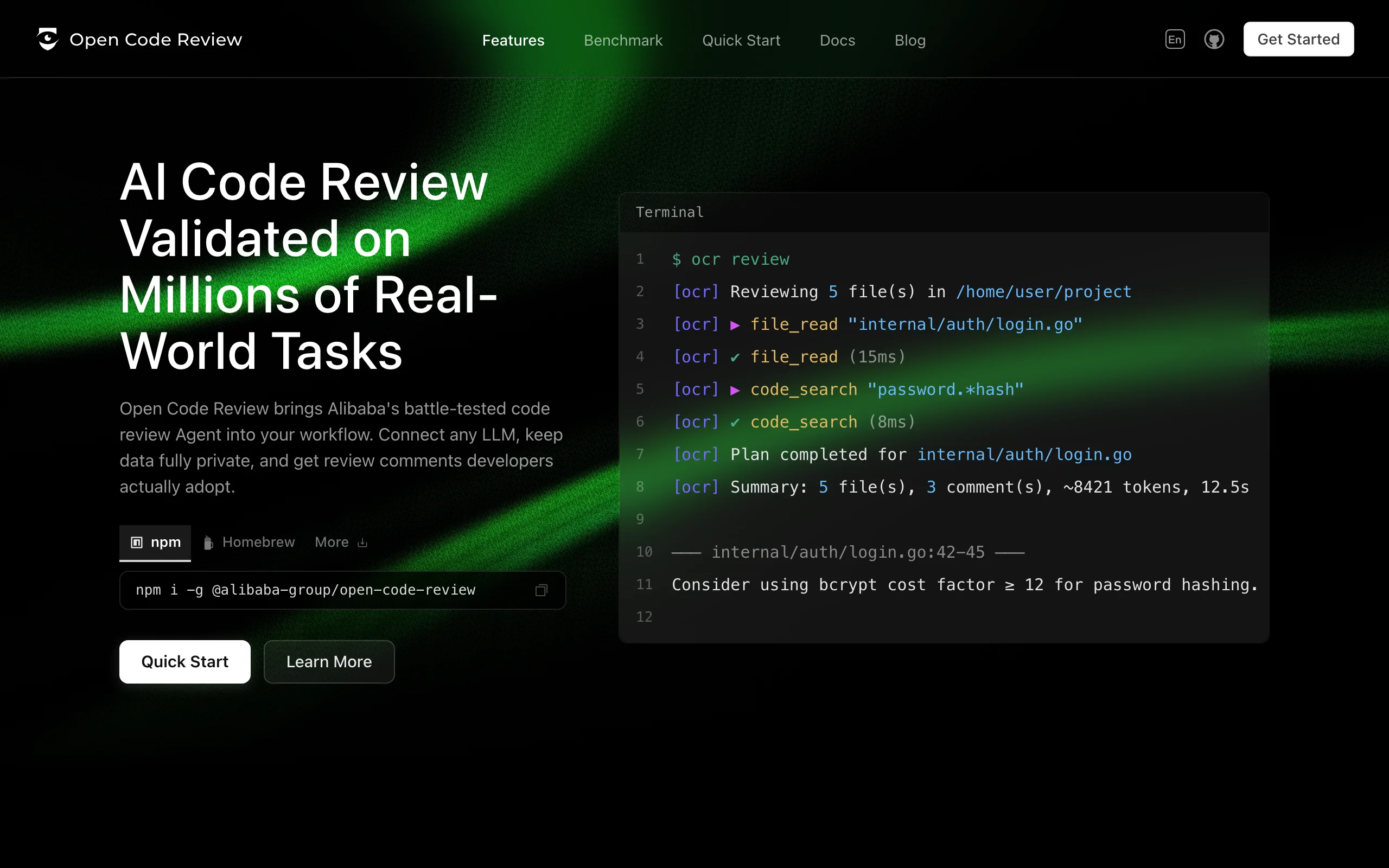
Executive Summary:
Open Code Review is an AI code review command-line tool open-sourced by Alibaba based on internal production practice. It gives developers efficient, accurate, and privacy-preserving review. Using a hybrid architecture of "deterministic engineering + LLM Agent," it overcomes cost, precision, and privacy limits of pure-AI review. It connects to any large language model and runs entirely locally so code never leaves the private environment. Built-in rules cover 10+ languages including Java, Go, and Python, validated by 20K+ internal active users and 1M+ review tasks. Token cost is about 1/5 of generic Agent approaches, with 26.1% SEM.F1 on AACR-Bench—showing professional, practical value in code review.
1. What Is Open Code Review
Open Code Review is an AI code review command-line tool open-sourced by Alibaba based on internal production practice. It gives developers efficient, accurate, and privacy-preserving review. Using a hybrid architecture of "deterministic engineering + LLM Agent," it overcomes cost, precision, and privacy limits of pure-AI review. It connects to any large language model and runs entirely locally so code never leaves the private environment. Built-in rules cover 10+ languages including Java, Go, and Python, validated by 20K+ internal active users and 1M+ review tasks. Token cost is about 1/5 of generic Agent approaches, with 26.1% SEM.F1 on AACR-Bench—showing professional, practical value in code review.
Image source: Official article
Technical positioning and domain: AI-assisted code review in DevOps and software engineering—not a simple LLM wrapper but a system combining deterministic algorithms with LLM reasoning to fix common LLM review issues (line drift, high cost, hallucinations) for individuals through enterprises.
Development background: Originated inside Alibaba from tens of thousands of developers needing efficient, low-cost review. After 1M+ internal tasks, the team open-sourced the validated system to raise industry review quality and address SaaS privacy and cost concerns.
Core value: Open Code Review partially resolves the AI review "impossible triangle" of high precision, low cost, and data privacy. Deterministic rules handle splitting and localization; LLMs handle deep risk analysis—minimizing tokens while preserving quality. Local execution eliminates code leakage, critical for finance, e-commerce, and other security-sensitive sectors.
Technical characteristics: Hybrid "deterministic engineering + LLM Agent" architecture for efficient decomposition and precise localization; proprietary three-layer progressive line-level localization and smart memory compression against hallucinations and context limits for professional, deep reviews.
2. Key Features
Hybrid review engine: Deterministic modules (static analysis, parsing) split tasks, filter files, and map line numbers; LLM Agents handle deep risk detection and logic reasoning. This division uses deterministic precision and LLM semantics to cut tokens and latency while maintaining quality.
Precise line-level comments: A three-layer progressive LLM localization module matches at block, function, and statement levels to anchor each comment to exact lines. A reflection module catches hallucination and knowledge drift early, improving trust and fixability.
Multi-model protocol support: Native Anthropic Messages API and OpenAI Chat Completions API for Claude, GPT-4, etc., plus compatible custom endpoints. Auto-detects Claude Code env vars for near zero-config setup and low migration cost across models.
Dynamic concurrency: Go goroutines split large changesets (dozens of files in one PR) into parallel subtasks so review speed scales with LLM API latency, not repo size—fast even on very large codebases.
Smart memory compression: Three-zone context management—"frozen" (shared interfaces), "compressed" (similar reviewed blocks), "active" (current code)—dynamically allocates tokens to overcome context limits for deep review of complex dependency-heavy code.
Built-in rule library: Rules validated at scale cover NPE, threading, XSS, SQL injection, and dozens of high-risk patterns including China-specific team pain points. Four-tier priority chain (block, critical, warning, suggestion) supports custom rules for flexible policy.
3. How to Use
Install: Node.js ≥16.x required. Install globally:
npm i -g @alibaba-group/open-code-review, or download prebuilt binaries from GitHub Releases for Linux, macOS, or Windows.Configure LLM: First run:
ocr config setfor API endpoint, token, and model name (e.g.,claude-3-5-sonnet-20241022orgpt-4o). If Claude Code env vars likeANTHROPIC_API_KEYexist, auto-detected for zero-config.Verify connectivity: Run
ocr llm testfor a simple request, connection status, and latency before full reviews.Run review: Core command
ocr reviewreviews uncommitted workspace changes by default. Branch diff:ocr review --from main --to feature. Single commit:ocr review --commit abc123. Output includes severity, description, and line anchors.CI/CD integration: Use
ocr review --format jsonin GitHub Actions or GitLab CI as a gate blocking high-risk merges. Can integrate as Claude Code Skill or Plugin.Read the output: Findings are grouped by severity (block / critical / warning / suggestion) with file path and exact line. Fix blockers first; pipe JSON into scripts for trend stats or auto-opened issues.
Scope the review: In large repos, skip generated code, vendor trees, and binaries via ignore files or path filters so tokens are not wasted. Run
git diff --statfirst to confirm the change set.Daily workflow: Run
ocr reviewlocally before commit, then again as a CI gate before merge. Tighten custom rules gradually against your security baseline instead of starting at maximum strictness.
4. Pros and Cons
| Pros |
|---|
| Production-proven adoption: From Alibaba's 20K+ users and 1M+ tasks with 30%+ adoption rate—high practical trust in suggestions. |
| Extreme cost control: Hybrid architecture and smart context cut tokens to ~1/5 of generic Agent+Skills—major savings for frequent large-repo review. |
| Fully private data: Local execution, no third-party cloud upload—decisive for finance, e-commerce, and government compliance. |
| Precise line anchoring: Three-layer localization fixes common AI "line drift" so comments map directly to fixes. |
5. Comparison with Similar Tools
| Dimension | Open Code Review | CodeRabbit | GitHub Copilot Code Review |
|---|---|---|---|
| Core architecture | Deterministic engineering + LLM Agent hybrid | LLM + 40+ open linter aggregation | LLM on Git diff |
| Deployment | Local / any CI | Cloud SaaS | GitHub cloud / self-hosted runners |
| Data privacy | Code never leaves local private env | Code uploaded to cloud | Processed on GitHub infra |
| Cost model | LLM tokens only (~1/5 generic Agent) | Free / Pro $24/user/mo / Enterprise | Bundled Copilot Business/Enterprise |
| Platforms | Any Git platform | GitHub / GitLab / Bitbucket / Azure DevOps | GitHub only |
| AI architecture | Deterministic + LLM Agent hybrid | LLM + linter aggregation | LLM diff analysis |
Selection advice:
For strict privacy (finance, e-commerce, government), Open Code Review is the option that keeps code fully local, with hybrid low cost for large teams. CodeRabbit and GitHub Copilot Code Review suit smaller teams wanting SaaS convenience with lower privacy requirements.
For deep AWS integration, CodeGuru offers unique performance analysis. For non-AWS repos or more flexibility and cost control, Open Code Review's open local deployment is stronger. Overall, Open Code Review differentiates on professionalism, cost, and privacy.
6. Editor's Take
Technically, the hybrid "deterministic engineering + LLM Agent" architecture is the standout—not a thin wrapper but deep optimization for code review, combining static analysis precision with LLM semantics to fix cost and localization pain while modeling how AI fits professional toolchains. Smart memory compression and three-layer localization address LLM defects at the engineering layer, reflecting strong Alibaba engineering depth.
Practically, it targets enterprise pain points: cost, privacy, precision. Large teams save an order of magnitude on daily AI review cost. Sensitive industries need local-only review—Open Code Review is among the few viable open AI review options. Internal 20K+ user validation backs reliability.
Audience: mid-to-large dev teams, DevOps platform teams, finance/e-commerce with high quality and security bars. Individuals or small teams may prefer convenient SaaS if cost is not sensitive. Open source also suits RL pipelines needing code quality verifiers as reward signals for code generation models.
Future: community rules for more languages and vulnerabilities; IDE plugins to lower barriers; CI ecosystem depth will determine industry standard status.
Rating: ★★★★☆ (4.5/5)
Rationale: −0.5 for learning curve and limited non-Git support. Excellent innovation, cost, privacy, and practicality—among the most competitive open AI code review options today.
7. Use Cases
Local pre-commit self-check: Run
ocr reviewbefore commit to catch logic bugs, security issues, and code smells—smart preflight reducing production incidents.Internal DevOps integration: Mandatory MR/PR step with unified rules and analytics for team-wide review policy and improvement data.
RL training verifier: Structured quality feedback (NPE, threading, etc.) for CodeRL-style pipelines to steer models toward safer code.
Finance/e-commerce compliance: Offline/air-gapped environments still get AI review without cloud upload.
Open-source PR automation: GitHub Actions auto-review on community PRs with structured comments, easing maintainer load.
8. FAQ
Q: Support private LLMs (e.g., internal Llama 3)?
A: Yes, if the endpoint is OpenAI Chat Completions or Anthropic Messages compatible—configure via ocr config set for fully internal runs.
Q: Slow on huge repos with thousands of files?
A: No—Go goroutines parallelize subtasks. Speed is mainly limited by LLM API latency, not repo size; concurrency helps most on large changesets.
Q: Difference from ESLint/Pylint?
A: Linters match static patterns and style; Open Code Review adds LLM semantic analysis for complex logic, concurrency, business correctness—complement, not replace.
Q: GitHub Actions integration?
A: Add a step: npm i -g @alibaba-group/open-code-review, then ocr review --format json; gate merges on risk levels in JSON output.
Q: Switch models per project?
A: Mostly global via ocr config set. Per-project models: env vars or separate config files (future/community). Simplest: change config/env before each run.
9. Project Links
- Official site: https://alibaba.github.io/open-code-review/
- GitHub: https://github.com/alibaba/open-code-review
Related AI Model Articles
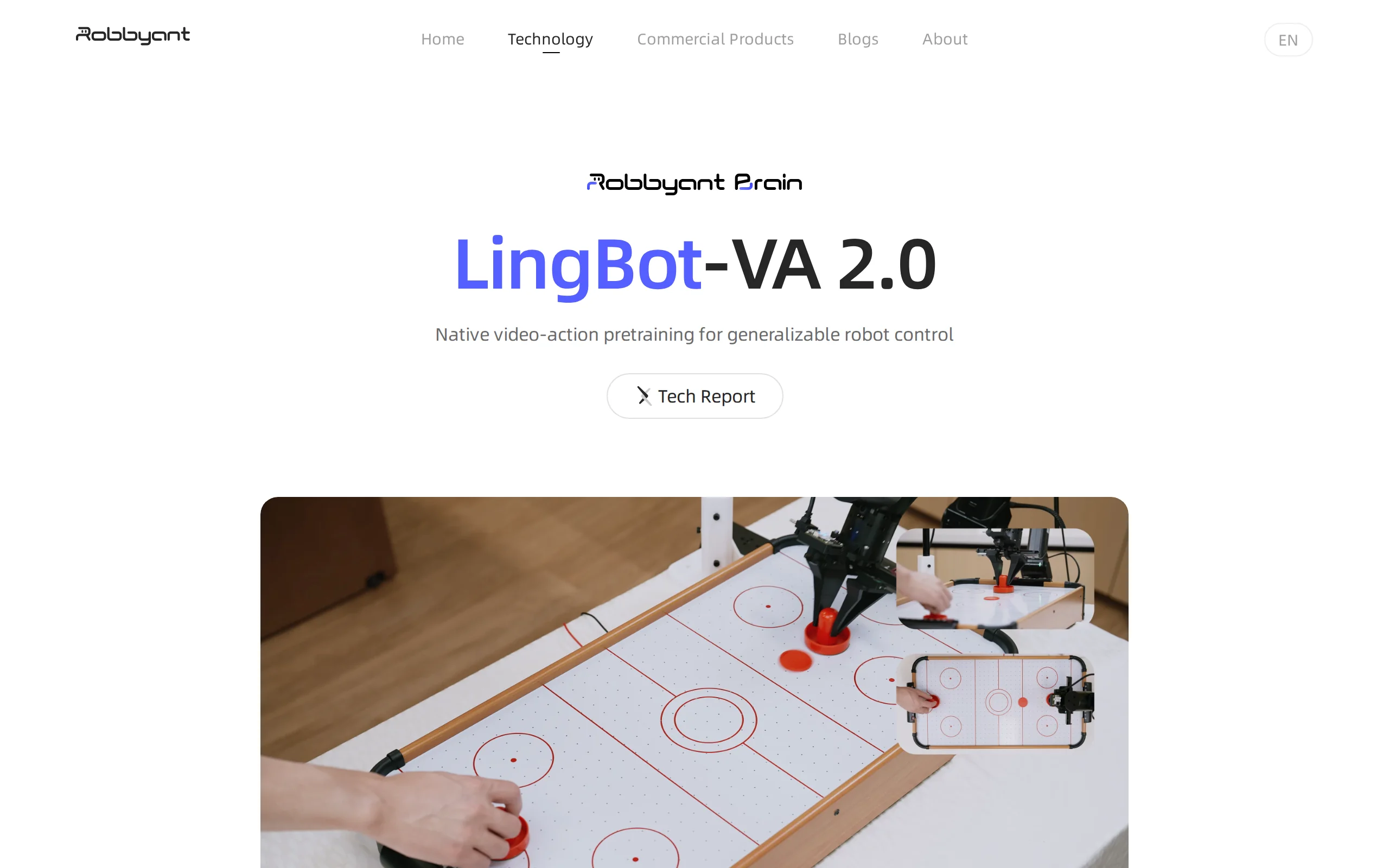
LingBot-VA 2.0 – AntWorld's Native World Action Model for Embodied Intelligence
LingBot-VA 2.0 is AntWorld's industry-first native world action model for embodied intelligence, pre-trained from scratch based on an autoregressive architecture, enabling robots to possess general-pu...
KAT-Coder-Pro V2.5 – Kwai's Agentic Coding Model
KAT-Coder-Pro V2.5 is the flagship Agentic Coding model introduced by KwaiKAT, focusing on long-range engineering capabilities and general Agentic abilities. By leveraging its self-developed AutoBuild...
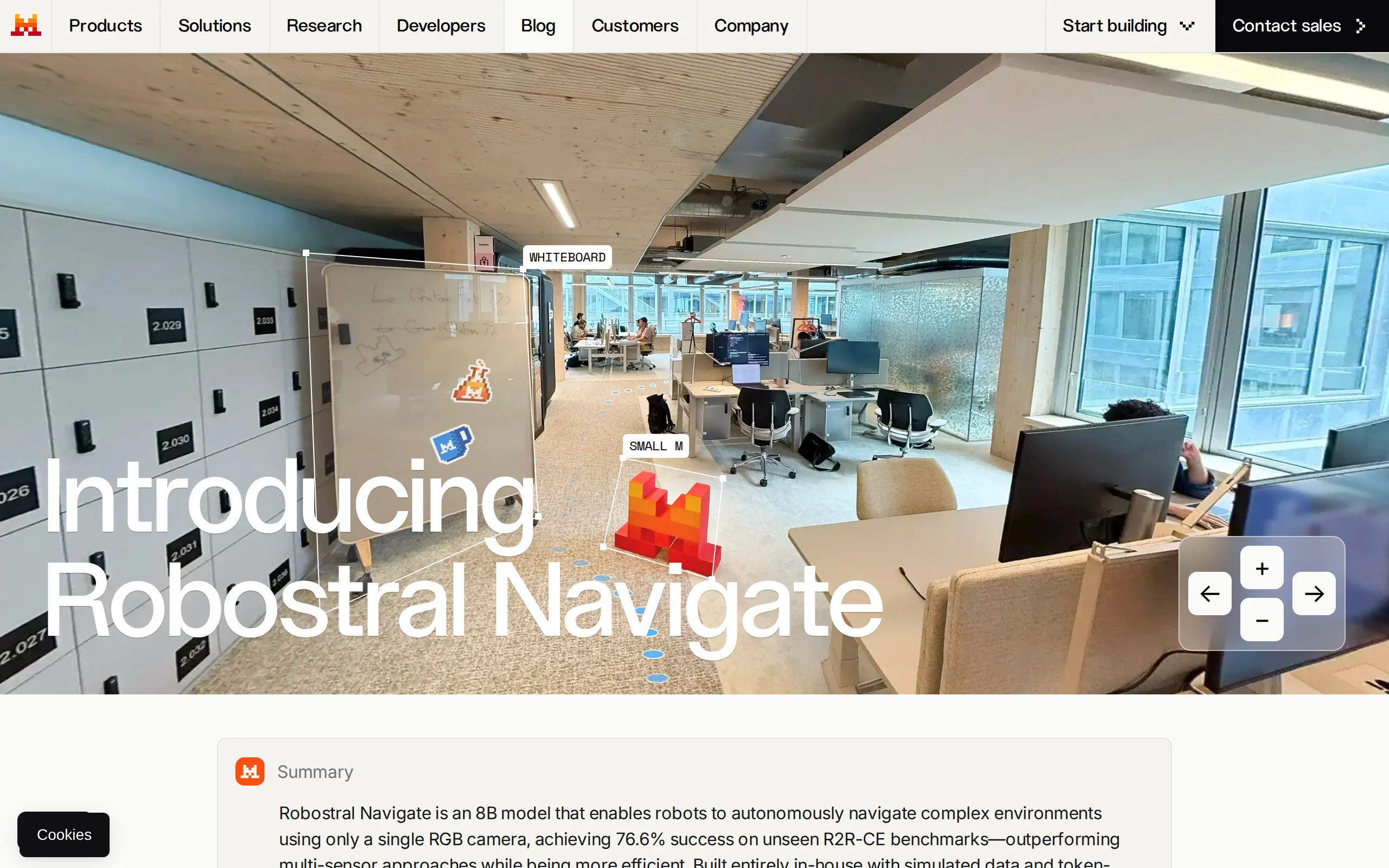
Robostral Navigate – Mistral AI's Embodied Intelligence Navigation Model
Robostral Navigate is Mistral AI's first embodied intelligence navigation model. Its core innovation lies in enabling robots to achieve autonomous navigation in complex environments using only a stand...
Seedream 5.0 Pro – A Multimodal Image Creation Model Launched by ByteDance
Seedream 5.0 Pro is a multimodal image creation model introduced by ByteDance's Seed team, specifically designed for complex professional scenarios. This model has achieved a comprehensive upgrade in ...
© All Rights Reserved. Some content on this site is partially generated by AI with human review.