
Lance – ByteDance's Lightweight Native Unified Multimodal Model
Executive Summary:
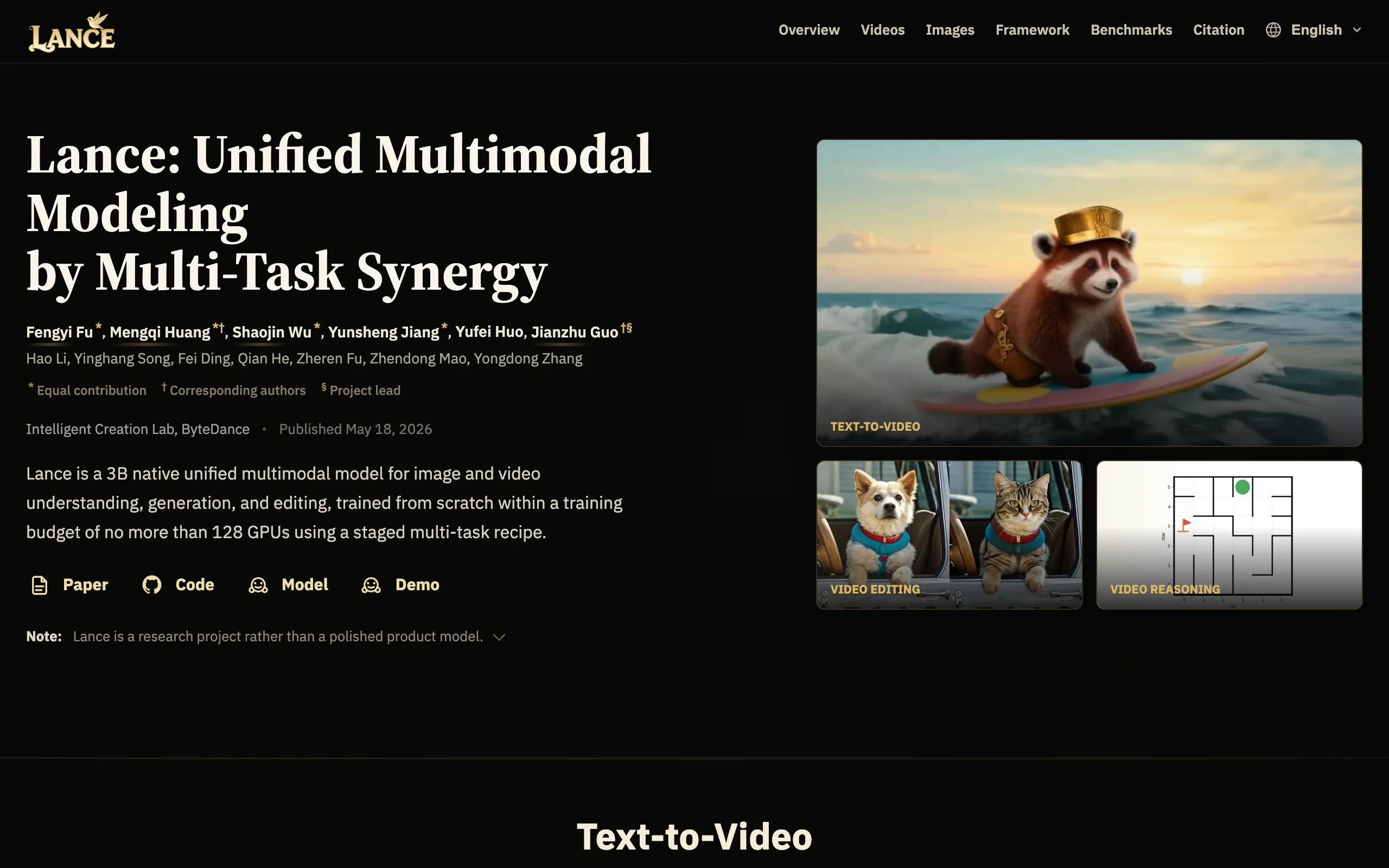
Lance is a lightweight native unified multimodal model open-sourced by ByteDance's Intelligent Creation team. With only 3B active parameters, it supports the full pipeline of image and video understan...
1. What Is Lance
Lance is a lightweight native unified multimodal model open-sourced by ByteDance's Intelligent Creation team. With only 3B active parameters, it supports the full pipeline of image and video understanding, generation, and editing within a single framework. Trained from scratch via a staged multi-task approach, the entire training cycle consumed only 128 A100 GPUs—significantly lowering the barrier to large-scale multimodal model R&D. On authoritative benchmarks including GenEval and VBench, Lance outperforms or matches open-source models several times its size. Released under Apache-2.0 for free commercial use and derivative development, it provides an efficient, flexible solution for multimodal AI adoption.
Image source: Official article
Technical positioning and domain: Lance sits at the intersection of multimodal LLMs (MLLMs) and visual generation models (VGMs), aiming for a "grand unification" of visual understanding and generation. Unlike treating image/video understanding and generation as separate tasks, it uses unified architecture and training to seamlessly complete the full loop from perception to creation in one model.
R&D background: Developed by ByteDance Intelligent Creation with deep expertise combining image, video content creation, and AI. Motivation came from fragmentation in multimodal models—understanding, generation, and editing models operate independently, causing system complexity, resource waste, and difficult cross-task coordination. Lance aims to break this barrier with a more efficient, unified path.
Core value: Lance addresses core multimodal AI pain points—fragmented architecture and high task-switching cost. Its "All-in-One" solution lets developers handle diverse image/video understanding, generation, and editing without integrating and scheduling multiple specialized models. This simplifies the stack, lowers deployment and ops cost, and enables smarter, more interactive applications (smart creation assistants, video editing Agents).
Technical characteristics: Core innovations include dual-stream Mixture-of-Experts (MoE) architecture and unified interleaved sequence representation. Independent expert paths for understanding vs. generation avoid cross-task interference. Generalized 3D causal attention and modality-aware positional encoding organize text, image, video, and other heterogeneous information in one unified sequence for true native multimodal fusion.
2. Key Features
Full-pipeline image generation and editing: Text-to-image generation plus instruction-based background replacement, object add/remove, style transfer, appearance reshaping, and complex edits. Unified architecture leverages deep semantic understanding for precise, natural modifications—not simple pixel operations.
Full-pipeline video generation and editing: Generate coherent video from text; support single-step and compositional editing—background change, subject replacement, action modification. Unified temporal processing maintains overall coherence while precisely modifying specific elements, greatly improving video creation efficiency.
Multi-round consistent editing: Continuous multi-round edits on the same subject while preserving identity, style, and core attributes. Solves "edits drift from original" pain points; unified sequence and attention track and maintain target features across rounds—ideal for fine-grained creative adjustment.
Image and video understanding: Semantic parsing, content recognition, visual QA on images; temporal analysis, action recognition, semantic understanding on video. Understanding and generation share underlying representations—the model can "understand" what it "generates," enabling advanced human-AI collaboration like auto-modifying output from user feedback.
Ultra-lightweight deployment: Only 3B active parameters enable inference on consumer GPUs (e.g., NVIDIA RTX 4090). Breaks dependence on expensive cloud GPUs—local, low-latency, privacy-preserving AI applications become feasible, greatly expanding scenarios.
Low training cost barrier: Full training from scratch needs only 128 A100 GPUs—far below peer models. Staged multi-task training with careful data ratio and order achieves positive cross-task synergy under limited compute, enabling resource-limited research teams and SMEs to reproduce and optimize.
3. How to Use
Environment preparation: Python 3.8+, PyTorch 2.0+. At least one CUDA-capable NVIDIA GPU; 16GB+ VRAM recommended (RTX 4080/4090) for smooth inference. Video generation: 24GB+ VRAM recommended.
Clone repo and install dependencies: Run
git clone https://github.com/bytedance/Lance.git,cd Lance, thenpip install -r requirements.txt(transformers, diffusers, etc.). Use virtual environment (conda) to avoid conflicts.Download pretrained weights: From Hugging Face (
bytedance-research/Lance) or GitHub Releases. Example:huggingface-cli download bytedance-research/Lance --local-dir ./checkpoints. Ensure path matches script config.Run inference examples: Use
scripts/run_inference.py. Image generation:python scripts/run_inference.py --task text_to_image --prompt "A corgi in a spacesuit walking on the moon". Image editing:python scripts/run_inference.py --task image_editing --input_image ./examples/dog.png --prompt "Replace the background with snowy mountains". Adjust paths per script comments.
4. Pros and Cons
| Pros |
|---|
| Extreme lightweight with high performance: Only 3B active parameters; on GenEval, VBench, and more, exceeds or matches 7B models—best balance of parameters and performance. |
| True full-pipeline unification: Single model seamlessly covers six tasks—image/video understanding, generation, editing—no switching between specialized models, greatly simplifying system architecture. |
| Very low training and reproduction cost: Full training on 128 A100 GPUs lowers barrier for academic research and SME fine-tuning, democratizing technology. |
| Commercial-friendly open license: Apache-2.0 allows free commercial use, modification, and distribution—removes IP concerns for enterprises. |
5. Comparison with Similar Tools
| Dimension | Lance (ByteDance) | TUNA (CMU) |
|---|---|---|
| Core architecture | Dual-stream MoE + unified interleaved sequence + generalized 3D causal attention | Unified autoregressive (Next-Token Prediction) |
| Active parameters | 3B | 7B |
| Task coverage | Image/video understanding, generation, editing | Image/video understanding, generation |
| GenEval total | 0.90 | 0.90 |
| GEdit-Bench average | 7.30 | 6.52 |
| VBench total | 85.11 | Not listed |
| Open-source license | Apache-2.0 | Not specified |
Selection advice:
Resource-limited developers/researchers validating unified multimodal potential: Lance is best—3B parameters, low training cost, consumer GPU inference, strong performance, Apache-2.0 freedom.
Applications requiring core image/video editing: Lance is the open-source leader. GEdit-Bench score far exceeds TUNA; Show-o2 not listed. Multi-round consistent editing has unique value in professional design and ad marketing.
Focus on extreme image generation quality with less editing need: TUNA is strong—ties Lance on GenEval with larger 7B scale, potentially better on complex generation. Note unclear open license and no editing capability.
6. Editor's Take
Lance is a forward-looking, highly practical innovation in multimodal LLMs. Rather than blindly pursuing larger parameters, clever architecture achieves fuller functionality and stronger performance at smaller size—a path distinct from "scale solves everything."
Technically, dual-stream MoE and unified interleaved sequence representation are core contributions. MoE resolves understanding-generation conflict in unified models; unified sequences elegantly handle text, image, video. Generalized 3D causal attention and modality-aware positional encoding solidify the foundation—these are insights into multimodal essence, not mere engineering stacking.
Practically, "full-pipeline unification" will accelerate AI content creation tools. Smart creation apps previously integrated image generation, editing, video understanding—bloated, high-latency, hard to maintain. Lance enables "all-in-one" AI creation assistants: conceive, generate, refine in one interface—a qualitative UX leap.
Audience: AI app developers, content creators, designers, CV-NLP crossover researchers. For enterprises, low cost and commercial-friendly license make it ideal for internal AI creation platforms or SaaS.
Future potential: Architecture scalability may extend to more modalities (audio, 3D), higher video resolution and duration, and improved complex instruction following via RL. Could become core foundation for future AI-native OS and creative tools.
Rationale: Excellent across technical innovation, practical value, open ecosystem, and cost efficiency. Not just a breakthrough but successful engineering practice—a reproducible, commercial, powerful unified multimodal model example. "Lightweight, unified, efficient" may guide next-gen multimodal direction.
7. Application Scenarios
Smart content creation platforms: One-stop tools for designers and video creators. Natural language from sketch to HD image, background swap, demo video, subject replacement—no software switching, greatly improving creative delivery efficiency.
Short video and social media production: Rapid short video generation and editing. Input "a cat drinking coffee under the Eiffel Tower" for video, then "change background to Shibuya" for low-cost viral content—lowering barriers for creators and small MCNs.
Ad marketing asset batch production: E-commerce and marketing teams batch-generate and iterate product images, posters, promo videos. Same product, different backgrounds (beach, home, office) and styles (retro, minimal, cyberpunk) for A/B testing and ad optimization.
Online education and training content: Auto-generate illustrations, animations, demo videos for teaching. Input "animation of Earth orbiting the Sun," then edit "enlarge Earth and label orbit"—making abstract concepts vivid, enriching multimedia resources.
8. FAQ
Q: How does Lance differ from diffusion models like Stable Diffusion?
A: Core difference is unification. Stable Diffusion is pure generation (text-to-image, image-to-image). Lance is unified—generation, understanding (visual QA), and editing (instruction background replacement) in one framework. Architecture differs too—Lance blends autoregressive and diffusion via unified sequence representation.
Q: Can I run Lance on 8GB VRAM?
A: Image understanding and simple generation/editing may barely run on 8GB but slowly with limited resolution. Video generation/understanding: strongly recommend 16GB+ VRAM. Official recommendation: RTX 4090 (24GB) for smooth experience.
Q: How to fine-tune Lance for specific data (e.g., product images in a style)?
A: Repo provides fine-tuning scripts (LoRA or full fine-tuning). Prepare datasets with images/videos, text instructions, expected outputs. Low training cost means relatively low fine-tuning compute. Start with LoRA—it saves VRAM and compute.
Q: Maximum video length for generation?
A: Official examples and benchmarks focus on short clips (2–5 seconds). Long video may have consistency or quality issues—limited by VRAM and training data length. Community explores temporal super-resolution and long-video strategies.
Q: Does Lance support Chinese input?
A: Trained mainly on English—best results with English instructions. Chinese possible via fine-tuning or Chinese CLIP but official version has very limited Chinese support. Targeted Chinese fine-tuning needed for Chinese-primary scenarios.
Q: How does multi-round consistent editing work?
A: Via unified interleaved sequence representation. During editing, the model encodes original image, historical edit instructions, and results in one sequence. Attention tracks target identity, style, and core features across rounds for consistency.
9. Project Links
- Project site: https://lance-project.github.io/
- GitHub repository: https://github.com/bytedance/Lance
- HuggingFace models: https://huggingface.co/bytedance-research/Lance
- arXiv paper: https://arxiv.org/pdf/2605.18678
Related AI Model Articles
OpenMuse – CopilotKit Open-Source Personal AI Assistant
OpenMuse is an open-source personal AI assistant project developed by the CopilotKit team. Its core design philosophy is "giving an Agent a computer" — by combining a persistent browser, optional Linu...
In-Depth Review of Longcat-2.5-preview: Meituan's Next-Generation Multimodal Long-Range Agent Model
LongCat-2.5-preview is Meituan's latest next-generation large model. Building upon the 1.6T total parameters, approximately 48B active parameters, and native 1M token context of LongCat-2.0, it marks ...
Review of DeepSeek Harness Desktop: How the Official GUI Client Lowers the Bar for Agent Usage
DeepSeek Harness Desktop is the official graphical client launched by DeepSeek, designed to provide a visual interface for the originally command-line-based DeepSeek Harness framework. After users log...
Step Code – In-Depth Review of StepFun's Open-Source Terminal Programming Agent
Step Code is an open-source terminal programming agent launched by StepFun, licensed under the MIT License, which allows developers to complete the full workflow of code writing, debugging, execution,...
© All Rights Reserved. Some content on this site is partially generated by AI with human review.