
Higgs Avatar v1 – Real-Time AI Digital Human for Voice Agents
Executive Summary:
Higgs Avatar v1 from BosonAI (founded by Mu Li) is a real-time AI digital human model for voice agents. From a single static photo it produces lip-synced faces with expressions and head motion for liv...
1. What Is Higgs Avatar v1
Higgs Avatar v1 from BosonAI (founded by Mu Li) is a real-time AI digital human model for voice agents. From a single static photo it produces lip-synced faces with expressions and head motion for live interaction. Single-frame rendering takes 16 ms—well below the 62.5 ms real-time conversation threshold—and one H100 GPU supports eight concurrent real-time sessions end-to-end with the in-house Higgs Audio speech model. It targets enterprise use cases such as customer service, sales, and training.
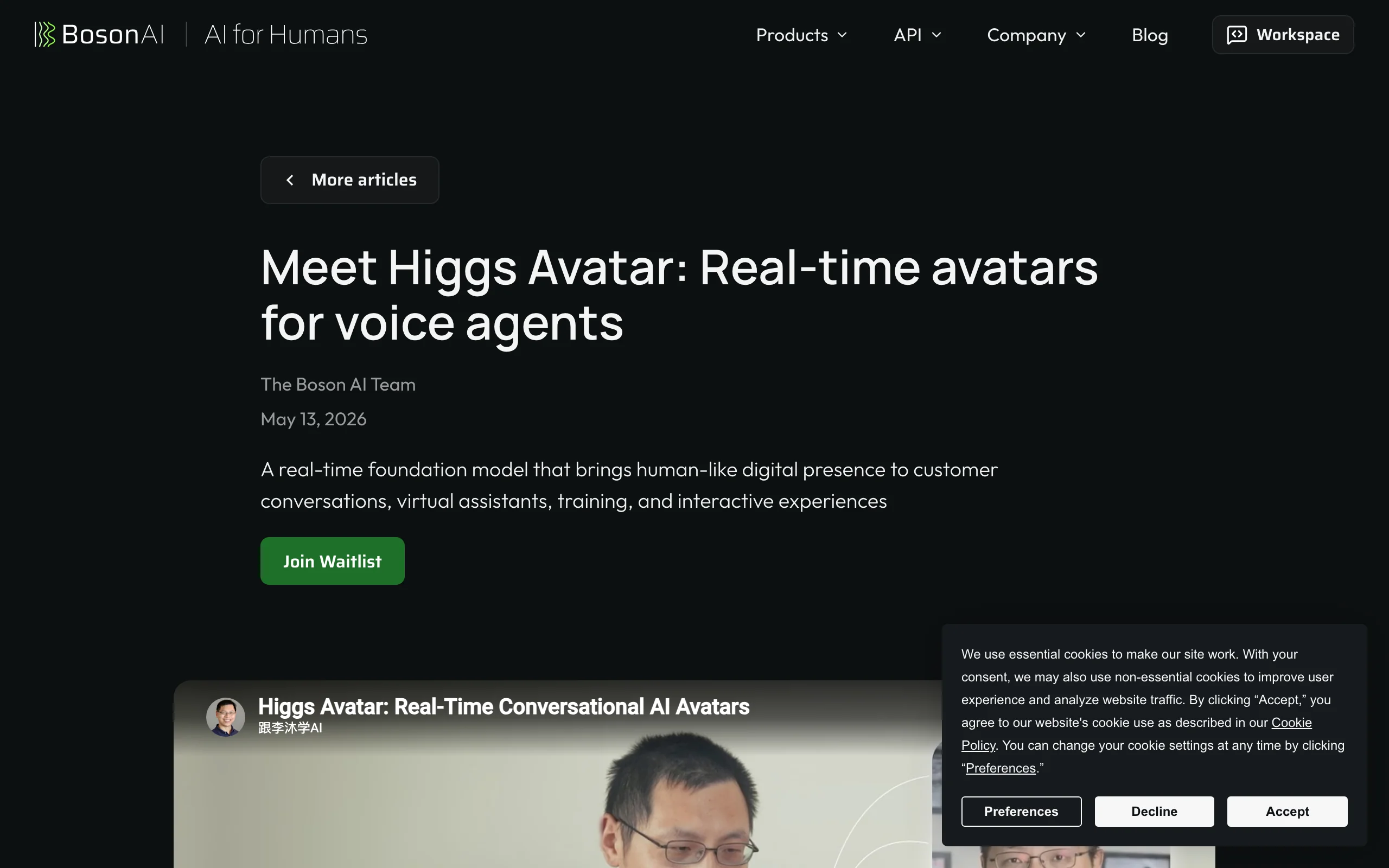
Image source: Official article
Technical positioning and domain: Multimodal real-time digital humans driven by speech. It leads the industry in simplifying traditional 3D modeling or motion capture to single-image input with real-time generation, cutting deployment cost and complexity.
Research background: Built by BosonAI, whose founder Mu Li is a well-known AI researcher and engineer. Deep experience in speech and multimodal generation; Higgs Avatar v1 fuses Higgs Audio with visual generation to fix desync, high latency, and costly multi-component stacks in prior digital-human solutions.
Core value: Fixes three classic problems: speech–expression mismatch (uncanny valley), latency and stutter from stitched pipelines, and dependence on 3D or mocap gear. End-to-end in-house design processes speech input through facial rendering in one path for natural, fluid interaction.
Technical characteristics: Streaming frame-by-frame inference adapts video models to real-time streaming (~16 ms per frame). Joint speech–vision alignment in training maps acoustic features to lips, expression, and head pose. Single-image identity encoding keeps faces consistent; H100-optimized inference and memory enable eight concurrent sessions per card.
2. Key Features
Single-image real-time digital human: Upload one clear front-facing photo to get a lifelike interactive avatar—no 3D modeling or mocap. Enterprises can quickly create virtual staff for service and sales without a 3D team.
Speech-driven expression sync: Lips, facial expression, and head motion follow speech in real time for a full listen–speak–respond loop. Co-designed with Higgs Audio during training—not post-hoc stitching—avoiding desync common in modular stacks.
Frame-by-frame live rendering: Every frame is generated live during conversation—no pre-render loops or canned animation scripts. Reactions feel natural and non-repetitive, improving immersion.
Multi-session concurrency: One H100 runs eight independent real-time conversations for high-volume service and consulting. H100 acceleration and memory tuning lower per-session compute cost for scale-out deployment.
End-to-end full-stack synergy: Deep integration with Higgs Audio from understanding through facial render—lower end-to-end latency than ASR + TTS + animation pipelines and less information loss between modules.
Zero-mocap identity encoding: An image encoder extracts identity from one photo and preserves it frame by frame—no drift or morphing over long sessions.
3. How to Use
Apply for private preview: Visit https://www.boson.ai/blog/higgs-avatar-v1, click Join Waitlist, submit business email, company, and use case. Private Preview review typically takes 1–2 weeks.
Wait for approval: After approval you receive trial access or enterprise onboarding. Enterprises can get dedicated API keys and private deployment; developers may get cloud sandbox. BosonAI often schedules a technical kickoff.
Upload avatar photo: Provide a clear front-facing static image (≥1024×1024 recommended, clean background, unobstructed face). Upload via admin UI or API; the system extracts identity encoding used for all subsequent sessions.
Connect voice dialogue: Integrate Higgs Audio via Boson Presence SDK or REST API—configure ASR, NLU, and TTS. Start real-time speech+video; the avatar generates matching expression and lip motion from audio input.
Deploy to production: Integrate into customer service, sales, or training workflows. Embed in web via WebRTC or connect private APIs to CRM and ticketing. Load-test before launch to match peak concurrency per GPU.
Environment requirements: NVIDIA H100 recommended (8 sessions per card); minimum A100 80GB (4 sessions). Ubuntu 20.04+, CUDA 12.0+, ≥100 GB SSD for model cache.
Notes: Confirm privacy policy and photo subject consent. Load-balance across GPUs when exceeding eight sessions per card. Update models regularly for quality improvements.
4. Pros and Cons
| Pros |
|---|
| End-to-end in-house design: Speech and vision co-trained—not API stitched—cuts delay, overlap, and expression mismatch; sub-16 ms frame latency vs. industry 100–200 ms averages. |
| Ultra-low latency and high concurrency: 16 ms per frame; eight real-time sessions per H100—leading on both latency and concurrency with controlled per-session cost. |
| Zero-mocap low barrier: One static photo replaces 3D and mocap—fast proof-of-concept for business teams. |
| Enterprise deployment: Private deploy and APIs; eight sessions per card suits e-commerce and finance contact centers; integrates with existing workflows. |
5. Comparison with Similar Tools
| Dimension | Higgs Avatar v1 (BosonAI) | Live Avatar (Alibaba + academia) | Synthesia |
|---|---|---|---|
| Core architecture | End-to-end base model with native Higgs Audio synergy | 14B diffusion, DMD-distilled 4-step streaming diffusion | Pretrained video gen, template workflows |
| Input | Single static photo | Live mic + camera A/V drive | Upload video/image + script |
| Generation latency | 16 ms/frame (below 62.5 ms real-time bar) | 20 FPS streaming | Minutes, non-real-time |
| Duration stability | Real-time dialogue focus | 10,000+ seconds, anti identity drift | Long video with segmentation |
| Speech synergy | Deep end-to-end with Higgs Audio | Lip sync from audio; no dedicated speech model | Multilingual TTS, not native co-design |
| Deployment | API / enterprise / private | Open model, self-host and fine-tune | SaaS only |
| Concurrency | 8 real-time sessions per H100 | Timestep pipeline parallelism for scale | Subscription-tier limits |
| Open source | Closed enterprise base model | Open (GitHub / Hugging Face) | Closed commercial |
Selection advice: For real-time, high-concurrency service (e-commerce, finance), Higgs Avatar v1's latency and concurrency are optimal—plan ahead for closed access and review. For research customization, Live Avatar's openness helps but needs mic+camera input. For non-real-time training and marketing video, Synthesia and HeyGen offer mature SaaS templates but not live dialogue.
6. Editor's Take
Higgs Avatar v1 sets a benchmark in real-time digital humans—16 ms frames and co-trained speech–vision alignment attack the uncanny valley at the architecture level, not by gluing modules. Eight sessions per H100 shows deployment-aware engineering for enterprise scale.
Practical impact: one photo replaces 3D, mocap, and specialist teams—valuable for SMB digital transformation. Closed, reviewed rollout and limited emotional nuance are current limits.
Audience: Enterprises needing real-time voice+face—e-commerce service, insurance sales, corporate training, telehealth. Individual researchers may prefer open alternatives like Live Avatar.
Future: Richer expression, affect, and languages; possible lighter tiers or partial openness would expand reach. Documentation and developer community should grow to lower integration friction.
- Innovation: 5/5
- Practical value: 4.5/5
- Ecosystem: 3.5/5
- Overall: 4.5/5 for real-time enterprise use
7. Use Cases
Intelligent customer service: 24/7 video+voice agents with expressive faces for e-commerce and finance—embedded in web or mobile; intent recognition and professional answers with human-like presence.
Sales advisory: Virtual advisors in insurance and real estate—real-time tone and expression for pitches, objections, and closing.
Corporate training: AI coaches for role-play and skills training—simulate customers, adapt teaching in real time, boost engagement.
Medical triage: Avatar-guided initial consults with calming expression and tone—symptom gathering and routing before clinician handoff.
Interactive entertainment: Virtual hosts and role-play for streams, short video, and games—improvised answers with facial reaction for audience engagement.
8. FAQ
Q: Need 3D modeling or mocap?
A: No. One clear front-facing photo suffices; identity encoding replaces 3D and mocap.
Q: Can one H100 really run eight conversations?
A: Yes, with H100-optimized inference and memory—each stream stays ~16 ms/frame. Actual count may depend on Higgs Audio compute; load-test to confirm.
Q: Multilingual support?
A: Primarily Chinese and English via Higgs Audio; more languages planned—watch official announcements.
Q: Face consistency over long sessions?
A: Single-image identity encoding is referenced every frame—stable over ~30-minute tests without drift.
Q: Private deployment hardware?
A: H100 recommended (8 sessions); A100 80GB minimum (4 sessions). Ubuntu 20.04+, CUDA 12.0+, ≥100 GB SSD.
Q: Custom clothing and backgrounds?
A: Current focus is face and head motion from the source photo. Custom wardrobe and backgrounds are planned for future releases.
9. Project Links
- Official site: https://www.boson.ai/blog/higgs-avatar-v1
- Tech blog: https://www.boson.ai/blog
Related AI Model Articles
OpenMuse – CopilotKit Open-Source Personal AI Assistant
OpenMuse is an open-source personal AI assistant project developed by the CopilotKit team. Its core design philosophy is "giving an Agent a computer" — by combining a persistent browser, optional Linu...
In-Depth Review of Longcat-2.5-preview: Meituan's Next-Generation Multimodal Long-Range Agent Model
LongCat-2.5-preview is Meituan's latest next-generation large model. Building upon the 1.6T total parameters, approximately 48B active parameters, and native 1M token context of LongCat-2.0, it marks ...
Review of DeepSeek Harness Desktop: How the Official GUI Client Lowers the Bar for Agent Usage
DeepSeek Harness Desktop is the official graphical client launched by DeepSeek, designed to provide a visual interface for the originally command-line-based DeepSeek Harness framework. After users log...
Step Code – In-Depth Review of StepFun's Open-Source Terminal Programming Agent
Step Code is an open-source terminal programming agent launched by StepFun, licensed under the MIT License, which allows developers to complete the full workflow of code writing, debugging, execution,...
© All Rights Reserved. Some content on this site is partially generated by AI with human review.