
Fara1.5 – Microsoft's Browser-Native AI Agent Model Family
Executive Summary:
Fara1.5 is a browser-native AI agent (CUA, Computer Use Agent) model family from Microsoft Research AI Frontiers, available in 4B, 9B, and 27B parameter sizes. Fine-tuned on Qwen3.5, it uses pure pixe...
1. What Is Fara1.5
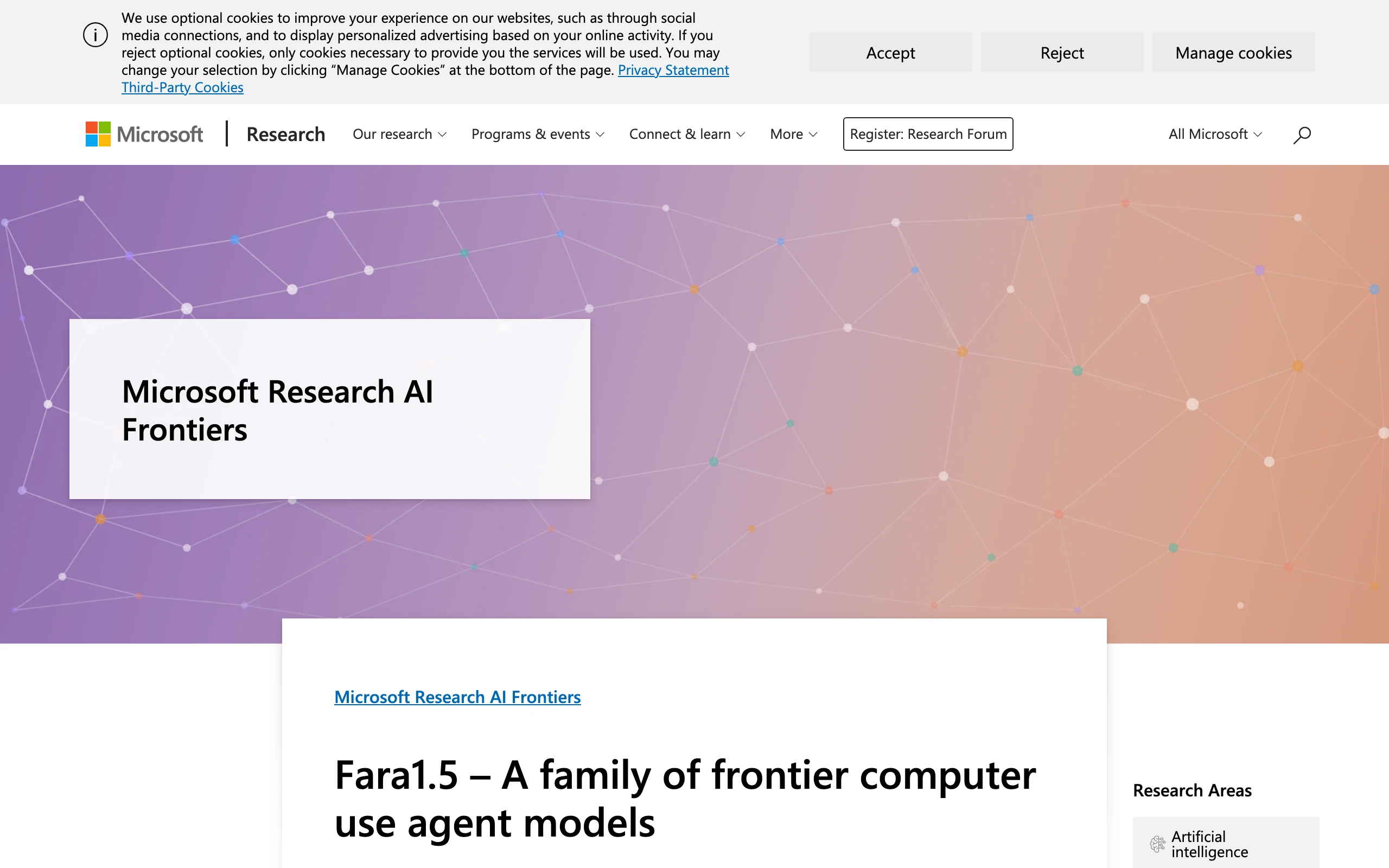
Fara1.5 is a browser-native AI agent (CUA, Computer Use Agent) model family from Microsoft Research AI Frontiers, available in 4B, 9B, and 27B parameter sizes. Fine-tuned on Qwen3.5, it uses pure pixel-level screenshots as the sole input and outputs mouse and keyboard actions through an Observe–Think–Act loop to control web pages autonomously. On Online-Mind2Web, the 27B variant reaches 72% task success—ahead of OpenAI Operator and Gemini 2.5 Computer Use. Paired with the MagenticLite sandbox browser, it handles form filling, cross-site price comparison, and event booking, requesting user confirmation before critical actions—balancing automation power with safety.
Image source: Official article
Technical positioning and domain: Fara1.5 applies vision-language models (VLMs) to Agentic AI as a general, vision-driven web operator. It addresses fragility of DOM/API automation on dynamic or non-standard pages by mimicking human visual browsing.
Development background: Led by Microsoft Research AI Frontiers with deep VLM and agent research. Motivation: GUI automation bottlenecks—DOM/accessibility trees don't generalize; pure vision bypasses those dependencies.
Core value: Improves generality and fault tolerance for complex, dynamic sites. Pixel-level understanding maps AI cognition to human browsing—new paths for test automation, data collection, RPA, and accessibility.
Technical characteristics: Pure vision (no DOM/HTML/API); strong small-model performance (4B/9B beat larger peers); safety via sandbox execution and proactive confirmation.
2. Key Features
Pixel-level browser control: Reads browser screenshots as the only visual input, understands layout, and outputs precise mouse (click, scroll, drag) and keyboard (type) actions—cross-platform and cross-framework without page structure dependency.
Web-specific shortcut actions: High-level meta-actions like
web_search,visit_url,go_backpack multiple primitives into one command for efficient planning (e.g., "search keyword X" vs. simulating every keystroke and click).Context management meta-actions:
memorize,ask_user, andfinishsupport long-horizon tasks—record form state, pause for ambiguous or irreversible steps, and signal completion for robust human–agent collaboration.Safe sandbox execution: All models run in MagenticLite, isolated from the host OS. Actions are logged and traceable; local files and system settings stay protected.
Multi-scale deployment: 4B, 9B, 27B cover edge devices through enterprise servers—4B on consumer hardware; 27B for peak complex web tasks.
Synthetic-data generalization: FaraGen1.5 synthetic data teaches login, email, booking, and other sensitive or irreversible flows—extending from read-only browsing to real write interactions.
3. How to Use
Environment and sandbox: Install MagenticLite from Microsoft's GitHub (guide or prebuilt binaries). Windows or Linux; meet minimum OS requirements.
Load model: Download weights from Hugging Face (
Fara1.5-4B,Fara1.5-9B, orFara1.5-27B). Load via provided inference scripts and bind to a MagenticLite instance—set resolution and model params.Task instruction: Describe the web task in natural language, e.g., "Book a hotel in NYC for Nov 24–28." The model decomposes into sub-goals (visit Booking.com, filter dates, etc.).
Observe–Think–Act loop: Screenshot → reasoning (thought) → atomic action (
click(x, y),type(text)) until done or user intervention needed.Confirmation: On missing info, ambiguity, or irreversible steps (orders, deletes),
ask_userpauses for approval before continuing.
4. Pros and Cons
| Pros |
|---|
| Pure vision, high generality: No DOM/HTML dependency—adapts to any frontend if layout is visible; far beyond traditional automation. |
| Small models, strong ROI: Fara1.5-4B hits 57.3% on Online-Mind2Web (~2× prior 7B); 9B at 63.4% leads same-size peers—complex tasks at lower deploy cost. |
| Safety by design: MagenticLite isolation plus confirmation before critical actions reduces accidental data loss or damage. |
| Open weights, local deploy: No third-party API required—privacy and compliance friendly. |
5. Comparison with Similar Tools
| Dimension | Fara1.5-27B | Fara1.5-4B | OpenAI Operator |
|---|---|---|---|
| Architecture | Qwen3.5 VLM, pure vision in/out | Same, smaller | Proprietary, undisclosed |
| Online-Mind2Web | 72.0% success | 57.3% success | 58.3% |
| Features | Open multi-scale, FaraGen data, confirmation | Cost-effective, edge-friendly, open | ChatGPT integration, cloud safety |
| Deployment | Open weights, local | Open weights, local | Cloud API only |
| License | Open, commercial (see official terms) | Same | Closed |
| Community | Microsoft-led, early stage | Same | Large user base |
Selection advice:
Peak performance + privacy: Fara1.5-27B—leading benchmark, local fine-tuning, no data egress; ecosystem still maturing but vision generality wins on messy sites.
Cost-sensitive / edge: Fara1.5-4B or 9B on consumer hardware—strong vs. same-size models; good for indie devs and SMBs.
Fast integration / cloud ecosystem: Operator or Gemini 2.5 Computer Use—mature APIs but closed, data leaves premises, cost scales with usage.
6. Editor's Review
Fara1.5 marks a new phase for browser agents—fully committing to pure vision with benchmark proof. Unlike DOM parsers or API-only cloud agents, it mirrors human "what you see is what you get" browsing—a moat for universal GUI adaptation. FaraGen1.5 extends training into authenticated, write-heavy flows—a hard real-world problem.
Open multi-scale weights democratize web automation. 4B/9B make local agents viable for scraping, testing, and personal assistants.
Limitations: still a research-grade framework—docs and toolchain are early vs. commercial products. Pure vision can struggle on tiny resolution, heavy CSS, or overlapping elements.
Overall, Fara1.5 is forward-looking and practical—right direction, strong numbers, open weights. Technical teams should evaluate now; it may underpin next-gen web automation.
— −0.5 for ecosystem/docs; excellence in innovation, performance, and open strategy.
7. Use Cases
Automated forms and data entry: Identify fields on hiring, expense, or long forms; fill from instructions or data; pause when required fields missing.
Cross-site price comparison and research: One command to search JD, Tmall, Pinduoduo for iPhone prices—navigate, scrape, summarize.
Scheduling and booking: Hotels, flights, rooms, tickets—multi-step flows with final confirmation before submit.
Email and content management: In sandbox—login, draft, send, attach—for batch email or multi-account social workflows.
Accessibility navigation: Voice or text goals ("find the pricing section"); model scrolls/clicks to guide users with vision or motor limitations.
8. FAQ
Q: How is Fara1.5 different from traditional RPA?
A: RPA uses selectors (ID, XPath)—brittle to DOM changes. Fara1.5 uses screenshots only; if visual layout stays similar after a rewrite, it still works—much stronger generalization.
Q: Can 4B run on a laptop?
A: With ≥8GB VRAM GPU (RTX 3060+) or 32GB+ RAM for slow CPU inference—feasible for non-real-time batch tasks.
Q: How are logins handled?
A: Fara1.5 doesn't store credentials. Log in manually in MagenticLite first, or guide the model through login (password supplied securely). Sandbox keeps secrets contained.
Q: Risk of accidental orders?
A: ask_user pauses before irreversible actions; sandbox isolates from real accounts even if mistakes occur.
Q: Can I test my own web app?
A: Yes—point at dev/test servers, describe cases in natural language ("click login, wrong password, check error"). Great for E2E UI tests with screenshots.
9. Project Links
- Research article: https://www.microsoft.com/en-us/research/articles/fara1-5-computer-use-agent/
- GitHub (weights & code): https://github.com/microsoft/fara
Related AI Model Articles
OpenMuse – CopilotKit Open-Source Personal AI Assistant
OpenMuse is an open-source personal AI assistant project developed by the CopilotKit team. Its core design philosophy is "giving an Agent a computer" — by combining a persistent browser, optional Linu...
In-Depth Review of Longcat-2.5-preview: Meituan's Next-Generation Multimodal Long-Range Agent Model
LongCat-2.5-preview is Meituan's latest next-generation large model. Building upon the 1.6T total parameters, approximately 48B active parameters, and native 1M token context of LongCat-2.0, it marks ...
Review of DeepSeek Harness Desktop: How the Official GUI Client Lowers the Bar for Agent Usage
DeepSeek Harness Desktop is the official graphical client launched by DeepSeek, designed to provide a visual interface for the originally command-line-based DeepSeek Harness framework. After users log...
Step Code – In-Depth Review of StepFun's Open-Source Terminal Programming Agent
Step Code is an open-source terminal programming agent launched by StepFun, licensed under the MIT License, which allows developers to complete the full workflow of code writing, debugging, execution,...
© All Rights Reserved. Some content on this site is partially generated by AI with human review.