
Dynamic Workflows – Claude Code's Dynamic Workflow System
Executive Summary:
Dynamic Workflows is Anthropic's dynamic workflow system in the Claude Code development environment, currently in research preview. It allows Claude to dynamically write orchestration scripts within a...
1. What Is Dynamic Workflows
Dynamic Workflows is Anthropic's dynamic workflow system in the Claude Code development environment, currently in research preview. It allows Claude to dynamically write orchestration scripts within a single session, parallel-scheduling dozens to hundreds of sub-Agents for large engineering tasks—with automatic task splitting, result verification, and checkpoint resume—compressing large-scale code refactoring or audit work from weeks to days. It marks a key transition for AI programming assistants from single-turn dialogue to multi-Agent collaborative systems.
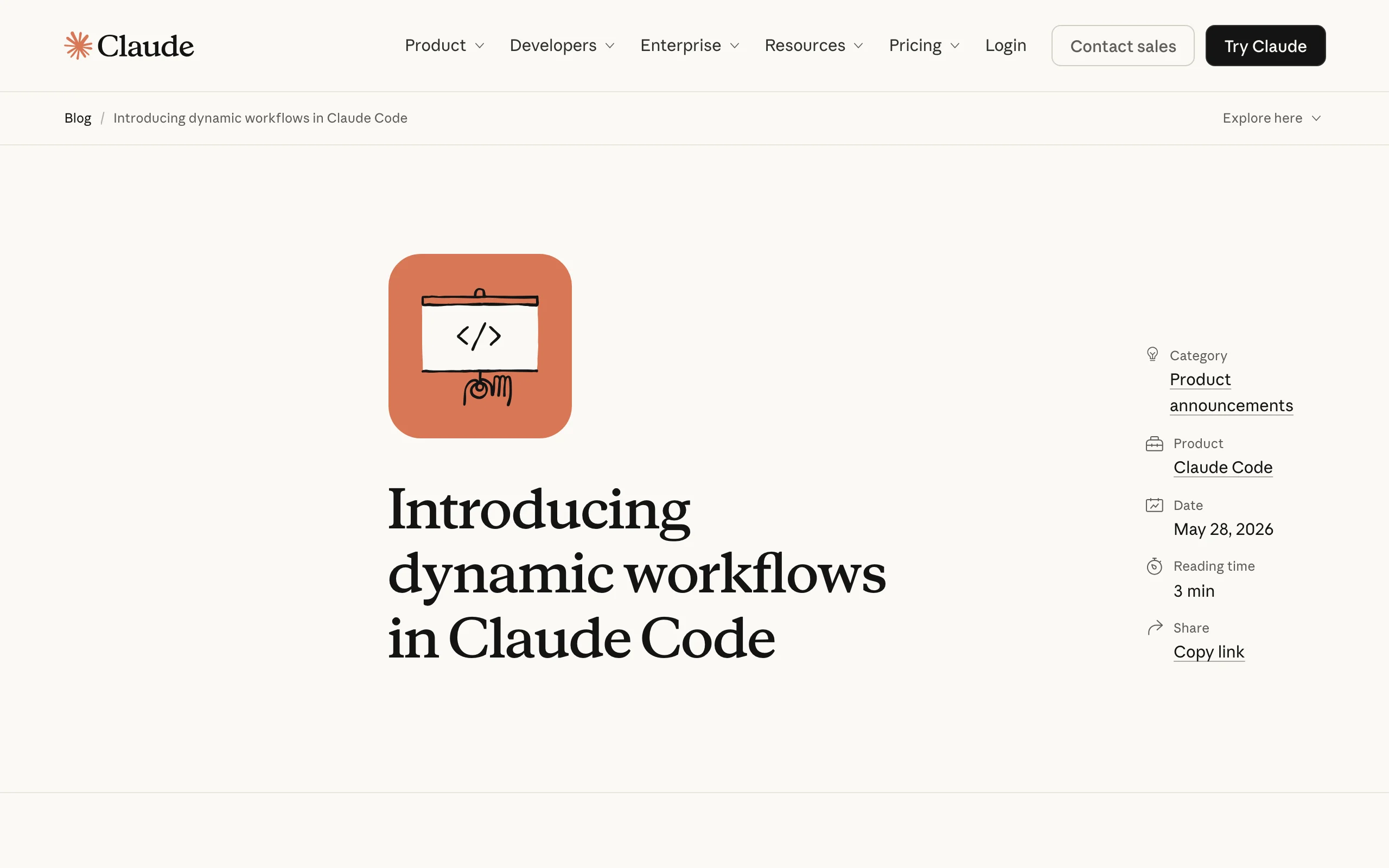
Image source: Official article
Technical positioning and domain: Dynamic Workflows belongs to multi-Agent collaboration frameworks in the AI programming assistant space, positioned for "ultra-large codebase automation." Unlike traditional single-Agent assistants, it parallel-schedules hundreds of sub-Agents through dynamic orchestration scripts—suitable for cross-file, cross-service whole-repository refactoring, vulnerability scanning, and performance audits.
Development background: Developed by Anthropic based on Claude models, driven by insight into efficiency bottlenecks of existing assistants on large projects. Previously developers manually split tasks and ran scripts one by one; Dynamic Workflows fully automates this—reflecting Anthropic's frontier exploration in Agent orchestration and task decomposition.
Core value: Solves three pain points of traditional AI assistants on large codebases: limited single-Agent capability, excessive manual intervention, and restart-from-scratch on failure. Parallel sub-Agents, adversarial verification, and checkpoint resume significantly improve speed and reliability of large engineering tasks. Real cases—Bun's Zig-to-Rust port in 11 days with 99.8% test pass rate—validate industrial-grade capability.
Technical characteristics: Core innovation is dynamic orchestration script generation—Claude generates coordination scripts in real time based on task characteristics, not predefined templates. Multi-level verification uses generate-review-iterate loops with independent attempts and adversarial challenge until convergence. External coordination architecture keeps plans outside conversation context limits, supporting hours-to-days continuous runs.
2. Key Features
Automatic task splitting and parallel execution: Claude auto-splits large tasks (whole-repo vulnerability scans, code migration) into hundreds of sub-tasks distributed to parallel sub-Agents. Each sub-Agent runs independently without interference, dramatically shortening total execution time.
Result verification and adversarial review: Each sub-Agent output is checked by independent verification Agents before aggregation. Adversarial Agents actively challenge conclusions from different angles to find errors or gaps. Multi-round iteration ensures high-reliability final answers.
Checkpoint resume: Workflows auto-save intermediate state. Environment interruptions (network fluctuation, server restart) can resume from checkpoint without starting over—critical for hours-to-days long tasks.
Full-process visualization: Real-time display of each sub-Agent's model, token consumption, tool call count, and execution time. Developers monitor workflow progress like observing a "cyber foreman"—useful for debugging and optimization.
Dynamic orchestration script generation: Unlike fixed templates, Claude generates coordination scripts in real time—flexibly deciding sub-Agent count, task dependencies, and verification strategy. This adaptability handles tasks of varying complexity.
External coordination architecture: Coordination logic runs outside conversation, unconstrained by Claude's context window. Even hundreds of Agents can proceed stably without context overflow failure.
Long-running support: Native design for hours-to-days continuous execution, matching large engineering task time requirements. Checkpoint resume and external coordination ensure long-task stability.
3. How to Use
Environment requirements: Install Claude Code CLI (macOS, Linux, Windows via WSL). Claude Max or Team subscription recommended; Enterprise users need admin manual enablement. API users can access via Claude API, Amazon Bedrock, Vertex AI, Microsoft Foundry.
Direct instruction start: In Claude Code, enter "Create a workflow" or descriptive instructions (e.g., "Scan the entire repository for SQL injection vulnerabilities"). Claude analyzes task complexity and decides whether to trigger a workflow. Simple tasks may complete with a single Agent; complex tasks auto-start dynamic orchestration.
Enable ultracode mode: Via Effort menu, enable ultracode to auto-set effort to xhigh. Claude more aggressively triggers workflows for complex tasks without manual specification—suitable for highly automated large projects.
Platform and permissions: Available on Claude Code CLI, desktop, and VS Code extension. Max, Team, and API users have workflow enabled by default; Enterprise requires admin enablement. Ensure subscription tier supports it.
Monitoring and intervention: After workflow start, view each sub-Agent status, token consumption, and tool calls in the visualization panel. If a sub-Agent drifts, manually interrupt and adjust instructions, then resume from checkpoint.
Best practices: First-time users should start with small-to-medium tasks (e.g., single-module code review) to learn workflow behavior. For whole-repo tasks, commit code to version control for rollback if unexpected changes occur. Token consumption may be high (multi-Agent parallel overhead)—use within budget.
4. Pros and Cons
| Pros |
|---|
| Large-scale parallel capability: Single session coordinates hundreds of parallel sub-Agents—suitable for cross-file, cross-service codebase operations—compressing weeks of work to days. |
| High-reliability output: Built-in adversarial review and multi-round verification reduce error rates—suitable for critical tasks where mistakes are costly (security audits, code migration). |
| End-to-end automation: Full pipeline from task planning to implementation and verification without manual sub-Agent orchestration—developers only provide high-level instructions. |
| Checkpoint resume and long runs: Native hours-to-days support with auto progress save—resume after interruption greatly improves large-task fault tolerance. |
5. Comparison with Similar Tools
| Dimension | Claude Code Dynamic Workflows | OpenAI Codex CLI | GitHub Copilot Workspace |
|---|---|---|---|
| Parallel scale | Hundreds of sub-Agents; codebase-scale refactoring | Limited sub-Agent parallel (~10–20); module-level tasks | No parallel Agents; single-thread step execution |
| Task orchestration | Dynamic auto-generated scripts; no manual intervention | User trigger or config; lower automation | Predefined workflow templates; limited flexibility |
| Verification | Built-in adversarial review and multi-round verification | Auto-review and user approval; traditional verification | Code review suggestions only; no auto verification |
| Run duration | Native days-level runs with checkpoint resume | Codex Cloud supports background long runs; local sessions limited | Limited by conversation context; unsuitable for ultra-long tasks |
| Token efficiency | Higher consumption (multi-Agent parallel overhead) | Lower (~1/3–1/4 of Claude) | Medium; single-thread controlled consumption |
| Use cases | Whole-repo vulnerability scan, large code migration, performance audit | Terminal programming, single-file refactor, rapid prototyping | Gradual refactor of small codebases |
Selection advice: Teams handling large codebases (tens of thousands of files+) for security scanning or language migration should choose Dynamic Workflows for parallel scale and verification—despite higher token cost. Terminal-focused tasks (shell scripts, CLI tools) may favor OpenAI Codex CLI for token efficiency and terminal performance. Gradual refactor of small-to-medium projects: GitHub Copilot Workspace's step execution is easier to control. Rapid prototyping or learning: Replit Agent's interactive experience is friendlier.
6. Editor's Take
Dynamic Workflows represents a paradigm shift from "solo combat" to "army collaboration" in AI programming assistants. Technical innovation lies in dynamic orchestration script generation and external coordination architecture—solving two long-standing multi-Agent problems: flexible task decomposition and context window limits. The Bun port validation shows stunning efficiency on large engineering tasks—11 days for work that could take weeks or months, 99.8% test pass rate—a productivity transformation, not just a technical breakthrough.
Practical value: especially strong for whole-repo security audits (parallel scan + independent verification), large code migration (end-to-end automation), and critical dual verification (adversarial review). Token cost and preview-stage instability are main constraints. Budget-rich enterprise teams seeking efficiency can adopt it; individual developers and small teams should validate on smaller tasks first.
Target audience: tech leads, security engineers, DevOps engineers at mid-to-large software teams, and developers maintaining legacy codebases. Future potential is substantial: as Anthropic optimizes token efficiency and stability, Dynamic Workflows could become a core component of next-generation CI/CD pipelines.
Basis: Innovation 5/5, practical value 4.5/5 (token cost deduction), ease of use 4/5 (learning curve and docs), stability 4/5 (preview stage). A highly forward-looking tool worth close attention and trial.
7. Application Scenarios
Whole-codebase vulnerability scanning: Parallel search across services or repositories; independent verification per finding; real-issue reports only. Example: 100k-line web app—50 sub-Agents check modules in parallel; adversarial review confirms vulnerabilities—very low false positive rate.
Large-scale code migration: End-to-end migration for framework replacement, API deprecation, language porting across thousands of files. Bun Zig-to-Rust example: auto-split migration; sub-Agents per module; verification Agents check compile and test pass rates; checkpoint resume prevents progress loss on mid-run failure.
Critical dual verification: Before high-risk decisions (database migration scripts, payment system updates), independent attempts and adversarial challenge ensure reliable conclusions. Multiple independent solutions generated; adversarial Agents find defects in each until convergence to consistent solution.
Performance optimization audit: Analyzer-guided parallel review of dead code, bottlenecks, and cleanup opportunities. Large Java project: 30 sub-Agents analyze hotspot functions per module; aggregated optimization priority list.
Automated test generation and maintenance: For legacy codebases, parallel function analysis, auto unit test generation, verification Agents ensure coverage and correctness—greatly improving test efficiency.
8. FAQ
Q: Does Dynamic Workflows support all Claude subscriptions?
A: Max, Team, and API users enabled by default; Enterprise requires admin manual enablement. Free and Pro subscriptions not supported currently. API users can call via Claude API, Amazon Bedrock, Vertex AI, Microsoft Foundry.
Q: How do I know if my task should trigger a workflow?
A: Claude auto-judges based on complexity. Simple tasks (single-file refactor) may use single Agent; complex tasks (cross-file refactor, whole-repo scan) auto-start workflow. Enable ultracode mode for more aggressive triggering.
Q: How do I control workflow token consumption?
A: Multi-Agent parallel means higher consumption. Test on small-scope tasks first to estimate cost. Token limits or sub-Agent count limits may help control spend. No direct config yet; budget controls may come in future versions.
Q: Can I manually intervene during workflow execution?
A: Yes. View sub-Agent status in the visualization panel. Interrupt drifting sub-Agents, adjust instructions, resume from checkpoint. Whole workflow does not fail due to single sub-Agent interruption.
Q: Where is checkpoint resume data stored?
A: Auto-saved in local workspace cache files. Ensure sufficient disk space (large tasks may need several GB). Switching machines or clearing cache requires re-run. Run long tasks in stable environments.
Q: How does Dynamic Workflows differ from Claude Code normal mode?
A: Normal mode is single-Agent dialogue for simple tasks. Workflow mode is multi-Agent parallel—auto task split, parallel execution, result verification. Normal mode requires manual user guidance.
9. Project Links
- Official announcement: https://claude.com/blog/introducing-dynamic-workflows-in-claude-code
- Claude Code documentation: https://docs.anthropic.com/en/docs/claude-code
- Anthropic blog: https://www.anthropic.com/blog (search Dynamic Workflows articles)
Related AI Model Articles
OpenMuse – CopilotKit Open-Source Personal AI Assistant
OpenMuse is an open-source personal AI assistant project developed by the CopilotKit team. Its core design philosophy is "giving an Agent a computer" — by combining a persistent browser, optional Linu...
In-Depth Review of Longcat-2.5-preview: Meituan's Next-Generation Multimodal Long-Range Agent Model
LongCat-2.5-preview is Meituan's latest next-generation large model. Building upon the 1.6T total parameters, approximately 48B active parameters, and native 1M token context of LongCat-2.0, it marks ...
Review of DeepSeek Harness Desktop: How the Official GUI Client Lowers the Bar for Agent Usage
DeepSeek Harness Desktop is the official graphical client launched by DeepSeek, designed to provide a visual interface for the originally command-line-based DeepSeek Harness framework. After users log...
Step Code – In-Depth Review of StepFun's Open-Source Terminal Programming Agent
Step Code is an open-source terminal programming agent launched by StepFun, licensed under the MIT License, which allows developers to complete the full workflow of code writing, debugging, execution,...
© All Rights Reserved. Some content on this site is partially generated by AI with human review.