
Command A+ – Cohere Labs' Open-Source Multimodal Large Language Model
Executive Summary:
Command A+ is an open-source multimodal large language model from Cohere Labs, built on a Mixture-of-Experts (MoE) architecture with 218B total parameters but only 25B activated at inference—deliverin...
1. What Is Command A+
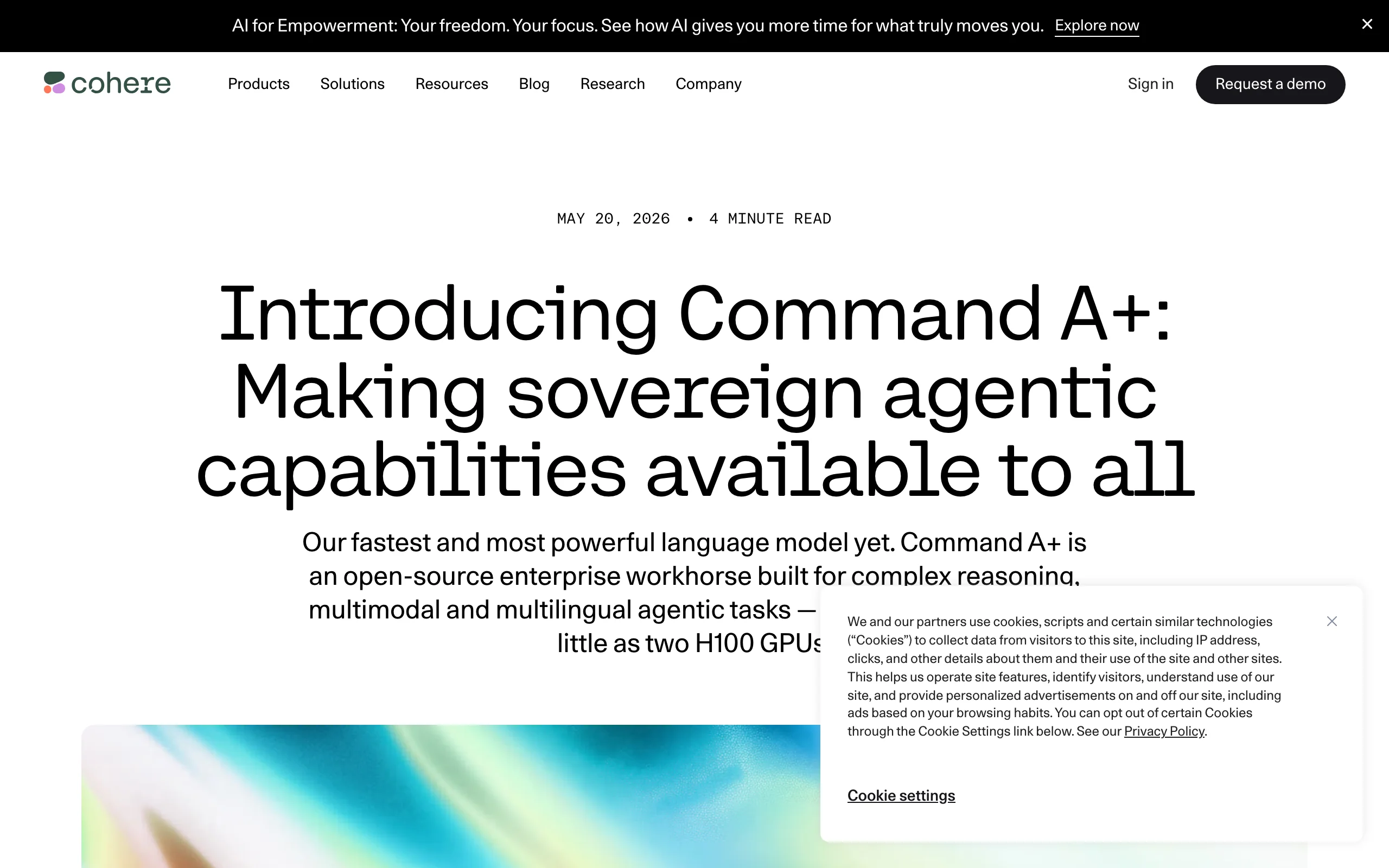
Command A+ is an open-source multimodal large language model from Cohere Labs, built on a Mixture-of-Experts (MoE) architecture with 218B total parameters but only 25B activated at inference—delivering strong performance with exceptional efficiency. It natively supports a 128K ultra-long context window and 48 languages, deeply integrating visual understanding, agent task execution, complex reasoning, and machine translation. Three quantization tiers (BF16, FP8, W4A4) enable private deployment with as little as one B200 or two H100 GPUs. Released under the Apache 2.0 license for free commercial use and derivative development, it is an ideal foundation model for enterprise agent applications, retrieval-augmented generation (RAG), and multimodal AI applications.
Image source: Official article
Technical positioning and domain: Command A+ targets the enterprise multimodal LLM space, focused on high-throughput, low-latency private deployment. Core application directions include agent systems, RAG pipelines, multilingual translation, and visual understanding tasks—competing directly with OpenAI GPT-4o and Anthropic Claude.
Development background: Cohere Labs is a Canadian company focused on enterprise AI solutions, founded by former Google AI researcher Aidan Gomez and others. The team has deep experience in Transformer architecture and model compression, previously releasing the Command R and Command R+ series. Command A+ was motivated by enterprise needs for data sovereignty, low deployment costs, and efficient inference.
Core value: Command A+ addresses three major enterprise LLM deployment challenges: high hardware costs, data privacy compliance risks, and multimodal capability integration complexity. Through MoE architecture maximizing parameter efficiency—218B total compressed to 25B activated—it maintains GPT-4o-level performance while lowering deployment barriers to single B200 level. Native RAG stack and tool-calling capabilities significantly reduce the technical barrier for enterprise agent application development.
Technical characteristics: Core technical highlights include: unified weight architecture fusing vision, reasoning, translation, and agent capabilities in a single model without multi-model stitching; natively optimized RAG ecosystem seamlessly integrating with Cohere Embed v3 and Rerank 3.5 with precise citation tracing; three-tier quantization strategy (BF16/FP8/W4A4) providing flexible deployment options for different hardware configurations, achieving fine balance between performance and resource consumption.
2. Key Features
Multimodal agent execution: Natively supports tool calling and multi-step agent task planning, performing strongest on tool use and autonomous execution benchmarks. The model autonomously calls external APIs, database queries, and code executors to complete complex multi-step workflows—such as automatically extracting attachments from emails, calling OCR to recognize image text, and writing to databases.
Visual understanding and reasoning: Supports joint image and text input for cross-modal understanding and generation. The model analyzes charts, identifies objects, extracts text from images, and reasons over visual content—such as automatically generating product descriptions from images or extracting structured to-do items from handwritten notes.
Multilingual translation and reasoning: Built-in world-class translation covering 48 languages including Chinese, English, French, German, and Japanese. Beyond text translation, it maintains semantic coherence and cultural adaptation during translation, with cross-lingual reasoning capability—such as answering technical questions based on translated Chinese results from English technical documents.
Ultra-long context processing: Supports 128K input context and 64K output length, suitable for long documents, complete codebases, or historical conversation records. In RAG scenarios, the model can ingest dozens of PDF pages at once and generate summaries or analysis reports with precise citations based on full content.
Efficient deployment and quantization support: Provides BF16, FP8, and W4A4 quantization tiers, enabling private deployment with as little as one B200 or two H100 GPUs. The W4A4 version compresses model size to 25% of original BF16, reducing inference latency by 30% compared to Command A Reasoning while maintaining over 95% performance.
Native RAG ecosystem integration: Forms an integrated RAG stack with Cohere Embed v3 and Rerank 3.5, supporting native citation tracing. The model automatically annotates source paragraphs when generating answers, with hallucination rates significantly lower than general models—especially suitable for finance, legal, and other accuracy-critical scenarios.
3. How to Use
Environment requirements and prerequisites: Recommended OS is Linux (Ubuntu 22.04 or newer) or Windows Server 2022. Hardware: BF16 version recommends 2×H100 or 1×B200 GPU with at least 80GB VRAM; FP8 can use 1×H100; W4A4 minimum is 1×A100 80GB. Requires Python 3.10+, CUDA 12.1+, and PyTorch 2.1+.
Download model weights: Use Hugging Face CLI to pull model files locally. Run
huggingface-cli download CohereLabs/command-a-plus-05-2026-bf16 --local-dir ./command-a-plus. For quantized versions, replacebf16withfp8orw4a4. Verify file integrity after download—BF16 ~130GB, FP8 ~65GB, W4A4 ~32GB.Transformers loading for inference: Use Hugging Face Transformers
pipelineinterface. Example:from transformers import pipeline; pipe = pipeline("image-text-to-text", model="./command-a-plus"); result = pipe(images="image.jpg", text="Describe this image"). Requirestransformers>=4.45.0andaccelerate>=0.33.0.vLLM service deployment: After installing vLLM, run
vllm serve ./command-a-plus --port 8000 --max-model-len 131072to expose OpenAI-compatible API endpoints. Call viacurl http://localhost:8000/v1/chat/completions -d '{"model":"command-a-plus","messages":[{"role":"user","content":[{"type":"text","text":"What is in this image?"},{"type":"image_url","image_url":{"url":"https://example.com/image.jpg"}}]}]}'.SGLang deployment: After installing SGLang, run
python -m sglang.launch_server --model-path ./command-a-plus --port 8000for OpenAI-compatible API. SGLang achieves ~15% higher throughput than vLLM in batch scenarios, suitable for high-concurrency production environments.Docker containerized deployment: Run
docker run -p 8000:8000 -v /path/to/model:/model cohere/command-a-plus:latestto launch containerized service. Docker image includes all dependencies pre-installed—no manual environment configuration needed, ideal for rapid prototyping.
4. Pros and Cons
| Pros |
|---|
| MoE architecture efficiency: 218B total parameters with only 25B activated—inference 3-5× faster than dense models of equivalent performance while maintaining GPT-4o-level generation quality, achieving Pareto-optimal performance-efficiency balance. |
| Native multimodal fusion: Vision, language, and tool-calling unified in single weights—no stitching multiple specialized models like other approaches, significantly reducing system complexity and inference latency. |
| Enterprise-grade RAG ecosystem: Seamless integration with Cohere Embed v3 and Rerank 3.5 providing end-to-end RAG solutions; citation tracing reduces hallucination to ~1/3 of general models. |
| Flexible quantization strategy: Three tiers covering cloud to edge deployment; W4A4 compresses model to 32GB runnable on single A100 80GB, significantly lowering deployment costs. |
5. Comparison with Similar Tools
| Dimension | Command A+ | OpenAI GPT-4o | Meta Llama 3.1 405B |
|---|---|---|---|
| Core architecture | MoE (218B/25B) | Dense (undisclosed) | Dense (405B) |
| Multimodal capability | Vision + text + tools | Vision + audio + text | Text only (needs external vision model) |
| Context window | 128K input / 64K output | 128K | 128K |
| Private deployment | 1×B200 or 2×H100 | API only | 8×H100 or 16×A100 |
| Native RAG ecosystem | ✅ Embed + Rerank + generation | ❌ Build yourself | ❌ Build yourself |
| Native agent tool calling | ✅ Native support | ✅ Native support | ✅ Needs external framework |
| Open-source license | Apache 2.0 | Closed / proprietary API | Custom (commercial license required) |
| API price (per million tokens) | $2.50 / $10.00 | $2.50 / $10.00 | N/A (open source) |
| Quantization support | BF16 / FP8 / W4A4 | N/A | BF16 / FP8 |
Selection advice: For enterprises needing private deployment with strong multimodal requirements, Command A+ is the optimal choice. Its MoE architecture lowers deployment costs to single B200 level while maintaining performance; native RAG ecosystem further reduces development complexity. Llama 3.1 405B has larger parameter scale but lacks native vision capability and requires 8×H100—several times higher hardware cost.
For budget-limited scenarios with lower multimodal needs, Mistral Large 2 has lower API pricing ($2.00/million tokens) and more mature community ecosystem. GPT-4o remains strongest in overall capability but closed-source and API-only restrictions make it unsuitable for industries with strict data sovereignty requirements such as finance and healthcare.
6. Editor's Take
Command A+ demonstrates Cohere Labs' deep technical accumulation in innovation. The 218B/25B MoE parameter ratio leads the industry—compared to Meta's Llama 3.1 405B dense model, Command A+ achieves order-of-magnitude inference efficiency improvement while maintaining comparable generation quality. More noteworthy is its unified weight architecture—fusing vision, reasoning, translation, and agent capabilities in a single model rather than multi-model stitching like other open-source models—a design approach with significant advantages in system complexity and inference latency.
From practical value, Command A+'s most prominent contribution is lowering enterprise multimodal LLM deployment barriers. The W4A4 version runs with only 32GB VRAM—meaning enterprises with single A100 80GB can deploy multiple instances or run other services simultaneously. Native RAG ecosystem integration further reduces development work—enterprises get citation-backed Q&A systems out of the box without building retrieval, ranking, and generation pipelines themselves.
Target audience: Three user types benefit most: institutions with strict data sovereignty requirements (finance, healthcare, government); development teams building multimodal agent applications; mid-size enterprises seeking GPT-4o-level capability at lower cost. For individual developers and academic researchers, Llama 3.1 70B or Mistral 7B may offer better value.
Future potential: Cohere Labs has stated continued Command series optimization, especially in Chinese capability and community ecosystem building. As W4A4 quantization matures, this model class may run on consumer GPUs. Additionally, Cohere's MoE optimization research may further reduce activated parameters below 10B—enabling laptop deployment.
Recommended rating: ★★★★☆ (4.5/5) Deductions mainly for Chinese capability and relatively weak community ecosystem. But considering enterprise deployment efficiency, native multimodal capability, and Apache 2.0 open-source license, Command A+ is undoubtedly one of 2025's most commercially valuable open-source multimodal LLMs.
7. Use Cases
Enterprise knowledge base Q&A: Based on 128K long context and native RAG capability, enterprises import internal documents, technical manuals, and compliance policies into knowledge bases. Employees ask questions in natural language and receive answers with precise citation tracing. For example, legal teams querying contract clauses get explanations plus source paragraph and page annotations.
Multilingual translation and localization: 48-language translation capability makes it ideal for cross-border e-commerce and international conference interpretation. The model maintains professional terminology consistency and automatically adapts cultural expression habits—such as adjusting tone to Japanese keigo norms when translating English marketing copy to Japanese.
Visual agent automation: Combining image understanding and tool calling for end-to-end business process automation. Typical scenarios: scan invoices, automatically extract amounts, dates, and vendor information, call accounting APIs to generate journal entries, and send approval notifications via email—all without human intervention.
Compliance industry private deployment: Finance, healthcare, and government institutions deploy locally or in private cloud ensuring sensitive data never leaves their domain. Audit log support makes all inference requests traceable, meeting GDPR, HIPAA, and other regulatory requirements. For example, hospitals use patient records for local Q&A without uploading to public cloud.
High-throughput intelligent customer service: MoE architecture's high throughput and low latency supports large-scale concurrent conversations. During e-commerce peak periods, a single B200 server handles 500+ concurrent sessions with sub-200ms response times. The model automatically identifies user intent and queries CRM systems for order status—end-to-end service automation.
8. FAQ
Q: What's the difference between Command A+ and Command R+?
A: Command A+ is a comprehensive upgrade over Command R+. Key improvements: MoE architecture (218B/25B vs Command R+'s 104B dense), new native visual understanding, context window expanded from 128K input to 128K input + 64K output, 30% lower inference latency, 110% higher throughput. Command A+ also offers richer quantization with new W4A4 version.
Q: How much performance does the W4A4 quantized version lose?
A: Per Cohere Labs official benchmarks, W4A4 loses ~3-5% on standard evaluations like MMLU and HellaSwag, with smaller losses (~1-2%) on translation and agent tasks. But in extreme long-context scenarios (>64K tokens), quantized model accuracy may drop 8-10%. FP8 is recommended as production balance point.
Q: Does it support Chinese fine-tuning? How to obtain Chinese training data?
A: Yes. Apache 2.0 license allows fine-tuning on proprietary data. Cohere provides fine-tuning toolchain (beta) supporting LoRA and QLoRA parameter-efficient methods. Chinese training data available from Hugging Face open datasets like Belle and WuDaoCorpora, or enterprise proprietary documents.
Q: How much VRAM is needed to deploy Command A+?
A: Varies by quantization: BF16 ~130GB VRAM (recommend 2×H100 or 1×B200), FP8 ~65GB (recommend 1×H100), W4A4 ~32GB (recommend 1×A100 80GB). Additional 8-16GB needed for KV Cache and inference intermediates in actual use.
Q: Does the model support streaming output?
A: Yes. Whether via vLLM, SGLang, or Transformers, streaming can be enabled. Set stream: true in API calls for token-by-token results. Streaming significantly improves UX in long-text generation—first token latency ~150-300ms.
Q: Do Command A+'s RAG capabilities require separately deploying Embed and Rerank models?
A: Yes. Command A+ itself doesn't include embedding and reranking—requires Cohere Embed v3 and Rerank 3.5. But Cohere provides complete RAG pipeline sample code covering document chunking, embedding indexing, retrieval, reranking, and generation—users can build full RAG systems in ~30 lines of code.
9. Project Links
- Official website: https://cohere.com/blog/command-a-plus
- Hugging Face model hub: https://huggingface.co/CohereLabs/command-a-plus-05-2026-bf16
- GitHub repository: https://github.com/cohere-ai/command-a-plus (examples and fine-tuning tools)
Related AI Model Articles
OpenMuse – CopilotKit Open-Source Personal AI Assistant
OpenMuse is an open-source personal AI assistant project developed by the CopilotKit team. Its core design philosophy is "giving an Agent a computer" — by combining a persistent browser, optional Linu...
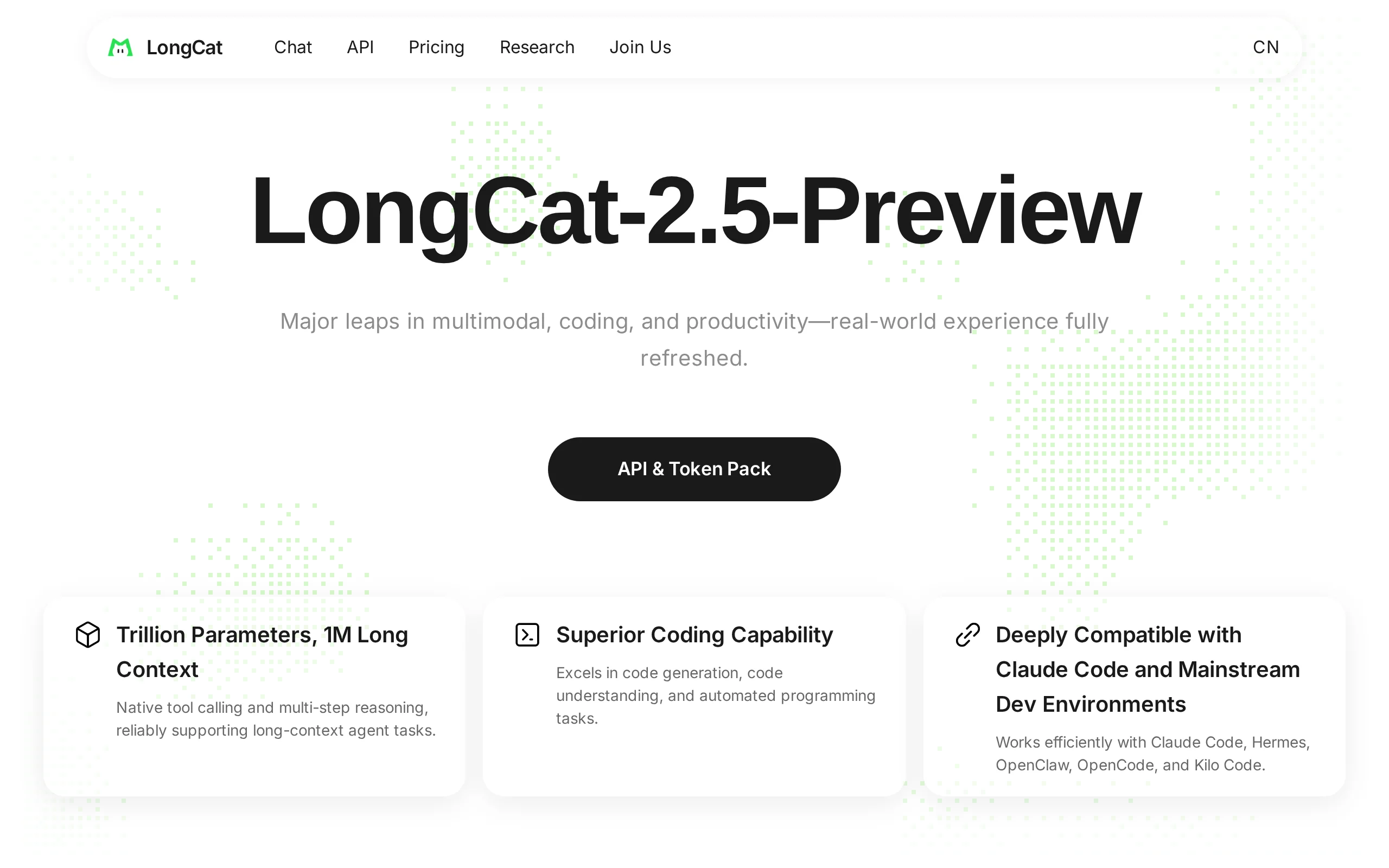
In-Depth Review of Longcat-2.5-preview: Meituan's Next-Generation Multimodal Long-Range Agent Model
LongCat-2.5-preview is Meituan's latest next-generation large model. Building upon the 1.6T total parameters, approximately 48B active parameters, and native 1M token context of LongCat-2.0, it marks ...
Review of DeepSeek Harness Desktop: How the Official GUI Client Lowers the Bar for Agent Usage
DeepSeek Harness Desktop is the official graphical client launched by DeepSeek, designed to provide a visual interface for the originally command-line-based DeepSeek Harness framework. After users log...
Step Code – In-Depth Review of StepFun's Open-Source Terminal Programming Agent
Step Code is an open-source terminal programming agent launched by StepFun, licensed under the MIT License, which allows developers to complete the full workflow of code writing, debugging, execution,...
© All Rights Reserved. Some content on this site is partially generated by AI with human review.