
Claude Sonnet 5 – Anthropic's Most Powerful Agent Model
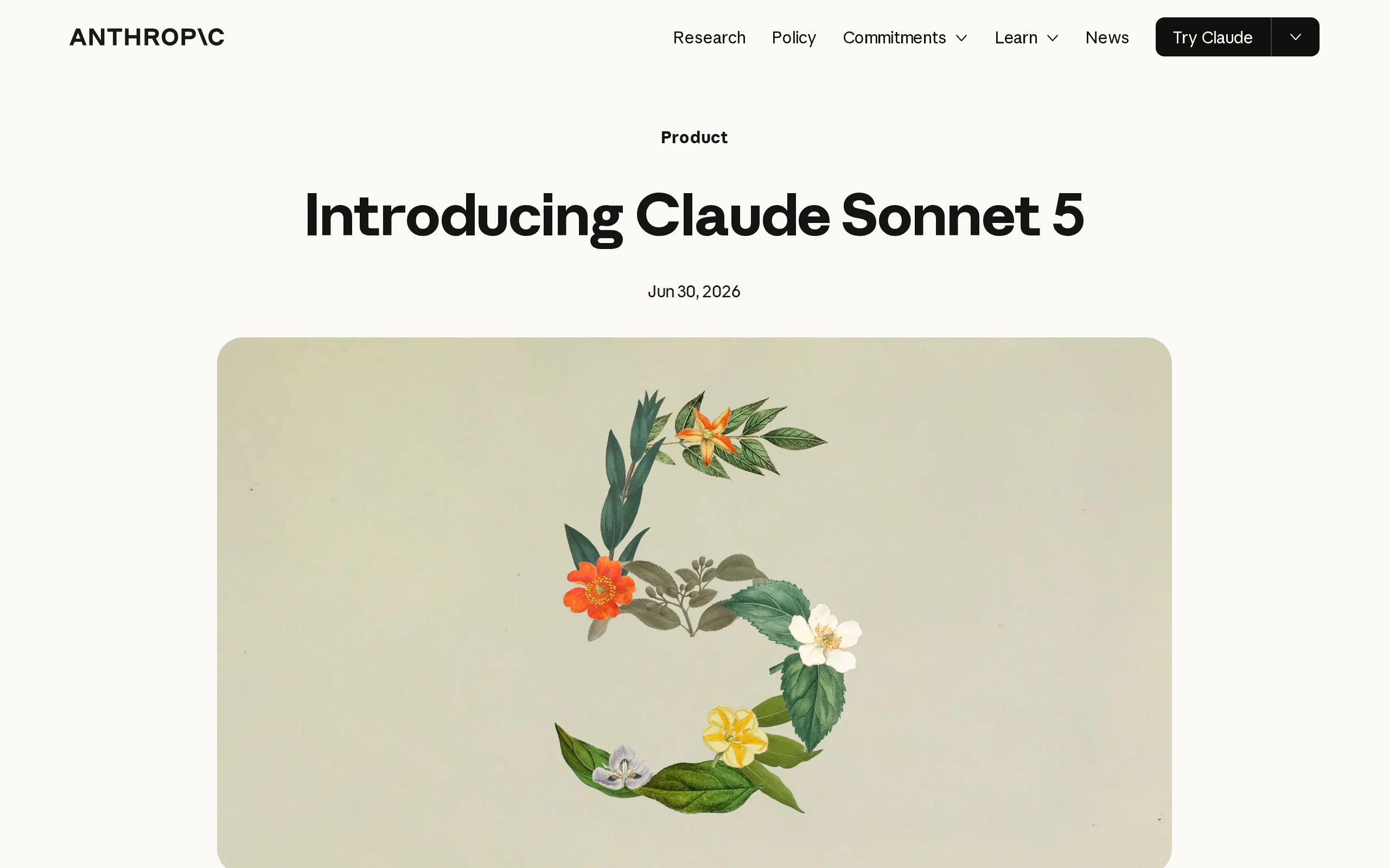
Executive Summary:
Claude Sonnet 5 is the most capable agent model in Anthropic's Sonnet series. Its performance in benchmarks for agentic coding, terminal operations, browser search, and computer use approaches that of...
1. What is Claude Sonnet 5
Claude Sonnet 5 is the most capable agent model in Anthropic's Sonnet series. Its performance in benchmarks for agentic coding, terminal operations, browser search, and computer use approaches that of the flagship Opus 4.8, but at a significantly lower price. This model has become the default model for Free and Pro users, and its safety (rate of undesirable behavior) also surpasses the previous generation Sonnet 4.6, marking a qualitative leap in autonomous execution capabilities for mid-range models.
Image source: Official article
Image source: official article
Technical Positioning and Domain: It belongs to the intersection of Large Language Models (LLMs) and Agents, positioned as a mid-range agent-native model. Unlike traditional models that only support dialogue, Sonnet 5 natively integrates planning, tool calling, multi-step execution, and self-correction capabilities. It can autonomously complete complex tasks ranging from code writing to server operations, filling the capability gap between the high-end Opus model and the basic Sonnet model.
R&D Background: Developed by the Anthropic team based on experience from the previous generation Sonnet 4.6. Anthropic has deep expertise in safety alignment and reasoning capabilities. The launch of Sonnet 5 aims to democratize agent capabilities to more users at a lower cost while maintaining industry-leading safety standards. The model's development focused on overcoming key challenges such as multi-step planning stability, tool calling precision, and reasoning efficiency.
Core Value: It addresses the lack of autonomy in mid-range models for complex tasks. Previously, users had to rely on high-priced Opus-level models to complete multi-step software engineering or cross-system process automation. Sonnet 5 provides agent capabilities close to Opus 4.8 at a Sonnet-level price, significantly lowering the barrier to high-end AI applications. Additionally, the five-level effort control allows users to balance cost and output quality on demand, further optimizing cost-effectiveness.
Technical Features: It adopts an adaptive reasoning architecture, allowing the model to autonomously determine reasoning depth based on task complexity without a fixed token budget. It natively integrates tool calling frameworks for browsers, terminals, etc., supporting multi-step planning and autonomous execution loops. The new Tokenizer improves semantic granularity, and high-resolution visual understanding enhances recognition of documents and interfaces.
2. Key Features
Agentic Coding: Supports complex software engineering tasks, achieving a 63.2% pass rate on SWE-bench Pro. It can autonomously write, debug, and test code, and submit Pull Requests. In real-world development scenarios, the model understands multi-file dependencies, performs incremental modifications and regression validation, significantly boosting development efficiency.
Terminal Operations: Can invoke terminal tools to execute commands, with an 80.4% pass rate on Terminal-Bench 2.1. It is proficient in server maintenance, script execution, and system configuration. The model parses command outputs and autonomously adjusts parameters or retries based on error messages, enabling unattended automated operations.
Web Search: Possesses autonomous web search and information integration capabilities, showing a significant performance improvement over Sonnet 4.6 on the BrowseComp benchmark. The model can formulate search strategies, extract key information from multiple sources, and generate structured research reports, suitable for scenarios like market research and academic literature reviews.
Computer Use: Can operate graphical interfaces to complete complex tasks, achieving an 81.2% pass rate on OSWorld-Verified, approaching the level of Opus 4.8. The model identifies screen elements, simulates mouse and keyboard operations, and completes tasks such as cross-application data migration, form filling, and software installation, enabling desktop-level automation.
Multidisciplinary Reasoning: Scores 43.2% without tools and 57.4% with tools on Humanity's Last Exam, and achieves a GDPval-AA v2 score of 1618 for knowledge work. The model handles complex problems across multiple domains like physics, mathematics, law, and finance, combining external tools for verification and deduction to produce rigorous reasoning chains.
Five-Level Effort Control: Supports five effort parameters: low / med / high / xhigh / max, enabling dynamic cost-performance balance through fine-grained control. Using the low level on simple tasks significantly reduces token consumption, while using the max level on critical tasks unlocks reasoning depth close to Opus 4.8.
High-Resolution Visual Understanding: Supports high-resolution image input, enhancing the recognition and understanding of documents, charts, and interfaces. The model accurately parses tables in PDFs, node relationships in flowcharts, and button positions in GUI interfaces, providing a foundation for computer use and document analysis.
Safety Alignment Optimization: Reduces hallucination rates, sycophancy, and prompt injection attack risks through improved alignment training, with overall undesirable behavior scores better than Sonnet 4.6. The model demonstrates stronger robustness in adversarial testing, capable of rejecting unreasonable instructions while maintaining honesty, making it suitable for enterprise-level deployment.
3. How to Use
Environment Requirements: Using Claude Sonnet 5 requires no local hardware, as all computation is completed on Anthropic's cloud. Users need an internet connection and a modern browser (latest version of Chrome/Firefox/Edge). API calls require registering an Anthropic account and obtaining an API Key.
Direct Use via Web: Visit the Claude official website. Free and Pro users are automatically switched to Sonnet 5 by default, requiring no configuration to start chatting directly. During conversations, you can ask the model to perform tasks such as code writing, web search, and file analysis, and the model will automatically invoke built-in tools.
API Calls: Developers can integrate the model into their applications via the Claude Platform by specifying the model name
claude-sonnet-5. It supports SDKs such as Python and Node.js. Example code:import anthropic client = anthropic.Anthropic(api_key="your-key") response = client.messages.create( model="claude-sonnet-5", max_tokens=4096, messages=[{"role": "user", "content": "Write a Python script to read a CSV and generate a statistical report"}] )Claude Code Integration: Directly select Sonnet 5 in the Claude Code programming assistant tool for coding collaboration and code review. The model can understand the entire code repository structure, provide refactoring suggestions, automatically fix bugs, and generate unit tests.
Enable via Enterprise Console: Users on Max, Team, and Enterprise plans can enable Sonnet 5 with one click in the admin console and assign team permissions. Enterprise administrators can set usage quotas, audit logs, and security policies to ensure compliant usage.
Adjust Effort Parameter: When calling the API, set the
effortparameter tolow/med/high/xhigh/maxto control reasoning depth and cost. For example, uselowfor simple Q&A andmaxfor complex mathematical proofs. The caching mechanism supports 5-minute and 1-hour writes, further reducing token consumption in repeated call scenarios.
Notes: High effort levels (xhigh/max) significantly increase token consumption and response latency; it is recommended to use them only for complex reasoning tasks. The browser search function requires the model to be online, so enterprise environments must ensure network policies allow it. It is recommended to manually review model outputs, especially when involving code deployment and financial decisions.
4. Pros and Cons Analysis
| Pros |
|---|
| Outstanding cost-effectiveness: Provides agent capabilities close to Opus 4.8 at Sonnet-level pricing (Input $2/M Tokens, Output $10/M Tokens), significantly lowering the barrier for high-end AI applications, suitable for budget-constrained teams. |
| Powerful autonomous execution: Natively integrates tools like browser, terminal, and computer use, supporting multi-step planning and self-correction. Capable of completing complex tasks from code writing to cross-system process automation, reducing manual intervention. |
| Flexible five-level effort control: Users can finely adjust between low and max based on task complexity, achieving a dynamic balance between cost and performance. Saves significant Tokens on simple tasks while enabling deep reasoning on critical tasks. |
| Industry-leading safety: Through improved alignment training, hallucination rates, sycophancy, and prompt injection attack risks are all lower than Sonnet 4.6. Performs robustly in adversarial tests, suitable for high-risk scenarios like finance and healthcare. |
5. Comparison with Similar Tools
| Dimension | Claude Sonnet 5 | Gemini 2.5 Pro | GPT-4o (OpenAI) |
|---|---|---|---|
| Developer | Anthropic | Google DeepMind | OpenAI |
| Product Positioning | Mid-range agent-native model | Flagship multimodal reasoning model | Flagship multimodal general-purpose model |
| Agent Coding | SWE-bench Pro 63.2%, native toolchain complete | Approx. 63-65% (industry estimate), tool calling requires configuration | SWE-bench Verified approx. 50%, requires third-party plugins |
| Terminal Operations | Terminal-Bench 80.4%, deep native support | Limited support, mainly via tool calling | No native terminal operations, requires Code Interpreter |
| Browser Search | BrowseComp significantly improved, strong autonomous search planning | Supports Google Search integration, but average autonomous planning ability | Supports Bing Search, but weak multi-step search planning |
| Computer Use | OSWorld-Verified 81.2%, close to Opus 4.8 | Supports screen operations but with relatively lower precision and stability | No native computer use support |
| API Input Price | $2 / Million Tokens (promotional period) | Approx. $1.25 / Million Tokens (context caching) | $2.5 / Million Tokens |
| API Output Price | $10 / Million Tokens (promotional period) | Approx. $10 / Million Tokens | $10 / Million Tokens |
| Context Window | 1M Tokens | 1M Tokens (standard) / 2M Tokens (experimental) | 128K Tokens |
Selection Recommendations:
For teams requiring end-to-end agent capabilities (e.g., automated software engineering, server operations, cross-system process automation), Claude Sonnet 5 is currently the most cost-effective choice. Its native tool calling and five-level effort control offer clear advantages in complex multi-step tasks, with superior safety compared to competitors. Gemini 2.5 Pro excels in multimodal reasoning (especially video understanding) but is less deep in terminal and computer use than Sonnet 5. GPT-4o performs well in general conversation and creative writing but lacks a native agent toolchain, making it more suitable for scenarios requiring a flexible plugin ecosystem. As an open-source model, DeepSeek-V3 has extremely low costs, ideal for budget-sensitive teams willing to develop their own toolchain, though it lags significantly in autonomous execution capabilities. If an enterprise already uses the Google Cloud ecosystem, Gemini 2.5 Pro offers greater integration convenience; if minimizing cost with acceptable functional trade-offs, consider DeepSeek-V3 paired with a third-party Agent framework.
6. Editor's Take
Claude Sonnet 5 represents Anthropic's precise positioning in the agent domain—rather than blindly chasing flagship performance, it brings Opus-level autonomous execution capabilities down to a mid-range price point, redefining what "cost-effectiveness" means in AI models. From a technological innovation perspective, the five-level effort control is not merely an adjustment of reasoning steps but an elegant engineering implementation of adaptive reasoning architecture: the model can quickly deliver reasonable answers in low mode while unfolding deep reasoning chains in max mode—this dynamic balancing mechanism is an industry first. Its scores of 63.2% on SWE-bench Pro and 81.2% on OSWorld-Verified demonstrate practical utility in real-world software engineering and desktop automation, rather than just benchmark performance.
In terms of practical value, Sonnet 5's most notable contribution is lowering the barrier to agent applications. Previously, enterprises had to customize expensive Opus models or complex open-source solutions for each agent task; now, a single API call provides near-flagship autonomous capabilities. For small and medium-sized development teams, this means achieving automated CI/CD, intelligent customer service, data collection, and other scenarios with a lower budget. Security improvements are also a highlight: the incidence of undesirable behavior is lower than Sonnet 4.6, and enhancements in prompt injection and hallucination control make it more suitable for highly regulated fields like finance and law.
The target audience is clearly defined: frontend/backend engineers (automated coding), DevOps engineers (terminal operations), data analysts (browser search + report generation), and enterprise process managers (multi-step business automation). Academic researchers can also leverage its multidisciplinary reasoning abilities for literature reviews and experimental design.
Future development potential is immense. As Anthropic continues to optimize adaptive reasoning and tool-calling frameworks, the Sonnet series is expected to achieve longer context retention and more stable cross-application operations in next-generation models. Extending computer use capabilities to mobile and cloud desktops would open up even broader application spaces.
7. Application Scenarios
Automated Software Engineering: End-to-end code writing, debugging, testing, and PR submission. Developers only need to describe requirements, and Sonnet 5 can generate complete code, write unit tests, run and fix failing cases, and finally submit a Pull Request, freeing engineers to focus on decision-making and review.
Enterprise Process Automation: Automatically update CRM data and send email notifications, completing multi-step business process handling across systems. For example, extracting data from an order system, creating customer records in CRM, generating invoice PDFs, and sending them to customers via email, all without human intervention.
Intelligent Customer Service & Deep Research: Autonomously browse web pages to collect information and integrate multi-source data to generate in-depth research reports. It can be used for competitive analysis, industry trend tracking, academic literature reviews, etc. The model can formulate search strategies, extract key data from multiple websites, and output structured reports.
Legacy Code Maintenance: Identify root causes in complex code and provide permanent fixes rather than superficial symptom patches. The model can understand module dependencies in large codebases, analyze logs and stack traces, propose minimal modification solutions, and verify fix effectiveness.
Legal & Financial Analysis: Handle multi-document reasoning tasks for legal research, contract review, and data insight extraction. The model can simultaneously read multiple contracts, compare clause differences, identify potential risks, and generate compliance recommendations; in the financial domain, it can analyze financial reports and predict trends.
8. FAQ
Q: What are the main differences between Claude Sonnet 5 and Opus 4.8?
A: Opus 4.8 is Anthropic's flagship model, still leading in extremely complex reasoning and long-context tasks, but its price is several times that of Sonnet 5. Sonnet 5 approaches Opus 4.8 in agentic capabilities (coding, terminal, computer use), but still lags in pure reasoning depth (e.g., mathematical proofs) and processing very long documents (>500 pages). It is suitable for most everyday agentic tasks, while Opus is better suited for top-tier scientific research and critical decision-making.
Q: How exactly does the five-level effort control affect output?
A: The effort parameter controls the amount of computation the model invests in reasoning. In low mode, the model provides quick answers with minimal token consumption; med and high gradually increase reasoning steps; xhigh and max unfold multi-step verification and backtracking, producing more rigorous outputs but potentially increasing token consumption severalfold. It is recommended to use low for simple Q&A, med for code writing, high or xhigh for complex reasoning, and max only for scenarios requiring extremely high accuracy.
Q: Does Sonnet 5 support Chinese? How effective is it?
A: Yes, it supports Chinese, but it is primarily optimized for English scenarios. It performs well on basic tasks like Chinese conversation, code comments, and document analysis, but falls short on culturally deep tasks such as classical Chinese poetry and idiom comprehension compared to specialized Chinese models (e.g., DeepSeek). For Chinese-focused applications, it is recommended to combine with local models or use a translation layer.
Q: How can API call costs be reduced?
A: The following strategies can be adopted: 1) Use low or med effort for simple tasks; 2) Enable Prompt Caching (supports 5-minute and 1-hour cache writes), significantly reducing costs when repeatedly calling the same prefix; 3) Combine multiple questions into a single request to reduce fixed overhead; 4) For non-real-time tasks, use the Batch API for a 50% discount.
Q: Does the model have hallucination issues? How can they be mitigated?
A: Sonnet 5's hallucination rate has decreased compared to Sonnet 4.6, but errors can still occur when dealing with specific numbers or cited sources. It is recommended to enable the "search verification" feature (via the browser tool) to allow the model to verify facts before answering. For critical outputs, set max_tokens limits and require citations. Enterprise users can combine with a RAG system, feeding their own knowledge base as context input.
Q: Does the computer use feature support all desktop operating systems?
A: Currently, it primarily supports graphical interface operations on Windows and macOS, with limited support for Linux desktops (requires X11 environment). The model accesses the user's desktop via Anthropic's cloud proxy, so a companion desktop proxy software must be installed. For servers without a graphical interface, it is recommended to use the terminal operation feature instead.
9. Project Address
- Official News Page (Project Introduction): https://www.anthropic.com/news/claude-sonnet-5
- Anthropic Official Website (Product & API Documentation): https://www.anthropic.com
- API Reference Documentation: https://docs.anthropic.com/en/docs
Related AI Model Articles
OpenMuse – CopilotKit Open-Source Personal AI Assistant
OpenMuse is an open-source personal AI assistant project developed by the CopilotKit team. Its core design philosophy is "giving an Agent a computer" — by combining a persistent browser, optional Linu...
In-Depth Review of Longcat-2.5-preview: Meituan's Next-Generation Multimodal Long-Range Agent Model
LongCat-2.5-preview is Meituan's latest next-generation large model. Building upon the 1.6T total parameters, approximately 48B active parameters, and native 1M token context of LongCat-2.0, it marks ...
Review of DeepSeek Harness Desktop: How the Official GUI Client Lowers the Bar for Agent Usage
DeepSeek Harness Desktop is the official graphical client launched by DeepSeek, designed to provide a visual interface for the originally command-line-based DeepSeek Harness framework. After users log...
Step Code – In-Depth Review of StepFun's Open-Source Terminal Programming Agent
Step Code is an open-source terminal programming agent launched by StepFun, licensed under the MIT License, which allows developers to complete the full workflow of code writing, debugging, execution,...
© All Rights Reserved. Some content on this site is partially generated by AI with human review.