
BitCPM-CANN – Edge LLM Open-Sourced by ModelBest and Tsinghua on Ascend
Executive Summary:
BitCPM-CANN is China's first 1.58-bit ternary LLM trained end-to-end entirely on Huawei Ascend domestic compute, jointly released by ModelBest, Tsinghua University's NLP Lab, and OpenBMB. Using quanti...
1. What Is BitCPM-CANN
BitCPM-CANN is China's first 1.58-bit ternary LLM trained end-to-end entirely on Huawei Ascend domestic compute, jointly released by ModelBest, Tsinghua University's NLP Lab, and OpenBMB. Using quantization-aware training (QAT), it ships in 0.5B, 1B, 3B, and 8B sizes—releasing ~6× VRAM at inference with 90.1%–97.2% capability retention. This milestone gives domestic NPUs a complete low-bit training stack, breaking the industry limitation that Ascend chips could only infer, not natively train, such models.
Technical positioning and domain: Extreme low-bit quantized LLMs on domestic Ascend—1.58-bit ternary weights trained and inferred natively on Ascend, filling the supply-side gap for low-bit models on domestic chips.
Development background: Co-developed by ModelBest, Tsinghua NLP Lab, and OpenBMB with prior GPU BitCPM work exceeding Microsoft BitNet training efficiency. Ascend adaptation driven by domestic compute autonomy and edge deployment memory/power constraints.
Core value: Enables native low-bit training on domestic chips—not just inference adaptation. ~6× VRAM release lets 8B models run on flagship phones, lowering hardware barriers. Scalable low-bit paradigm hedges HBM price/supply risk and foundations larger domestic training.
Technical characteristics: QAT learns ternary weights (-1, 0, +1) from training start—not post-training compression. MindSpeed × Megatron-LM on Ascend with env adaptation, 32K sequences, parallelism, and fused ops for train-infer integration. 1:1 benchmarks vs MiniCPM4 full precision on 11 tasks across sizes validate reproducibility and scale.
2. Key Features
1.58-bit ternary inference: 0.5B–8B sizes for efficient edge runs—8B on flagship phones with practical speed and quality for NLU/NLG.
Full Ascend training loop: Data load through QAT to inference natively on Ascend—no foreign GPU pretrain required—true compute autonomy.
Extreme VRAM savings: ~6× vs BF16—e.g., 8B on 16GB devices, lowering edge deployment barriers.
Full-precision benchmarks: 1:1 vs same-size MiniCPM4 on 11 tasks—3B 97.2%, 8B 95.7%, 0.5B 90.1% retention.
Open weights and training stack: Full series weights plus MindSpeed × Megatron-LM low-bit base for fine-tuning and research on Ascend.
Scalable low-bit paradigm: 0.5B–8B engineering proof for future 50B–100B low-bit training reference.
3. How to Use
Environment: Ascend NPU (910B+ recommended), Linux (Ubuntu 20.04+), CANN 5.0+. Edge: flagship phones with 8GB+ RAM.
Download weights: Hugging Face 0.5B–8B series; use
git lfsfor full files, e.g.,./models/bitcpm-cann-8b/.Training stack: Clone MindSpeed × Megatron-LM base;
pip install -r requirements.txt;bash setup.shfor CANN and ops. Setexport ASCEND_DEVICE_ID=0; tuneconfig.yaml.Edge inference example:
from transformers import AutoModelForCausalLM, AutoTokenizer
model = AutoModelForCausalLM.from_pretrained("./models/bitcpm-cann-8b", trust_remote_code=True)
tokenizer = AutoTokenizer.from_pretrained("./models/bitcpm-cann-8b")
inputs = tokenizer("Hello, please introduce yourself.", return_tensors="pt")
outputs = model.generate(**inputs, max_length=100)
print(tokenizer.decode(outputs[0]))
Enable quantized inference on edge for lower memory.
Fine-tuning:
train.pywith model path, data, output dir, e.g.,python train.py --model_path ./models/bitcpm-cann-8b --data_path ./data/finetune.json --output_dir ./output. Test small batches first.Notes: Match NPU driver and CANN (5.1.0 recommended). Multi-card via
--nproc_per_node. Reduce sequence length or streaming if OOM on edge.
4. Pros and Cons
| Pros |
|---|
| Domestic full-loop breakthrough: First end-to-end 1.58-bit training on Ascend to 8B with full-precision benchmarks—breaks inference-only stereotype. |
| Leading retention: 3B 97.2%, 8B 95.7%, 0.5B 90.1%—reproducible scalable low-bit value. |
| Training efficiency vs BitNet: Prior GPU BitCPM 1B beat BitNet 2B with 1/20 compute—QAT route validated. |
| Raises edge ceiling: 6× VRAM + future MoE could fit 50B–100B on devices—phones, IoT, automotive impact. |
5. Comparison with Similar Tools
| Dimension | BitCPM-CANN | Microsoft BitNet |
|---|---|---|
| Architecture | 1.58-bit ternary QAT | 1.58-bit ternary post-train |
| Training platform | Huawei Ascend | NVIDIA CUDA |
| Retention | 90.1%–97.2% (3B 97.2%) | No public full-precision compare |
| VRAM release | ~6× vs BF16 | ~4× vs BF16 |
| Openness | Weights + training base | Partial (weights + infer code) |
| Edge focus | Ascend + flagship phones | GPU servers |
| Community | OpenBMB, strong Chinese support | Global English-led |
Selection advice: Ascend or domestic closed-loop users—BitCPM-CANN is essentially the only end-to-end option with 6× VRAM gains. NVIDIA researchers use BitNet on GPU but lower training efficiency vs BitCPM. Snapdragon edge teams may prefer Qualcomm AI Hub for direct chip tooling but weaker quant/VRAM vs BitCPM-CANN.
6. Editor's Review
BitCPM-CANN marks a key step in domestic LLM supply chains—first complete 1.58-bit ternary training on Ascend, QAT from day one vs post-hoc compression, 3B at 97.2% retention proving low-bit need not sacrifice quality. 6× VRAM makes 8B on phones realistic; with MoE, 50B–100B on device is conceivable—revolutionary for phones, IoT, automotive.
Audience: chip vendors, domestic compute devs, edge app builders, quantization researchers. NVIDIA-only shops face migration friction.
Future: as Ascend matures, BitCPM-CANN may become a domestic training standard. Next priorities: long-context and better docs.
— breakthrough innovation and VRAM value; ecosystem and docs still catching up.
7. Use Cases
Smartphone edge AI: Larger models in limited RAM—local assistants, translation, image captioning offline.
Domestic chip ecosystem: Supply high-quality 2-bit-ready models for Snapdragon 8 Gen 4-class chips—hardware/software co-design.
Enterprise edge: PCs, cars, IoT with low memory cost—hedging HBM supply risk; in-car voice assistants, smart home.
Low-bit research: Reusable QAT infra on Ascend for finer quant (0.5-bit/binary) or vertical fine-tunes (medical, legal).
Edge privacy: Local inference without cloud upload—hospital chart analysis on-prem, etc.
8. FAQ
Q: NVIDIA GPU support?
A: No—full stack is Ascend-native. Use GPU BitCPM series on GitHub for NVIDIA.
Q: Phone RAM for 8B?
A: ~2GB model memory at 1.58-bit plus system overhead—8GB+ recommended; current flagships qualify.
Q: How is retention calculated?
A: BitCPM-CANN scores divided by same-size MiniCPM4 full precision averaged over 11 tasks (MMLU, RACE, GSM8K, etc.).
Q: Train on Ascend 910A?
A: Yes, 910B preferred. 910A may need aggressive parallelism for 8B—start 0.5B/1B to validate env.
Q: Custom datasets on open base?
A: Yes—JSONL with instruction/response; respect 32K sequence limit in config.
Q: Inference frameworks?
A: Official Transformers Python API; community adapting vLLM/TGI; CANN APIs for edge acceleration.
9. Project Links
- Hugging Face collection: https://huggingface.co/collections/openbmb/bitcpm-cann
- GitHub (training base): https://github.com/OpenBMB/BitCPM
- Technical blog: https://openbmb.medium.com/
Related AI Model Articles

In-Depth Review of Spark-ASR-2.0: A New Paradigm in Speech Recognition with Non-Autoregressive Architecture
Spark-ASR-2.0 is the latest generation speech recognition large model launched by iFLYTEK based on its proprietary Spark-Audio speech foundation model. This model continues the non-autoregressive para...

In-Depth Review of Step 5 Preview: A 600B Sparse MoE Flagship with 1M Token Context and 1/8 Cost Advantage
Step 5 Preview is a new-generation flagship foundation model launched by StepFun, designed for real-world Agentic tasks. Based on a sparse MoE architecture, the model has a total of 600B parameters bu...

Review: GLM-5.3-FlashX — Zhipu AI's High-Speed Inference Model, Setting a New Benchmark for Real-Time Interaction at 200 tokens/s
GLM-5.3-FlashX is a high-speed inference model launched by Zhipu AI in 2026, serving as an accelerated upgrade of GLM-5.3-Flash. Its core selling point lies in its maximum output speed of up to 200 to...
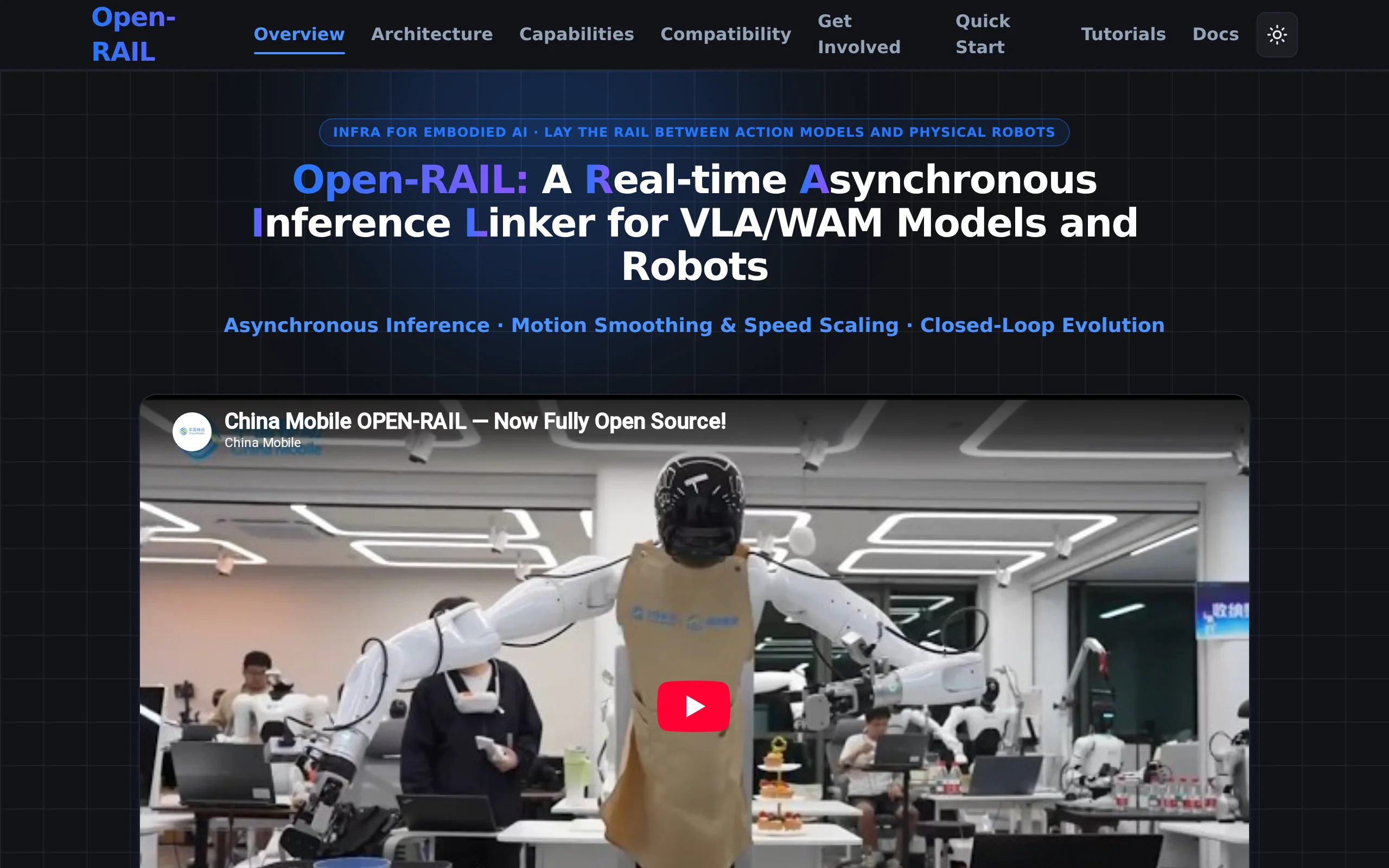
Open-RAIL Evaluation: China Mobile's Open-Source General-Purpose Engineering Foundation for Embodied Intelligence, Bridging the "Last Mile" for VLA/WAM Model Deployment
Open-RAIL is a general-purpose engineering foundation for embodied intelligence that China Mobile has open-sourced globally. It is positioned as the industry's first universal "nervous system" connect...
© All Rights Reserved. Some content on this site is partially generated by AI with human review.