
Review: GLM-5.3-FlashX — Zhipu AI's High-Speed Inference Model, Setting a New Benchmark for Real-Time Interaction at 200 tokens/s
Executive Summary:
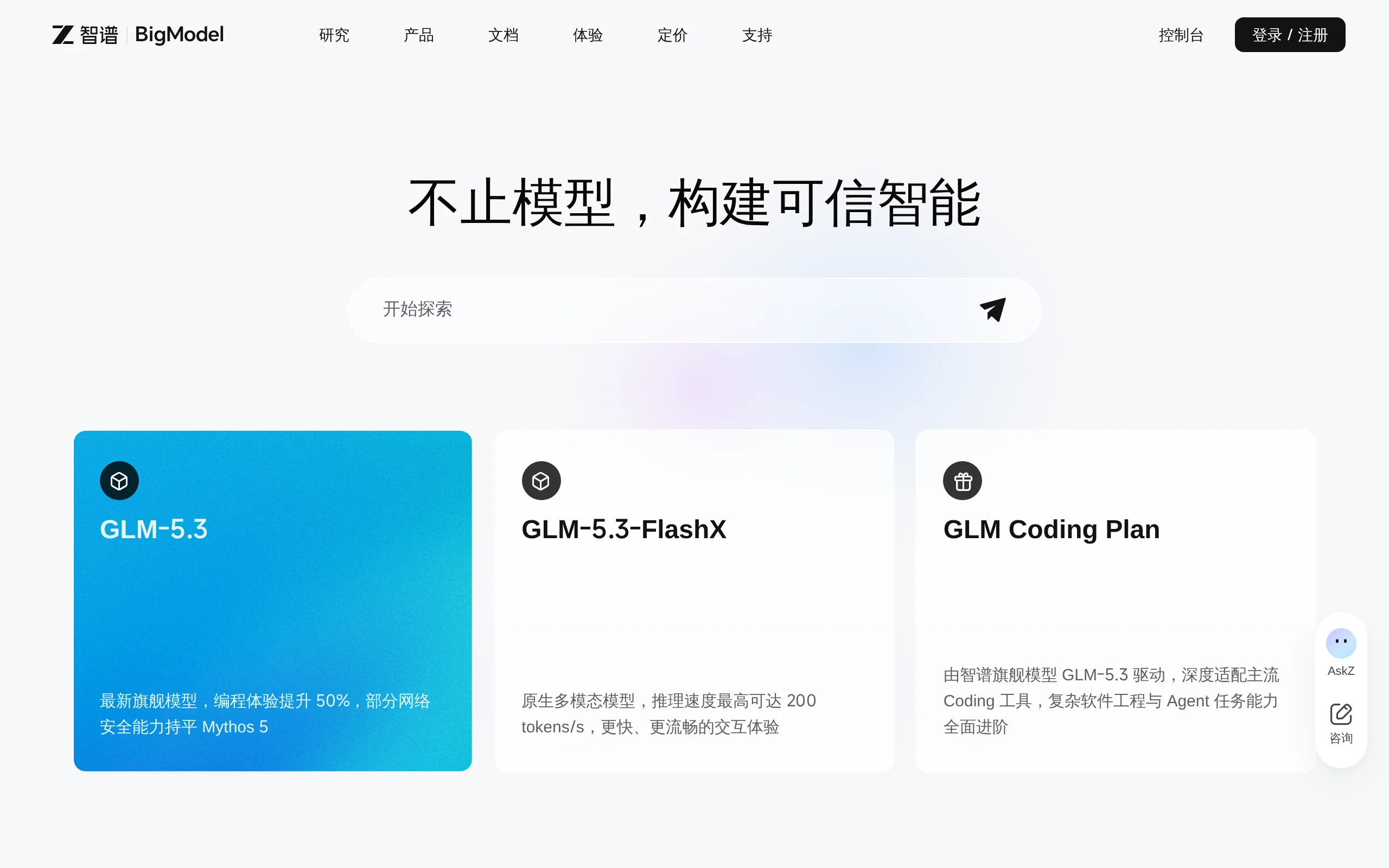
GLM-5.3-FlashX is a high-speed inference model launched by Zhipu AI in 2026, serving as an accelerated upgrade of GLM-5.3-Flash. Its core selling point lies in its maximum output speed of up to 200 to...
1. What is GLM-5.3-FlashX
GLM-5.3-FlashX is a high-speed inference model launched by Zhipu AI in 2026, serving as an accelerated upgrade of GLM-5.3-Flash. Its core selling point lies in its maximum output speed of up to 200 tokens/s, which is 5 times faster than its predecessor, while achieving this at 2.5 times the cost, thereby re-establishing a balance between performance and cost. The model is built on an inference cluster composed of 100,000 domestic chips, and the inference infrastructure was autonomously constructed within two weeks by an Agent driven by GLM-5.3. This process increased the end-to-end throughput to three times the initial baseline, fully demonstrating a new paradigm of AI-driven AI infrastructure development.
Image source: Official article
Image source: official article
Technical positioning and domain: GLM-5.3-FlashX belongs to the large language model inference service in the natural language processing domain, targeting latency-sensitive scenarios that require high-frequency tool calling in real-time interactions. It plays the role of a "high-speed channel" within the GLM product matrix, serving as a cost-effective inference entry point and complementing the flagship model's complete ecosystem.
Development background: As a leading domestic large model enterprise, Zhipu AI has accumulated deep technical expertise in the GLM series. The motivation behind developing FlashX stems from the need to respond to low-latency and high-throughput requirements in real-time interaction and high-frequency Agent calling scenarios. Its unique development path involves using the Agent driven by GLM-5.3 to autonomously build the inference infrastructure, with human engineers only responsible for setting goals and reviewing key changes. The Agent independently completes testing, log analysis, Trace debugging, and code optimization, forming a closed-loop known as "Dense Feedback."
Core value: While this model significantly improves speed, it maintains the intelligence level of similarly sized models. It provides 5 times the speed at 2.5 times the cost, effectively reducing the unit cost of intelligence. The use of domestic chips in the inference cluster ensures supply chain autonomy and controllability, while the Agent-driven infrastructure development model compresses the time traditionally required for human optimization from weeks to just two weeks, greatly shortening the iteration cycle of the inference system.
Technical features: The model achieves a leap in performance optimization at the operator level, for example, the KDA Decode operator's performance has increased to 1.71 times its optimized level. On the technical path, it addresses TF32 precision bias, GIL blocking issues, and optimizes KV Transfer concurrency, achieving a balance between low latency and high throughput. The precision correction results have also been fed back to the upstream Flash Linear Attention, showcasing the open-source and shared nature of its technical solutions.
2. Key Features
High-speed Text Generation: Output speed can reach up to 200 tokens/s, 5 times faster than GLM-5.3-Flash. This performance metric places it among the leading models in its category, meeting the strict low-latency requirements of real-time chat and streaming output scenarios, significantly enhancing user experience.
Dialogue Completion API: Through bigmodel.cn, a standard API is made available. Developers can invoke the interface using a Model Key of
GLM-5.3-FlashX. The API is compatible with OpenAI-style dialogue completion formats, reducing integration costs for developers and enabling quick integration into existing application architectures.Online Experience Center: The Zhipu official website provides a visual trial entry point, allowing users to test model capabilities without deployment or coding. This lowers the evaluation barrier, making it easier for developers to quickly verify model performance and speed, aiding in technical selection decisions.
Real-time Agent Interaction: Thanks to its low-latency characteristics, this model can support high-frequency calls required by Agents. In multi-round cycles involving planning, tool calling, and result integration, the reduction in single-call latency directly decreases the total task time, significantly shortening the completion time for complex tasks.
High Cost-effectiveness Inference: While maintaining the strongest intelligence of the same size, it offers 5 times the speed at 2.5 times the price. This means the inference cost per unit time is actually reduced. For high-frequency calling scenarios with significant computational demands, it enables effective overall cost control.
Domestically Produced Compute Infrastructure: Based on a large-scale inference cluster composed of 100,000 domestic chips, this architecture ensures supply chain autonomy and controllability. While ensuring the security of compute resource supply, continuous optimization on the infrastructure side guarantees high-speed and stable output in large-scale concurrent scenarios.
3. How to Use
Environment Requirements: No local model deployment is required; the model can be used via API calls. Developers need to have the capability to make HTTP requests using Python, JavaScript, or other mainstream programming languages, and ensure that the network can access the API endpoints of Zhipu AI (docs.bigmodel.cn).
Register an Account: Visit the Zhipu AI Open Platform (bigmodel.cn), register and log in to a personal or enterprise account. Enterprise users are recommended to complete enterprise verification to obtain a higher API call quota and more stable service guarantees.
Obtain API Key: After logging in, go to the console and create a new API Key on the API Key management page. Once created, make sure to save it properly. This key is used for request authentication and should be kept confidential, avoiding exposure or submission to public repositories.
Confirm Model Name: When making API calls, you must explicitly specify the model in the request body. The Model Key is
GLM-5.3-FlashX. Please ensure that the API version you are using matches the model name to avoid errors indicating that the model does not exist.Send API Request: Refer to the official dialogue completion API documentation to construct an HTTP POST request. The request body must include the
modelfield (set toGLM-5.3-FlashX), themessagesfield (dialogue history), and other optional parameters such astemperature,max_tokens, etc. After sending the request, wait for a streaming or non-streaming response.Online Experience (Optional): Visit the Zhipu AI Experience Center (bigmodel.cn/trialcenter) to test the model's high-speed generation capabilities without any development work. This is suitable for early-stage solution validation and performance evaluation.
Integrate into Applications: Integrate the API into actual business systems or Agent workflows. It is recommended to use the streaming output mode to fully leverage the speed advantage of 200 tokens/s, and configure appropriate timeout and retry mechanisms to ensure stability and reliability in production environments.
4. Pros and Cons Analysis
| Pros |
|---|
| Ultra-fast Output Performance: Output speed reaches up to 200 tokens/s, 5 times faster than the previous generation. Real-time interaction experiences almost no latency, significantly enhancing user experience and Agent task execution efficiency. |
| Agent-Driven Infrastructure Construction: The inference system is autonomously built by GLM-5.3, completed in less than two weeks, with end-to-end throughput three times the baseline. This self-bootstrapping iterative approach reduces human resource investment and lays the foundation for future continuous optimization. |
| Deep Engineering Optimization: Issues such as TF32 precision bias, GIL blocking, and KDA operator redundancy are resolved. The KDA Decode operator is improved by 1.71 times, demonstrating that technical refinement has reached the operator level. |
| Domestically Produced Computing Infrastructure: Based on a cluster of 100,000 domestic chips, the supply chain is self-controlled, avoiding potential risks from geopolitical factors and technological restrictions, ensuring long-term service stability. |
5. Comparative Analysis with Similar Tools
| Dimension | GLM-5.3-FlashX | DeepSeek-V4-Flash | GPT-4o mini |
|---|---|---|---|
| Output Speed | 200 tokens/s (explicitly stated, key selling point) | No official figures provided, but measured as high throughput | Approximately 150 tokens/s (measured reference value) |
| Price (per million tokens) | Estimated as mid-range at 2.5 times that of Flash (exact price not disclosed) | $0.14 / $0.28 (approx. ¥1 / ¥2), Flash version is the "price屠夫" | $0.15 / $0.60 |
| Cache Hit Price | Not disclosed separately | ¥0.02 / million tokens, further reducing costs for multi-turn conversations | $0.075 / $0.30 |
| Context Length | Long context comparable to Flash series | Supports 1M tokens | 128K tokens |
| Intelligence Level | Claims to be the "most intelligent of the same size," speed does not compromise model capabilities | Distilled from the V4 series, intelligence is slightly lower than the flagship | Designed for lightweight tasks, with weaker performance in complex reasoning |
| Computing Infrastructure | 100,000 domestic chips + Agent built infrastructure in two weeks | Full-stack deep adaptation with domestic chips (including Ascend, Cambricon, etc.) | Global infrastructure from cloud vendors |
Selection Recommendations: If the business scenario primarily involves real-time conversations and high-frequency Agent calls, and cost sensitivity is a priority, the speed advantage of GLM-5.3-FlashX and the supply chain security of the domestic computing infrastructure are worth serious consideration, especially for enterprises with data sovereignty requirements. DeepSeek-V4-Flash offers a more competitive price and cache hit cost, making it suitable for scenarios with extremely tight cost constraints and high proportions of multi-turn conversations.
If prioritizing ecosystem compatibility and global deployment: GPT-4o mini and Claude 3.5 Haiku have mature ecosystems and stable service quality in overseas markets, and they provide more transparent pricing models, facilitating financial calculations. However, their speed performance is relatively conservative, and their performance in certain Chinese-specific scenarios may be inferior to domestic models. It is recommended that teams conduct A/B testing based on actual business traffic, taking into account regional business scope, latency sensitivity, and budget structure, before making a final decision.
6. Editor's Summary
GLM-5.3-FlashX demonstrates the engineering depth of Zhipu AI in optimizing inference performance. From a technical perspective, the model does not merely rely on stacking computational power, but instead elevates end-to-end throughput to three times the initial baseline by enabling the Agent to autonomously build infrastructure. This "AI building AI infrastructure" self-bootstrapping iteration shifts the traditional paradigm of manual tuning in R&D, potentially paving the way for a new direction in large model infrastructure optimization. The meticulous refinement of technical details, such as TF32 precision restoration, elimination of GIL concurrency blocking, and redundancy reduction in KDA operators, reflects a rigorous approach to progressively optimizing the inference pipeline—details that often determine the actual performance gap in production environments.
In terms of practical value, a speed of 200 tokens/s can directly translate into experience advantages in real-time voice interaction, code assistance, and live streaming engagement scenarios. The pricing strategy of "2.5 times the cost for 5 times the speed" effectively optimizes the unit intelligence cost, making the total cost of ownership in high-frequency Agent calling scenarios promising. The computational foundation based on domestic chips also holds strategic value in terms of supply chain security.
This model is suitable for developers and enterprises that are extremely sensitive to latency and require high-frequency model calls, particularly excelling in the fields of AI Agent, real-time content generation, and voice interaction. It also represents a strategic positioning move by Zhipu AI in the "intelligence, price, speed" triangle dilemma—establishing a differentiated barrier through speed.
The future evolution of the model is worth watching: on one hand, if the iterative model of Agent autonomously optimizing infrastructure can continue to operate, the efficiency of infrastructure development will keep improving; on the other hand, the engineering challenges of combining long context support with high speed, as well as the transparency of absolute pricing, still require further clarification from the official side. Overall, GLM-5.3-FlashX is a significant benchmark product in the high-speed inference model market in 2026.
7. Application Scenarios
High-frequency AI Agent Calls: In AI Agent workflows, the model needs to be repeatedly called to complete planning, tool selection, and result integration. Low latency directly reduces the total time required for tasks. For example, a multi-step web navigation Agent can reduce the waiting time for each decision from seconds to sub-seconds, significantly shortening the overall completion time for complex tasks.
Code Assistants and IDE Completion: Programming scenarios require immediate visibility of streaming output. High-speed generation can significantly improve the flow experience for developers. With just half a line of code input, developers can receive near-real-time completion suggestions, reducing interruptions and enhancing coding efficiency.
Real-time Content Generation for Live Streaming and Marketing: Scenarios such as e-commerce live stream scripts, live chat interactions, and real-time hot topic reporting require "output while speaking." During live streaming, responses generated based on real-time chat comments can be delivered within the perceptible delay time for viewers, with a speed of 200 tokens/s ensuring timely presentation.
Voice Interaction and AI Companionship: Voice assistants and emotional companionship applications are highly sensitive to first-character latency and streaming speed. Faster output speed means a more natural conversation rhythm, reducing mechanical and waiting feelings. This is one of the scenarios where speed premium is easiest to achieve commercial value.
8. FAQ
Q: What is the difference between GLM-5.3-FlashX and GLM-5.3-Flash?
A: The core difference lies in the rebalancing of speed and cost. FlashX can output at a maximum speed of 200 tokens/s, which is 5 times faster than Flash, but at 2.5 times the cost. In terms of intelligence, FlashX maintains the same capabilities as the model of the same size, without compromising on intelligence performance. It is a version optimized for speed.
Q: Is local GPU or special hardware required to call the model?
A: No. GLM-5.3-FlashX is provided via the Zhipu AI API, with model inference running on Zhipu's domestic chip inference cluster. Developers only need basic HTTP request capabilities and do not need to concern themselves with hardware configuration, model deployment, or maintenance to access high-speed inference capabilities.
Q: What is the billing model for the API?
A: Officially published information states that FlashX is 2.5 times more expensive than Flash, but the exact absolute pricing has not been disclosed. Developers are advised to visit the pricing page on the Zhipu AI Open Platform to check the latest rates and estimate costs based on actual usage. The pricing for cache hits has not been disclosed separately either.
Q: How can FlashX be integrated into an existing Agent workflow?
A: FlashX's chat completion API can be called within the Agent loop of your application, by setting the model field to GLM-5.3-FlashX. It is recommended to use the streaming output mode to fully leverage its speed advantages, and to set a reasonable timeout threshold based on the complexity of the task. If multiple-round tool calls are involved, historical context can be passed through the messages field to maintain conversation coherence.
Q: Does the model support long context processing?
A: This model supports long context processing comparable to the Flash series. The official team has specifically addressed the issue of error accumulation caused by the default use of TF32 computation for FP32 inputs in the KDA's CP path. It is recommended to explicitly set input_precision="tf32x3" in long context scenarios to ensure stable precision.
9. Project Links
- Product Official Website: https://bigmodel.cn/
- Online Experience Center: https://www.bigmodel.cn/trialcenter/modeltrial/visual?modelCode=glm-5.3-flashx
- Model Open Platform (Model Key Management): https://open.bigmodel.cn/
- Official API Documentation: https://docs.bigmodel.cn/api-reference/
Related AI Model Articles
Review of DeepSeek Harness Desktop: How the Official GUI Client Lowers the Bar for Agent Usage
DeepSeek Harness Desktop is the official graphical client launched by DeepSeek, designed to provide a visual interface for the originally command-line-based DeepSeek Harness framework. After users log...

Step Code – In-Depth Review of StepFun's Open-Source Terminal Programming Agent
Step Code is an open-source terminal programming agent launched by StepFun, licensed under the MIT License, which allows developers to complete the full workflow of code writing, debugging, execution,...
In-Depth Review of Claude Opus 5.5: A Revolution in Programming Efficiency and Safety for Anthropic's Flagship Model
Claude Opus 5.5 is the first flagship model in Anthropic's Claude 5.5 series, launched in June 2026. It is positioned as a high-end AI model designed for enterprise-level agent programming, complex kn...
In-Depth Review of GPT-6 Sol: A Cost-Effective Revolution in OpenAI's Mid-to-High-End Large Model
GPT-6 Sol is a mid-to-high-end large model introduced by OpenAI, derived from the GPT-6 Astra base model. It brings Astra's reasoning, programming, factual accuracy, and Agent capabilities down to a m...
© All Rights Reserved. Some content on this site is partially generated by AI with human review.