
ACE-Ego – Open Embodied Manipulation VLA from ACERobotics and CUHK
Executive Summary:
ACE-Ego is an open one-brain-multi-embodiment manipulation VLA model co-developed by ACERobotics (大晓机器人) and CUHK MMLab. Pretrained on 6.0K+ hours of egocentric human video, it uses camera-space actio...
1. What Is ACE-Ego
ACE-Ego is an open one-brain-multi-embodiment manipulation VLA model co-developed by ACERobotics (大晓机器人) and CUHK MMLab. Pretrained on 6.0K+ hours of egocentric human video, it uses camera-space actions and morphology-conditioned encoding so one model adapts across robot bodies. It sets SOTA on RoboCasa GR1 TableTop at 72.8%, reliably performing complex retail ops like bagging in plastic and packing shoes in boxes—cutting multi-embodiment deployment cost sharply.
Technical positioning and domain: Embodied VLA for robot manipulation. Core innovation: one-brain-multi-embodiment generalization—one pretrained model adapts to different hardware without retraining, addressing costly per-body training. Targets retail, logistics, home service with long-horizon contact-rich tasks; fills open-source gap on complex contact manipulation.
Research background: ACERobotics focuses on retail robotics; CUHK MMLab on vision and robot learning. Retail fulfillment needs many robot models in different stores—per-body training does not scale. Human-centric pretraining from daily egocentric video builds general manipulation representations with less robot demo data.
Core value: Cuts cost and barrier for multi-embodiment deployment. Human-centric pretrain + small robot finetune migrates skills efficiently. Camera-space actions and morphology conditioning let one weight set deploy across UR5, Franka, GR1, etc.—order-of-magnitude lower deploy cost. 72.8% on RoboCasa GR1 TableTop beats π0.5 (37.0%) and GR00T-N1.6 (47.6%) on contact-heavy tasks.
Technical characteristics: Human-centric pretrain on 6.0K+ hours egocentric video plus multi-embodiment robot data; camera-space actions unify prediction in camera frame; morphology conditioning encodes URDF, DOF, etc.; reliability-aware training filters low-confidence actions for safer long-horizon ops.
2. Key Features
One-brain-multi-embodiment: One VLA adapts via morphology interface—register URDF, DOF, camera params, reuse weights without per-robot training. Ideal for retail chains with mixed robot fleets.
Complex manipulation: Long-horizon contact-rich retail tasks—bagging, shoe boxing, shelf organizing—72.8% SOTA on RoboCasa GR1 TableTop with multi-step grasp, push, fold sequences.
Bimanual coordination: 90.62% on RoboTwin 2.0 for dual-arm tasks like unboxing and assembly—camera-space actions unify both end-effector trajectories without extra coordination heuristics.
Human-centric pretrain: 6.0K+ hours egocentric human video plus multi-robot and sim data—general ops representation from human video, few robot demos for transfer, far less robot teleop data needed.
Unified camera-space actions: Predictions in camera frame remove body/view inconsistencies—same action space for UR5, Franka, GR1, simplifying cross-embodiment engineering.
Reliability-aware validation: Confidence scoring in training; inference filters low-confidence actions for safer long retail fulfillment sequences.
Open ecosystem: Weights, training code, inference scripts, paper under Apache 2.0—commercial use and community extension welcome.
3. How to Use
Environment and dependencies: Clone official GitHub repo (link to be updated upon official release). Python 3.10+, PyTorch 2.0+, CUDA 11.8+. A100 or RTX 4090 recommended, ≥24GB VRAM.
pip install -r requirements.txt(torch, transformers, open3d, opencv-python, etc.).Download and load model: Get ACE-Ego weights from GitHub Releases or Hugging Face.
from ace_ego import ACE_Ego; model = ACE_Ego.from_pretrained("ace-ego-base")loads human-pretrained weights for direct inference.Embodiment config and camera calibration: Register URDF, DOF (6/7-axis), end-effector type via morphology interface. Calibrate RGB-D intrinsics and extrinsics. Official toolkit supports RealSense, Kinect, etc.
Inference with reliability: Feed live RGB-D and language (e.g., “put shoes in the box”);
model.infer(rgb_image, depth_image, instruction)returns camera-space end-effector actions (pose + gripper).model.set_reliability_threshold(0.8)filters low-confidence steps. IK converts to joint commands—validate in sim before real hardware.
4. Pros and Cons
| Pros |
|---|
| Leading performance: 72.8% SOTA on RoboCasa GR1 TableTop vs π0.5 37.0% and GR00T-N1.6 47.6% on contact-rich ops. |
| Cross-morphology generalization: One model, many bodies via morphology encoding—big savings for retail chains. |
| Data efficient: Human video pretrain + tens of robot demos often enough for new tasks. |
| Fully open: Apache 2.0 weights, code, paper—commercial OK, community extensions. |
| Reliability module: Filters low-confidence actions—safer long sequences, less error accumulation. |
5. Comparison with Similar Tools
| Dimension | ACE-Ego | π0.5 | GR00T-N1.6 |
|---|---|---|---|
| Publisher | ACERobotics × CUHK MMLab | Physical Intelligence | NVIDIA |
| Architecture | Human-centric VLA, camera-space + morphology | Flow-matching VLA, large multi-body pretrain | Diffusion-policy VLA for humanoids |
| RoboCasa GR1 TableTop | 72.8% (SOTA) | 37.0% | 47.6% |
| Pretrain data | 6.0K+ h human video + multi-robot | Large private robot demos | Large humanoid demos |
| Signature | One-brain-multi-body, reliability | Smooth flow actions, scale | Humanoid whole-body |
| Open source | Full Apache 2.0 | Closed / limited weights | Partial, weights closed |
| Body adaptation | Native one-brain-multi-body | Per-body finetune | Specific humanoids |
Selection guidance: Retail/logistics with multi-body contact ops: ACE-Ego—SOTA, open, one-brain-multi-body. Budget-rich teams wanting closed π0.5 API: good in-distribution ops but weak cross-body. Humanoid research: GR00T-N1.6 for whole-body, weaker retail. RT-2: early VLA, weak on contact, closed—not for production manipulation.
6. Editor's Take
ACE-Ego breaks ground on embodied VLA. Human-centric pretrain + camera-space actions + morphology encoding solves multi-body generalization. vs π0.5’s massive robot data, 6.0K+ hours human video cuts data cost while beating performance (72.8% vs 37.0%)—strong evidence for human video pretrain. Reliability filtering fills a safety gap in open VLAs.
Fully open Apache 2.0 and one-brain-multi-body fit retail chains and warehouses—one weight set, URDF registration per robot. Stable on bagging and shoe boxing—production-ready retail fulfillment potential.
Clear audience: robot companies, embodied AI labs, retail automation integrators. Academics get full pretrain code and benchmarks; industry gets commercial license and workable inference stack.
Core framework (human video + morphology) extends to home service and assembly as community adds bodies and data. Dual-arm generality and hardware bar still need work.
Innovation 5/5, practical value 5/5, open ecosystem 5/5; −0.25 each for hardware requirements and doc gaps.
7. Use Cases
Retail fulfillment: Supermarkets/convenience stores—shelving, bagging, shoe boxing from human-like ops learned from video.
Logistics warehousing: Sorting, packing, palletizing with contact—90.62% bimanual on RoboTwin 2.0 for irregular items; camera-space actions across shelf heights.
Home service: Tidying, organizing, light cleaning—one-brain-multi-body across wheeled and dual-arm home robots.
Commercial service: Malls, hotels, restaurants—natural language (“move vase to windowsill”) for staff-free ops.
Industrial manufacturing: Assembly, tool pick-place, material transfer—reliability module protects long assemblies; few industrial demos finetune per line.
8. FAQ
Q: What hardware is required?
A: A100 or RTX 4090, ≥24GB VRAM, CUDA 11.8+, 16+ CPU cores, 32GB RAM recommended. Real-time control needs <50ms latency—RTX 3060 often insufficient.
Q: Non-retail scenes—home or industrial?
A: Human video includes daily manipulation—reasonable home generalization. Industrial tasks need tens of demo finetunes; official scripts provided.
Q: Where to get human egocentric video?
A: Open release does not include raw video; pretrained weights already encode it. Reproduce pretrain per paper if needed—weights recommended for finetune.
Q: Adapt to my robot?
A: Morphology interface: URDF, DOF, gripper type, cameras. Examples for UR5, Franka Panda, GR1—write URDF and calibrate for new platforms.
Q: Inference speed for real-time control?
A: A100 ~30–50ms/frame; RTX 4090 ~60–80ms. TensorRT/ONNX can help.
Q: vs π0.5 main advantages?
A: One-brain-multi-body (π0.5 per-body finetune), fully open (π0.5 closed), higher retail performance (72.8% vs 37.0%). π0.5 smoother flow actions and larger pretrain for general closed-API use cases.
9. Project Links
Related AI Model Articles
Xiaomi MiMo-V2.6 – Xiaomi's Open-Source Multimodal Model Series
Xiaomi MiMo-V2.6 is a series of fully multimodal models released and open-sourced by Xiaomi, comprising two native full-modal models: Pro and Flash. It is centered on large-scale Agentic reinforcement...
In-Depth Review of Step 5 Preview: A 600B Sparse MoE Flagship with 1M Token Context and 1/8 Cost Advantage
Step 5 Preview is a new-generation flagship foundation model launched by StepFun, designed for real-world Agentic tasks. Based on a sparse MoE architecture, the model has a total of 600B parameters bu...
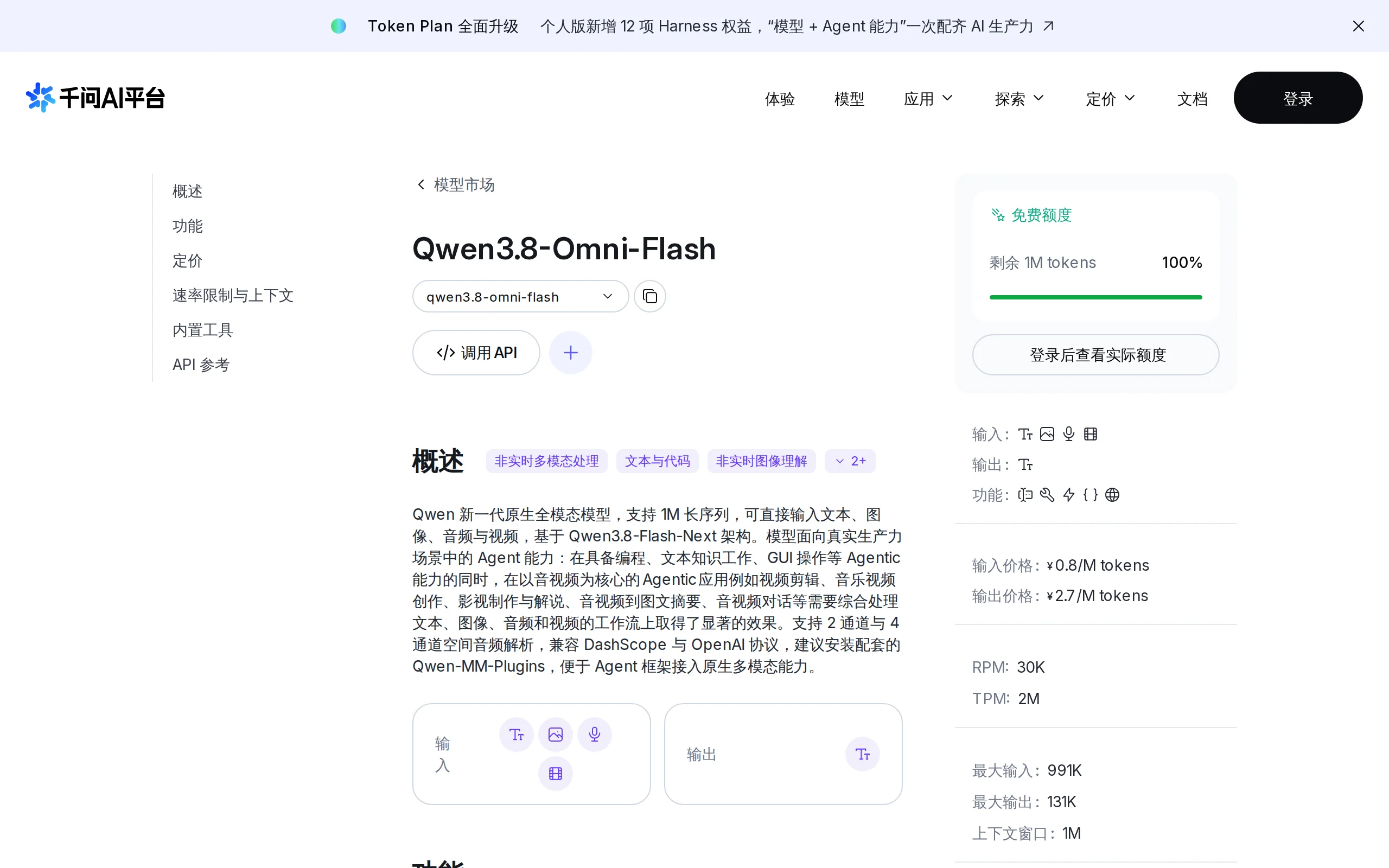
Qwen3.8-Omni-Flash – A Native Multimodal Model Launched by Alibaba Qwen
Qwen3.8-Omni-Flash is a native multimodal model launched by Alibaba Qwen. It jointly models four modalities—text, image, audio, and video—within a single architecture, supporting a context length of u...
Union Alpha – A Mysterious Multimodal Large Model with Unlimited Free Access for a Limited Time
Union Alpha is a multimodal large language model released in "stealth" mode, recently launched on mainstream AI service platforms such as OpenRouter, Cline, and OpenCode. The model supports dual-modal...
© All Rights Reserved. Some content on this site is partially generated by AI with human review.