
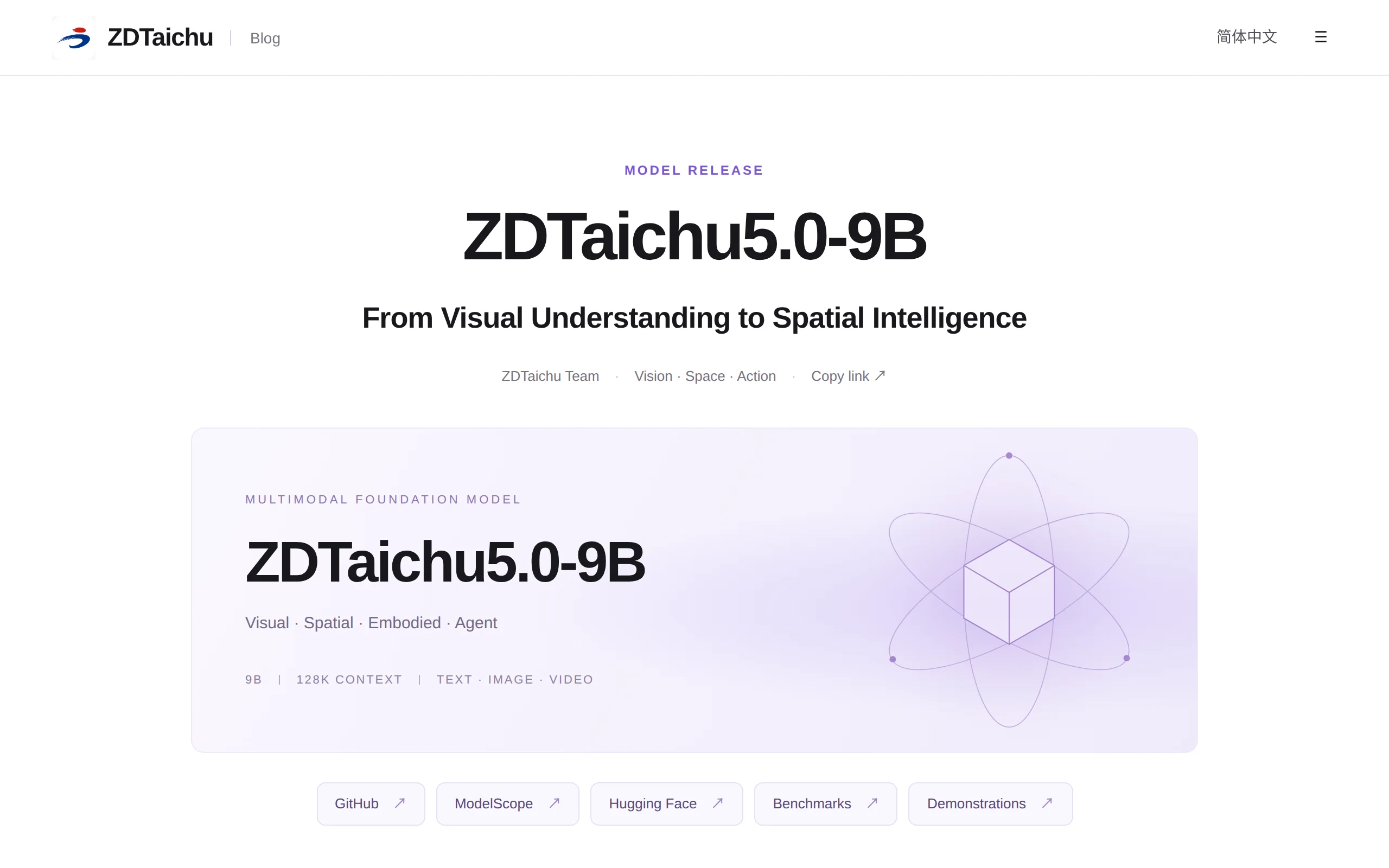
ZDTaichu5.0-9B – A New Generation Open-Source General-Purpose Multimodal Large Model from Taichu-AI
Executive Summary:
ZDTaichu5.0-9B is a new generation general-purpose multimodal large model open-sourced by Taichu-AI, specifically designed for understanding the physical world and embodied intelligence scenarios. The...
1. What is ZDTaichu5.0-9B
ZDTaichu5.0-9B is a new generation general-purpose multimodal large model open-sourced by Taichu-AI, specifically designed for understanding the physical world and embodied intelligence scenarios. The model has achieved first place in 8 out of 9 international spatial benchmark tests within the same parameter category, with a MindCube-tiny score of 78.27, significantly outperforming models of similar scale. At the same time, its general capabilities such as image-text understanding, OCR, mathematical reasoning, and code generation remain in the first tier. The model employs an adaptive cyclic reasoning mechanism, which adds cyclic computations to Tokens with high uncertainty through entropy gating, precisely allocating computational resources to the most challenging parts of the reasoning process without relying on external tools. This model has already been validated in real-world tasks in scientific research and industrial manufacturing, with full openness of weights, data production, and training solutions, supporting developers to perform secondary fine-tuning based on their own scenario data.
Image source: Official article
Image source: official article
Technical positioning and domain: Belongs to the intersection of multimodal large models and embodied intelligence, focusing on physical world understanding and spatial reasoning, providing high-level perception and planning capabilities for physical systems such as robots.
Development background: Developed by the Taichu-AI team, which has deep expertise in the field of domestic large models. The motivation behind the development directly addresses the current shortcomings in spatial reasoning within embodied intelligence applications—traditional multimodal models struggle with tasks such as directional judgment, coordinate localization, and attribute binding, making them inadequate for operational needs in real physical environments.
Core value: Solves the accuracy challenges in spatial understanding and task planning within embodied intelligence scenarios. The model achieves the top performance globally in 8 international spatial benchmarks with the same parameter size, with multiple performance metrics leading Gemini 3 Pro by over 7%. It maintains robust general capabilities in image-text understanding, OCR, mathematics, and code generation, achieving both "superior spatial capabilities" and "balanced general capabilities." Full open-sourcing of weights and training solutions greatly reduces the replication threshold for embodied intelligence research and development.
Technical features: The core innovation lies in entropy-gated adaptive cyclic reasoning—the model detects the uncertainty of each prediction while generating Tokens. When the probability distribution is more dispersed, partial layer block computations are cyclically executed at the corresponding position, iteratively refining internal representations before outputting. This is supported by three stabilization mechanisms: damping update control for adjusting correction magnitude, dual stopping criteria based on KL divergence and hidden state residual, and low-risk representation rollback for multi-round results. Combined with progressive data curriculum and GRPO reinforcement learning, it enables a closed-loop task progression from perception to cognition, action, and feedback.
2. Key Features
Spatial Understanding and Reasoning: Achieved first place in 8 out of 9 international spatial benchmarks with the same parameter configuration, scoring 78.27 with MindCube-tiny, surpassing peer models by over 15 points. It excels at tasks such as reference frame transformation, directional judgment, and target coordinate localization, capable of producing precise spatial descriptions like "upper right front" or "coordinates [237,226]," far outperforming the vague judgments of similar models.
Adaptive Iterative Reasoning: Dynamically assesses the prediction uncertainty of each Token using an entropy gating mechanism—when the probability distribution is more scattered, partial layer block computations are iteratively executed at that position, refining internal representations round by round before outputting results. High certainty positions are directly generated, concentrating computational resources where uncertainty is greatest. This mechanism does not rely on external tools, enhancing reasoning accuracy while controlling average computational costs.
General Multimodal Capabilities: Balanced and top-tier performance in image-text understanding, OCR recognition, mathematical reasoning, and code generation. Scores of 91.48 on AI2D, 85.5 on OCRBench, 89.2 on AIME2026, and 73.4 on LiveCodeBench v6 confirm that the model's enhanced spatial capabilities have not compromised its performance on general tasks.
Embodied Task Planning: As the "high-level brain" of a robot, it is responsible for understanding the environment, remembering object identities, and breaking down task steps. In real-world workbench scenarios, it can identify target objects from dense shelves, determine the grasping location, and after performing the action, look back to verify whether the placement is correct, forming a complete task execution pipeline.
Scientific Experiment Assistance: Integrates simulation computation with wet lab experimental procedures. After receiving a scientific question described in natural language, the model automatically invokes Python/SciPy to compute analytical and numerical solutions, cross-verifies the results, and generates analysis reports. It has been validated in real scientific scenarios for tasks such as sequential test tube placement and pipette liquid transfer across multiple samples.
Long-range Task Closure: The model resolves single-step reasoning internally, while task progression is driven by an external feedback mechanism—after executing each step, it confirms the change in environmental status through new visual input, achieving a continuous feedback loop of "perception—cognition—action—feedback," supporting the execution of complex, multi-step, and multi-object long-range tasks.
Industrial Manufacturing Execution: Covers real-world manufacturing scenarios such as material preparation and delivery, machine loading/unloading, and workbench organization. It can handle practical workbench challenges like dense shelf identification, object occlusion, and preconditions judgment, completing attribute binding, spatial sorting, and target localization.
Fully Open Source and Customizable: Weights, data generation strategies, and training methods are all open. Developers can continuously fine-tune the model using their own scenario data, adapting it to their specific on-site environments and business needs, thereby reducing the customization costs of embodied intelligence applications.
3. How to Use
Environment Requirements: The model has a 9B parameter scale and requires relatively low VRAM, allowing it to be loaded and run on a single consumer or professional-grade GPU. It is recommended that the GPU has at least 16GB of VRAM. The operating system should support Linux (recommended: Ubuntu 20.04+) and Windows. Specific minimum requirements will be announced in the official detailed documentation.
Obtaining Weights: Download the open-source weight files from the HuggingFace model repository (huggingface.co/TaichuAI/ZDTaichu5.0-9B) or the GitHub repository (github.com/Taichu-AI/ZDTaichu5.0-9B). The model weights and training methodology are also open-sourced, allowing access to the full data generation process.
Local Deployment: Load the model onto a single GPU that meets the VRAM requirements. It supports multimodal input—images and text instructions—and can output spatial reasoning results such as orientation judgment, object coordinates, and placement locations. The installation and configuration of the inference framework should follow the official README instructions.
Integration with Robot Systems: Integrate it as a high-level planning module into a robot system, connecting with lower-level control systems such as grasping and navigation. The model is responsible for "understanding the environment—remembering objects—breaking down steps," while the lower-level controller executes specific actions, forming a hierarchical architecture of perception and execution.
Fine-tuning: Use the data generation and training methodology provided with the weights, and continue fine-tuning with your own scenario data. The progressive data curriculum offers a phased training process—pre-training uses image-text pairs, web pages, multi-view videos, and 3D simulation data as a foundation, followed by supervised fine-tuning with real business Q&A and spatial embodiment cases. Finally, long-reasoning samples are used for annealing, combined with GRPO reinforcement learning.
Notes: The internal model loop only handles single-step reasoning; long-term tasks require external visual feedback to confirm environmental status. During training, it is essential to verify the consistency of images, object relationships, and operational constraints in the samples. Reward signals can include automatically verified metrics such as answer accuracy, coordinate hit rate, and format compliance.
4. Pros and Cons Analysis
| Pros |
|---|
| Leading in spatial capabilities: Achieved first place in 8 out of 9 international spatial benchmarks in the general parameter category, with MindCube-tiny outperforming its peers by over 15 points. Multiple performance metrics exceed Gemini 3 Pro by more than 7%, with quantifiable validation of its spatial reasoning abilities. |
| Maintained general capabilities: While enhancing spatial capabilities, general abilities such as image-text understanding (AI2D 91.48), OCR (OCRBench 85.5), mathematics (AIME2026 89.2), and coding (LiveCodeBench v6 73.4) remain in the first tier, achieving both "spatial enhancement" and "general capability preservation." |
| Adaptive recursive reasoning: The entropy-gated mechanism enables the model to perform additional computations only on "uncertain" Tokens, achieving a dynamic balance between inference accuracy and computational cost without relying on external retrieval tools, showcasing an innovative architecture. |
| Fully validated on real hardware: Successfully implemented in real-world tasks in both scientific experiments (test tube operations, pipette transfers) and industrial manufacturing (loading/unloading, workstation organization), not just theoretical models from papers, offering practical deployment reference value. |
| Fully open-source and customizable: Weights, data generation, and training solutions are all open, allowing developers to continuously fine-tune using their own data. It has a high level of open-source availability in the embodied intelligence domain, with a low barrier to reproduction. |
5. Comparative Analysis with Similar Tools
| Comparison Dimension | ZDTaichu5.0-9B (ZiDong TaiChu) | Qwen3.5-9B (Tongyi Qianwen by Alibaba) |
|---|---|---|
| Core Positioning | General-purpose multimodal model oriented toward the physical world, emphasizing spatial embodied reasoning | General-purpose multimodal model, focusing on image-text understanding and application ecosystem |
| MindCube-tiny Score | 78.27 points | 57.60 points (20.67 points behind) |
| Reference Frame Transformation | Correctly answered "upper right," with accurate directional judgment | Reference frame confusion, unable to correctly output direction |
| Attribute Binding + Spatial Ordering | Coordinate [237,226] hits the true value | Coordinate [360,280] points to the wrong box |
| Affordance Reasoning | Coordinate [650,720] falls in the free area, judgment is correct | Coordinate falls in an area that does not meet requirements |
| Spatial Benchmark Performance | 8 items ranked first globally at the same parameter size, leading Gemini 3 Pro by over 7% in multiple areas | No mention of top rankings |
| General Capabilities | AI2D 91.48, OCRBench 85.5, AIME2026 89.2, LiveCodeBench v6 73.4 | Balanced general capabilities, article does not provide specific scores |
| Core Features | Adaptive cyclic reasoning (entropy gating) + fully open training solution | Mature ecosystem, wide application in general scenarios |
| Deployment Method | Open-source weights, local deployment with a single GPU card, supports fine-tuning | Open-source weights, local deployment + cloud services |
| Open Source License | Full openness of weights and training solutions | Open-source weights, training solution not fully open |
| Community Ecosystem | Open-source ecosystem in early stages, accumulating community cases | Active community, rich third-party resources |
Selection Recommendations: For teams working on embodied intelligence and robotics development, ZDTaichu5.0-9B demonstrates measurable advantages in spatial reasoning at the current 9B parameter level, with a MindCube-tiny score over 20 points ahead of its peers. Additionally, its full openness of weights and training solutions makes it suitable for secondary development as a foundational model for spatial perception and task planning. It is recommended for scenarios requiring precise spatial judgment, such as industrial manufacturing and intelligent warehousing.
For teams focused on general-purpose multimodal application development and those requiring a mature ecosystem, Qwen3.5-9B is more established in terms of community resources, peripheral tools, and experience in Chinese scenarios, making it ideal for quickly building general-purpose applications.
For enterprises that prioritize top-tier comprehensive performance and have sufficient budget, Gemini 3 Pro, as a closed-source API, offers leading general capabilities. However, it lacks the ability for local deployment and customization, and there is no direct comparative data for its spatial capabilities under the same parameter size.
6. Editor's Summary
ZDTaichu5.0-9B demonstrates clear technological innovation value in the fields of embodied intelligence and spatial reasoning. Its core contribution lies in implementing an adaptive cyclic reasoning mechanism as an engineering solution—by dynamically assessing uncertainty at the Token level through an entropy gate, and appending cyclic corrections to ambiguous computational positions, it achieves a dynamic balance between reasoning accuracy and computational cost. This mechanism exhibits differentiated characteristics among similar open-source models, while the three stabilization mechanisms (damping updates, dual stopping criteria, low-risk rollback) reflect systematic considerations at the engineering level regarding the reliability of cyclic computations. The practical performance results, which achieved first place in eight out of nine international spatial benchmarks with the same parameters, as well as comparative data showing improvements of over 7% against Gemini 3 Pro, provide quantifiable validation for the model's spatial reasoning capabilities.
In terms of practical value, the model has been validated in real-world tasks within scientific research and industrial manufacturing. The successful execution of scenarios such as test tube operations, pipette transfers, loading/unloading, and workstation organization indicates that it is not merely a theoretical demonstration in academic papers, but a tangible engineering achievement with real deployment reference significance. With a parameter scale of 9B, the model can run on a single GPU card, and full openness of weights, data production, and training solutions provides developers with a complete path for reproduction and customization.
The target audience primarily includes: teams working on embodied intelligence and robotics development, requiring spatial reasoning capabilities as part of high-level planning modules; designers of automation solutions for industrial manufacturing and intelligent warehousing; academic institutions researching spatial intelligence and understanding of the physical world; and application developers who need multimodal models to possess both general and spatial capabilities.
The current open-source ecosystem of the model is still in its growth phase, and the richness of peripheral tools and community cases lags behind leading open-source projects. Long-term tasks also rely on sensor feedback, which requires the integration party to have a complete visual confirmation mechanism. Looking ahead, as community cases accumulate and the derivative toolchain becomes more complete, ZDTaichu5.0-9B is expected to occupy an important position within the open-source ecosystem of embodied intelligence. Its technical approach of adaptive cyclic reasoning also provides a reference implementation path for enhancing spatial capabilities in future larger-scale models.
7. Application Scenarios
Industrial Manufacturing: Covers scenarios such as material preparation and delivery, machine loading/unloading detection, and workstation organization. The model identifies target objects from densely packed shelves, determines the grasping position, and after completing the operation, verifies whether the placement is correct through visual feedback to ensure the quality of each action. It is suitable for precise operational stages on real production lines.
Automation in Scientific Experiments: Acting as the "high-level orchestration brain" of an automated experimental platform, the model performs diverse multi-sample operation procedures such as sequentially placing test tubes and transferring liquids with pipettes. It also tracks the identity, spatial location, and progress of each sample. The model bridges the gap between simulation computing and wet lab experiments, enhancing the level of automation in experimental workflows.
Scientific Computing Assistance: After receiving a scientific problem described in natural language, the model automatically invokes Python/SciPy to compute analytical and numerical solutions, cross-checks the results, and generates an analysis report. It is applicable to research scenarios requiring frequent numerical computation and result verification, reducing the repetitive workload of manually writing computational scripts.
High-Level Robot Planning: As the "brain" of an embodied intelligent system, the model is responsible for understanding the environment, remembering object identities, and breaking down task steps. It collaborates with lower-level control systems such as grasping and navigation to accomplish long-range tasks. The coordinates, orientation, and placement points output by the model can be directly converted into motion instruction parameters for the lower-level systems.
Intelligent Warehousing and Logistics: Handles space-intensive work orders such as "retrieve the second box in the third row," completing attribute binding, spatial sorting, and target localization. The model can address real-world warehouse challenges such as object occlusion and targets moving out of the field of view, ensuring reliable execution through visual confirmation after each step.
8. FAQ
Q: What hardware configuration is required to run ZDTaichu5.0-9B?
A: With 9B parameters, the model has relatively low memory requirements and can be loaded and run on a single consumer-grade or professional GPU. It is recommended that the GPU has at least 16GB of memory. The operating system is recommended to be Linux (Ubuntu 20.04+) or Windows. Specific inference framework configurations and minimum hardware requirements should be referenced from the README document in the official GitHub repository.
Q: How does the entropy gating mechanism work? Does it add significant inference time?
A: The entropy gating mechanism evaluates the uncertainty of predictions at each Token generation step—when the probability distribution is more spread out, the model is less confident about its prediction at that position, and it will repeatedly compute partial layer blocks at that position, iteratively refining internal representations before outputting. For positions with high confidence, the model outputs directly. The increased computational cost is concentrated on low-confidence Tokens, and the overall increase in inference time depends on the proportion of uncertain Tokens in the input, rather than being uniformly increased.
Q: Is the model's long-range task capability fully autonomous?
A: No, it is not fully autonomous. The internal loop only addresses the accuracy of single-step reasoning. The progression of long-range tasks relies on an external feedback mechanism—after each step, the environment state is confirmed through new visual input, forming a closed loop of "perception—cognition—action—feedback." This means that when integrated into a robotic system, a visual confirmation mechanism must be included to ensure the reliability of multi-step task execution.
Q: Can the model be fine-tuned with custom data?
A: Yes. ZDTaichu5.0-9B provides access to weights, data generation, and training schemes, allowing developers to continue fine-tuning using their own scenario data. The official documentation offers a complete progressive data curriculum: pre-training is based on image-text pairs, web pages, multi-perspective videos, and 3D simulation data; during the supervised fine-tuning phase, real business dialogues and spatial embodied cases are fed into the model; finally, long-reasoning samples are used for annealing, combined with GRPO reinforcement learning. During training, it is essential to verify the consistency of images, object relationships, and operational constraints in the samples.
Q: Does the enhancement of spatial capabilities lead to a decline in the model's general abilities?
A: There is no significant decline. According to official data, the model scores 91.48 on AI2D, 85.5 on OCRBench, 89.2 on AIME2026, and 73.4 on LiveCodeBench v6, all maintaining first-tier performance. The improvement in spatial understanding and reasoning capabilities does not come at the expense of general multi-modal abilities, thanks to the progressive data curriculum design. During the supervised fine-tuning phase, both general business dialogues and spatial embodied cases are fed into the model, preventing catastrophic forgetting caused by single-type data. This makes ZDTaichu5.0-9B one of the strongest open-source options for spatial capabilities at the 9B parameter level.
Q: Does the model support commercial use?
A: The model weights, data generation schemes, and training schemes are all open-sourced, allowing developers to use the model in commercial scenarios and fine-tune it with their own scenario data. Specific open-source license types and commercial usage constraints should be confirmed by reviewing the License file in the official GitHub repository.
9. Project Links
- Project Website: https://taichu-ai.github.io/ZDTaichu5.0-9B
- GitHub Repository: https://github.com/Taichu-AI/ZDTaichu5.0-9B
- HuggingFace Model Library: https://huggingface.co/TaichuAI/ZDTaichu5.0-9B
Related AI Model Articles
Xiaomi MiMo-V2.6 – Xiaomi's Open-Source Multimodal Model Series
Xiaomi MiMo-V2.6 is a series of fully multimodal models released and open-sourced by Xiaomi, comprising two native full-modal models: Pro and Flash. It is centered on large-scale Agentic reinforcement...
In-Depth Review of Step 5 Preview: A 600B Sparse MoE Flagship with 1M Token Context and 1/8 Cost Advantage
Step 5 Preview is a new-generation flagship foundation model launched by StepFun, designed for real-world Agentic tasks. Based on a sparse MoE architecture, the model has a total of 600B parameters bu...
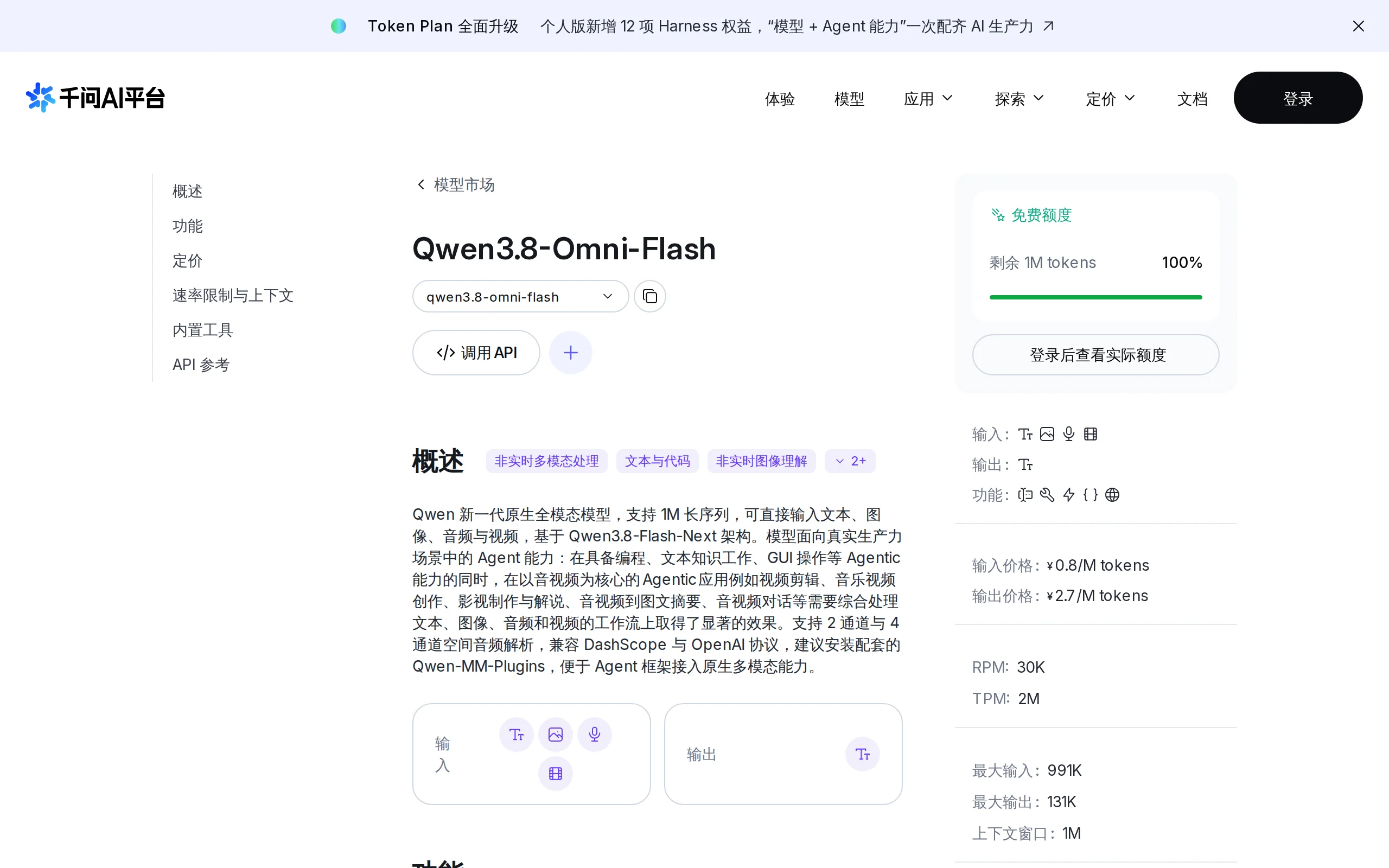
Qwen3.8-Omni-Flash – A Native Multimodal Model Launched by Alibaba Qwen
Qwen3.8-Omni-Flash is a native multimodal model launched by Alibaba Qwen. It jointly models four modalities—text, image, audio, and video—within a single architecture, supporting a context length of u...

Union Alpha – A Mysterious Multimodal Large Model with Unlimited Free Access for a Limited Time
Union Alpha is a multimodal large language model released in "stealth" mode, recently launched on mainstream AI service platforms such as OpenRouter, Cline, and OpenCode. The model supports dual-modal...
© All Rights Reserved. Some content on this site is partially generated by AI with human review.