
Vidu S1 – Real-Time Interactive Video Foundation Model by Shengshu Technology

Executive Summary:
Vidu S1 is a globally leading real-time interactive video foundation model launched by Shengshu Technology, marking the transition of AI video generation from offline batch rendering to real-time bidi...
1. What is Vidu S1
Vidu S1 is a globally leading real-time interactive video foundation model launched by Shengshu Technology, marking the transition of AI video generation from offline batch rendering to real-time bidirectional interaction. Based on an autoregressive diffusion (AR+Diffusion) hybrid architecture, it supports real-time video streaming at 540P resolution and 25FPS (up to 42FPS), and can run on consumer-grade GPUs, significantly lowering the deployment barrier. Users can create a digital character with zero training by simply uploading a single image, and drive the character's expressions, lip sync, gestures, and full-body movements in real time via voice commands, enabling stable interaction of unlimited duration. Vidu S1 features scene awareness, capable of recognizing the number of people and their action states in the camera view and providing real-time feedback. It is widely used in scenarios such as AI companionship, virtual idols, interactive live streaming, and game NPCs, redefining the evolution path of digital humans from static content assets to persistent, intelligent interactive entry points.
Image source: Official article
Image source: official article
Technical Positioning and Domain: Vidu S1 belongs to the intersection of generative AI and real-time interactive systems, specifically positioned as a "real-time interactive video foundation model." It differs from traditional text-to-video or image-to-video tools (e.g., Sora, Runway), which focus on offline video generation. The core of Vidu S1 is the deep integration of video generation with real-time human-computer dialogue, achieving bidirectional interaction that understands, generates, and outputs simultaneously. Its technical approach combines the sequence prediction capability of autoregressive language models with the image generation quality of diffusion models, placing it at the industry forefront in terms of real-time performance, consistency, and interaction depth.
R&D Background: Shengshu Technology is an R&D team focused on multimodal generation and real-time interaction, having previously launched the Vidu series of text-to-video models. The motivation behind Vidu S1 stems from long-standing pain points in the digital human industry: traditional digital humans rely on 3D modeling, motion capture, or pre-set animations, resulting in high production costs, rigid interaction, and an inability to achieve true real-time emotional responses. Shengshu Technology aims to leverage the autoregressive diffusion architecture and efficient inference engine to make AI characters "understand, move accurately, and react quickly" like real people, thereby driving the evolution of digital humans from tool-like assets to intelligent companions.
Core Value: Vidu S1 addresses three key issues: First, real-time performance and unlimited duration—traditional video generation models have limited single-generation duration (typically seconds to minutes) and cannot respond to user commands in real time; Vidu S1 achieves continuous interaction for hours without character degradation through autoregressive frame-by-frame generation + TurboServe streaming scheduling. Second, interaction depth—existing solutions are mostly limited to lip sync; Vidu S1's voice-driven control covers expressions, eye movements, gestures, and full-body posture, truly achieving full-dimensional mapping of semantics and emotions. Third, deployment barrier—it runs on consumer-grade GPUs and allows zero-training character creation from a single image, enabling small teams and individual developers to quickly build real-time digital human applications.
Technical Features: The core technology stack includes the autoregressive diffusion architecture (AR+Diffusion), balancing sequence generation coherence with single-frame image quality; the TurboDiffusion and TurboServe inference engines working in synergy to achieve 540P/25FPS real-time output on consumer-grade GPUs; and a scene awareness module that understands the physical environment via camera input, enabling multimodal interaction beyond voice commands.
2. Key Features
Real-time Bidirectional Video Interaction: Supports real-time conversations with AI characters similar to video calls. While receiving user speech, the model simultaneously understands semantics, generates visuals, and outputs a video stream. Users can interrupt and change instructions at any time, with the model instantly adjusting subsequent frames to deliver a truly lag-free interactive experience.
Voice-Driven Full-Dimensional Behavior: Breaks through the limitations of traditional solutions that only drive lip movements. Voice signals directly control expressions, eye movements, gestures, and complete body motions. The system not only synchronizes lip shapes but also automatically matches corresponding facial muscle movements and body postures based on the emotions in the semantics (e.g., happiness, surprise, anger), significantly enhancing the expressiveness of the digital human.
Unlimited Duration Real-time Generation: Based on an autoregressive diffusion architecture, the model continuously generates video streams through frame-by-frame prediction, theoretically extending indefinitely. During hours of continuous interaction, the character's identity, clothing, hairstyle, and facial features remain consistent, avoiding the common issues of collapse or drift seen in traditional video generation.
540P HD Real-time Quality: Supports real-time output at 960×540 resolution and 25 FPS, reaching up to 42 FPS when hardware conditions permit. The image quality is at a leading level among similar real-time interaction solutions, balancing smoothness and visual clarity to meet the needs of live streaming, video calls, and other scenarios.
Zero-Training Character Creation from a Single Image: Users do not need 3D modeling or specialized training. Simply upload an image (e.g., a real person's photo, anime illustration, cute pet photo), and the model automatically understands the character's appearance and style, creating an interactive digital human within seconds. This feature significantly lowers the barrier to digital human creation.
Customizable Voice: Supports selecting from the system's preset voice library and allows users to record and upload their own voice. The system binds the visual image and voice uniformly, enabling personalized character customization and enhancing the user's emotional engagement.
Scene Perception and Understanding: When the camera is turned on, the model can recognize environmental information such as the number of people in the frame, their action states, and gestures, providing real-time feedback accordingly. For example, when a user waves, the digital human can respond with a waving motion, or adjust the conversation content based on changes in the number of people in the frame, achieving a linkage between the physical world and the virtual character.
Streaming Real-time Response: Utilizes the proprietary TurboServe inference engine for efficient streaming scheduling. Through chunked inference and asynchronous transmission technologies, it ensures end-to-end latency is below the human-perceptible threshold (typically <200ms). Paired with TurboDiffusion model acceleration, it runs stably on consumer-grade GPUs.
3. How to Use
Environment Requirements & Access: Vidu S1 offers multiple access methods. Users can directly open the official website experience page (https://www.vidu.cn/vidu-stream) for web-based interaction, or download the "Vidu AI Pro" mobile app; developers can access it via the API platform (link to be updated after official release). A GPU of RTX 3060 or above is sufficient for smooth real-time generation, with no need for professional servers.
Create a New Character: Click "New Character" on the interaction interface, and upload a first-frame image (supports any image such as real people, anime, cute pets, game characters, etc.). Fill in the character name and description (optional, used to enhance the model's understanding of the character's style). The system will automatically analyze the image features and build a basic digital human model, with no training or waiting required throughout the process.
Configure Voice: After the character is created, proceed to the voice configuration stage. Users can choose from a variety of preset voices in the system (e.g., gentle female voice, steady male voice, etc.), or click "Record Voice" to record their own voice samples. The system will bind the voice to the visual character. After configuration, click Submit, and the character is ready.
Start a Conversation: Select a created character or an official preset character from the character list to enter the real-time interaction interface. The system will request microphone and camera permissions. After the user clicks "Allow" to grant authorization, the digital human will appear on the screen. At this point, the model is in real-time standby mode.
Real-Time Voice Interaction: Directly issue voice commands through the microphone, such as "Introduce yourself," "Tell a joke," "Make a heart shape," etc. The digital human will understand the semantics in real time and simultaneously generate corresponding lip movements, facial expressions, gestures, and full-body motion feedback. During the conversation, you can interrupt and change commands at any time, and the model will seamlessly switch its behavior.
Adjust Commands at Any Time: During the conversation, users can speak new commands at any time (e.g., "Push up your glasses," "Get angry," "Dance"). The model will respond instantly and adjust the subsequent visual content without needing to restart or wait. This interruptible interaction is the core experience that sets Vidu S1 apart from traditional digital human solutions.
Enable Camera for Enhanced Interaction: If you want the digital human to perceive the physical environment, you can turn on the camera. The model will recognize environmental information such as the number of people in the frame and their action states (e.g., raising a hand, walking), and combine this with voice commands to provide richer real-time feedback, such as adjusting the conversation tone based on the number of people in the frame or proactively greeting them.
4. Pros and Cons Analysis
| Pros |
|---|
| Real-time bidirectional interaction: Supports video-call-level real-time conversation, allowing users to interrupt and change instructions at any time, with the model adjusting visuals instantly. The interactive experience far surpasses traditional offline generation solutions. |
| Voice-driven full-dimensional behavior: Voice not only drives lip movements but also understands semantics and emotions, generating matching expressions, eye contact, gestures, and full-body movements in real time. The digital human's expressiveness significantly outperforms solutions that only synchronize lip movements. |
| Unlimited duration stable generation: Based on an autoregressive diffusion architecture, it can generate continuously for hours, maintaining consistent character identity and actions without drift or collapse, solving the consistency challenge of traditional video generation in long sequences. |
| Single-image zero-training character creation: No 3D modeling or specialized training is needed. Upload any image to instantly create an interactive digital human, greatly lowering the creative barrier and making it suitable for individual creators and small teams for rapid prototyping. |
5. Comparison of Similar Tools
| Dimension | Vidu S1 | HeyGen | D-ID |
|---|---|---|---|
| Core Positioning | Real-time interactive video foundation model, emphasizing bidirectional interaction and unlimited duration | AI real-time digital human and video generation platform, focusing on enterprise-level video production | AI digital human and real-time conversational agent platform, focusing on simple interactions |
| Interaction Mode | Video-call-level real-time bidirectional interaction, allowing interruptions and instruction changes at any time | Real-time conversational digital human (Streaming Avatar), but actions are primarily preset | Real-time conversational agent (D-ID Agents), with limited range of motion, mainly head and lip movements |
| Command Response Depth | Voice semantics + emotion-driven full-body behavior (expressions, gaze, gestures, posture) | Primarily responds to conversational text, actions are mainly preset/lip-sync, lacking full-body movement | Primarily responds to conversational content, actions are mainly head and lip movements, with limited gestures |
| Real-time Video Quality | 540P / 25FPS (up to 42FPS) | High-definition output, but real-time interaction frame rate is typically low (<15FPS) | Prioritizes smoothness, real-time resolution is typically below 720P |
| Character Creation | Zero training from a single image, starts in seconds, supports real people/anime/cute pets | Requires uploading video material for training or selecting platform template characters | Upload a single photo, no training required, but the effect is relatively flat |
| Sustained Interaction Capability | Unlimited duration, continuous generation for hours, long-term consistency of character identity | Single real-time session duration is limited (typically <30 minutes), requires re-initialization | Single real-time session duration is limited (typically <20 minutes) |
| Deployment Barrier | Can run locally on consumer-grade GPUs, also accessible via cloud API | Pure cloud SaaS, no local computing power needed, but relies on network | Pure cloud SaaS, no local computing power needed, but relies on network |
| Scenario Focus | AI companionship, game NPCs, interactive live streaming, virtual idols, XR | Enterprise training, marketing videos, cross-border e-commerce customer service | Intelligent customer service, brand marketing, online education |
Selection Recommendations: For scenarios requiring high immersion and long-duration real-time interaction (e.g., AI emotional companionship, interactive live streaming, game NPCs), Vidu S1 is currently the best choice due to its unlimited duration, full-body motion drive, and support for consumer-grade hardware. HeyGen and D-ID are more suitable for enterprise-level lightweight interactions, such as customer service conversations or simple demonstrations, but their action depth and sustained capability are limited. For offline video production (e.g., training videos, marketing shorts), the offline modes of Synthesia and HeyGen offer better cost-effectiveness as they support higher resolutions and more refined editing controls. If developers wish to embed real-time digital humans into their own applications (e.g., metaverse, XR devices), Vidu S1's API platform and local deployment capabilities provide greater flexibility and customization space.
6. Editor's Take
Vidu S1 stands out in technological innovation. The real-time application of the autoregressive diffusion architecture combines the sequence prediction advantages of language models with the image generation quality of diffusion models, resolving the long-standing "consistency vs. real-time" conflict in live video generation. Additionally, the co-optimization of TurboDiffusion and TurboServe enables consumer-grade GPUs to support real-time 540P/25FPS output, a rarity among similar products. From a quantitative perspective, Vidu S1 outperforms mainstream solutions like OmniAvatar and HeyGen on audio-driven digital human evaluation metrics such as CSIM (0.9192) and Sync-D (7.8470), validating the effectiveness of its technical approach.
In terms of practical value, Vidu S1 truly lowers the barrier to creating real-time digital humans. Its three core features—single-image zero-shot training, voice-driven full-dimensional behavior, and unlimited interaction duration—allow individual creators, game developers, live streaming teams, and even educational institutions to quickly build custom digital humans without expensive 3D modeling or motion capture equipment. Compared to competitors like HeyGen and D-ID, Vidu S1 offers a generational advantage in interaction depth and sustained capability, making it especially suitable for scenarios requiring a "human-like" feel, such as emotional companionship and interactive live streaming.
The target audience is clearly defined: technical developers can integrate it into their own products via the API platform; content creators can rapidly generate virtual idols or live-streaming characters; game developers can use it for real-time NPC interactions; and enterprise users can deploy it for brand digital human customer service. However, for professional film production demanding 4K ultra-high-definition quality, Vidu S1's 540P resolution remains a limitation; additionally, control over character details (e.g., precise facial feature adjustments) is not yet on par with 3D modeling solutions.
Future development potential is immense. With hardware iteration (e.g., the proliferation of RTX 50-series GPUs) and model optimization, resolution is expected to improve to real-time 720P or even 1080P output. If scene perception capabilities are enhanced with richer environmental understanding (e.g., object recognition, spatial positioning), applications could further expand into AR/VR and robotic interaction. Should Shengshu Technology open-source model weights or provide more customizable interfaces, it would attract a broader developer ecosystem.
7. Application Scenarios
AI Emotional Companion: Users can transform real-life photos, anime characters, or pet images into virtual companion characters capable of real-time conversation and emotional feedback. The digital human can understand the user's emotional state and provide comfort, encouragement, or casual chat, enabling 24/7 online emotional interaction. This is especially suitable for elderly people living alone, children, or those in need of psychological support.
AI Virtual Idols and Interactive Live Streaming: Virtual streamers can respond in real-time to live chat comments and tipping commands, adjusting their performance movements and expressions based on audience voice input. For example, when a fan shouts "heart gesture," the streamer immediately makes a heart sign; when they shout "dance," the streamer improvises a dance. This creates a truly real-time interactive live streaming experience, significantly boosting audience engagement and tipping conversion rates.
Game NPCs and Role-Playing: Game characters no longer rely on pre-written scripts; they can understand player voice commands in real-time and generate corresponding actions and dialogues. For instance, in an RPG, when a player says "Take me to the weapon shop" to an NPC, the NPC immediately turns around and leads the way while introducing the surroundings. In role-playing games, players can freely converse with AI characters to drive the storyline forward, greatly enhancing immersion and freedom.
Brand Digital Humans and Virtual Customer Service: Enterprises can quickly transform their brand IP into real-time online digital employees for scenarios such as reception, product explanation, and intelligent customer service. The digital human can adjust its response content and expressions in real-time based on the customer's voice questions, providing personalized service, reducing labor costs, and enhancing brand affinity.
Online Education and Intelligent Practice Partners: Historical figures (such as Einstein or Confucius) or subject tutor avatars can be "brought to life" for real-time Q&A and interactive teaching. In language learning, real-time conversation practice partners can be created to simulate real dialogue scenarios, correct pronunciation, and provide instant feedback, thereby improving learning efficiency.
XR/Metaverse Experiences: Provides low-latency, high-frame-rate real-time digital human rendering capabilities for VR/AR devices. For example, in VR social applications, users can engage in real-time conversations and interactions with AI digital humans. The digital human can perceive the user's gestures and gaze direction and respond accordingly, supporting real-time social interaction and virtual meetings within the metaverse.
8. FAQ
Q: What hardware configuration is required for Vidu S1 to run smoothly?
A: The official recommendation is an NVIDIA RTX 3060 or higher consumer-grade GPU (at least 8GB VRAM), which can run smoothly at 540P/25FPS. To achieve up to 42FPS or run multiple characters simultaneously, an RTX 4070 or higher configuration is recommended. CPU requirements are modest (mainstream Intel i5/AMD Ryzen 5 is sufficient), and 16GB or more of RAM is recommended.
Q: What are the requirements for uploaded images? Can the character be modified after creation?
A: Images should be clear front or half-profile photos, supporting any style such as real people, anime, or cute pets, with a resolution no lower than 512×512. After character creation, direct modification of appearance (e.g., changing outfits or adjusting facial features) is not currently supported, but users can upload new images to create new characters. Future versions may offer more detailed editing features.
Q: What languages does Vidu S1 support? How effective is Chinese interaction?
A: Currently, it mainly supports Chinese and English. Chinese interaction has been specially optimized, with good speech recognition accuracy and emotion understanding performance in Mandarin. For users with dialects or heavy accents, recognition accuracy may slightly decrease. English scenarios have also been tested, supporting common accents such as American and British English.
Q: Will there be delays or stuttering in the digital human's movements during real-time interaction?
A: Under the recommended hardware configuration, end-to-end latency is typically within 200ms, almost imperceptible to the human eye. If the network environment is poor (cloud API mode) or GPU load is too high, slight stuttering or frame rate drops may occur. It is recommended to use a wired network connection and close other GPU-intensive programs when running locally.
Q: Can Vidu S1 be used for commercial purposes? Are there copyright restrictions?
A: Vidu S1 offers commercial licensing through its API platform, and enterprise users need to purchase the corresponding package. Individual users can try basic features for free on the official website's experience page, but the copyright of generated video content belongs to the user, provided that the uploaded images do not infringe on others' portrait rights or copyrights. For specific terms, please refer to the official service agreement.
Q: How can Vidu S1 be integrated into my own application?
A: Developers can access the API platform (link to be updated after official release) via API and WebSocket interfaces, supporting real-time video streaming, character management, voice input/output, and other features. The official documentation includes detailed integration guides and sample code, which is currently being continuously updated.
9. Project Address
- Official Experience Page: https://www.vidu.cn/vidu-stream
- API Platform: https://platform.vidu.cn/live/landing
- Technical Report: https://jt-zhang.github.io/files/Vidu_S1.pdf
- Shengshu Technology Official Website: https://www.vidu.cn
Related AI Model Articles
Xiaomi MiMo-V2.6 – Xiaomi's Open-Source Multimodal Model Series
Xiaomi MiMo-V2.6 is a series of fully multimodal models released and open-sourced by Xiaomi, comprising two native full-modal models: Pro and Flash. It is centered on large-scale Agentic reinforcement...
In-Depth Review of Step 5 Preview: A 600B Sparse MoE Flagship with 1M Token Context and 1/8 Cost Advantage
Step 5 Preview is a new-generation flagship foundation model launched by StepFun, designed for real-world Agentic tasks. Based on a sparse MoE architecture, the model has a total of 600B parameters bu...
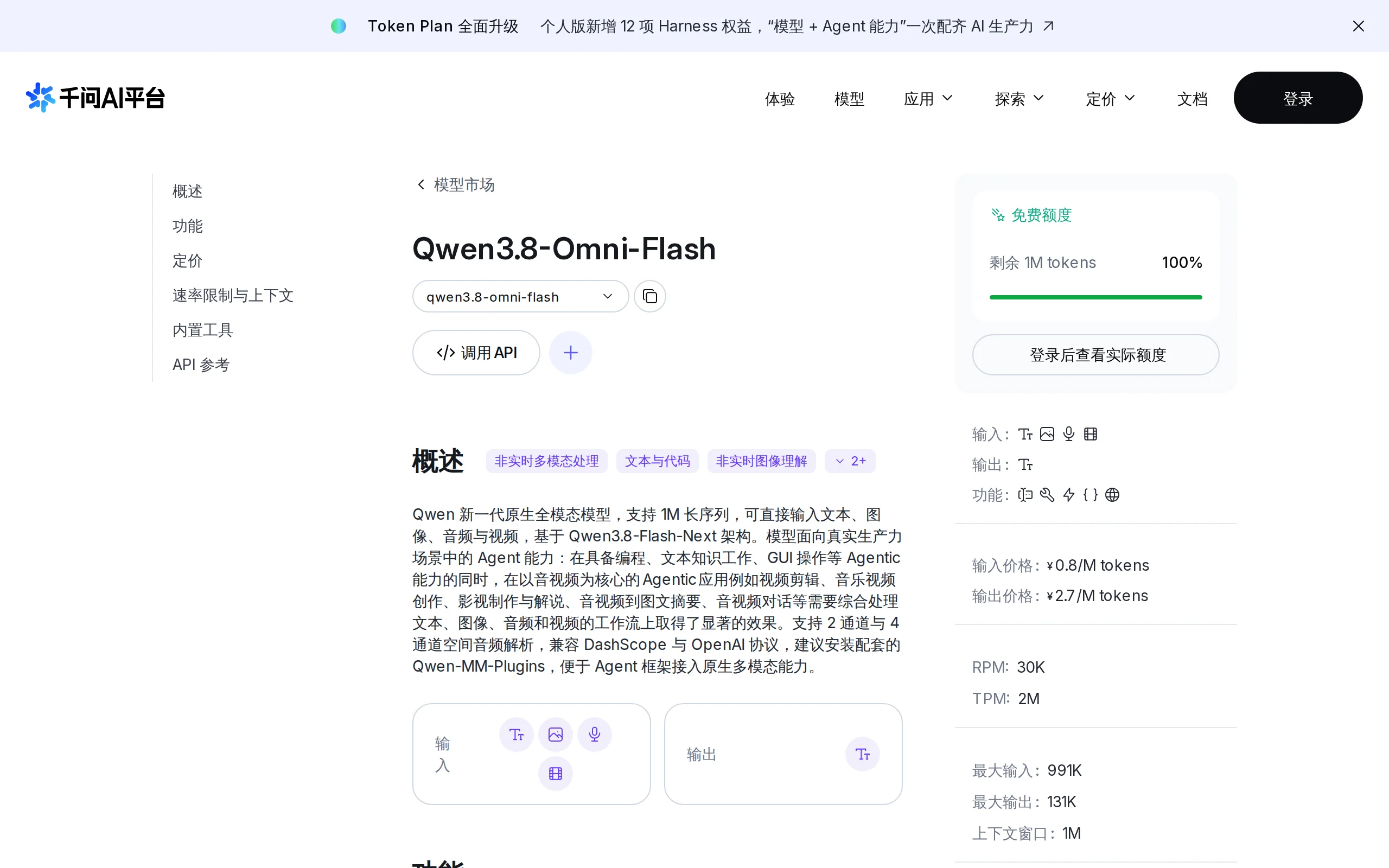
Qwen3.8-Omni-Flash – A Native Multimodal Model Launched by Alibaba Qwen
Qwen3.8-Omni-Flash is a native multimodal model launched by Alibaba Qwen. It jointly models four modalities—text, image, audio, and video—within a single architecture, supporting a context length of u...

Union Alpha – A Mysterious Multimodal Large Model with Unlimited Free Access for a Limited Time
Union Alpha is a multimodal large language model released in "stealth" mode, recently launched on mainstream AI service platforms such as OpenRouter, Cline, and OpenCode. The model supports dual-modal...
© All Rights Reserved. Some content on this site is partially generated by AI with human review.