
VDN-MiniMax-H3 – OpenVDN's Open-Source Video Generation Acceleration Solution

Executive Summary:
VDN-MiniMax-H3 is an open-source video generation acceleration solution developed by the OpenVDN team, based on architectural modifications and deep optimization of the MiniMax-H3 model. This solution...
1. What is VDN-MiniMax-H3
VDN-MiniMax-H3 is an open-source video generation acceleration solution developed by the OpenVDN team, based on architectural modifications and deep optimization of the MiniMax-H3 model. This solution decomposes video attention into a local sliding window Softmax branch and a long-range linear attention branch using a hybrid attention architecture. It also employs DMD2 distillation technology to reduce the denoising steps from 50 to 8. On 8 NVIDIA B200 GPUs, the model can generate a 768p resolution video of approximately 14.4 seconds in just 11.23 seconds, with visual quality nearly indistinguishable from the original 50-step Dense H3 baseline. This achieves significant inference acceleration while maintaining a balance in generation quality.
Image source: Official article
Image source: official article
Technical positioning and domain: This solution lies at the intersection of diffusion model inference acceleration and video generation, focusing on reducing the computational overhead and inference latency of video generation models. It provides a feasible engineering path for real-time generation of high-definition long videos while maintaining visual quality and semantic consistency of the output content.
Development background: Developed and open-sourced by the OpenVDN team, whose members come from research institutions specializing in video generation and efficient inference. The motivation for development stemmed from the high computational cost of full quadratic attention in high-resolution video generation. Based on the MiniMax-H3 model, the team redesigned the architecture to explore an efficient generation approach combining hybrid attention with few-step distillation.
Core value: This solution addresses the issue of excessive generation time caused by a large number of denoising steps and complex attention calculations in video diffusion models. By leveraging a hybrid attention architecture and a three-stage training adaptation, it achieves a 74.5x speedup without significantly compromising visual quality, making rapid generation of high-resolution 768p videos possible and lowering the application barriers of video generation technology in real-time interaction and content creation scenarios.
Technical features: Key innovations include the Video Delta Attention (VDA) mechanism for frame-level joint solving, a bidirectional sliding window design for the local Softmax branch, and a branch-specific parallel strategy that assigns the Softmax and VDA branches to different GPUs.
2. Key Features
Hybrid Attention Architecture: Splits video attention into a local Softmax branch and a long-range linear branch. The former retains fine details using a bidirectional sliding window, while the latter processes long-range context with linear complexity, effectively replacing full quadratic attention and balancing quality and efficiency.
8-Step Rapid Generation: Utilizes DMD2 distillation technology to compress denoising steps from 50 to 8, significantly reducing generation time. It can generate approximately 14.4 seconds of 768p video on 8 NVIDIA B200 GPUs in just 11.23 seconds, achieving a 74.5x speedup compared to the original model.
Near-Lossless Visual Quality: Maintains visual details, subject consistency, and instruction-following capabilities close to the 50-step Dense H3 baseline while enabling rapid generation. It significantly outperforms faster generation solutions like 4-step FastH3, achieving a balance between speed and quality.
Frame-Level Joint Solving (VDA): Upgrades the traditional token-by-token Delta Rule to frame-level joint solving, using normal equations to allow all spatial tokens to jointly determine the new state. This approach is inherently non-expansive and can adaptively capture token correlations, eliminating the need for forced frame size scaling.
Three-Stage Training Adaptation: Implements a three-stage training strategy, including layer-by-layer alignment of the linear branch, end-to-end branch adaptation, and joint fine-tuning of QKVO LoRA. The pre-trained backbone is frozen throughout the process, preventing random initialization from disturbing the pre-trained model and ensuring generation quality remains intact.
Branch-Specific Parallelism: Assigns the Softmax and VDA branches to different GPUs for execution, further reducing latency by 13.3% compared to standard Ulysses parallelism and improving inference efficiency in multi-GPU environments.
Dual-Branch Text Injection: In the Softmax branch, text is globally visible for each frame. In the linear branch, text is written into the bidirectional state once during initialization, avoiding redundant computation and improving the efficiency of text condition injection.
Gating Fusion Mechanism: The two branches produce outputs at different scales, each equipped with content-related Sigmoid gates and independent output projections before being merged. Additionally, the Softmax gate is frozen during the first two training stages to prevent the optimizer from reducing the original branch's contribution to minimize loss.
3. How to Use
Environment Setup: After cloning the GitHub repository, create a Python 3.12 environment and install PyTorch 2.13.0 along with the project dependencies. It is recommended to use a Linux operating system with an NVIDIA GPU that supports CUDA for optimal inference performance.
Download the Model: Download the OpenVDN/vdn-minimax-h3 weights from ModelScope or HuggingFace to the local
ckptsdirectory. Make sure the downloaded model weight files are complete to avoid inference failures due to missing files.Run the Official Example: Execute the
scripts/inference/8nfe_tuned_fp8.shscript to generate example videos using a single GPU. This script includes an 8-step FP8 inference configuration, suitable for quickly verifying the model's performance.Multi-GPU Inference: Choose either the
8nfe_tuned_fp8_ulysses_h200.shor8nfe_tuned_fp8_b200.shscript based on your hardware environment to run on 8 GPUs. The multi-GPU configuration uses branch-specific parallelism, assigning the Softmax and VDA branches to different GPUs. Ensure normal communication between GPUs.Custom Prompts: Use the
encode_prompt.pyscript to call Qwen3-VL-32B and encode text into a.ptfeature file, then pass it toinfer.pyto generate custom videos. Flexible adjustment of prompts is supported to produce personalized content.
Best Practices: When using the model for the first time, verify the correctness of your environment configuration with the official example script. For large-scale generation tasks, prioritize multi-GPU inference to reduce waiting time. When creating custom prompts, refer to the text format used in the official examples to ensure stable generation results.
4. Pros and Cons Analysis
| Pros |
|---|
| Ultra-fast generation performance: With 8-step distillation combined with a hybrid attention architecture, it generates 14.4 seconds of 768p video in 11.23 seconds on 8 B200 GPUs, accelerating the original model by 74.5 times and significantly improving production efficiency. |
| Near-lossless visual quality: Visual details, subject consistency, and instruction-following capabilities are close to the 50-step Dense H3 baseline, significantly outperforming the 4-step FastH3, thus balancing speed and quality. |
| Hybrid attention innovation: Local Softmax preserves fine details, while long-range linear attention handles contextual relationships, and frame-level joint solving of VDA naturally avoids token expansion and adapts token relevance. |
| Staged smooth adaptation: The three-stage training strategy freezes the pre-trained backbone throughout the process, avoiding disturbances from random initialization and ensuring generation quality remains intact, with mature engineering implementation. |
5. Comparative Analysis with Similar Tools
| Comparison Dimension | VDN-MiniMax-H3 | Sparse VideoGen2 (SVG2) |
|---|---|---|
| Core Idea | Replaces full attention with hybrid attention (local Softmax + long-range linear VDA) + few-step distillation | Training-agnostic sparse attention framework, identifies key tokens through semantic-aware permutation |
| Technical Approach | Architecture modification + three-stage training adaptation + 8-step DMD2 distillation | Semantic k-means clustering + top-p dynamic budget control + custom sparse attention kernel, zero training required |
| Acceleration Effect | 74.5× (compared to single GPU Dense H3 baseline), 10.7× (compared to 8 GPU baseline) | 2.30× (HunyuanVideo), 1.89× (Wan 2.1) |
| Generation Speed | 11.23 seconds to generate 768p video (8×B200, 8 NFE) | Approximately 13 minutes to generate 5-second video (H100, after sparsification) |
| Visual Quality | Almost lossless, with visual details and instruction-following performance close to 50-step Dense H3 | PSNR up to 30 (HunyuanVideo) / 26 (Wan 2.1), better than other methods with the same sparsity rate |
| Applicable Models | Specifically designed for MiniMax H3 modification | General framework, plug-and-play for DiT models such as HunyuanVideo and Wan 2.1 |
| Training Cost | Requires three-stage training (layer-by-layer alignment → end-to-end adaptation → LoRA joint fine-tuning) | Zero training cost, directly applied to pre-trained model inference |
Selection Recommendations: If the primary requirement is to achieve maximum acceleration on the MiniMax H3 model while maintaining high visual quality, VDN-MiniMax-H3 is the optimal choice. Its 74.5× speedup and nearly lossless visual quality make it suitable for high-quality video generation scenarios with strict response latency requirements. However, if compatibility with multiple video generation models (such as HunyuanVideo and Wan 2.1) is needed, SVG2's generality and zero training cost provide a more advantageous solution, ideal for rapid integration as a cross-model acceleration layer. For scenarios with limited inference resources and higher tolerance for visual quality degradation, FastH3's 4-step sampling can serve as a lightweight alternative.
6. Editor's Summary
VDN-MiniMax-H3 demonstrates a combination of technological innovation and engineering completeness in the field of video generation acceleration. From a technical perspective, its hybrid attention architecture design is motivated by the need to retain details using local Softmax and handle long-range context with linear attention, rather than simply stacking optimization techniques. The Video Delta Attention at the frame level, introduced as a key technical contribution in this open-source release, achieves joint optimization per frame through the normal equation, naturally non-expanding and adaptive to token relevance, thereby avoiding the cumulative error issues associated with traditional token-by-token updates. The three-stage training adaptation strategy also reflects engineering rigor, employing a progressive approach that includes layer-by-layer alignment, end-to-end adaptation, and joint fine-tuning with LoRA to ensure the pre-trained model's capabilities remain intact. This provides a reusable methodology for future architectural modifications.
In terms of practical value, the speed of generating a 768p video of 14.4 seconds in just 11.23 seconds has reached near real-time interaction levels, significantly reducing the time cost of video generation by a factor of 74.5 compared to the original model. For scenarios sensitive to iteration speed, such as real-time interactive creation, bulk production of advertising materials, and film previsualization, this solution offers substantial efficiency improvements. Meanwhile, the near-lossless visual quality ensures the usability of the output content in terms of visual details, subject consistency, and instruction-following, meeting the dual demands of speed and quality.
In terms of target users, this solution is suitable for researchers and engineers with a solid foundation in deep learning. They should be familiar with Python environment configuration, understand the model inference process, and have access to multi-GPU resources to fully leverage the acceleration performance. As the project is still in its early stages, documentation and community support are relatively limited, requiring users to have the ability to independently troubleshoot issues.
In terms of potential for development, VDN-MiniMax-H3 validates a feasible path combining hybrid attention mechanisms with few-step distillation. Its staged training adaptation and branch-specific parallel design concepts can serve as references for acceleration optimization in similar video generation models. As the project community continues to grow and more model architectures are adapted, this technical approach holds ongoing potential for evolution in the field of video generation efficiency optimization.
7. Application Scenarios
Real-time Interactive Video Creation: The 8-step rapid generation enables creators to adjust prompts in real-time and instantly preview generated results, significantly shortening the creative iteration cycle. It is ideal for individual creators and design teams that frequently explore different creative directions.
Bulk Production of Advertising and Marketing Materials: E-commerce platforms and brands can quickly generate multiple versions of product showcase videos and dynamic posters, meeting the high-frequency content demands of holiday promotions and new product launches, achieving large-scale content production at a low cost.
Film Previsualization and Dynamic Storyboarding: Directors and production teams can rapidly generate storyboard animations before formal filming, validating visual language, scene composition, and narrative pacing, aiding in filming decisions and reducing time and financial costs in pre-production.
Dynamic Content Generation for Games: Real-time generation of NPC animations, environmental cutscenes, and personalized story segments for open-world games or virtual social platforms enhances the dynamic expressiveness of the game world and improves player immersion.
Industrialized Production of Short-form Social Media Content: MCN organizations and self-media creators can produce short-form content such as narrative clips and virtual character Vlogs at low cost and high concurrency, achieving standardization and large-scale operations in content production.
8. FAQ
Q: How much of a difference is there in generation quality between VDN-MiniMax-H3 and the original MiniMax-H3?
A: According to evaluation data from the OpenVDN team, after undergoing 8-step distillation and hybrid attention modification, the generated videos in terms of visual details, subject consistency, and instruction-following capabilities are close to the 50-step Dense H3 baseline. Although there are minor quality differences, they significantly outperform faster sampling methods like 4-step FastH3, with the difference being almost imperceptible in practical applications.
Q: Can consumer-grade GPUs run VDN-MiniMax-H3?
A: Yes, they can run. The official team provides a single-card inference script (8nfe_tuned_fp8.sh), which can generate example videos on a single NVIDIA GPU that supports FP8. However, it is important to note that consumer-grade GPUs have limited VRAM and computational power, so generating high-resolution, long-duration videos will result in a noticeable slowdown and may encounter VRAM limitations. A multi-card parallel setup (e.g., an 8-card B200 configuration) is recommended to fully leverage the model's peak performance.
Q: How can I configure custom prompts for VDN-MiniMax-H3?
A: You need to use the encode_prompt.py script provided by the project. This script uses the Qwen3-VL-32B model to encode text prompts into .pt feature files, which are then passed to infer.py for video generation. This process ensures that the text feature encoding aligns with the fine-tuning method of the pre-trained model, resulting in stable generation outcomes.
Q: Can VDN-MiniMax-H3 perform video editing or local modifications during the generation process?
A: The current version is primarily designed for generating complete videos directly from text prompts and does not support targeted editing or modification of specific regions in already generated videos. For users requiring fine-grained video editing capabilities, it is recommended to combine this model with other video editing tools or models.
Q: Is the training data for VDN-MiniMax-H3 publicly available?
A: The OpenVDN team has currently open-sourced the inference code, model weights, and related configuration files, but has not made the specific datasets used during the training phase public. For users who wish to perform fine-tuning or secondary development on their own data, it is recommended to refer to the project documentation and the description of the three-stage training adaptation, and prepare aligned data for experimentation on their own.
Q: How can I integrate VDN-MiniMax-H3 into my own application?
A: Integration can be achieved by loading the officially released model weights and calling the inference interface provided by the project. The project code is implemented using PyTorch and supports standard model loading and inference workflows. Additionally, an FP8 quantized version is provided to reduce VRAM usage. It is recommended to refer to the official example scripts for environment configuration and validation of the calling process.
9. Project Links
- Project Website: https://openvdn.github.io/
- GitHub Repository: https://github.com/OpenVDN/vdn-minimax-h3
- HuggingFace Model Library: https://huggingface.co/OpenVDN/vdn-minimax-h3
- ModelScope Model Library: https://modelscope.cn/models/OpenVDN/vdn-minimax-h3
Related AI Model Articles

Kimu: In-Depth Review of the Open-Source AI Video Editor from the trykimu Team
Kimu (officially named Kimu Studio) is an open-source AI video editor developed by the trykimu team. Its core concept lies in describing requirements through natural language, allowing AI to automatic...

Qwen-Audio-3.1: A Full-Stack Evaluation of the Qwen Audio Large Model Series
Qwen-Audio-3.1 is a series of large audio models launched by Alibaba's Qwen. It consists of five models: ASR speech recognition, ASR-Next audio understanding, TTS speech synthesis, TTS-Next audio crea...

Qwen3.8-LiveTranslate – A Real-Time Simultaneous Interpretation Model Launched by Alibaba Tongyi
Qwen3.8-LiveTranslate is a real-time simultaneous interpretation large model launched by the Tongyi Qianwen team at Alibaba. Based on the Interleave single-stream architecture, it processes audio and ...
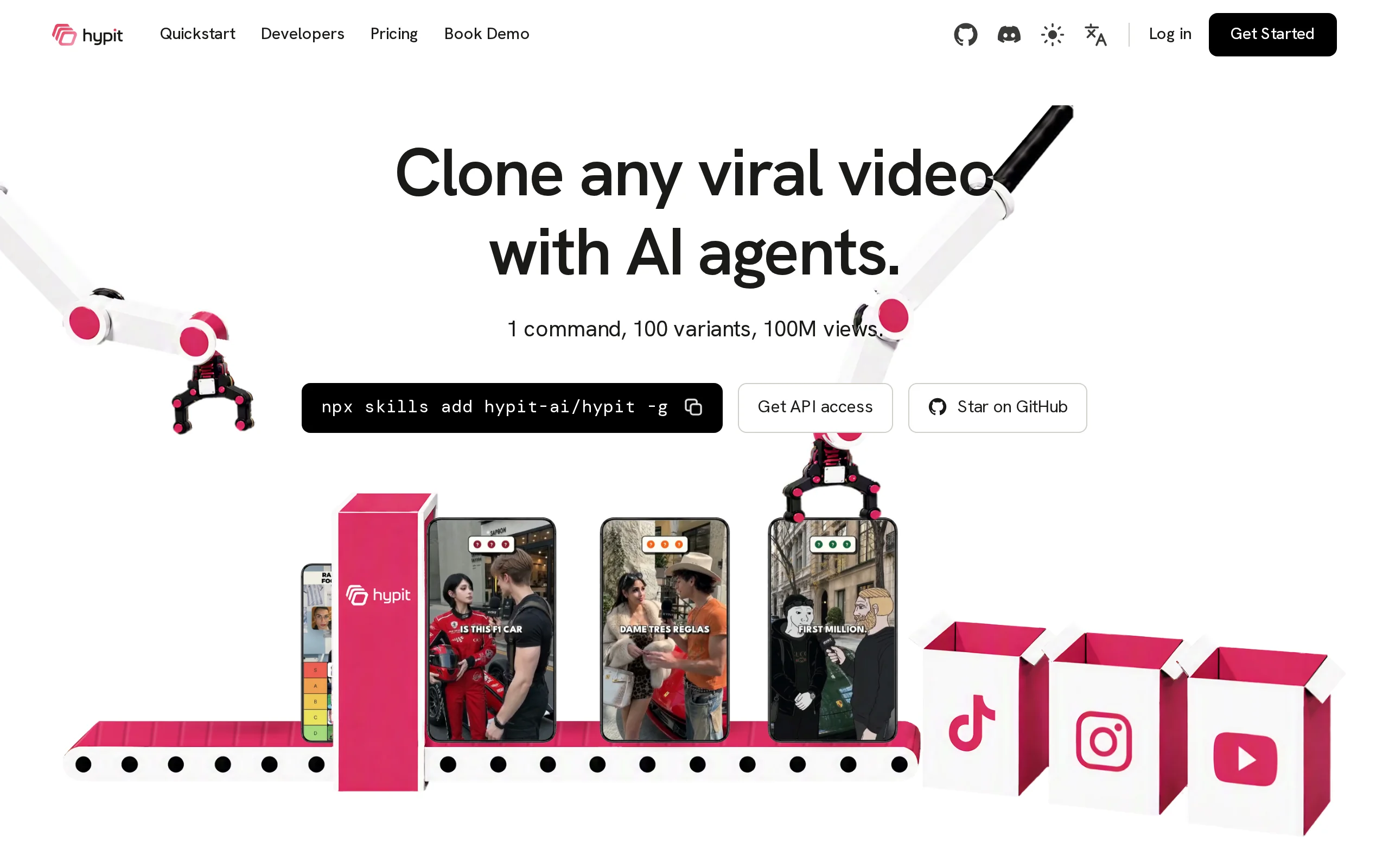
Hypit – Open-Source AI Video Generation Tool, Automatically Replicates Viral Videos
Hypit is an open-source AI video generation tool, centered on the methodology of "Provide an Agent with a viral video, and it will automatically replicate the entire workflow." It breaks down viral vi...
© All Rights Reserved. Some content on this site is partially generated by AI with human review.