
TACO – Open-Source Self-Evolving Observation Compression for Terminal Agents
Executive Summary:
TACO is an open-source self-evolving observation compression framework for terminal agents, developed jointly by the University of Manchester, Beihang University, HKUST, and the MAP team. It addresses...
1. What Is TACO
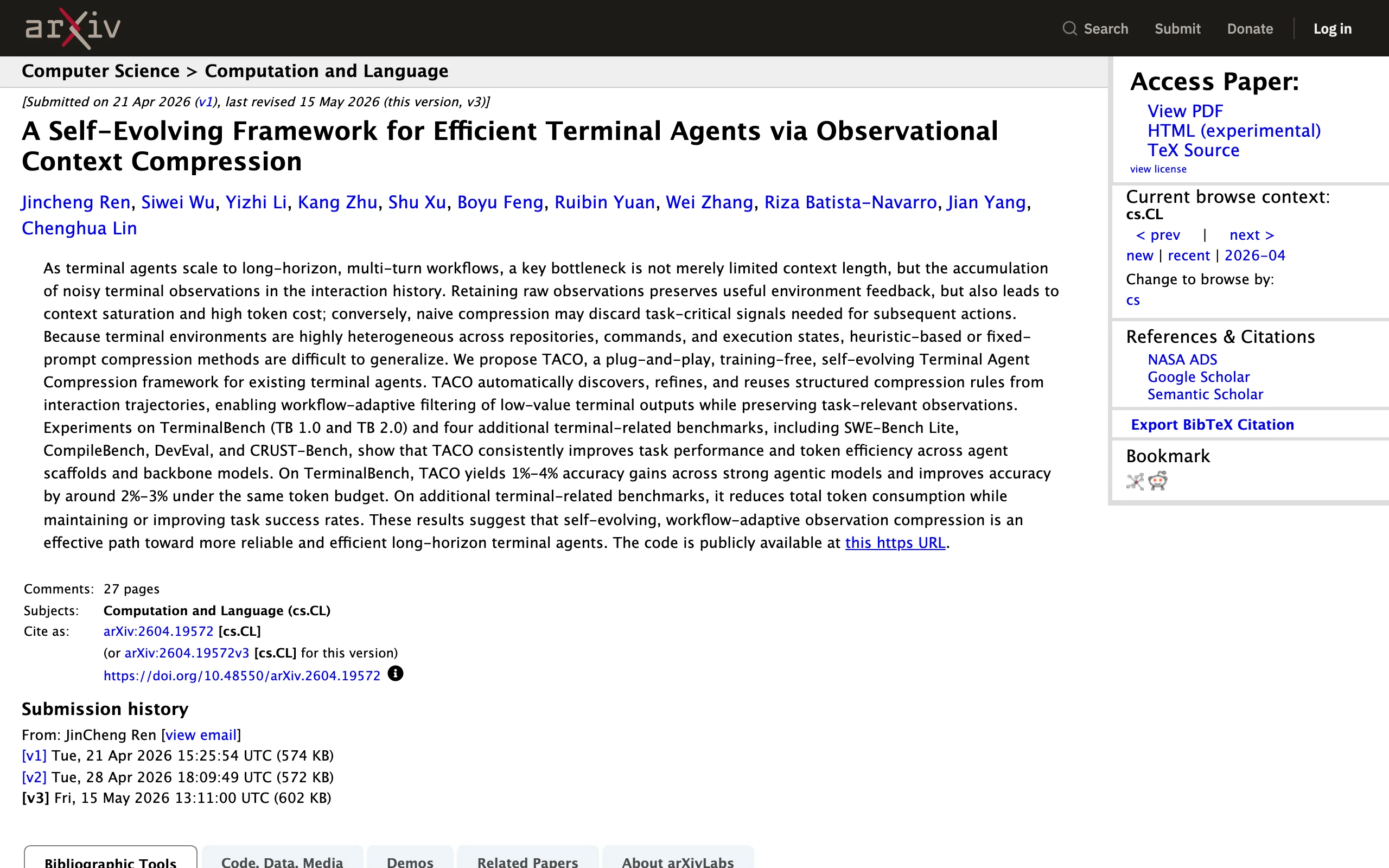
TACO is an open-source self-evolving observation compression framework for terminal agents, developed jointly by the University of Manchester, Beihang University, HKUST, and the MAP team. It addresses context bloat from accumulated shell output noise in multi-turn CLI tasks—without training, plug-and-play. It automatically discovers and reuses compression rules from terminal interaction traces, preserving critical errors while filtering redundant logs, significantly reducing token use on long-horizon tasks. Integrated into Harbor's terminus-2 component, TACO delivers 1%–4% accuracy gains on TerminalBench for models such as DeepSeek-V3.2 and Qwen3.
Image source: Official article
Technical positioning and domain: TACO sits at the intersection of NLP and agent systems, focused on context management for terminal agents. Unlike generic text compression or summarization, it is a structured observation compression framework for multi-turn command-line interaction, using rule discovery and refinement for dynamic context control.
Development background: A cross-university team with depth in agents, NLP, and software engineering. The pain point: shell noise grows with turns, flooding the context window with low-value tokens, raising cost and losing critical error signals. Prior approaches relied on hand-written rules or long-context models—ill-suited to dynamic terminal environments.
Core value: TACO breaks the cycle of output inflation → context pollution → degraded performance. Self-evolving rule discovery identifies redundancy patterns and generates compression rules without manual work. A global rule pool enables cross-task transfer so agents accumulate compression experience over time—"smarter with use." That cuts token cost and improves accuracy, providing key infrastructure for scaling terminal agents.
Technical characteristics: Three modules—rule discoverer, rule refiner, global rule pool—evolve compression online. It embeds as a plugin in existing terminal agents with no model architecture changes or fine-tuning—truly plug-and-play. The innovation is turning compression from static rules into dynamic self-evolution that adapts to changing terminal output.
2. Key Features
Self-evolving rule discovery: Scans raw shell output across multi-turn traces, detects redundancy patterns, and generates candidate compression rules. Unlike fixed prompts or heuristics, the discoverer dynamically targets system logs, progress bars, repeated status output, and similar noise—zero manual intervention.
Online rule refinement: Iterates rule boundaries from live task feedback, fixing over-compression or missed critical signals. The refiner monitors whether compressed output harms execution and adjusts parameters when errors are dropped or noise remains.
Global rule pool and cross-task transfer: A persistent global knowledge base lets new tasks load rules validated in prior sessions. Compression learned debugging one repo applies immediately to another—cross-task, cross-session accumulation for faster long-horizon startup.
Plug-and-play, no training: Embeds in terminal agents (e.g., Harbor terminus-2) via CLI flags for compression and self-evolution. No architecture changes, fine-tuning, or training—enable with launch parameters.
Token efficiency and performance: Filters low-value terminal noise while keeping critical environment feedback, keeping multi-turn token growth linear and controlled. On TerminalBench, TACO improves MiniMax-M2.5, DeepSeek-V3.2, Qwen3-Coder-480B by 1%–4%, with ~2%–3% more under the same token budget—cost and quality together.
Dynamic evolution: Compression is not fixed. Each turn matches the global pool first; uncovered long output triggers new discovery; validated rules merge into the pool. An external planner LLM drives the flow—no training data or model fine-tuning required.
3. How to Use
Install: Clone the GitHub repo, run
pip install -e .at the project root. TACO works via Harbor terminus-2—install Harbor too. Python 3.8+; Linux recommended; Windows via WSL.Quick start: Run Harbor with terminus-2 agent and TACO parameters. Use
scripts/run_taco_example.shas a template—swap model API URL and key. Start with defaults, then tune.Core parameters: Via
--akprefix:enable_compress=True,enable_self_evo=True. Setcompress_base_url,compress_api_key,compress_model_nameto any OpenAI-compatible planner LLM (DeepSeek-V3.2 or Qwen3-Coder-480B recommended).Modes: Full experience needs compression + self-evolution + external LLM.
freeze_rules=Truefor fixed-rule ablations;disable_global_evo=Truefor single-task local evolution without the global pool. Production should keep the global pool enabled.Run control:
--ak max_turns=200caps turns. Passmodel_infoJSON for LiteLLM input/output token limits, e.g.{"max_input_tokens": 32768, "max_output_tokens": 4096}. SWE-Bench-style tasks: 200–300 turns; simple ops: ~50.Best practices: Validate on a small test set first. If critical errors are dropped, tune refiner sensitivity or planner context length. Back up the global rule pool when migrating environments.
4. Pros and Cons
| Pros |
|---|
| Plug-and-play, zero training: Enable compression and self-evolution via CLI—no fine-tuning or agent rearchitecture—very low integration cost. |
| Self-evolution and cross-task transfer: Global pool accumulates compression experience; new tasks inherit prior knowledge—"smarter with use." |
| Performance and cost win: 1%–4% accuracy gains on TerminalBench plus ~2%–3% under same token budget, with lower total token use. |
| Strong generalization, lower consumption: Maintains or improves success on SWE-Bench Lite, CompileBench, DevEval, CRUST-Bench while cutting tokens—robust and general. |
5. Comparison with Similar Tools
| Dimension | TACO | SWE-agent | OpenHands |
|---|---|---|---|
| Context handling | Self-evolving rule compression; global pool cross-task reuse | Full raw terminal output; no smart compression | Long context or custom prompts |
| Training | No training; plug-and-play | No training; Docker setup | No training; sandbox/runtime |
| Cross-task transfer | Global rule pool across repos/sessions | Per-task isolation; no inherited knowledge | Multi-task but no structured rule reuse |
| Token efficiency | Explicit noise filtering; linear long-horizon cost | Raw refill → quadratic token growth | High token use; easy context ceiling |
| Open integration | Open source; deep Harbor integration | Open source; mature community | Open source; general agent platform |
| Deploy complexity | Low—Python deps + LLM endpoint | Medium—Docker and environment | High—sandbox, runtime, network |
Selection advice: For maximum token efficiency and cross-task knowledge, TACO is best—especially SWE-Bench-scale software engineering. Self-evolving rules improve with sustained use—ideal for long-running production. Simple terminal tasks or low complexity favor SWE-agent's mature ecosystem. OpenHands works if context cost is acceptable. CodeActAgent suits deep customization and fine-tuning at higher deploy cost.
6. Editor's Take
TACO's self-evolving rule discovery is a meaningful advance for terminal agents. Unlike fixed rules or raw long context, compression becomes a dynamic system that learns and adapts—meta-learning and online learning applied to CLI agents with real academic and practical value.
On utility, TACO tackles token cost runaway—the core blocker for scaling terminal agents. A 1%–4% gain on SWE-Bench sounds small but often means materially higher success on long tasks. Cutting tokens while preserving performance matters for DevOps agents handling thousands of long jobs daily—often 30%–50% token savings.
Best for: academic SWE-agent researchers; enterprises running automated ops and debugging; indie developers wanting easy integration.
Future potential: multimodal compression (images, log files), distributed rule sync, rule visualization, RL for discovery efficiency.
Innovation 5/5, utility 4.5/5, community 3.5/5, docs 4/5, deploy ease 5/5. Deductions for external LLM dependency and cold start—still among the most innovative open frameworks for terminal agents.
7. Use Cases
Long-horizon SWE agents: On SWE-Bench-style multi-turn debug and compile tasks, TACO suppresses log explosions and keeps context focused on errors—hundreds of turns without pollution-driven mistakes. SWE-Bench Lite: ~40% lower average tokens, ~2% higher success.
Automated ops and deploy: DevOps agents see redundant system status and process output; TACO discovers and compresses logs and monitors while keeping error codes and state changes—stable decisions under high-frequency polling (Kubernetes, CI/CD).
Code review and test analysis: Filters compile warnings and pass noise; keeps failures and diffs. Regression suites with thousands of tests compress context to 10%–20% of raw size.
Research and benchmarking: As a Harbor terminus-2 plugin for token-efficiency and long-horizon evaluation—compare models with/without compression, study cross-task rule transfer; open for extensions.
8. FAQ
Q: Do I need to modify or fine-tune my agent model?
A: No. TACO embeds as a plugin via CLI flags. An external planner LLM drives discovery and refinement; the backbone model is unchanged.
Q: Which planner LLMs are supported?
A: Any OpenAI-compatible API—DeepSeek-V3.2, Qwen3, GPT-4o, Claude 3.5, etc. DeepSeek-V3.2 or Qwen3-Coder-480B recommended. Configure compress_base_url, compress_api_key, compress_model_name.
Q: How is the global rule pool stored?
A: Persisted locally as files with trigger conditions, compression patterns, and validation status. Loaded on new tasks; backup/restore supported for migrations.
Q: How does TACO perform on 1000+ turn tasks?
A: Its strength is long horizons—explicit filtering keeps growth linear vs. exponential. At 1000 turns, context may shrink to 5%–10% of raw size while preserving key info. Set max_turns to avoid infinite loops; pool + history still need window space.
Q: How do I detect over-compression?
A: The refiner monitors task feedback and adjusts boundaries when critical errors are dropped. Use freeze_rules=True for ablations. Validate on a small test set before production.
Q: Does TACO support non-English terminals?
A: Design is language-agnostic. Rule discovery/refinement depends on the planner LLM—for Chinese Linux, use a multilingual planner (e.g., Qwen3). Compression quality is comparable to English in testing.
9. Project Links
- GitHub: https://github.com/multimodal-art-projection/TACO
- arXiv paper: http://arxiv.org/abs/2604.19572
Related AI Model Articles
OpenMuse – CopilotKit Open-Source Personal AI Assistant
OpenMuse is an open-source personal AI assistant project developed by the CopilotKit team. Its core design philosophy is "giving an Agent a computer" — by combining a persistent browser, optional Linu...
In-Depth Review of Longcat-2.5-preview: Meituan's Next-Generation Multimodal Long-Range Agent Model
LongCat-2.5-preview is Meituan's latest next-generation large model. Building upon the 1.6T total parameters, approximately 48B active parameters, and native 1M token context of LongCat-2.0, it marks ...
Review of DeepSeek Harness Desktop: How the Official GUI Client Lowers the Bar for Agent Usage
DeepSeek Harness Desktop is the official graphical client launched by DeepSeek, designed to provide a visual interface for the originally command-line-based DeepSeek Harness framework. After users log...
Step Code – In-Depth Review of StepFun's Open-Source Terminal Programming Agent
Step Code is an open-source terminal programming agent launched by StepFun, licensed under the MIT License, which allows developers to complete the full workflow of code writing, debugging, execution,...
© All Rights Reserved. Some content on this site is partially generated by AI with human review.