
Ring-2.6-1T – Ant Bailing's Trillion-Parameter Deep Reasoning Model
Executive Summary:
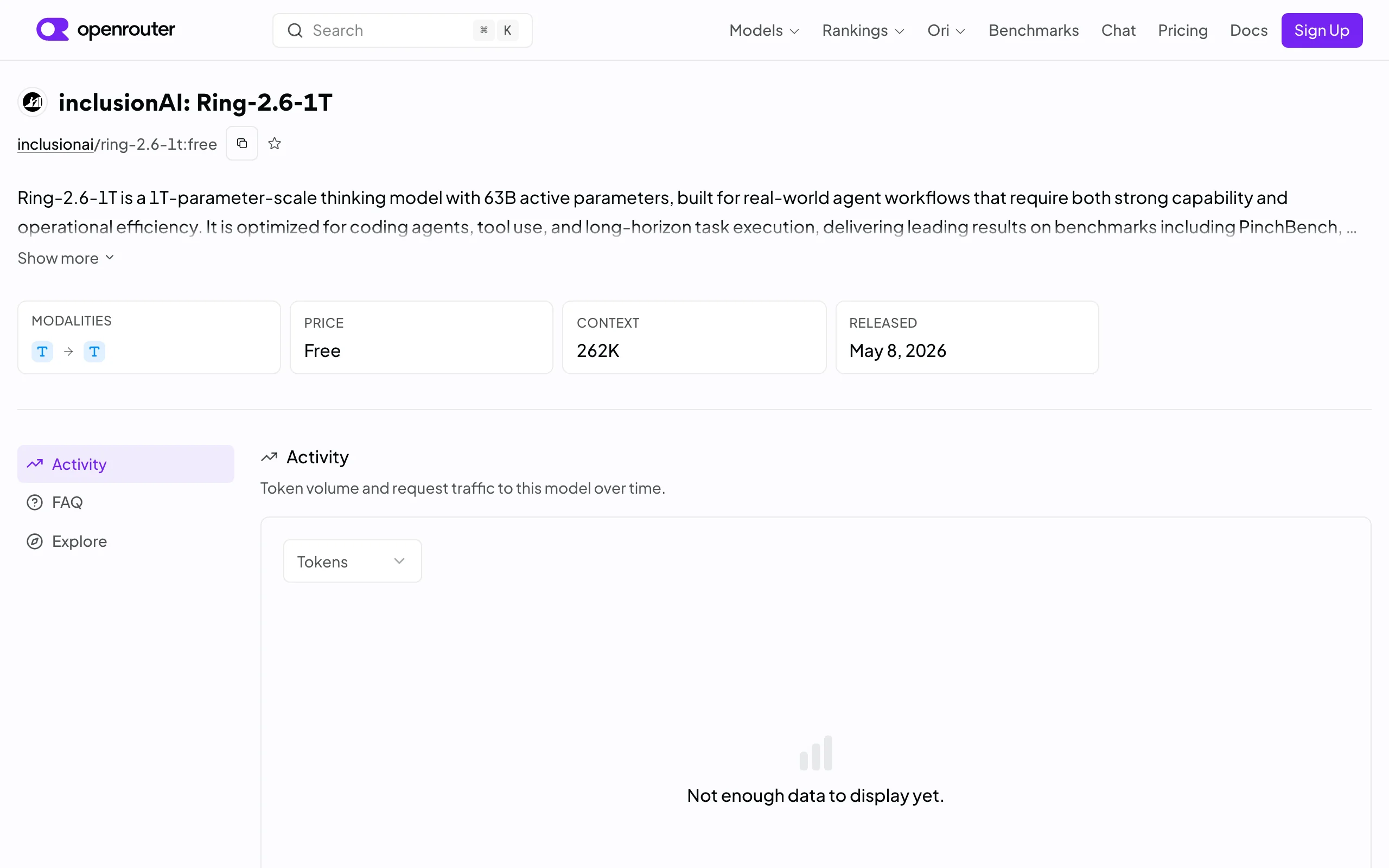
Ring-2.6-1T is Ant Group Bailing's trillion-parameter deep reasoning LLM in the Ring series, focused on "slow thinking" for math competitions, code generation, and other hard cognitive tasks. MoE arch...
1. What Is Ring-2.6-1T
Ring-2.6-1T is Ant Group Bailing's trillion-parameter deep reasoning LLM in the Ring series, focused on "slow thinking" for math competitions, code generation, and other hard cognitive tasks. MoE architecture reaches trillion-scale total parameters while activating only a subset of experts per step, balancing knowledge coverage and compute efficiency. It leads open models on AIME, IMO, and similar math benchmarks and anchors Bailing's matrix alongside Ling (fast thinking) and Ming (multimodal) from instant execution to deep reasoning for research, finance, and advanced software engineering.
Image source: Official article
Technical positioning and domain: NLP/LLM deep reasoning and slow thinking vs. fast reactive models. Emphasizes multi-step proof, code synthesis, and long logical chains with self-check and correction—targeting high-precision professional work.
Research background: Bailing previously shipped Ling and Ming. Ring-2.6-1T addresses incomplete reasoning chains and weak self-verification in open models on competition math and hard code—trillion MoE plus slow-thinking optimization fills open deep-reasoning gaps.
Core value: Improves precision and chain integrity on complex tasks by combining trillion scale, sparse MoE, and reasoning-specific training—usable open deep reasoning for researchers, analysts, and senior engineers at controlled inference cost.
Technical characteristics: Trillion MoE knowledge coverage; stable chain-of-thought for slow thinking; 256K long context for global logic; synergy with Ling in one Bailing stack; heavy math/code/long-reasoning pretrain plus RL alignment for self-verification and error correction.
2. Key Features
Deep mathematical reasoning: Strong on AIME, IMO, etc.—multi-step proofs with self-check at each step; constructive proofs and counterexamples.
Advanced code generation and debugging: Complex algorithms, long completions, logic analysis, bug diagnosis—cross-file awareness and global consistency; trace error paths with fix suggestions.
Long-chain logical decisions: Multi-step causal reasoning for risk, compliance, credit—structured reports from multidimensional inputs.
Ultra-long document understanding: 256K context with improved position encoding and attention—papers, contracts, tech docs without mid-chain forgetting.
Multi-step self-verification and correction: Detects logical or arithmetic errors and backtracks—RL-aligned outputs with fewer hallucinations on hard tasks.
Bailing ecosystem synergy: Shares vocabulary and base capabilities with Ling—fast Ling retrieval plus Ring deep pass in one workflow.
3. How to Use
Requirements: Local deploy needs ≥8× NVIDIA A100 80GB (~640 GB+ VRAM), Linux (Ubuntu 20.04+), CUDA 11.8+, PyTorch 2.0+. Most teams should use cloud API first.
OpenRouter trial: Register at https://openrouter.ai/inclusionai/ring-2.6-1t:free for free API key; set model
inclusionai/ring-2.6-1t—no local deploy for quick tests.API parameters:
temperature0.1–0.3,max_tokens4096–8192,top_p0.9; enable chain-of-thought for hard tasks;max_context_lengthup to 256K when needed.Local deploy (advanced): Clone official repo,
git lfsweights (~600 GB),pip install -r requirements.txt, e.g.python deploy.py --model_path ./ring-2.6-1t --gpu_memory_utilization 0.95 --tensor_parallel_size 8with vLLM or TensorRT-LLM.Best practices: Start simple, ramp complexity; specify output format for math; provide full code context for generation; expect minutes on hard tasks—design async non-real-time flows.
4. Pros and Cons
| Pros |
|---|
| Leading reasoning: Open SOTA-class on AIME/IMO-style tasks vs. peers. |
| Trillion-parameter base: Broader knowledge and generalization across domains. |
| Bailing synergy: Complements Ling fast and Ming multimodal across scenarios. |
| 256K context: Coherent long doc and repo reasoning. |
| Strong self-verification: Fewer logic errors on long chains. |
5. Comparison with Similar Tools
| Dimension | Ring-2.6-1T | DeepSeek-R1 | Qwen3-235B-A22B |
|---|---|---|---|
| Architecture | MoE ~1T total, activated size undisclosed | MoE 671B total, ~37B activated | MoE 235B total, 22B activated |
| Performance | Claims open SOTA on hard math; exact AIME score undisclosed | ~79.8% AIME 2024 | ~70% AIME 2024 |
| Features | Deep reasoning, 256K, Bailing synergy | Deep reasoning, code, open deploy | Hybrid reasoning, Agent, multimodal |
| Deployment | Cloud API primary; extreme local HW | Local 8×A100 or API | Local 4×A100 or API |
| Open source | Planned; schedule TBD | Full MIT open weights | Apache 2.0 open |
| Context | 256K | 128K | 128K |
| Best for | Math, complex decisions, long docs | Code, math, open ecosystem | General + Agent balance |
Selection advice: For peak math reasoning via API with trillion scale, Ring-2.6-1T is compelling. Need full weight control: DeepSeek-R1 fully open with strong math/code. Balance general Agent tasks and lower deploy bar: Qwen3-235B-A22B. Budget for best closed overall: OpenAI o1 at higher cost and privacy tradeoffs.
6. Editor's Take
Ring-2.6-1T combines trillion MoE with slow-thinking optimization—sparse activation keeps cost manageable while targeting hard proof and code tasks. 256K context and chain stability fit professional reasoning; open strategy lag vs. DeepSeek-R1 slows community momentum.
Practical for researchers, risk/compliance analysts, senior engineers, and elite education—not daily quick Q&A. Ling+Ring "fast then deep" is a sensible enterprise pattern.
Watch Bailing for clearer open release and speed/hardware improvements—potential open deep-reasoning flagship if execution follows.
Strong specialist reasoning; deductions for speed, hardware, unclear open path, and ecosystem maturity.
7. Use Cases
Research and academia: Theorem proving, algorithm design, paper analysis with global consistency over 256K.
Financial risk and compliance: Multi-step causal chains for credit, fraud, and regulatory rule checking.
Advanced software engineering: Architecture design, long-chain bug root cause, performance analysis, hard algorithm implementation with correctness reasoning.
Elite education: Olympiad-style walkthroughs, multi-path solutions, personalized logic training.
Strategic decision support: Long causal modeling for policy and business strategy from multi-source inputs.
8. FAQ
Q: Is it free?
A: OpenRouter offers limited free API; heavy use may need paid tiers. Local deploy bears hardware and ops cost.
Q: Ring-2.6-1T vs. DeepSeek-R1?
A: Similar deep-reasoning focus; Ring claims 1T scale vs. 671B; DeepSeek-R1 has published AIME ~79.8% and full open weights. Choose API peak try vs. self-hosted control.
Q: Chinese tasks?
A: Substantial Chinese pretrain—good on professional Chinese math/code; general chat may trail Chinese-tuned general models.
Q: How slow?
A: Simple queries tens of seconds; hard proofs or long code analysis often 5–10 minutes—use asynchronously.
Q: Will it open source?
A: Bailing states intent to open; no date yet—follow GitHub/Hugging Face announcements.
Q: Hardware for local?
A: ≥8× A100 80GB, 640 GB+ VRAM, 512 GB+ RAM, ~1 TB storage—most users should use API.
9. Project Links
- OpenRouter trial: https://openrouter.ai/inclusionai/ring-2.6-1t:free
Related AI Model Articles
In-Depth Review of Longcat-2.5-preview: Meituan's Next-Generation Multimodal Long-Range Agent Model
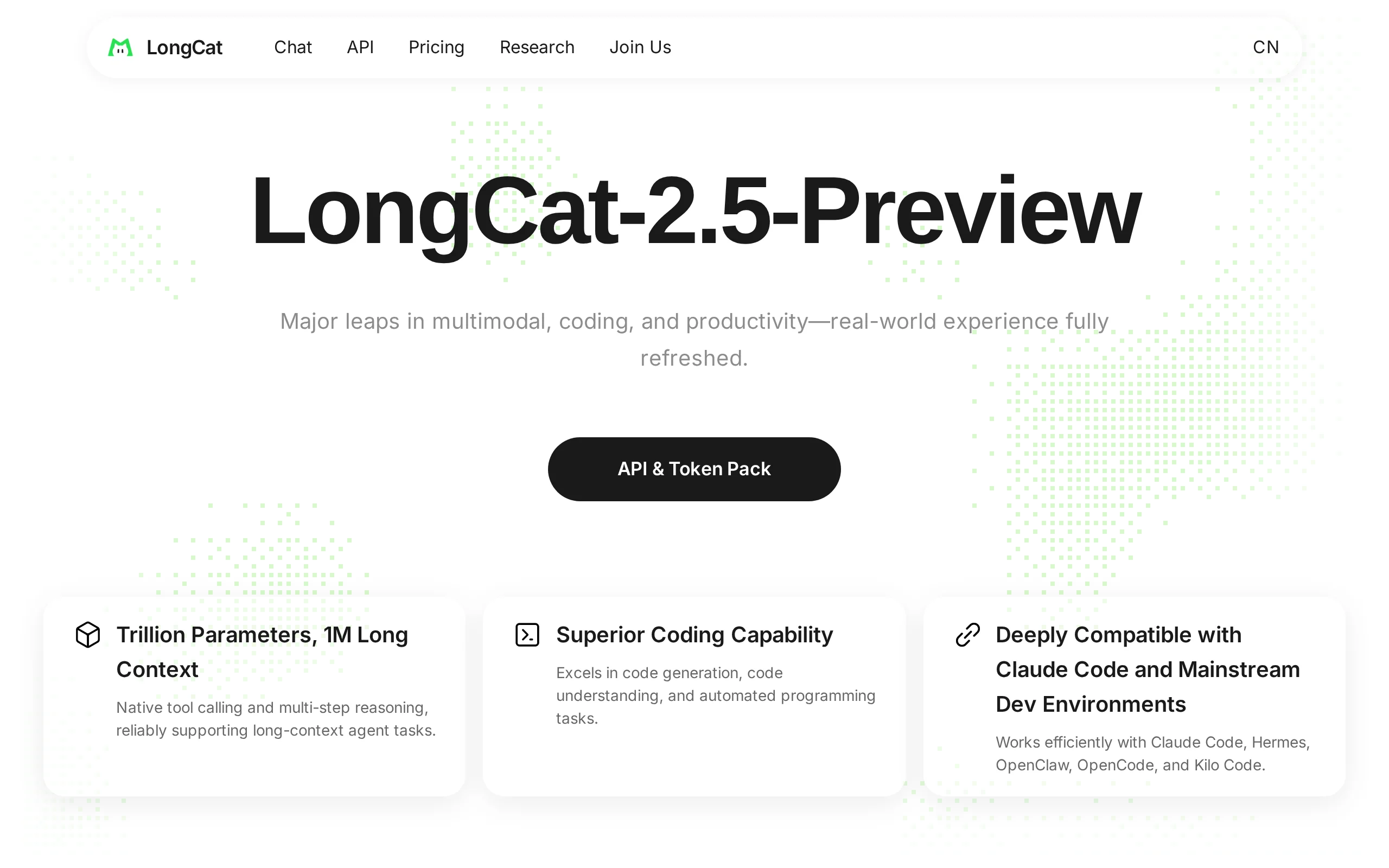
LongCat-2.5-preview is Meituan's latest next-generation large model. Building upon the 1.6T total parameters, approximately 48B active parameters, and native 1M token context of LongCat-2.0, it marks ...
Xiaomi MiMo-V2.6 – Xiaomi's Open-Source Multimodal Model Series
Xiaomi MiMo-V2.6 is a series of fully multimodal models released and open-sourced by Xiaomi, comprising two native full-modal models: Pro and Flash. It is centered on large-scale Agentic reinforcement...
In-Depth Review of Step 5 Preview: A 600B Sparse MoE Flagship with 1M Token Context and 1/8 Cost Advantage
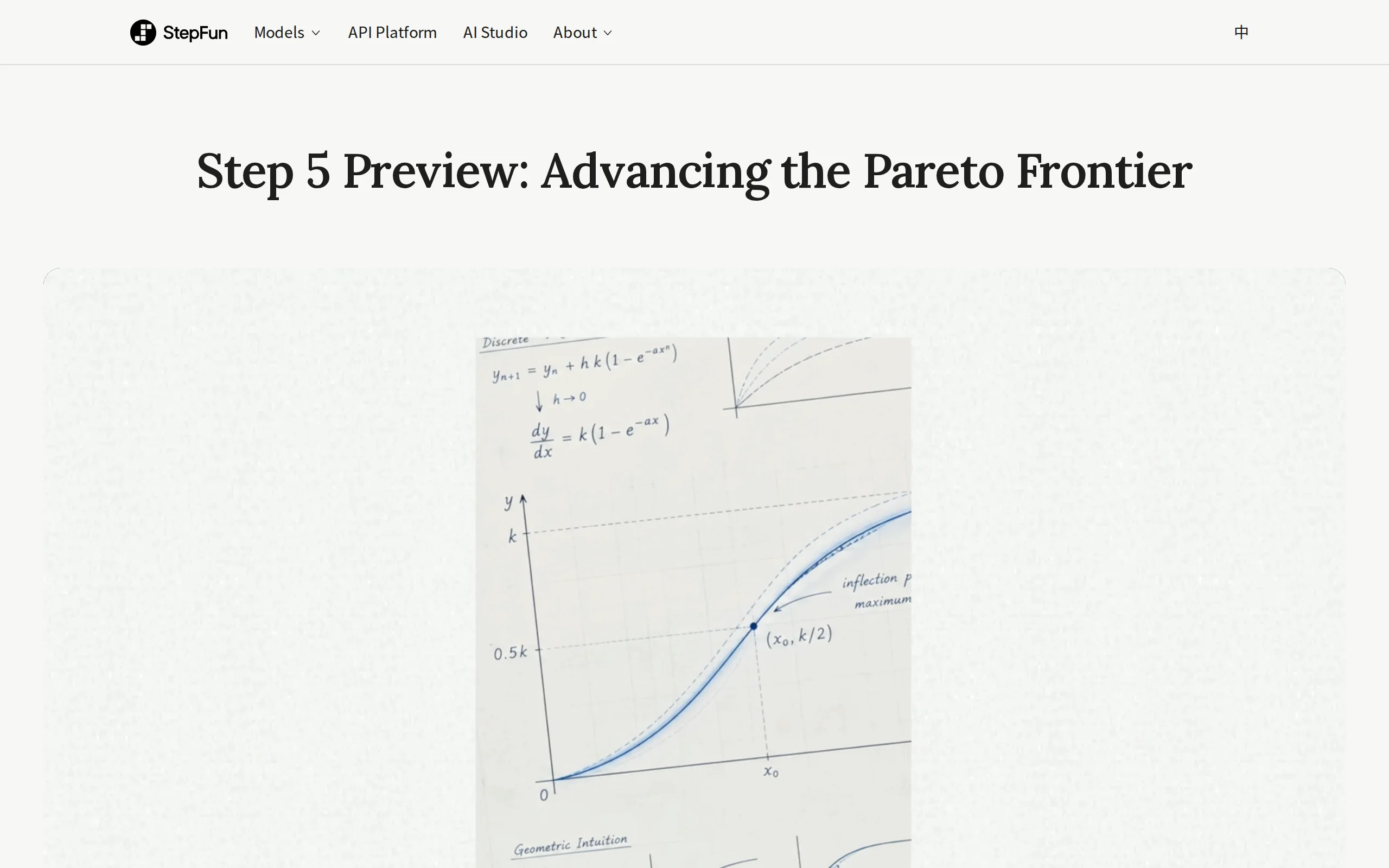
Step 5 Preview is a new-generation flagship foundation model launched by StepFun, designed for real-world Agentic tasks. Based on a sparse MoE architecture, the model has a total of 600B parameters bu...
Qwen3.8-Omni-Flash – A Native Multimodal Model Launched by Alibaba Qwen
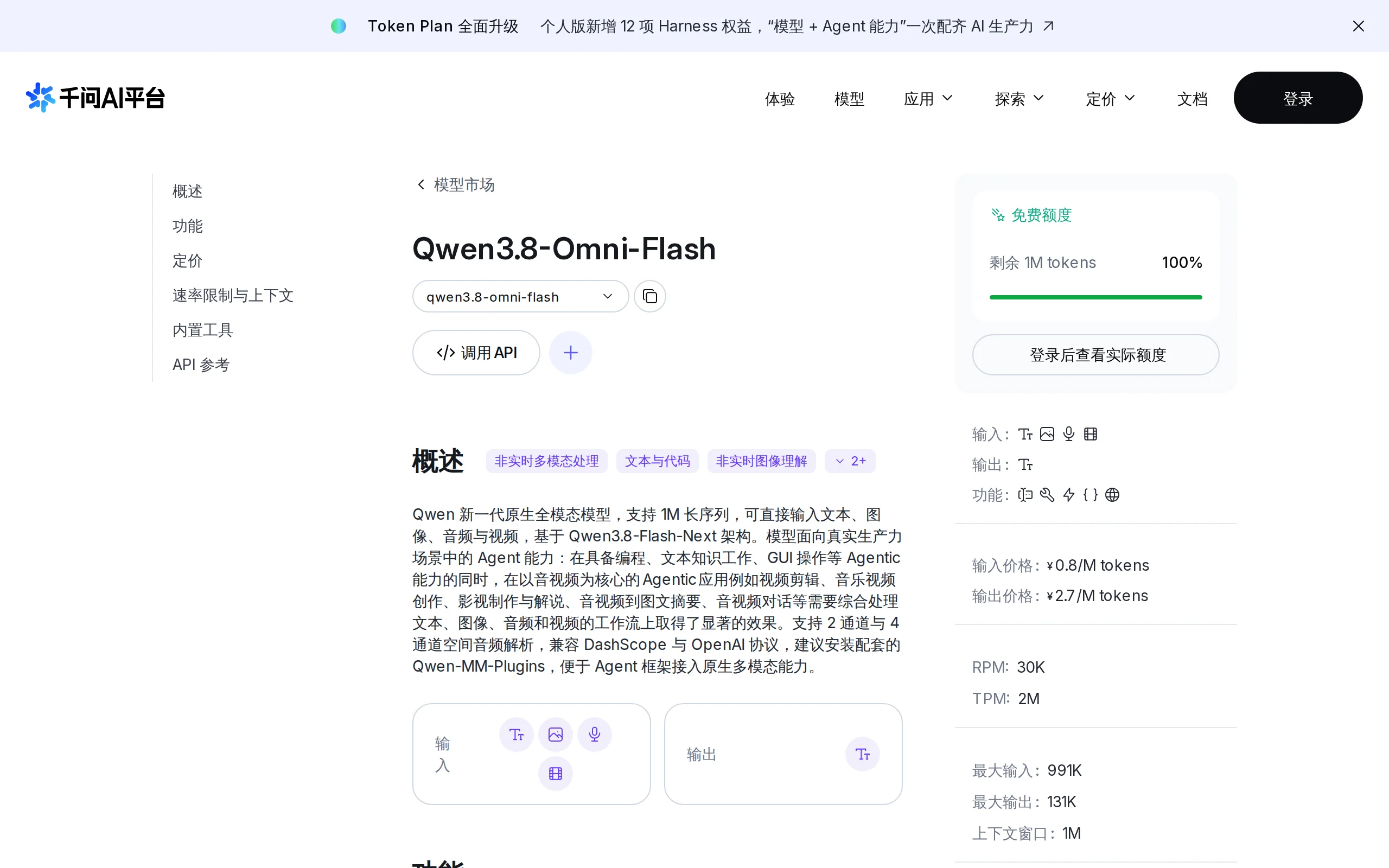
Qwen3.8-Omni-Flash is a native multimodal model launched by Alibaba Qwen. It jointly models four modalities—text, image, audio, and video—within a single architecture, supporting a context length of u...
© All Rights Reserved. Some content on this site is partially generated by AI with human review.