
North Mini Code – Cohere's Open-Source Agentic Coding Model
Executive Summary:
North Mini Code is Cohere's open-source Agentic coding model for code generation and software engineering. It uses a Mixture-of-Experts (MoE) architecture with 30B total parameters but only 3B activat...
1. What Is North Mini Code
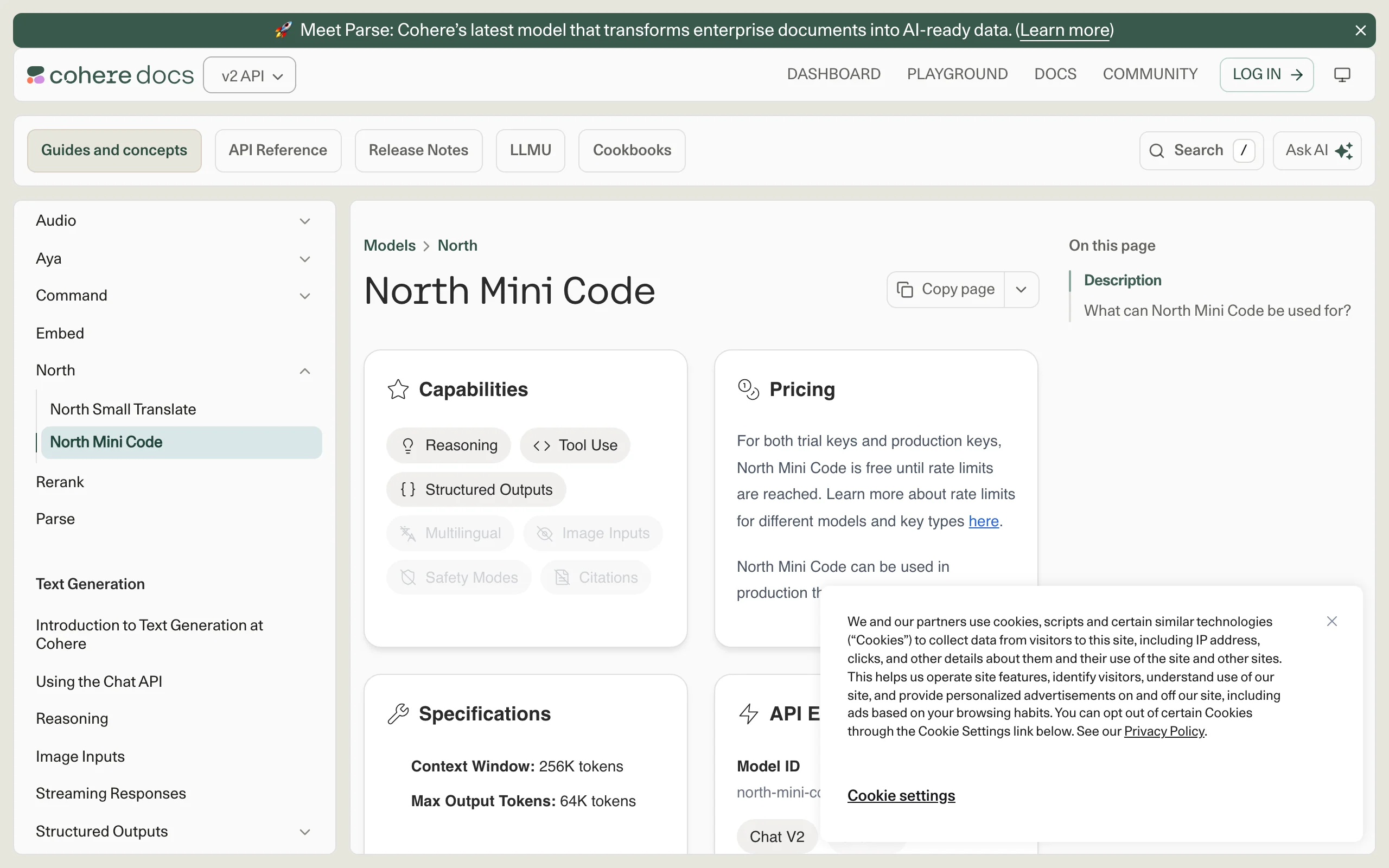
North Mini Code is Cohere's open-source Agentic coding model for code generation and software engineering. It uses a Mixture-of-Experts (MoE) architecture with 30B total parameters but only 3B activated per forward pass, delivering strong performance at a fraction of dense-model compute cost. It supports a 256K input context window and 64K output length, allowing mid-size codebases to be loaded in one pass for full-module generation. On the Artificial Analysis Coding Index, North Mini Code scores 33.4, with API throughput around 199 tokens/s, and can be deployed locally on a single NVIDIA H100 GPU. Its core positioning targets enterprise code development, automated engineering pipelines, and privacy-sensitive local coding workloads.
Image source: Official article
Technical positioning and domain: North Mini Code sits at the intersection of NLP and code generation, focused on Agentic software engineering and code intelligence. Unlike traditional completion models, it is designed to autonomously execute multi-step software development tasks—repository-level edits, terminal command execution, and sub-agent coordination. Its approach combines sparse MoE activation with Agent-framework training to address the lack of autonomy and context understanding that limits code models in complex engineering scenarios.
Research background: North Mini Code comes from Cohere, a Canadian company focused on enterprise AI with deep NLP experience and the Command-R model family. The motivation is that most code models excel at single-step completion but fail on repository structure, cross-file changes, and shell-driven toolchains. Cohere introduced MoE architecture and targeted training for SWE-Agent, ReAct, and similar frameworks to fill that gap with an efficient, deployable coding assistant capable of autonomous decision-making.
Core value: North Mini Code addresses three pain points in code AI: (1) high-performance models usually demand heavy compute—3B active parameters match larger dense models while cutting inference cost by 70%+; (2) enterprise development needs large codebases—256K context lets the model understand dependency graphs across hundreds of thousands of lines; (3) privacy compliance is tightening—local, VPC, and private-cloud deployment meet regulatory needs in finance, healthcare, and similar sectors. Its innovation lies in pairing Agentic capability with efficient inference so autonomous code edits and terminal automation become production-ready tools.
Technical characteristics: Four core advantages: (1) MoE sparse activation—only 3B of 30B routed per step, with lower latency and VRAM than dense peers at comparable quality; (2) ultra-long context—256K input and 64K output for whole-repo analysis and batch generation; (3) Agentic training optimized for SWE-Agent, ReAct terminal toolchains, and multiple frameworks, with stronger generalization than generic coding models; (4) output speed—under comparable concurrency and hardware, throughput is ~2.8× higher than similar models with ~30% lower inter-token latency.
2. Key Features
Code generation: The model handles scientific computing, algorithmic reasoning, and complex code generation beyond simple completion. It understands math, algorithm logic, and data structures to produce engineering-grade snippets. Its 33.4 Artificial Analysis Coding Index score shows competitive performance on demanding coding tasks.
Agentic software engineering: The core differentiator. North Mini Code performs repository-level edits in SWE-Agent, OpenCode, and similar frameworks—cross-file dependency analysis, refactors, bug fixes. It understands project architecture and decides which files to change and how, without line-by-line human guidance.
Terminal agents: End-to-end shell-driven workflows for multi-round build and deploy tasks. Via ReAct and related frameworks, the model runs compile, test, and deploy commands autonomously, forming complete automation pipelines valuable for DevOps and CI.
Local coding: 3B active parameters enable low-latency local inference on capable hardware for privacy-sensitive workloads. Enterprises deploy on local servers or VPCs so core code never leaves the boundary while staying close to cloud inference quality.
Sub-agent orchestration: The model understands system architecture and coordinates sub-agents for review and refactors. On large projects it acts as a main agent, delegating test generation, documentation, or performance work to specialized sub-agents and orchestrating their workflows for team-scale efficiency.
Multi-framework compatibility: Native OpenCode support plus SWE-Agent, ReAct, and mainstream coding Agent scaffolds. Developers can swap or integrate North Mini Code without rewriting existing toolchains, lowering migration cost.
3. How to Use
Environment and prerequisites: Local deployment requires at least one NVIDIA H100 GPU (80GB VRAM) or equivalent. Recommended OS: Linux (Ubuntu 22.04+), Python 3.10+, PyTorch 2.0+, CUDA 12.1+. For API use, no local GPU is required—only network access and an API key.
Download weights from Hugging Face: Visit Cohere's model repo at https://huggingface.co/CohereLabs/north-mini-code and download via
git lfsorhuggingface_hub. Load withtransformers, e.g.:from transformers import AutoModelForCausalLM, AutoTokenizer; model = AutoModelForCausalLM.from_pretrained("CohereLabs/north-mini-code").Cohere API calls: Register for a Cohere account and API key. Use the Chat V2 API with
model="north-mini-code". Free trial credits are available. Example:cohere.chat(model="north-mini-code", message="Write a Python function to sort a list of integers").Model Vault enterprise hosting: Enterprise users can one-click deploy to production on Cohere's Model Vault with private cloud, VPC, and on-prem options, SLA, and monitoring. Configure model version, compute, and security policies in the Cohere console.
OpenCode integration: In OpenCode, select
north-mini-code-freefor a free trial. OpenCode is an Agentic coding IDE plugin supporting repo-level edits and terminal execution. Enable the model in OpenCode settings and set it as the default coding agent.Best practices: For large repos, use the full 256K context when VRAM allows; trim input if needed. For Agentic tasks, pair with SWE-Agent to maximize autonomous decision-making. For interactive coding, API calls often beat local latency.
4. Pros and Cons
| Pros |
|---|
| Efficient low cost: MoE sparse activation with 3B active parameters yields far lower inference cost than dense peers at similar quality—more concurrent requests per GPU and lower enterprise operating cost. |
| Enterprise compliance friendly: Local, VPC, or private-cloud deployment meets data-residency requirements in regulated industries; Model Vault adds enterprise security and audit controls. |
| Long-context advantage: 256K input and 64K output excel at large-repo analysis and batch generation—dependency relationships across hundreds of thousands of lines in one pass. |
| Multi-framework Agentic: Native OpenCode plus SWE-Agent and ReAct scaffolds—integrate without toolchain rewrites. |
5. Comparison with Similar Tools
| Dimension | North Mini Code | Devstral Small 2 | DeepSeek Coder V2 |
|---|---|---|---|
| Core architecture | MoE (30B / 3B active) | Dense | MoE (236B / 21B active) |
| Performance | Artificial Analysis Coding Index 33.4 | ~28 | ~35 |
| Output speed | 199 tokens/s (API); ~2.8× Devstral throughput | Baseline | ~150 tokens/s |
| Max context | 256K in / 64K out | 128K in / 32K out | 128K in / 32K out |
| Agentic capability | Native SWE-Agent, ReAct, OpenCode | Limited | Basic Agent frameworks |
| Deployment | Local, API, Model Vault | API, local | API, local |
| Open license | Apache 2.0 | Varies by version | MIT |
| Community | Early; strong official docs | Smaller | Active; strong Chinese community |
Selection advice: For enterprise Agentic coding, North Mini Code is the top pick—native SWE-Agent and OpenCode support for repo edits and terminal automation is rare among peers. Apache 2.0 and low inference cost suit large-scale deployment. Teams on Chinese stacks needing dense precision may prefer DeepSeek Coder V2 for Chinese support and community maturity. Individual developers and small projects may favor Code Llama 34B for mature ecosystem and lower hardware (single A100), but it lacks Agentic capability. Devstral Small 2 fits latency-sensitive micro tasks but is more limited in scope.
6. Editor's Take
North Mini Code marks Agentic coding models moving from experiment to production readiness. Technically, Cohere combines MoE sparse activation with Agentic training for an outsized effect—3B active parameters beat 7B and even 13B dense models on multiple benchmarks while matching ~34B-class coding ability. That design cuts inference cost and enables single-H100 deployment—a milestone for enterprises bringing AI coding on-prem.
In practice, the standout is Agentic capability. Traditional code models emit single snippets; North Mini Code understands whole-repo structure and autonomously performs cross-file edits, shell commands, and sub-agent coordination. Developers can offload repetitive review, refactors, and tests and focus on design and architecture. The 256K context window loads mid-size codebases in one pass—especially useful on large legacy projects.
Best fit: enterprise dev teams, DevOps engineers, and regulated finance/healthcare. Individuals face higher local barriers but can try Agentic features via Cohere's free API tier. Researchers benefit from Apache 2.0 for experiments and forks.
Future potential is strong. As SWE-Agent and OpenCode mature, North Mini Code could become a reference model in this space. Cohere plans ongoing weight and data updates, including Chinese code and multilingual projects. Quantized or smaller variants could broaden adoption if hardware requirements drop.
Rationale: Strong innovation (MoE + Agentic training) and high practical value (enterprise deploy, long context, multi-framework)—deduct 0.5 for hardware gate and early community. For enterprise Agentic coding, it is among the most compelling options today.
7. Use Cases
Enterprise private code assistant: Local or VPC deployment meets compliance—code never leaves the corporate network. Teams get generation, review, and suggestions with all data processed internally.
Repository-wide refactors: 256K context loads mid-size repos for cross-file dependency analysis and batch refactors—e.g., framework upgrades that update API calls across all related files consistently.
Terminal automation pipelines: SWE-Agent drives shell toolchains for automated build, test, and deploy—
git, test suites, pre-release deploys as end-to-end CI/CD.Scientific computing support: Generate algorithm implementations, data-processing scripts, and math-heavy code from LaTeX and symbols into executable Python or Julia for research workflows.
IDE real-time plugins: 3B active parameters support low-latency inference for in-editor completion and suggestions—Copilot-like experience with deeper Agentic capability when integrated into VS Code or JetBrains IDEs.
8. FAQ
Q: Does North Mini Code support Chinese code comments and technical documentation?
A: Training and optimization focus on English code and comments. The underlying language model has some multilingual ability, but Chinese support is not formally validated. For Chinese-comment-heavy projects, run small tests first or consider Chinese-optimized models like DeepSeek Coder V2.
Q: What hardware is required for local deployment?
A: Minimum is one NVIDIA H100 (80GB VRAM). Total parameters are 30B; even with 3B active, full weights must load into VRAM. Consumer cards like RTX 4090 (24GB) cannot run the full model. Cohere plans quantized variants to lower the bar.
Q: How much free API quota is available?
A: Cohere offers monthly free API credits for new users; exact amounts depend on signup tier. Free tier covers full North Mini Code features including Agentic coding and terminal agents; beyond that, token billing applies.
Q: Does the model support multimodal input (images, charts)?
A: No. North Mini Code is text-only for code and natural language. It cannot process images, charts, or graphics in PDFs. Pair with vision models if multimodal coding is needed.
Q: How does North Mini Code compare to GitHub Copilot?
A: Key advantages: Agentic capability and long context. Copilot focuses on single-step completion; North Mini Code does repo-level edits, terminal execution, and sub-agent coordination. 256K context handles large codebases vs. Copilot's typical 8–16K limits. Copilot wins on mature ecosystem and IDE plugin support.
Q: What is the open-source license? Can it be used commercially?
A: Apache 2.0—commercial use and derivative works are allowed. Enterprises may modify weights and integrate into products without extra fees to Cohere, subject to license attribution and disclaimer terms.
9. Project Links
- Official docs: https://docs.cohere.com/docs/north-mini-code-1.0
- Hugging Face model: https://huggingface.co/CohereLabs/north-mini-code
- Cohere API docs: https://docs.cohere.com/reference/chat
- OpenCode integration guide: https://github.com/opencode-ai/opencode
Related AI Model Articles
OpenMuse – CopilotKit Open-Source Personal AI Assistant
OpenMuse is an open-source personal AI assistant project developed by the CopilotKit team. Its core design philosophy is "giving an Agent a computer" — by combining a persistent browser, optional Linu...
In-Depth Review of Longcat-2.5-preview: Meituan's Next-Generation Multimodal Long-Range Agent Model
LongCat-2.5-preview is Meituan's latest next-generation large model. Building upon the 1.6T total parameters, approximately 48B active parameters, and native 1M token context of LongCat-2.0, it marks ...
Review of DeepSeek Harness Desktop: How the Official GUI Client Lowers the Bar for Agent Usage
DeepSeek Harness Desktop is the official graphical client launched by DeepSeek, designed to provide a visual interface for the originally command-line-based DeepSeek Harness framework. After users log...
Step Code – In-Depth Review of StepFun's Open-Source Terminal Programming Agent
Step Code is an open-source terminal programming agent launched by StepFun, licensed under the MIT License, which allows developers to complete the full workflow of code writing, debugging, execution,...
© All Rights Reserved. Some content on this site is partially generated by AI with human review.