
MiniMax H3 Max: fal's Post-trained Real-time Video Model — Faster than Real-time, No Benchmarks Published
Executive Summary:
H3 Max is a hosted service built on the open-source H3 base model. It suits teams that want to integrate video generation into real-time content production workflows, as well as individual users looki...
H3 Max is a hosted service built on the open-source H3 base model. It suits teams that want to integrate video generation into real-time content production workflows, as well as individual users looking for a low-friction way to try it out. It is not a good fit for teams that require controllable weights, reproducible evaluation, or local deployment.
H3 Max is a joint release from MiniMax and fal.ai: fal post-trains the open-source MiniMax H3 model for video generation. The MiniMax Open Platform describes it as "optimized for high-speed inference," while fal's blog says the post-training work focuses on prompt understanding, visual aesthetics, and rapid creative iteration. Some outlets have simplified this to "MiniMax releases," but technically it is a joint release by two companies.
H3 Max supports text-to-video and image-to-video generation, producing clips from 5 to 15 seconds long at up to 768p resolution, with native audio generated alongside the visuals.
Faster than Real-time, with Audio-Visual Synchronization
The official speed claim is "faster than real-time" — that is, generation takes less time than the video's duration. H3 Max is aimed at real-time interactive scenarios such as live streaming, where the audience's visuals can shift in real time with the input. Some media outlets have cited specific latency numbers, but these have not been confirmed by official sources, so they cannot be independently verified.
Audio-visual synchronization is another key selling point: the model generates matching audio alongside the visuals. The maximum resolution is officially confirmed at 768p.
Three Access Paths
H3 Max is available through three access paths. Developers can use the Video Generation API on the MiniMax open platform to create videos from text or images. Regular users can work through the visual interface of MiniMax Design. Alternatively, anyone can use the free entry point on fal.ai without registering, which allows up to five 5-second, 768p videos with native audio per day.
Open Source H3 vs. Hosted H3 Max
H3 Max is built on MiniMax H3, an open-source, general-purpose multimodal model that can understand and generate text, images, video, and audio in a unified framework. H3 Max is further fine-tuned by fal Research.
The distinction is straightforward: H3 is an open-source base model that supports local deployment, while H3 Max is a hosted service running on fal/MiniMax's inference infrastructure. Teams that require local deployment should use the H3 base model.
The Weight of Being Number One
fal's official page labels H3 Max the "Top Free AI Video Generator." However, third-party sites such as kingy.ai note that no numerical benchmark tables have been published, so the basis for the ranking is unclear. The comparison set, sample size, and scoring rules are all missing. The ranking is worth noting, but it should not be the primary factor in choosing a tool.
Who Should Use It
H3 Max's value lies in real-time content production in the cloud. It runs faster than real time, which suits live streaming and other interactive scenarios, and it outputs synchronized audio and video, making it a good fit for production work that needs both. fal's free quota lowers the barrier to trying it out, so teams can validate results before committing.
If your work requires reproducible evaluation, controllable weights, or local deployment, H3 Max won't meet those needs. In that case, the open-source H3 base model or other open-weight models are the better choice.
Sources and Project Links
- MiniMax Open Platform: https://platform.minimaxi.com/
Related AI Model Articles
Xiaomi MiMo-V2.6 – Xiaomi's Open-Source Multimodal Model Series
Xiaomi MiMo-V2.6 is a series of fully multimodal models released and open-sourced by Xiaomi, comprising two native full-modal models: Pro and Flash. It is centered on large-scale Agentic reinforcement...
In-Depth Review of Step 5 Preview: A 600B Sparse MoE Flagship with 1M Token Context and 1/8 Cost Advantage
Step 5 Preview is a new-generation flagship foundation model launched by StepFun, designed for real-world Agentic tasks. Based on a sparse MoE architecture, the model has a total of 600B parameters bu...
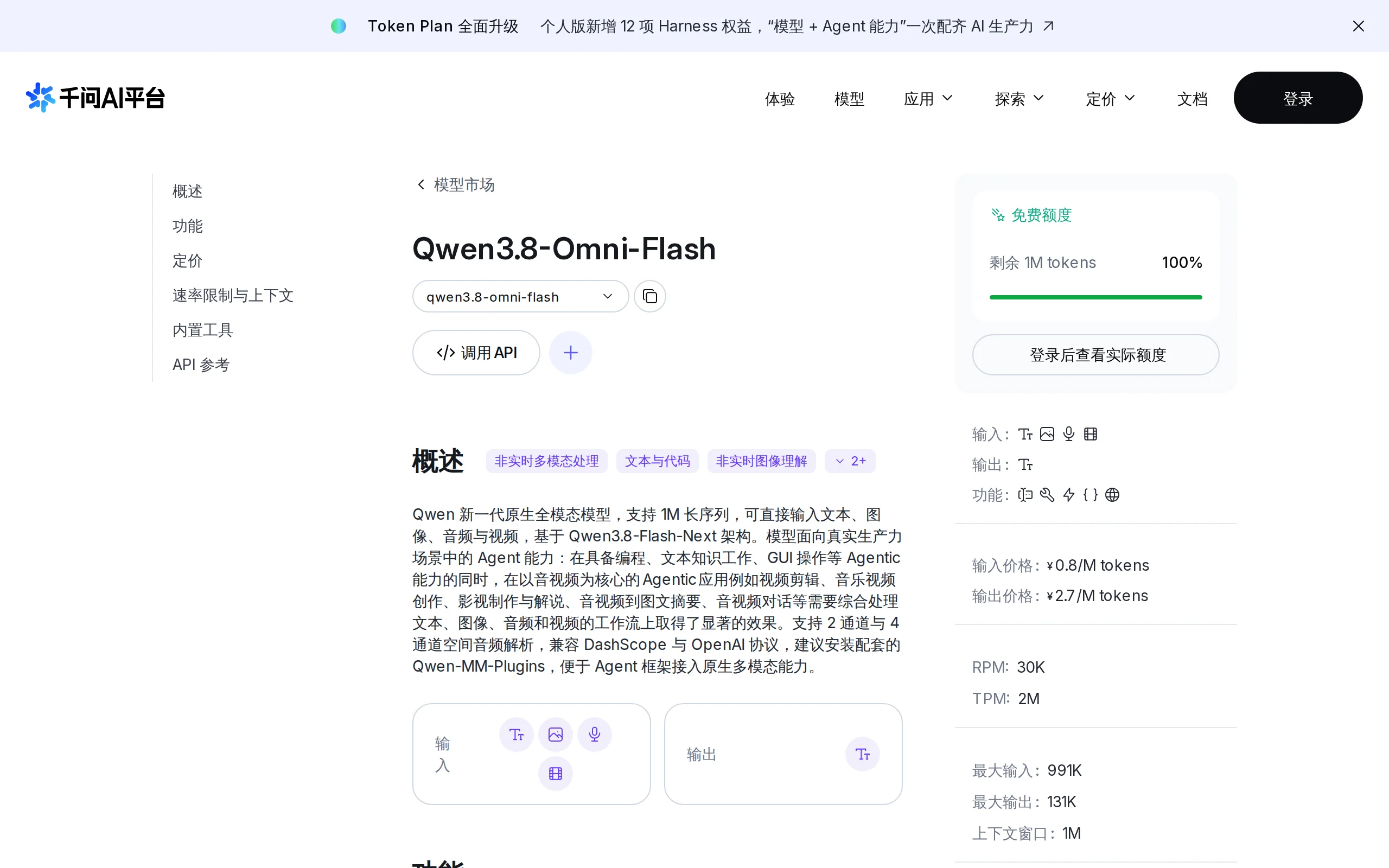
Qwen3.8-Omni-Flash – A Native Multimodal Model Launched by Alibaba Qwen
Qwen3.8-Omni-Flash is a native multimodal model launched by Alibaba Qwen. It jointly models four modalities—text, image, audio, and video—within a single architecture, supporting a context length of u...
Union Alpha – A Mysterious Multimodal Large Model with Unlimited Free Access for a Limited Time
Union Alpha is a multimodal large language model released in "stealth" mode, recently launched on mainstream AI service platforms such as OpenRouter, Cline, and OpenCode. The model supports dual-modal...
© All Rights Reserved. Some content on this site is partially generated by AI with human review.