
JoyAI-Echo – JD's Open-Source Long-Form Audio-Video Generation Framework
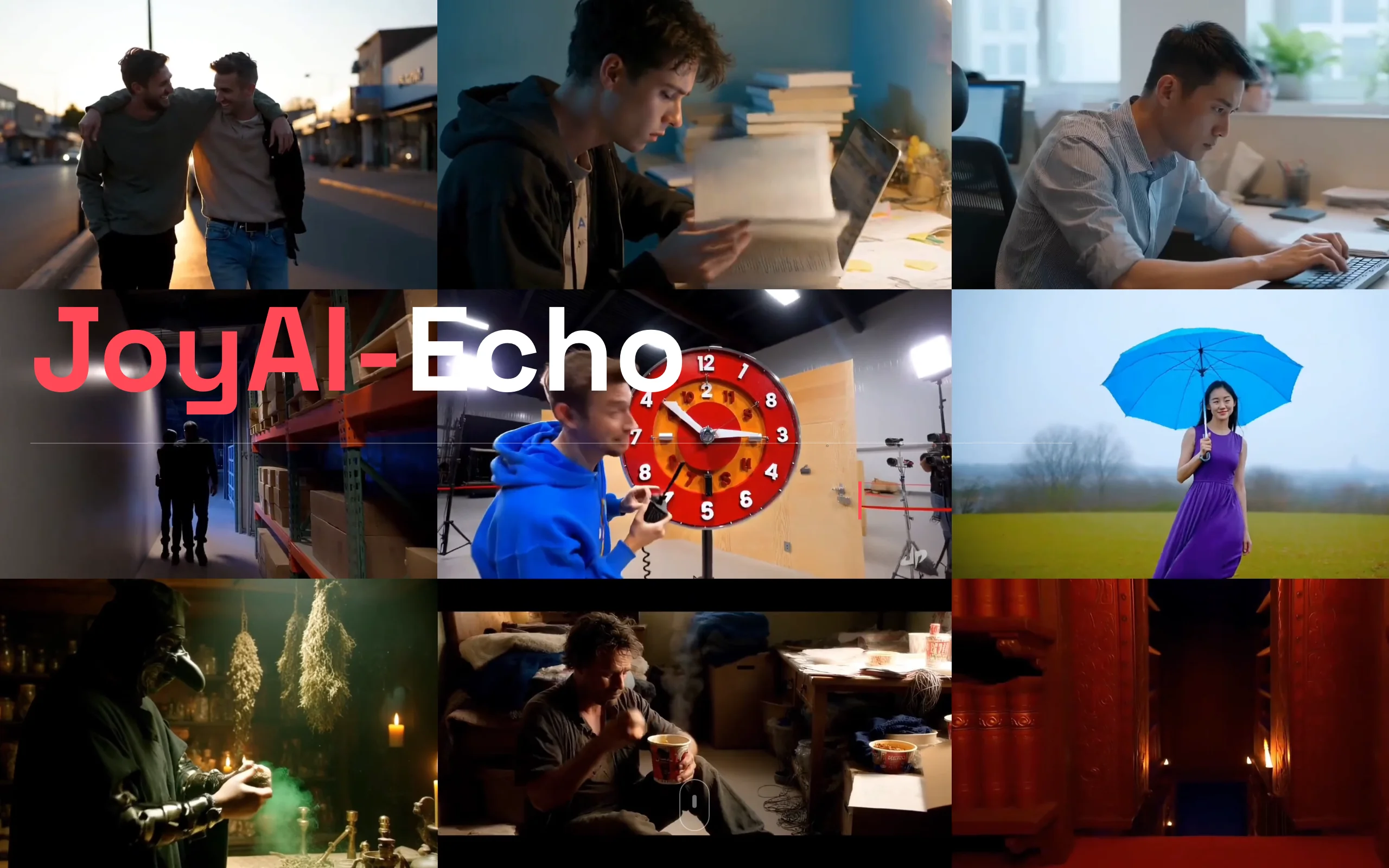
Executive Summary:
JoyAI-Echo is an open-source long-form audio-video generation framework from JD Future Academy, designed for minute-scale multi-shot story generation. Through four technical innovations—a paired cross...
1. What Is JoyAI-Echo
JoyAI-Echo is an open-source long-form audio-video generation framework from JD Future Academy, designed for minute-scale multi-shot story generation. Through four technical innovations—a paired cross-modal memory bank, memory-driven post-training, Director Agent conversational editing, and lightweight real-time super-resolution—it addresses core pain points in long video generation: character face drift, voice inconsistency, and slow generation. It is the first system to deliver up to 5 minutes of highly consistent, interactive, HD long-form video. Built end-to-end on LTX-2.3 and Gemma-3-12B, JoyAI-Echo marks JD's entry into the global top tier of long video generation and provides a deployable open-source solution for virtual content creation, digital humans, and film pre-visualization.
Image source: Official article
Technical positioning and domain: JoyAI-Echo sits in multimodal generation, focused on joint long video and audio synthesis. Unlike short-clip models (seconds to tens of seconds), it targets cross-shot consistency, interactivity, and real-time performance at minute scale—positioned as a professional long-form content production tool rather than a simple text-to-video demo.
Development background: Led by JD Future Academy (Joy Future Academy), the team has deep experience in video generation, multimodal retrieval, and diffusion acceleration. The project builds on LTX-2.3 (Lightning Transformer) and Google's Gemma-3-12B text encoder, aiming to break bottlenecks in duration, consistency, and interactivity. JD serves its own e-commerce marketing and digital human business while advancing open-source progress in long video generation.
Core value: JoyAI-Echo tackles three industry challenges: (1) character identity drift—inconsistent facial features and voice across shots; (2) slow generation—minute-scale video requiring hours of inference; (3) high creation barrier—users struggle to control multi-shot narrative in natural language. Paired cross-modal memory preserves consistency; DMD distillation delivers ~7.5× speedup; Director Agent enables conversational local edits so non-experts can produce up to 5 minutes of high-quality story video.
Technical characteristics: A "paired cross-modal memory bank" binds visual and audio features for reuse across shots; Distribution Matching Distillation (DMD) compresses multi-step diffusion to few steps for practical streaming generation; Director Agent expands natural language into structured scripts, shots, characters, and scenes with closed-loop editing; a lightweight single-step super-resolution module upscales 736×1280 to 1472×2560 under streaming latency for professional output.
2. Key Features
Minute-scale multi-shot coherent stories: Generate multi-shot video sequences up to 5 minutes from a single prompt or JSON file. The system splits text into coherent shots while preserving character, scene, and narrative continuity—breaking the short-clip limit of existing models.
Cross-modal joint audio-video generation: A single pipeline outputs synchronized video and audio—character speech, ambient SFX, and background music—without manual alignment, reducing production complexity.
Paired cross-modal memory bank: Core component using slot-paired binding of visual memory (face, appearance) and audio memory (speaker timbre). Each new shot is conditioned on prior identity features for story-level consistency up to 5 minutes; user preference rate 59.4% vs. 27.7% for competitors.
DMD few-step inference acceleration: Distribution Matching Distillation reduces dozens of diffusion steps to ~7, achieving ~7.5× speedup while preserving quality—making minute-scale streaming practical; per-shot time drops from minutes to seconds.
Director Agent conversational editing: Interact via natural language; the agent expands intent into structured script, characters, scenes, and shots. Supports plan-generate-review-local-revise workflow—edit a problematic segment without rerunning the full video, turning static generation into dynamic collaboration.
Lightweight real-time audio-video super-resolution: Single-step module sharpens 736×1280 base output to 1152×1920 or 1472×2560 under streaming latency without breaking real-time generation.
Fully open source and reproducible: Code and weights under Apache 2.0 (academic/non-commercial); built on LTX-2.3 and Gemma-3-12B with inference scripts, sample prompts, and docs for reproduction.
3. How to Use
Environment and prerequisites: Python 3.11, PyTorch 2.8, CUDA 12.8, and a compatible NVIDIA GPU (24GB+ VRAM recommended, e.g., RTX 4090 or A100). Install ffmpeg for AV processing. Use conda or uv for dependencies.
Clone and install: Run
git clone https://github.com/jd-opensource/JoyAI-Echo.git, create env withconda create -n joyai python=3.11, thenpip install -r requirements.txt. Install PyTorch manually for your CUDA version.Download weights: From Hugging Face, download ~46GB
echo-longvideo-release.safetensorsand ~24GBgemma-3-12bencoder intocheckpoints/. Use resumable download for stability.Write story prompt JSON: Create JSON describing each shot—characters/subjects, actions/dialogue, style, camera motion, background, SFX/BGM. See
examples/. Multiple shots auto-maintain cross-shot consistency.Run inference: Execute
python inference.py; model loads once and processes all prompt files. Output defaults toinference_result/outputs/. First load ~2–3 minutes; per-shot generation ~5–15 seconds depending on resolution and complexity.Director Agent editing (optional): Run
python director_agent.py --input your_story.jsonfor conversational edits—e.g., "change the third shot background to dusk"—for localized regeneration without full reruns.
4. Pros and Cons
| Pros |
|---|
| Ultra-long consistency: Paired cross-modal memory keeps appearance, voice, and identity consistent up to 5 minutes; 59.4% user preference—solving character drift. |
| Fast generation: DMD ~7.5× speedup—minute-scale video in minutes vs. hours for standard diffusion. |
| Conversational creation: Director Agent enables natural language planning and local edits—lower barrier for non-experts. |
| Real-time super-resolution: Lightweight single-step upscaling to 1472×2560 without breaking streaming latency. |
| Fully open source: Public code and weights on LTX-2.3+Gemma—reproducible for research and extension. |
5. Comparison with Similar Tools
| Dimension | JoyAI-Echo | HappyOyster | VideoCrafter2 |
|---|---|---|---|
| Long video | ✅ Up to 5 min multi-shot stories | ✅ Long video; duration not public | ❌ 4–16 s clips; no multi-shot stories |
| Identity consistency | ✅ 59.4% preference; cross-modal memory | ✅ 27.7% preference; no disclosed memory | ❌ No cross-shot memory; drift common |
| Audio generation | ✅ 81.7% preference; joint A/V; stable voice | ✅ 11.8% preference; average audio | ❌ No audio; post dubbing needed |
| Generation speed | ✅ DMD ~7.5×; streaming | ❌ Standard multi-step diffusion | ✅ LCM-style; ~2–3 s/frame |
| Conversational editing | ✅ Director Agent | ❌ Not disclosed | ❌ Text-to-video only |
| Real-time super-res | ✅ Single-step to 1472×2560 | ❌ Not disclosed | ❌ Low base res; external SR |
| Open source | ✅ Full (academic/non-commercial) | ❌ Closed | ✅ Apache 2.0 |
| Architecture | LTX-2.3 + Gemma-3-12B + memory bank | Proprietary; limited details | Stable Diffusion 2.1 |
Selection advice: For multi-minute, multi-shot stories with high consistency (animators, digital human ops), JoyAI-Echo is the only complete open solution. For budget short social ads, VideoCrafter2 or AnimateDiff may suffice. HappyOyster is close commercially but closed. For synced audio-video, JoyAI-Echo is the standout open option.
6. Editor's Take
JoyAI-Echo shows JD's depth in long video generation. The paired cross-modal memory bank is not simple feature caching—it binds visual and audio via slot-pairing with latent conditioning in diffusion—a novel industrial and academic approach. DMD uses distribution matching to map teacher multi-step distributions to student few-step paths for 7.5× speedup—a distinct route from LCM with stronger theoretical grounding.
Practically, it addresses "face drift," "voice jumps," and slow generation. Director Agent upgrades generative AI from one-shot output to interactive collaboration—ideal for marketing teams iterating brand video. Hardware (24GB+) and Chinese support remain gaps for individual creators.
Audience: professional animators, digital human producers, pre-viz teams, researchers. Enterprises need license review for commercial use.
Future potential is strong—distillation maturity and hardware cost drops could make JoyAI-Echo a long-video open benchmark. Watch for more languages, lower VRAM, stronger multilingual encoders, and richer editing (background swap, outfit change).
— Strong innovation (memory + DMD), high utility (5 min + conversational edit), open-friendly.
7. Use Cases
Virtual storytelling and animation: Produce multi-minute coherent animation; Director Agent iterates plot and shots with consistent look, voice, and character—80%+ time savings vs. frame-by-frame work.
Digital human content and live streaming: Long-form virtual host/customer content with stable face and voice; real-time SR for HD live push.
Brand marketing rapid iteration: Conversational edits to scripts and shots—indoor/outdoor swaps, outfit changes—in hours not weeks.
Film pre-viz and storyboards: Natural-language long-form pre-viz for shot language, blocking, and pacing; 5-minute coverage for key scenes reduces shoot risk.
Education and training: Multi-shot teaching video—historical reenactments, lab demos—with consistent presenter identity and local revision support.
8. FAQ
Q: Which operating systems are supported?
A: Primarily Linux (Ubuntu 20.04+) and Windows 10/11 (WSL2 or native CUDA). macOS lacks NVIDIA GPU for full inference—prompt authoring only.
Q: Minimum hardware?
A: Minimum 16GB VRAM (e.g., RTX 3080) with speed/resolution limits. Recommended 24GB+ (RTX 4090) for smooth 1080p. CPU: 8+ cores suggested.
Q: Poor Chinese prompt results?
A: Translate to English or mix EN for key names/scenes. Future versions may add multilingual encoders; Gemma fine-tuning can help.
Q: Output formats?
A: Default MP4, H.264 video, AAC audio. Adjust ffmpeg in inference script for GIF/WebM. SR supports 1152×1920 or 1472×2560.
Q: Single GPU for full pipeline?
A: Yes with ≥24GB VRAM. Use --low-memory for sharded loading if tight. Full model ~18–20GB VRAM per shot complexity.
Q: Commercial use?
A: Academic/non-commercial license; contact JD Future Academy for commercial authorization. Personal non-commercial use is allowed.
Q: What Director Agent commands work?
A: Reorder shots, change appearance/background, camera motion, add/remove SFX—e.g., "change outfit to red in shot 2," "insert close-up after shot 5." Emotional nuance may need multiple iterations.
9. Project Links
- Project site: https://echo-team-joy-future-academy-jd.github.io/Echo-LongVideo-Page/
- GitHub: https://github.com/jd-opensource/JoyAI-Echo
- Hugging Face weights: https://huggingface.co/jd-echo
Related AI Model Articles
OpenMuse – CopilotKit Open-Source Personal AI Assistant
OpenMuse is an open-source personal AI assistant project developed by the CopilotKit team. Its core design philosophy is "giving an Agent a computer" — by combining a persistent browser, optional Linu...
In-Depth Review of Longcat-2.5-preview: Meituan's Next-Generation Multimodal Long-Range Agent Model
LongCat-2.5-preview is Meituan's latest next-generation large model. Building upon the 1.6T total parameters, approximately 48B active parameters, and native 1M token context of LongCat-2.0, it marks ...
Review of DeepSeek Harness Desktop: How the Official GUI Client Lowers the Bar for Agent Usage
DeepSeek Harness Desktop is the official graphical client launched by DeepSeek, designed to provide a visual interface for the originally command-line-based DeepSeek Harness framework. After users log...
Step Code – In-Depth Review of StepFun's Open-Source Terminal Programming Agent
Step Code is an open-source terminal programming agent launched by StepFun, licensed under the MIT License, which allows developers to complete the full workflow of code writing, debugging, execution,...
© All Rights Reserved. Some content on this site is partially generated by AI with human review.