
Hy-Memory – Tencent Hunyuan's Agent Memory Plugin
Executive Summary:
Hy-Memory is a professional memory plugin from Tencent's Hunyuan team, designed for long-term collaborative Agents such as OpenClaw. Through a 6-layer memory framework, System1/System2 dual-system pro...
1. What Is Hy-Memory
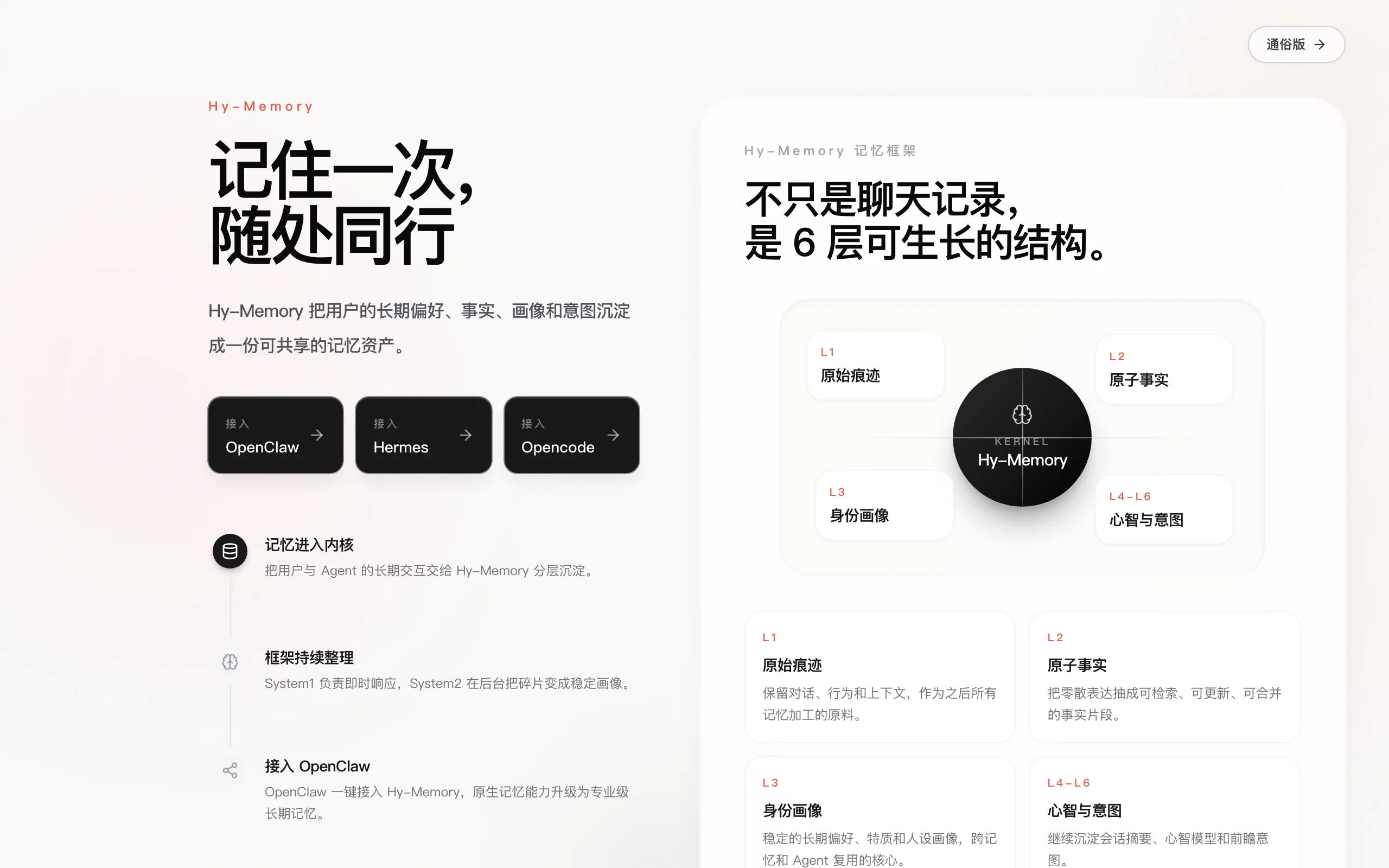
Hy-Memory is a professional memory plugin from Tencent's Hunyuan team, designed for long-term collaborative Agents such as OpenClaw. Through a 6-layer memory framework, System1/System2 dual-system processing, and a three-tier evolution-chain architecture, it enables fine-grained Agent memory management. The framework ranks first among peers on LongMemEval and PersonaMem, reduces memory count by over 70%, increases information density by 45%, and achieves write speed 8× faster than comparable products—giving Agents true "remember well, remember correctly, remember lightly, understand you better" capability.
Image source: Official article
Technical positioning and domain: Hy-Memory belongs to AI Agent memory management infrastructure, focused on persistent, structured, and efficient retrieval of memory across sessions and tasks in long-term collaborative Agents. Unlike traditional vector databases or simple caching, Hy-Memory elevates Agent "memory" from plain storage to an intelligent system with cognitive evolution through layered architecture and dual-system processing—filling a gap in professional long-term Agent memory management.
Development background: Developed by Tencent Hunyuan, building on dialogue systems, large-model applications, and Agent framework expertise. The team observed that existing Agent frameworks suffer from fragmented memory, information redundancy, and low retrieval efficiency in long-term tasks—especially OpenClaw and similar collaborative Agents across sessions. Inspired by cognitive psychology, they designed a professional memory system simulating human memory layering.
Core value: Hy-Memory solves three core memory management problems—fragmentation (similar information scattered, incomplete retrieval), redundancy (old and new facts coexist as noise), and missing cognitive evolution (inability to track attitude changes in user preferences). The 6-layer framework and evolution-chain mechanism enable efficient storage and retrieval while preserving full cognitive evolution paths so Agents truly "understand" long-term user behavior patterns.
Technical characteristics: Layered storage architecture processes memory from raw dialogue traces to abstract mental models. System1/System2 dual-system processing enables millisecond real-time writes and second-to-minute asynchronous consolidation. Evolution-chain pointer structure links memories via supersedes pointers into causal chains—hitting any node auto-expands full attitude evolution, a core innovation versus overwrite or accumulation schemes.
2. Key Features
Six-layer memory framework: Agent memory is divided into six tiers—raw traces (L1), atomic facts (L2), identity profile (L3), session summary (L4), mental model (L5), and forward intent (L6)—each with distinct processing strategies and retrieval weights. L1–L4 are handled by System1 in milliseconds; L5–L6 are asynchronously consolidated by System2, progressively abstracting from raw data to higher-order cognition.
System1/System2 dual-system processing: System1 (fast path) completes raw trace writes, atomic fact extraction, identity profile updates, and session summary compression in real time when users send messages—keeping main-path response unaffected. System2 (slow path) runs in background, abstracting mental models from behavioral data and predicting forward intent—second-to-minute high-order cognitive consolidation.
Evolution-chain mechanism: supersedes pointers link each memory write into bidirectionally traversable causal chains, preserving full preference evolution paths. When any node in the chain is hit, the system auto-expands complete attitude changes before and after that node—avoiding overwrite schemes that only record latest state or accumulation schemes with incomplete recall.
Memory merge and deduplication: Similar facts auto-merge; conflicting preferences auto-refresh—preventing old and new coexistence as noise. Semantic similarity and conflict detection merge dispersed or contradictory information across sessions, significantly reducing redundancy. Single-entry density reaches 130.5 tokens/entry—1.5–2.5× comparable frameworks.
Cross-session continuous memory: Seamless continuation from yesterday to today—Agents maintain context consistency across days, weeks, or months in long-term tasks. Persistent storage and session identification ensure each conversation loads prior memory accurately for true long-term collaboration.
Attention gate mechanism: System1 attention module decides which information merits deep-memory processing. Novelty, association with existing memory, and user interaction frequency filter high-value information into L3 and above—avoiding irrelevant data occupying memory space.
3. How to Use
Environment requirements: Hy-Memory runs as an OpenClaw plugin; deploy OpenClaw first (recommended version ≥1.0.0). Supports Linux and macOS; Python ≥3.8; at least 8GB RAM recommended for System2 background processes. Ultra mode recommends NVIDIA GPU for model inference acceleration.
Installation and integration: Install via OpenClaw one-click integration:
pip install hy-memory. Addmemory_provider: hy_memoryin OpenClaw config. The system auto-detects hardware and selects optimal run mode.Mode selection and configuration: Three run modes:
- Lite: Memory write and retrieval only, zero LLM cost—suitable for "remember well" without semantic understanding. Config:
mode: lite. - Pro: MemAgent for extraction, summarization, and reflection; no background worker—memory self-organization with limited resources. Config:
mode: pro. - Ultra: Full System1+System2 kernel; async slow path for continuous replay and induction—"more like the user over time." Config:
mode: ultra.
- Lite: Memory write and retrieval only, zero LLM cost—suitable for "remember well" without semantic understanding. Config:
Best practices: For long-term project collaboration, use Ultra mode with weekly System2 replay. After first deployment, run at least 3–5 conversation sessions to accumulate data for System2 cognitive abstraction. Monitor storage space; set
max_memory_per_userupper limits in extreme scenarios despite density optimizations.
4. Pros and Cons
| Pros |
|---|
| Extremely high memory density: 130.5 tokens/entry—2.5× mem0, 1.5× Graphiti—significantly reducing fragmentation. |
| Leading write speed: 12.3 s/k tokens write time—only 1/8 of Graphiti—ensuring main-path response unaffected by memory operations. |
| Benchmark-leading scores: First among peers on LongMemEval (85.20%) and PersonaMem (76.91%)—performance backed by data. |
| Complete cognitive evolution: Evolution-chain preserves full attitude evolution—avoiding overwrite (latest only) or accumulation (incomplete recall) problems. |
5. Comparison with Similar Tools
| Dimension | Hy-Memory | mem0 |
|---|---|---|
| LongMemEval total | 85.20% | 47.00% |
| PersonaMem total | 76.91% | 65.82% |
| Write time (s/k tokens) | 12.3 | 15.6 |
| Memory entries/user | 82.3 | 309.8 |
| Density (tokens/entry) | 130.5 | 52 |
| Memory architecture | 6-layer + evolution chain | Single-layer vector |
| Dual-system processing | System1 + System2 | None |
| Deployment | OpenClaw plugin | Standalone library |
| Open license | Commercial license | MIT |
Selection advice: For long-term collaborative Agent applications prioritizing peak memory management performance, Hy-Memory is the optimal choice—benchmark leadership, fastest writes, highest density. For cross-session continuity and cognitive evolution tracking, its 6-layer framework and dual-system mechanism offer irreplaceable value. For non-OpenClaw frameworks or fully open-source needs, mem0's MIT license and standalone deployment may fit better. Graphiti excels in graph-structured memory for complex relation reasoning—but slow writes are its main bottleneck.
6. Editor's Take
Hy-Memory's 6-layer framework and System1/System2 dual-system design show significant originality. Unlike traditional schemes treating Agent memory as simple key-value or vector index storage, Hy-Memory draws from cognitive psychology—simulating human memory layering and dual-system processing—a major breakthrough in AI Agent memory management. The evolution-chain mechanism solves long-standing "memory conflict" and "preference drift" problems—Agents track full attitude evolution, not just final state.
Benchmark scores support practical value: LongMemEval 85.20%, PersonaMem 76.91%, 70%+ memory reduction, 8× write speed improvement—all prove effectiveness in real scenarios. For cross-session Agent apps (long-term project management, personal knowledge management, health planning), Hy-Memory significantly improves continuity and consistency.
Primary audience: OpenClaw Agent developers and teams building long-term memory capabilities. Academic researchers gain valuable reference from layered architecture and evolution chains. Lite mode offers low-barrier entry for beginners or simple memory needs.
Future potential: expand support for other Agent frameworks and optimize Chinese scenarios. As Agent apps evolve from short conversations to long collaboration, professional memory management becomes essential—Hy-Memory has first-mover advantage in this track.
Basis: Outstanding innovation and benchmarks, high practical value; deductions for OpenClaw dependency and Chinese support optimization needs.
7. Application Scenarios
Long-term project collaboration: Across weeks of complex projects, Agents remember each decision's rationale and rejected options via Hy-Memory—continuous, consistent progress. In software development, remember prior technical selection reasons and avoid repeated debates.
Personal knowledge management: Accumulate work habits, decision mental models, and knowledge preferences—Agents understand users better over time. Researchers organizing literature: remember preferred citation formats and categorization, auto-optimize recommendations.
Fitness and health planning: Record preference evolution and effectiveness feedback for training methods—avoid recommending approaches users tried with poor results. Track changing attitudes toward HIIT and adjust recommendations gradually.
Creative assistance: Track creators' evolving attitudes toward distribution channels and content style—advice aligned with values. Self-media operators: remember platform preference shifts and offer targeted content suggestions.
Learning tutoring: Remember student progress, weak points, and learning styles for continuous guidance. Online education: track math concept understanding changes and dynamically adjust teaching strategies.
8. FAQ
Q: Does Hy-Memory support non-OpenClaw Agent frameworks?
A: Currently runs primarily as an OpenClaw plugin; direct integration with other frameworks is not supported. The team plans standalone API interfaces in future versions for LangChain, AutoGPT, and other mainstream frameworks.
Q: How much resource does System2 use in Ultra mode?
A: Ultra mode System2 uses ~2–4GB memory and 1–2 CPU cores. Recommended on servers with at least 16GB RAM; Pro mode on consumer devices to reduce resource use.
Q: Can memory data be exported or backed up?
A: Yes. memory_export and memory_import export memory to JSON including full six-layer structure and evolution-chain information—for migration and backup.
Q: How are privacy-sensitive items in memory handled?
A: Built-in privacy filter auto-identifies and redacts sensitive information (phone numbers, emails, etc.) at write stage. Custom filter rules in config files for additional privacy control.
Q: Is there a memory storage capacity limit?
A: No hard default limit, but set max_memory_per_user in config (recommended 100–500 entries). At limit, high-weight memories are retained; low-value information is auto-cleaned.
9. Project Links
- Official site: https://memory.hunyuan.tencent.com/
- OpenClaw integration docs: https://openclaw.ai/docs/memory/hy-memory
Related AI Model Articles
OpenMuse – CopilotKit Open-Source Personal AI Assistant
OpenMuse is an open-source personal AI assistant project developed by the CopilotKit team. Its core design philosophy is "giving an Agent a computer" — by combining a persistent browser, optional Linu...
In-Depth Review of Longcat-2.5-preview: Meituan's Next-Generation Multimodal Long-Range Agent Model
LongCat-2.5-preview is Meituan's latest next-generation large model. Building upon the 1.6T total parameters, approximately 48B active parameters, and native 1M token context of LongCat-2.0, it marks ...
Review of DeepSeek Harness Desktop: How the Official GUI Client Lowers the Bar for Agent Usage
DeepSeek Harness Desktop is the official graphical client launched by DeepSeek, designed to provide a visual interface for the originally command-line-based DeepSeek Harness framework. After users log...

Step Code – In-Depth Review of StepFun's Open-Source Terminal Programming Agent
Step Code is an open-source terminal programming agent launched by StepFun, licensed under the MIT License, which allows developers to complete the full workflow of code writing, debugging, execution,...
© All Rights Reserved. Some content on this site is partially generated by AI with human review.