
Gamma-World – NVIDIA's Multi-Agent World Model
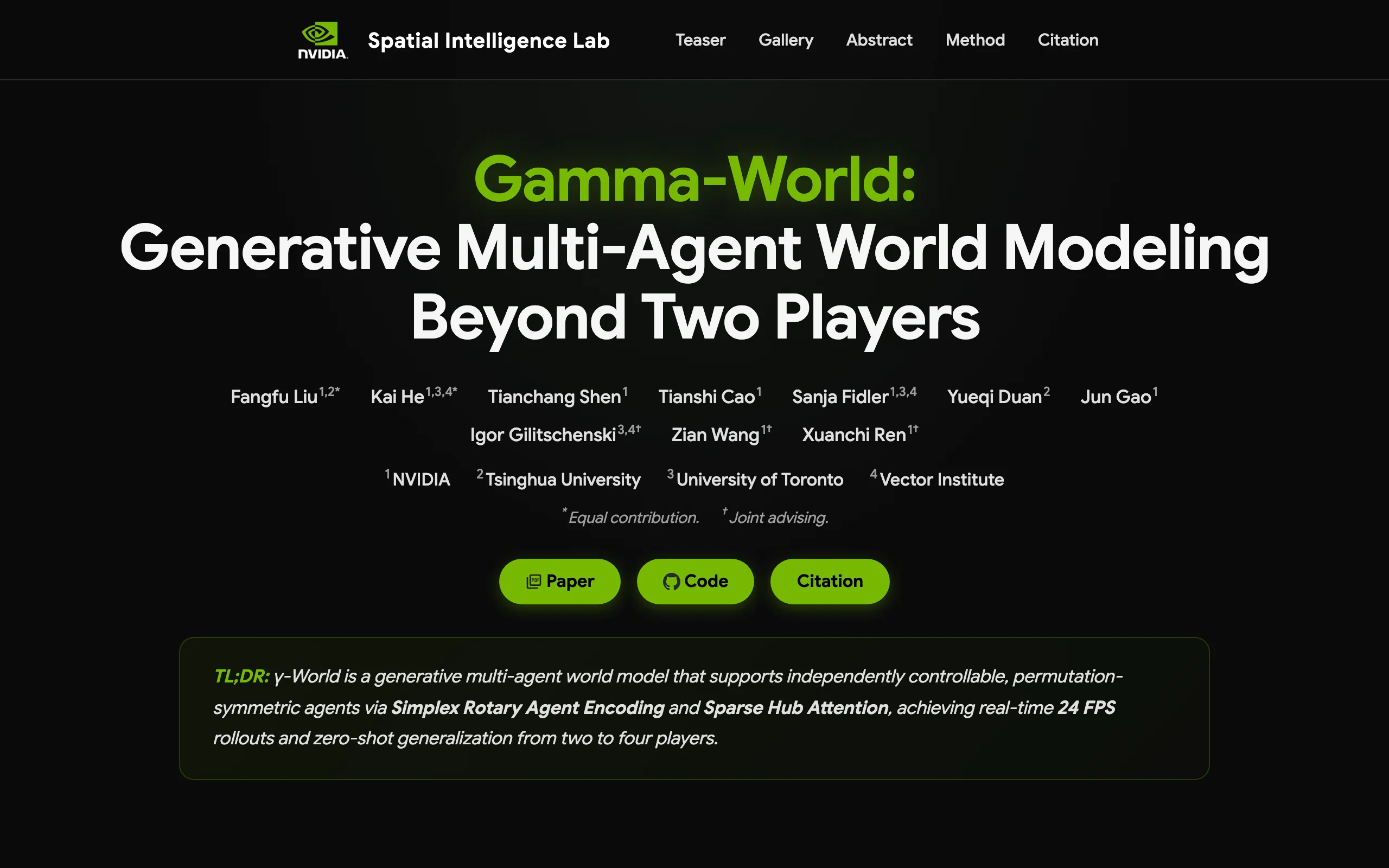
Executive Summary:
Gamma-World is a multi-agent world model from NVIDIA Research, designed so multiple agents interact equally in one simulated world with global consistency. It uses Simplex Rotation Encoding for identi...
1. What Is Gamma-World
Gamma-World is a multi-agent world model from NVIDIA Research, designed so multiple agents interact equally in one simulated world with global consistency. It uses Simplex Rotation Encoding for identity symmetry and Sparse Hub Attention to cut inter-agent communication from quadratic to linear complexity, enabling real-time, scalable multi-view video generation. Trained on two-agent interaction data, it zero-shot generalizes to four or more agents—a key step toward interactive virtual worlds.
Image source: Official article
Technical positioning and domain: Generative world models focused on multi-agent interaction video generation and simulation. Unlike single-agent world models, it handles independent actions and mutual influence while preserving global physical and viewpoint consistency—for games, robot simulation, autonomous driving, and multi-entity coordination.
Development background: NVIDIA Research, with deep work in vision, generative models, and physical simulation. Long-standing challenges: identity asymmetry (master/slave presets) and quadratic cost of full connectivity. Gamma-World addresses both via encoding and attention design.
Core value: A feasible path to "any number of agents, any viewpoint, real-time generation." It removes unequal treatment of agents and O(N²) scaling. Zero-shot generalization from two-agent training to multi-agent scenes cuts data collection and fine-tuning cost.
Technical characteristics: Parameter-free simplex rotation encoding for permutation-symmetric equivalent identities; sparse hub attention uses shared hub tokens as relays, reducing cross-agent communication from O(N²) to O(N). Supports 24 FPS real-time inference; FVD improved by 40%+ vs. baselines on average.
2. Key Features
Equal multi-agent co-presence: Any number of agents act independently and interact equally without master/slave roles. Simplex encoding gives each agent a unique but equivalent identity with permutation symmetry—no bias toward one agent in multi-person scenes.
Synchronized multi-view video: Generates multiple viewpoint-consistent, physically plausible frame sequences with spatial occlusion and causal interaction. Each view is an agent's egocentric or global observation with temporal and spatial global consistency.
Zero-shot generalization to unseen counts: After two-agent training, generates four or more agents without fine-tuning. Simplex encoding's symmetric design scales dynamically at inference to new agent counts.
Real-time interactive inference: Engineering optimizations reach 24 FPS; FVD down 40%+ vs. baselines. Suitable for real-time games (NPC behavior) or online robot policy adjustment.
Linear computational complexity: Sparse hub attention reduces communication from O(N²) to O(N)—at 8 agents, ~1/16 the cost of full connectivity; scales to many agents without bottlenecks.
General architecture: Parameter-free simplex encoding ensures symmetry across games, robotics, and AV. Output frames usable downstream (policy learning, visual reasoning) without heavy post-processing.
3. How to Use
Requirements: NVIDIA GPU Linux or Windows, ≥24GB VRAM (A100 or RTX 4090 recommended). Python 3.8+, PyTorch 2.0+, CUDA 11.8+.
pip install -r requirements.txt.Code and weights:
git clone https://github.com/nv-tlabs/Gamma-World.git. Download pretrained weights (e.g.,gamma_world_2agent.pth) tocheckpoints/.Inference:
python run_generation.py --num_agents 4 --prompt "two robots passing a box". Outputs multi-view MP4 by default.Training: Multi-agent interaction dataset (≥2 agents with view labels). Three stages: single-view base, multi-view consistency loss, sparse hub attention fine-tune. Scripts in
scripts/train.py; tune viaconfig.yaml.
- Key config: Resolution (default 256×256), frames (32), hub tokens (64). Lower batch or
--fp16if OOM. - Notes: First run downloads backbone (e.g., VAE)—stable network recommended. For unseen agent counts, prompts should describe all agents' behaviors clearly.
4. Pros and Cons
| Pros |
|---|
| Breakthrough zero-shot generalization: Two-agent training → four+ agents; unique among world models; lowers data and fine-tuning cost. |
| Linear complexity: O(N) communication; 8-agent scene ~1/16 cost vs. full connect; good scalability. |
| Real-time performance: 24 FPS; FVD −40%+ vs. baselines; speed and fidelity for interactive apps. |
| General design: Simplex symmetry adapts across domains without structural changes. |
5. Comparison with Similar Tools
| Dimension | Gamma-World (NVIDIA) | GameNGen (Google) | Genie (DeepMind) |
|---|---|---|---|
| Core architecture | Multi-agent world model; simplex + sparse hub attention | Single-agent; diffusion Transformer | Single-agent; generative video foundation |
| Agent support | Arbitrary count; zero-shot generalization | Single agent only | Single agent only |
| Inference speed | 24 FPS (real-time) | ~20 FPS | ~5 FPS |
| Quality (FVD) | −40%+ vs. baselines | Low FVD on specific games | Medium on general video |
| Deployment | Open; local; 24GB VRAM | Open; TPU/high-end GPU | Open; heavy compute |
| License | Unclear (research expected) | Apache 2.0 | Apache 2.0 |
| Community | New; basic docs | Mature reimplementations | Active; large models |
Selection advice: For equal multi-agent interaction (multiplayer games, multi-robot collaboration), Gamma-World is the only option with zero-shot generalization and linear complexity—great for rapid prototypes. Single-agent environment interaction (solo games, one robot): GameNGen is more stable with richer community. RL policy training: DreamerV3 has mature framework and lower hardware bar but needs custom multi-agent extension.
6. Editor's Review
Gamma-World shows high technical innovation. Simplex rotation encoding plus sparse hub attention solve identity symmetry and communication efficiency from first principles. Zero-shot from two to four agents is impressive—a first in world models. 24 FPS targets games, robotics, and AV with real deployment potential. Limits: hardware bar, special data, long-video stability. Audience: DL researchers and industrial devs building multi-agent simulation. Strong future potential as community and model iterate. —deductions for ecosystem maturity and hardware; technical breakthrough keeps it leading in multi-agent world models.
7. Use Cases
Multiplayer game development: Real-time NPC–player interaction; multi-view cutscenes from player behavior without pre-authored animation—lower art cost.
Multi-robot collaborative training: Virtual dual/multi-arm assembly and transport; zero-shot from dual-robot data to triple/quadruple setups for RL data.
Autonomous driving simulation: Multi-vehicle and pedestrian interaction; multi-view traffic for complex intersections without signals.
Film and virtual production: Script-driven synchronized multi-character performance for previz and creative iteration.
Embodied AI research: Digital sandboxes for home service and warehouse logistics; zero-shot evaluation across agent counts.
8. FAQ
Q: What hardware runs Gamma-World smoothly?
A: 24GB+ VRAM (A100, RTX 4090). RTX 3090 ~15 FPS—not full 24 FPS real-time without A100+. 32GB+ RAM, 50GB+ disk.
Q: Commercial use?
A: License unclear as of May 2025; NVIDIA Research often uses research terms. Contact NVIDIA for commercial licensing. Free for academic download.
Q: Where to get training data?
A: Custom multi-view video with per-agent view labels, or synthetic Unity/Unreal scenes. Public multi-agent datasets scarce; MAMBA benchmark emerging.
Q: vs. single-agent world models like GameNGen?
A: Single-agent models one entity vs. environment; can't model mutual influence. Gamma-World models multiple agents with equal status and global consistency in one pass.
Q: Customize behavior or appearance?
A: Mainly text prompts (e.g., "two robots passing a box"). Appearance from training data. Future conditional control possible; limited controllability today.
Q: Long-video inconsistency?
A: Default ~1 s (32 frames). Longer: sliding window or autoregressive segments—possible drift; control length or post-smooth.
9. Project Links
- Official site: https://research.nvidia.com/labs/sil/projects/gamma-world/
- GitHub: https://github.com/nv-tlabs/Gamma-World
- arXiv paper: https://arxiv.org/pdf/2605.28816
Related AI Model Articles
OpenMuse – CopilotKit Open-Source Personal AI Assistant
OpenMuse is an open-source personal AI assistant project developed by the CopilotKit team. Its core design philosophy is "giving an Agent a computer" — by combining a persistent browser, optional Linu...

In-Depth Review of Longcat-2.5-preview: Meituan's Next-Generation Multimodal Long-Range Agent Model
LongCat-2.5-preview is Meituan's latest next-generation large model. Building upon the 1.6T total parameters, approximately 48B active parameters, and native 1M token context of LongCat-2.0, it marks ...
Review of DeepSeek Harness Desktop: How the Official GUI Client Lowers the Bar for Agent Usage
DeepSeek Harness Desktop is the official graphical client launched by DeepSeek, designed to provide a visual interface for the originally command-line-based DeepSeek Harness framework. After users log...

Step Code – In-Depth Review of StepFun's Open-Source Terminal Programming Agent
Step Code is an open-source terminal programming agent launched by StepFun, licensed under the MIT License, which allows developers to complete the full workflow of code writing, debugging, execution,...
© All Rights Reserved. Some content on this site is partially generated by AI with human review.